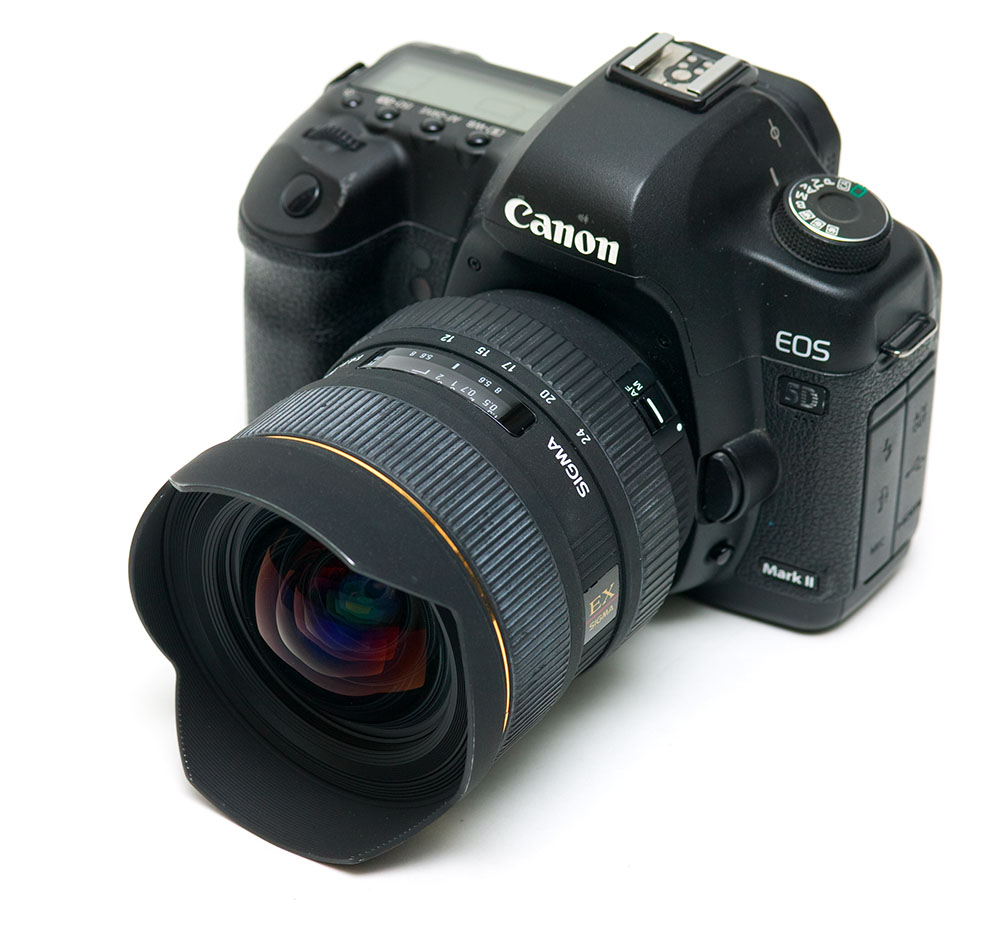
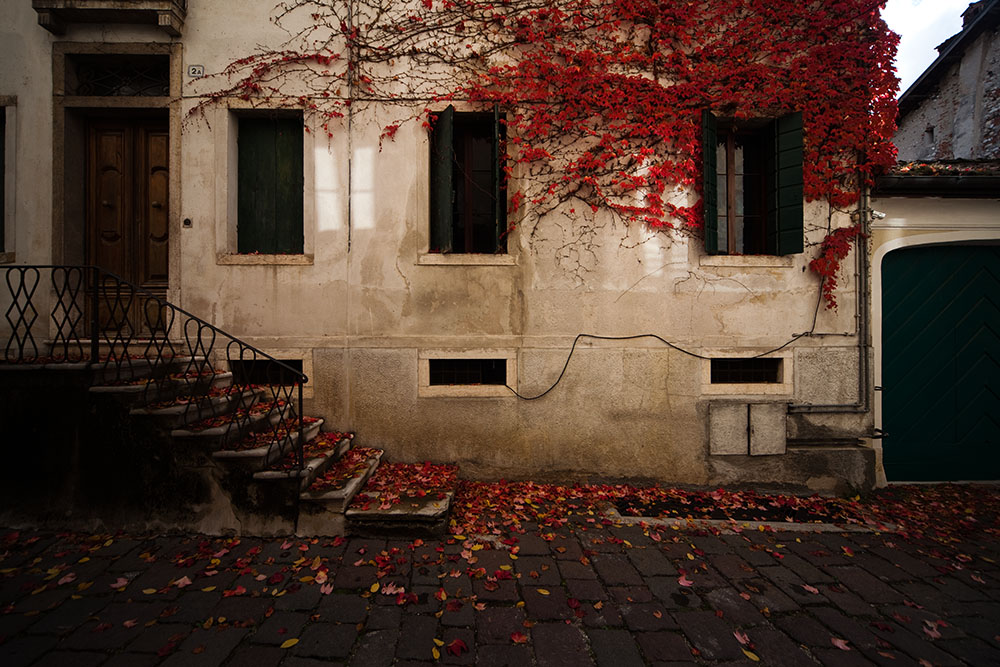
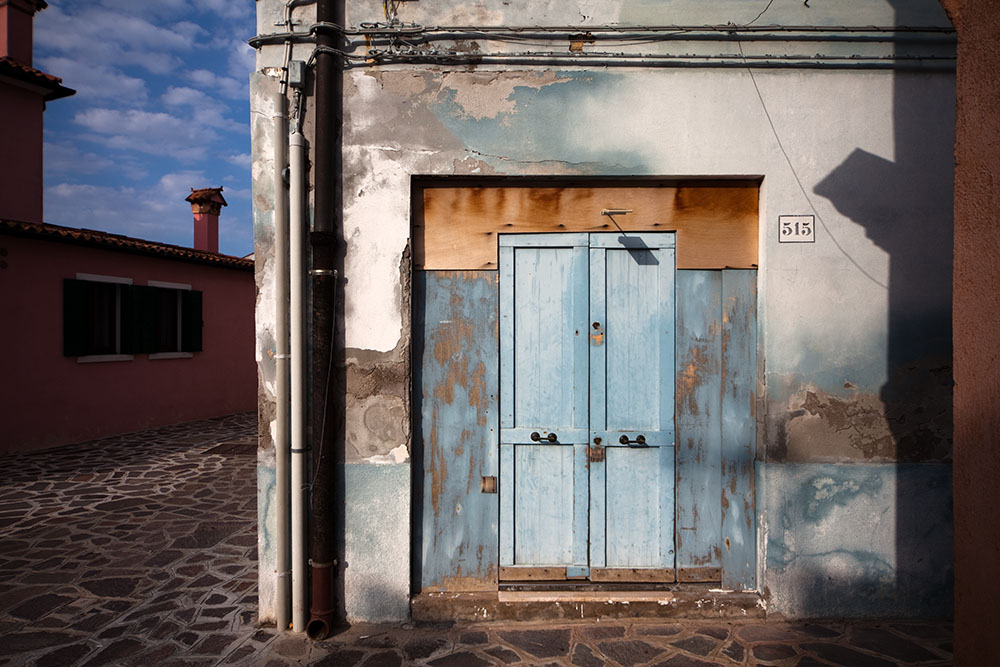
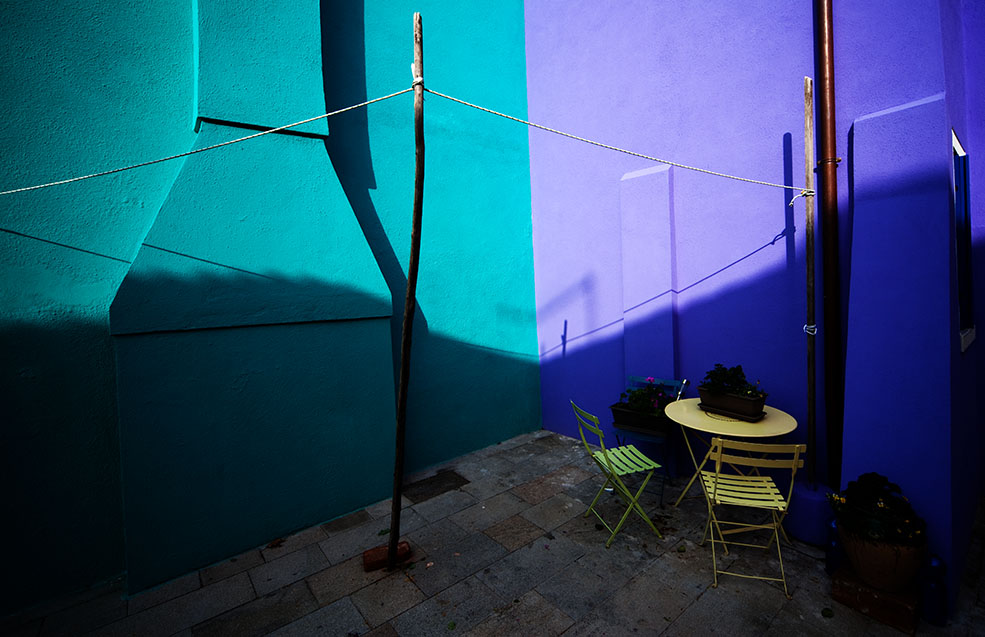
Let's have a look at the Sigma 12-24mm f/4.5-5.6 DG HSM, an ultrawide
zoom lens that was launched back in 2003. At the time Sigma had a thing for
extreme lenses, and for several years afterwards the 12-24mm was the widest
zoom lens for 35mm-format cameras and indeed one of the widest lenses of any
kind. The only other 12mm lens was the Voigtlander 12mm Heliar, a manual focus
lens for Bessa / Leica rangefinders.
Almost twenty years later there are still only a handful of 12mm-or-so
ultrawide lenses. I've always been curious about the 12-24mm, but not enough
to buy one. However after so long in production they're widely available on
the used market so when one popped up on eBay I decided to try it out.
The 12-24mm went through two generations. The original 12-24mm DG HSM was
launched in 2003 for all the major camera formats of the day, plus Sigma's own
SA mount. DG in Sigma parlance means that the coatings are optimised for
digital cameras, and HSM means that it has a silent hypersonic focus motor,
akin to Canon's USM.
There was a variation of the generation one lens for Pentax and Sony/Minolta
cameras, which didn't have HSM, instead relying on the camera's screw drive.
The Pentax / Sony-Minolta version had a slightly different physical design,
with a manual aperture ring and a painted-on distance scale.
I have the Canon version of the lens. It goes swoosh when it focuses. You can
override autofocus by twisting the manual focus ring, which is towards the
front of the lens (the inner ring is the zoom control).
The 12-24mm has a bulging front element that produces masses of flare if
you shoot towards the sun. There's a small filter holder at the mount end
of the lens.
The 12-24mm is a full-frame lens, but it's wide enough to work as an ultrawide
zoom for APS-C cameras as well, in which case it becomes a kind of 20-40mm.
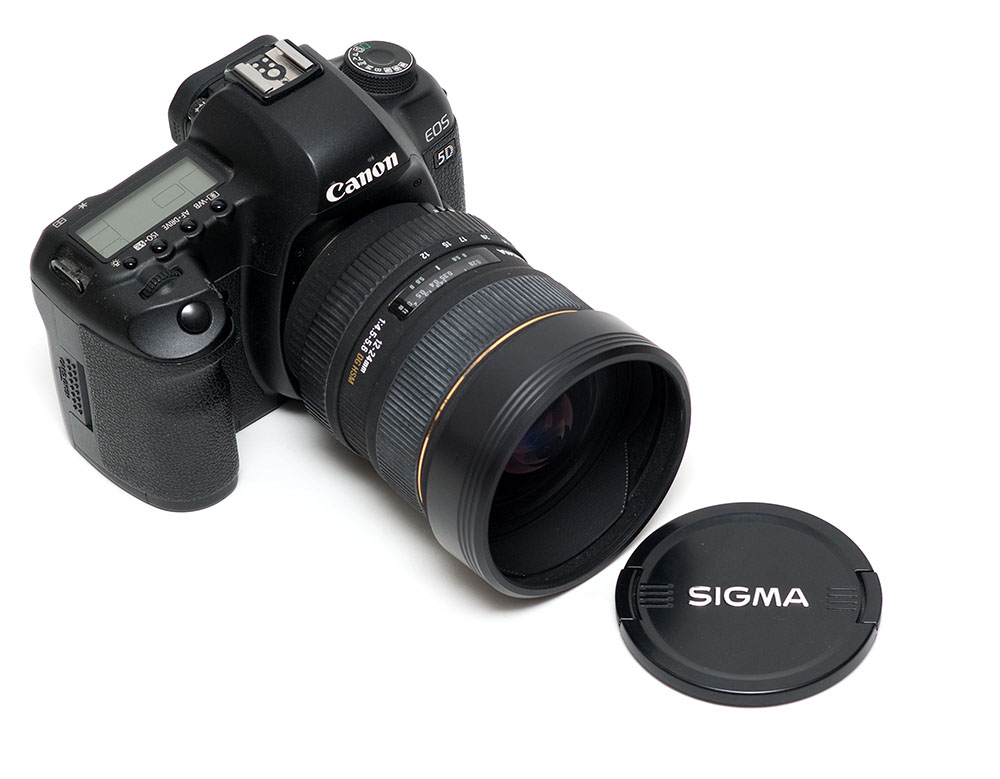
The lens cap clips into a removable ring that acts as an 82mm filter holder,
which is handy if you need to use graduated ND filters. On an APS-C camera you
can leave the cap holder in place, but on full-frame it vignettes at all focal
lengths wider than 24mm.
This is what happens if you leave the lens cap holder on at 12mm on a
full-frame camera. You get a Fax Records album cover.
Physically the 12-24mm comes across as a refinement of Sigma's earlier,
massive 15-30mm. Internet reviews grumbled about inconsistent build quality,
but the geometry and resolution were praised. The general consensus is that
the lens was almost purpose-designed for estate agents, because it's very good
at capturing entire rooms and it keeps all the lines nice and straight.
In 2011 Sigma replaced it with the 12-24mm DG HSM II, which had a new body and
a slightly different optical design. Judging by the reviews the replacement
was sharper but the geometry wasn't as good.
In 2017 Sigma launched the 12-24mm f/4 ART, a completely new (and heavier)
design with a constant f/4 aperture. By that time the 12-24mm wasn't the
widest zoom lens any more, having been beaten in 2015 by the Canon 11-24mm
f/4L, which is one wider. And
L.
What's the 12-24mm like? On the surface 12mm sounds fantastic, because it's
really really wide, but it's also really awkward. You have to make sure that
there's something interesting in the top and bottom of the image as well,
otherwise you get masses of dirt and sky.
It strikes me that it would be a good widescreen video lens, which is
something Sigma couldn't have anticipated back in 2003. My hunch is that it
would be terrific for hip-hop videos. And porn, although it's not sealed for
moisture and I have no idea how the coating would hold up against
petroleum-based lubricants.
Back when I was young hip-hop videos were shot with a fisheye lens screwed
onto the front of a DV camera, viz the Beastie Boys' "Shake Your Rump", and
every porn video consisted of the camera operator moving an ultrawide lens up
and down the actors - from a distance of about six centimeters - as they did
their thing. Because there are few things more erotic than a close-up of
hairless testicles.
Let us move on. As a reportage lens it's simultaneously good - you can get
really close to the action - and bad, because the dim aperture makes it hard
to focus closely in low light. For landscapes you really need to be in a
canyon, or in the mountains, or underneath a fascinating cloud formation.
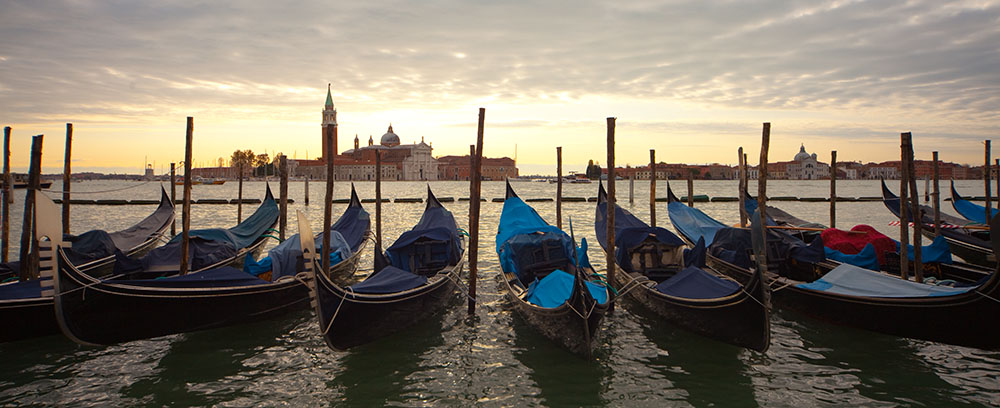
As mentioned in the text I found 12mm a lot easier to use if I "thought
in 16:9", per the following image.
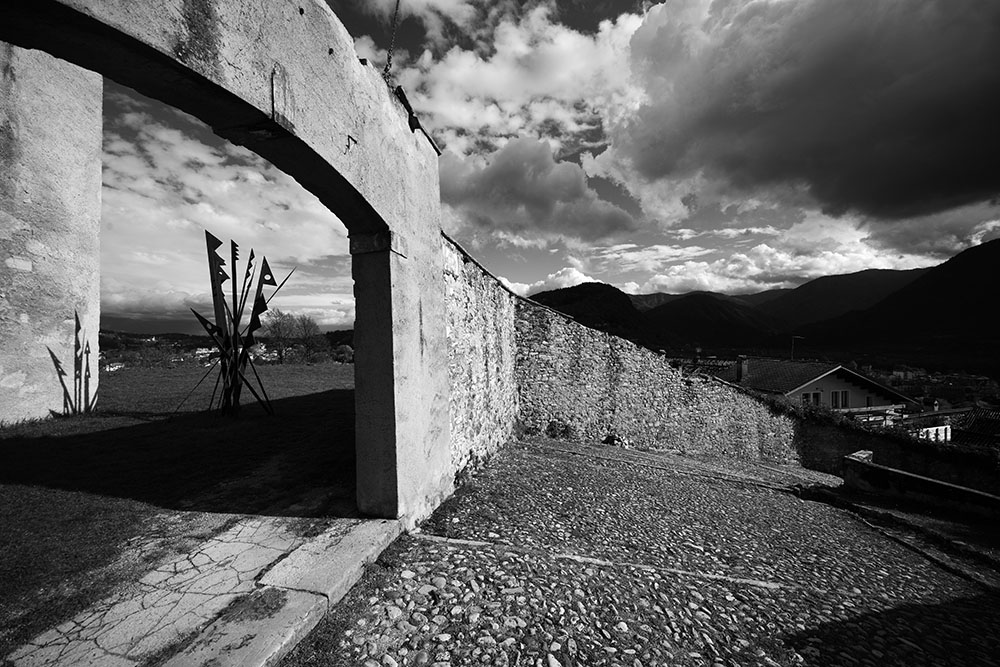
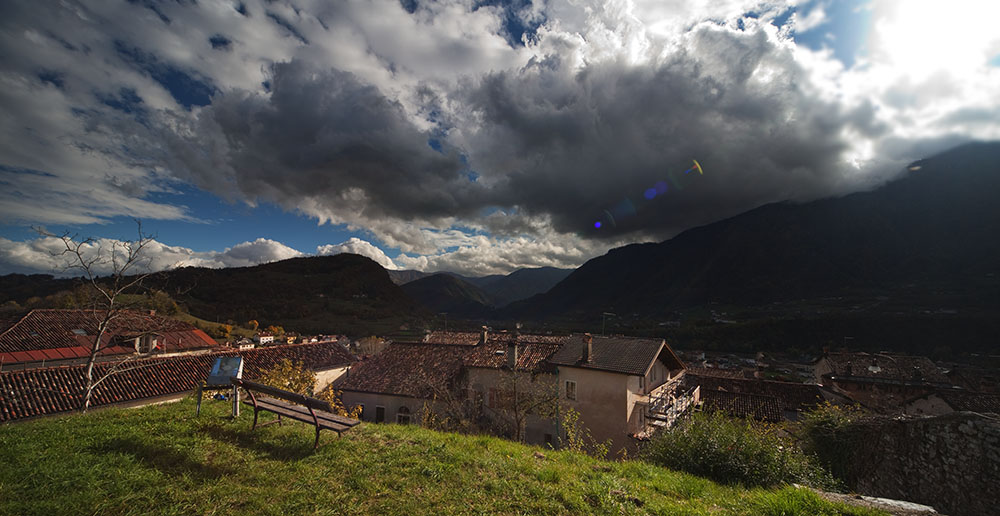
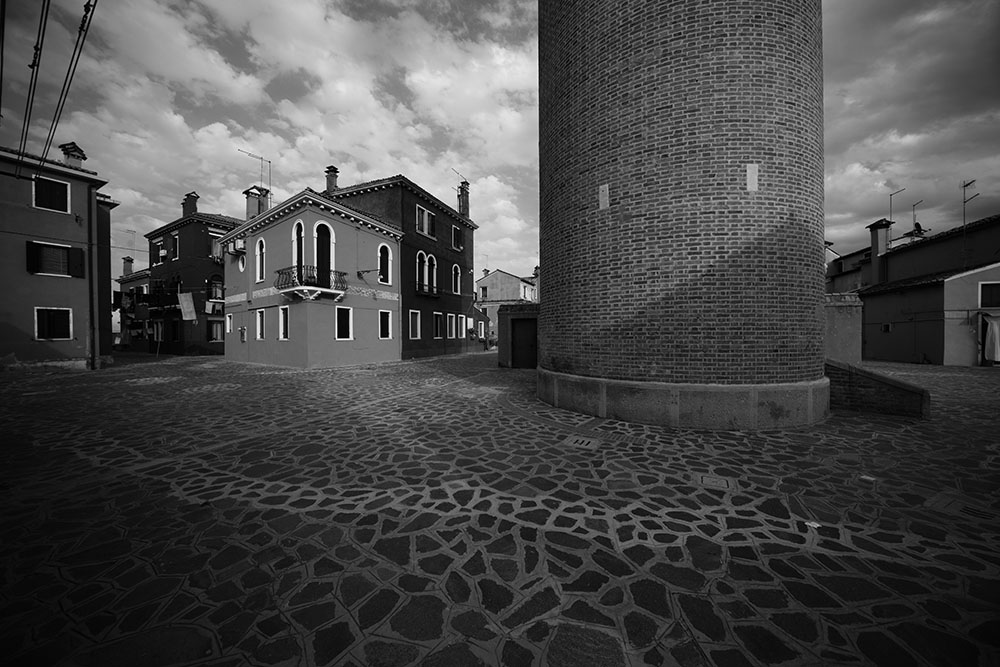
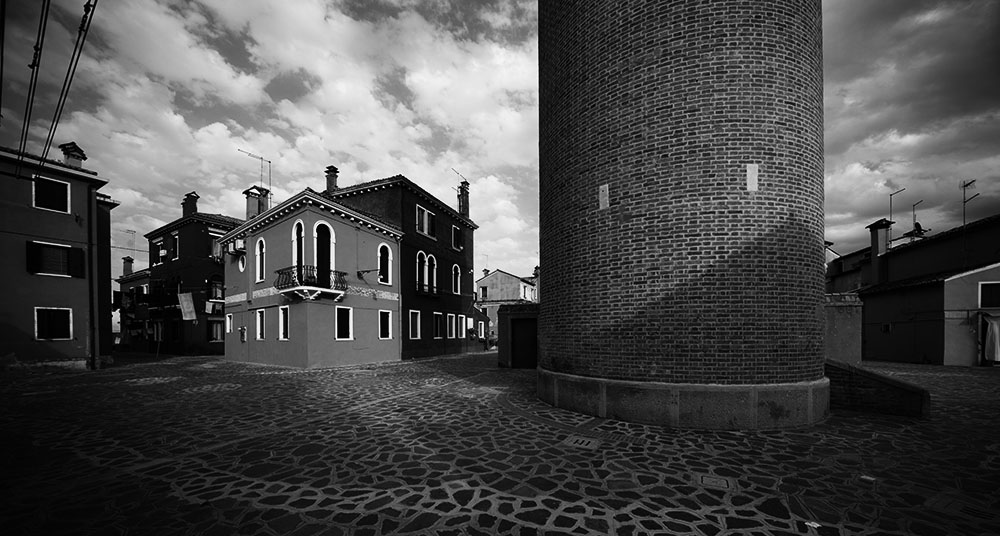
The geometry is excellent. Compare the following two images:
For the second shot I panned the camera up until the horizon was at the bottom
of the viewfinder. Note how it's still a flat line, with just a tiny amount of
barrel distortion.
I've shot wider, with fisheye lenses. Compare the following two pictures.
The one at the top was made with the Sigma lens at 12mm. The one at the
bottom was made with an 8mm fisheye lens mounted on an APS-C Fuji S5,
corrected - but not fully - with software:
AS you can see the fisheye lens is slightly wider, even though the S5 is an
APS-C camera. On a full-frame Canon 5D the result with an 8mm fisheye tests
is mind-boggling:
Back to the Sigma lens. Vignetting at f/4.5 is a heck of a thing:
Central resolution at 12mm is excellent, here at f/11, and at f/4.5 it was
much the same:
The corners are hard to judge because of the stretching, but they don't
improve much when stopped down (f/11 at the top, f/4.5 below, corrected for
brightness):
My copy seemed to be less sharp on the left side than the right. The corners
aren't an issue if you're shooting video at 16:9 or indeed if you crop the
image to a wider aspect ratio. The performance of my copy at 24mm is
essentially the same, again with a blurrier left side. I found the
viewfinder uncomfortably dim at f/5.6. Some Sigma lenses of this vintage had
a slight yellow colour cast, but looking at the images I shot I can't
convince myself that I see it.
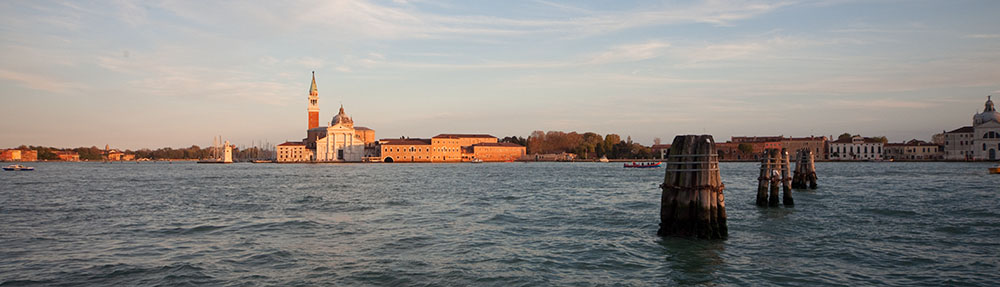
I'm not sure if it was the time of year, or the lack of cruise liners, or
the weather, but the air was unusually clear in Venice. I could see the
foothills of the Dolomites, about forty miles away:
If I had brought along a super-telephoto and stood on the Lido I could have
taken some shots of the Basilica with mountains in the background, but I
didn't, so I didn't.
This is a "majlis" made of bamboo.
Do I have anything else to say about the 12-24mm? It's simultaneously
extraordinary and slightly boring. After a while everything I shot resembled
a
Doom level, with perfect geometry and everything in focus. Which is
nice, but it gets monotonous. With the aperture wide open there's a lot of
vignetting, but even though the lens doesn't have any kind of image
stabilisation it's easy to shoot at slower speeds, so I kept mine at f/8
almost all of the time.
As a video lens the bulbous front element prevents the use of a graduated ND
filter, although this isn't a huge problem if you shoot landscape stills,
because you can bracket. Back in 2003 it was one of a handful of lenses that
had ultrawide coverage with APS-C cameras, but almost twenty years later
there are smaller, faster options if you intended to shoot APS-C.
Still, on a full-frame camera it's an excellent way to get "proper"
ultrawide coverage without using software correction or panorama stitching,
and as mentioned passim the geometry requires essentially no work in
Photoshop, so if you need to shoot a mass of interiors you can go
bang-bang-bang until the flash burns out. My copy also had essentially no
CA, which is odd because some reviews point out that it has lots; perhaps I
was lucky to have a well-aligned sample.