Thursday, 28 July 2022

Raspberry Pi OS on a ThinkPad X60s

Let's have a brief look at the newest version of the Raspberry Pi operating system, Raspberry Pi OS. It's made for the Raspberry Pi 4, but it runs on a wide range of hardware, and in this post I'm going to install it on my ancient ThinkPad X60s. Will it work? Will it work well?

I'm installing a version that includes a desktop environment, which I mention because a lot of Raspberry Pis are set up once and then left running in a cupboard under the stairs forever, as a file server or home automation tool, so they don't even need a graphical desktop. They can be set up remotely with terminal commands.

The Raspberry Pi OS is essentially a cut-down version of the popular Linux distribution Debian, in this case version 11, Bullseye. Pi OS is particularly interesting because it still has support for 32-bit processors, which is handy if you have a laptop from 2005, 2006 or so. Which I do! It's this little bastard here, with a lovely old-fashioned keyboard and a ThinkPoint nipple:


The X60/X60s models were the first ThinkPads with a Windows key. Many years after the failure of OS/2 I like to imagine that IBM finally, grudgingly admitted that Windows was here to stay, just as they washed their hands of the ThinkPad range.

My ThinkPad X60s has a dual-core, 32-bit Intel Core Duo CPU running at 1.66ghz. It came out in 2006. I still use it every now and again as a mobile typewriter. Compared to the regular ThinkPad X60 it has a slimline heatsink, which was made possible by the use of a special low-voltage version of the Core Duo. Apparently some versions of the X60 had a 64-bit Core 2 Duo, but they must have been very rare. I've never seen one. Apart from the 32-bit CPU the machine's other major limitation is the SATA 1 interface. I have a small SSD in mine, but the extra speed of an SSD is wasted - it can transfer data faster than SATA 1 can receive it. Nonetheless I like the lack of noise and moving parts.

The X60s was released during the heyday of Windows XP. In theory it can run the 32-bit version of Windows 10, which was kept current until 2020, but I imagine it would be very slow. The built-in Intel GMA graphics accelerator is pretty poor, and the machine can only have a maximum of 4gb. Even then some of the memory is reserved for the graphics chip, so it can't use all of it. Video out is VGA, which made sense in 2006 but is very old-fashioned nowadays.

On the positive side the X6x models were only slightly larger than the netbooks that appeared about a year later, but were a lot more functional. They had a full-sized screen and lots of ports. The X60s has three USB 2 ports, an SD card slot, a PCMCIA slot, Ethernet, and, unusually for a PC, a FireWire 400 port. The presence of SD and PCMCIA slots is handy if you want to use it as a storage device for your digital camera. The timing was such that a glut of X6x models appeared on the used market circa 2009 or so, when the world's IT departments switched to the widescreen ThinkPad X200 instead, so for a while you could pick up X6xes for pennies.
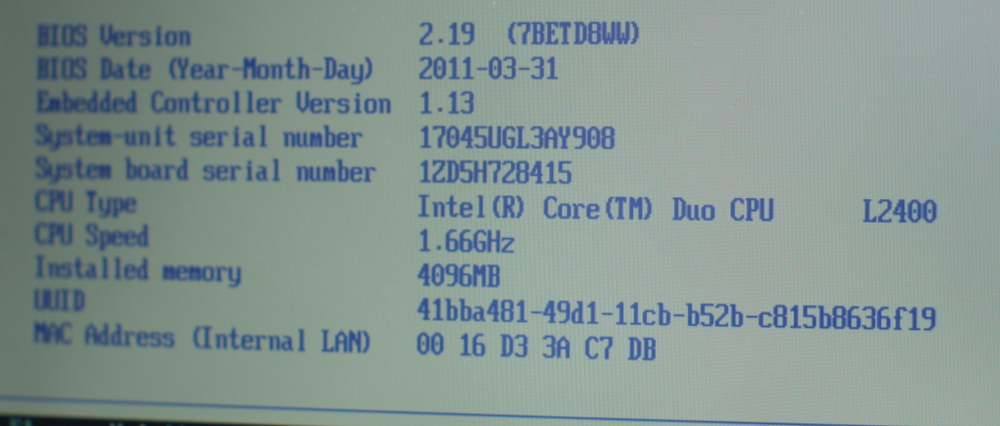
As you can see the machine has 4gb of memory, because there's no reason not to max out the two memory slots nowadays, but only 3gb is available for the operating system. After startup Pi OS's free command shows a total of 3091416 magical memory units.

Older ThinkPads are easy to fix up and modify. I bought my X60s because I had an X61 with a dim screen; I swapped the top half between the two machines, which is why my X60s has an X61 logo on the bezel. IBM sold the ThinkPad range to Lenovo in 2005, but Lenovo retained the rights to use the IBM name for a short while, which is why the palmrest has an IBM sticker.

But what of Raspberry PI OS? There's some debate as to whether the Raspberry Pi is a desktop replacement or not. The manufacturers originally intended for it to be a hobby project machine for robotics etc, but the Pi 4 has 8gb of memory, dual 4k video output, and more USB ports than a MacBook Air, so there's no reason why you can't plug it into a monitor and use it as a simple desktop computer.

As such Pi OS comes with a mixture of standard desktop software (LibreOffice, a browser, VLC) plus a bunch of esoteric stuff that makes more sense if you're a hobbyist - such as SmartSim, a digital circuit simulator, and Sonic Pi, a live coding environment aimed at nerds who are also musicians. Do such people exist? In any case you can install whatever you want using Debian's package manager, so that's not a problem.

Installing Pi OS is easy. Gone are the days when you had to manually edit Xorg to get Linux working properly. I downloaded the ISO to my Mac Mini and used Etcher to make a bootable USB stick:

Installation involved inserting the USB stick, switching on the X60s, and pressing the F12 key to boot from the USB stick. I chose the "run with persistence" option, which runs from the USB stick with a small area set aside to retain my preferences. The installation procedure was simple, with just two pages of options. The first asked for localisation data:

The second asked for my wifi details. At the point it set about downloading and installing updates, which took a while. Half an hour? Forty minutes? I didn't time it:

Notice how the screen is yellowy and dim. All of the X60 and X61 models had a matte, 1024x768 LCD panel that wasn't particularly great even back in 2006. The convertible laptop tablet models - the X60T and X61T - had a 1400x1050 panel, which is a popular modification, for the non-tablet models, but it's rare on the used market nowadays.

After installation the standard desktop appeared:


It's slightly laggy, but that's probably because it was running from USB. The Chromium browser is version 103.0.5060.114, the most recent as of this writing. Does this make the X60s immune to viruses and other internet nasties? I have no idea, but it's a lot more secure than XP with the last version of Chrome, which was released back in 2016. The Core Duo is vulnerable to Meltdown and Spectre attacks, but you can't worry about everything all the time.

Just to make sure that LibreOffice Writer works I loaded it up and typed "Alan Bean was the third person to walk on the moon. Sean Bean has never visited the moon but there is still time." Both of those statements are true. Chromium takes a while to start up, and generates a number of "page unresponsive" errors, but after a while it settles down, so I imagine that's more the fault of the USB stick than the X60s. It runs YouTube at 480p well enough:


720p also works, but it's very choppy. Battery life? The system monitor shows a battery life of around a hour, which is fair enough given that that the battery is probably sixteen years old. Windows XP reports a battery life of around ninety minutes, but there are too many variables to compare the two.

I plugged it into an external 1920x1080 monitor, which worked, although there doesn't seem to be a way to set the resolution, screen layout, refresh rate etc using the desktop. It also made the system very slow, I know not why.

Is that it? I think it is. I can report that Pi OS installs without any tinkering on a 2006 laptop and works well enough to type things, read the news, and play videos at 480p at least. And it'll do so for about an hour with a sixteen-year-old battery. The Raspberry Pi people don't give a minimum hardware specification for the Pi Desktop, or indeed any instructions at all, so I have no idea whether it'll work on older ThinkPads. My hunch is that the X40 models should be fine (the Pentium M had a similar architecture to the Core Duo), but before that I have no idea, the end.

Thursday, 14 July 2022

NaissanceE: Ownership Implies Control

Today we're going to have a look at Naissancee, an indie art game from 2014. Naissance is the French word for born, so I suppose if you're born you are a naissance-ee. That might be why it has an extra E at the end. Is it a French pun on borne? We may never know.

The game was developed by a chap called Mavros Sedeño. As with Gris it's a one-off. The developer hasn't made anything since. It began as a mod for Far Cry, using that game's engine, but it was polished up and released as a full product with the Unreal engine instead. Is it any good?

It's so-so. It starts off well, collapses, then gets better. Sedeño is a professional level designer, and NaissanceE feels like a disjointed bag of ideas that he couldn't use during his day job strung together one after the other. It's intermittently clever, but also very frustrating. There's a bit near the end where some objects dance a waltz around you that made me forgive some of its flaws. I wish more of the game had been like that.


The soundtrack uses a bunch of pre-existing music from Pauline Oliveros' Deep Listening project, which sounds like trombones and accordions being played in a vast underground space, and selections from the works of Thierry Zaboitzeff and Patricia Dallio, occasional members of (it says here) Art Zoyd. I have to admit that I had never heard of Art Zoyd until playing NaissanceE so plus one to NaissanceE for bringing good music to my attention.

My recollection is that the game got decent reviews in 2014, and at least on a visual level its mixture of textureless environments and stark lighting was very influential, but it didn't have much of an afterlife. Neither Limited Run nor Special Reserve have made physical releases of NaissanceE, there isn't a vinyl soundtrack on Important Records etc.

NaissanceE is a bit like The Unfinished Swan, in the sense that they both begin with a clever gameplay idea that isn't complicated enough to support a complete game, and then they turn into a grab-bag of minigames. Swan starts off with the player navigating through a featureless void by firing a paint gun at the walls; NaissanceE has starkly-lit black and white platforming sequences that ask the player to navigate through a three-dimensional world that looks like a two-dimensional silhouette. It's a clever idea but not enough for a whole game.

NaissancE essentially has four different components. There are the shadowy platform parts; there are lengthy sequences where the player has to explore a huge environment; there are some simple puzzle sequences that involve sliding blocks or manipulating lights to clear a path; and there are platforming sequences that involve altered gravity or fans or rhythmic jumping.

The game has a mechanic where the player has to periodically take a breath while running, so there are a couple of rhythmic sequences with running, breathing, jumping, running, breathing, jumping etc. The breathing-running-jumping parts and the shadowy levels feel the most developed, the rest of the game - including the exploration parts - feels like filler, although ironically the exploration sequences are the thing the reviewers noticed most. They're the bits I will remember.


The image above isn't just a skybox, it's an actual environment. You can only explore the suspended walkways in the distance, but the game doesn't cheat with its depiction of vast scale.

On the positive side the game is very stylish. A chap on Discogs.com once described the music of Thomas Koner as sounding like "mechanical insects trapped in an air ventilator on the surface of a giant metal moon", and NaissanceE captures that kind of atmosphere really well. It even has giant cooling vents spewing steam into the sterile air. NaissanceE is one of the few games I have played that has a smell - a giant train station, a mixture of dust and soot.

It reminded me of a clutch of ancient 8-bit and 16-bit 3D games, such as Driller or Damocles, in which the player was entirely alone in a giant space made up of untextured polygons. They felt like a whole world inside the computer. Several worlds in the case of Damocles.


Unfortunately NaissanceE's technology is starting to show its age. The shadows are flickery and the use of ambient occlusion is unsubtle. It would benefit greatly from a remaster. I was also struck by the relative conservatism of the level design. The maps are huge, but unlike for example Antichamber - which was released a year earlier - the geometry is mostly conventional. There are a couple of tricky bits with portals. but the game was less mindbending than I expected. I wonder if the developer was still getting to grips with the engine?

The game was never ported for any platform other than the PC. If you want to play it on the PlayStation you're out of luck. The nearest console equivalent I can think of is Bound, which is a lot more colourful. Or Manifold Garden, which I wrote about a few months ago.

The game also does the whole grunge quiet/loud thing where the player walks from a small corridor into a gigantic space and it's like "no" and "whoah" and "no". As with the distant mountains of Battlezone the actual play area is much smaller than the environments, but it's still a fascinating place to get lost in.

Bad stuff? Well, the big problem is the game side of things. The platforming starts off well enough, with a sequence where the player has to descend a giant wall by riding the backs of polygonal slugs. It's clunky but imaginative. Some of the running-breathing-jumping-running-breathing sequences are also solid, but the player character's motion is awkward at the best of times, and I found myself falling and dying because the controls felt stiff. Neither realistic nor stylised, just stiff.

The platforming reaches a nadir with the sequence pictured above, in which the player has to negotiate a bunch of turbines in a series of ventilation tunnels. It's no fun at all. The rotating axles throw the player off; the air blows the player back back; the blades themselves are lethal, and to cap it all the player only has one chance to do it, because the air pressure gradually increases until the tunnel is impassable. This section is needlessly sadistic and feels like part of a completely different game.

And it doesn't work very well, because the wind continually pinned me against the ceiling, and I had to restart the run. Apparently the game goes wobbly unless it runs at exactly 60fps. I also kept getting stuck on things, or bouncing off things, but perhaps that's just me being clumsy.

One complaint levelled at Journey and Abzu etc is that they're not much fun to play, because the player can't lose and the action sequences are entertaining rather than challenging. For most of its length NaissanceE is like that, but the fan level suddenly appeared and brought me to a crashing halt. Bear in mind that I've completed Manic Miner. I've completed Map24 of Hell Revealed. I finished about three-quarters of Ori and the Blind Forest before something distracted me. I once had breakfast and dinner in two different McDonalds eighty miles apart and was order #000 in both of them. I wish had kept the receipts. That actually happened. I was order #000 in both of them.

Just being order #000 was impressive enough. But to be order #000 twice in consecutive meals in two completely different restaurants eighty miles apart, was incredible. I suppose the odds depend on the footfall in each restaurant, which is probably linked to the time of day. There would be more orders in the morning and at lunchtime, but does that make getting double-zeroes more likely, or less likely? Do the restaurants reset to #000 when they open, or do they roll over from the day before? There is so much in this world that I don't know. But the point is that I am a superior sort. I walk in eternity. The world is at most my equal, mostly my lesser. And yet even I had trouble with NaissanceE's fans.

Elsewhere the game has a gag where the player is warned not to go down a certain path, because it eventually crashes to the desktop (and it does). This should have been funny, but after the fan level I was in a bad mood, so it was just irritating.

The game's second problem is that the next section, "Deeper Into Madness", really makes it obvious that the developer didn't have a central theme for the game. NaissanceE is is just a set of level ideas glued together, without a story or characterisation.

It feels unsatisfying, as if it was an interactive 64kb demo. NaissanceE is often described as an art game, but it's essentially posh street graffiti. The kind of council-approved graffiti that brings in tourists. The video game equivalent of a mural of a baby holding the planet Earth and crying. It has the form of art, the surface appearance of art, but it's just pretty visuals. FAR: Lone Sails also had pretty visuals, but underneath the looks there was a bittersweet meditation on mortality. NaissanceE has nothing.

I mean, yes, the universe is an arbitrary series of events with no inherent meaning, and in that respect NaissanceE is more honest than Journey, but the game has enough wisps of a storyline that I suspect it wasn't intended to be completely abstract. There is an implication that the environment of NaissanceE is a little bit like the alien hotel at the end of 2001 - a construction intended to mimic human habitation - and that the player eventually outstays their welcome, but it's very vague.


The game pulls itself together in the final level, which takes place in a vast-but-not-endless desert. It's another one of the big exploration sequences, but there's a good blend of hugeness and fun platforming. The final sequence is a timed chase, but it's not too hard, and I enjoyed it, and so ultimately NaissanceE starts off good and ends good but falls apart in the middle. If the middle section had been replaced with some more large-scale levels, and if perhaps some of the ideas in "Deeper Into Madness" had been scattered about as optional diversions, the game would have worked a lot better.

If anything, NaissanceE made me appreciate Manifold Garden and Gris even more. Gris is a surprisingly slick platform game even if you find the story sappy, and Garden has a clever balance between visual spectacle and tricky puzzles. NaissanceE on the other hand is all over the place. The exploration sequences don't really have gameplay, but the platforming sections are too hectic for sightseeing. The vague storyline is too amorphous to be emotionally satisfying.

Having said all that NaissanceE is available on Steam for free, so you don't lose anything by trying it out. If nothing else you can see where all those untextured large-scale environments came from. Something something liminal spaces something isolation more relevant than ever in the post-COVID age something something the end.