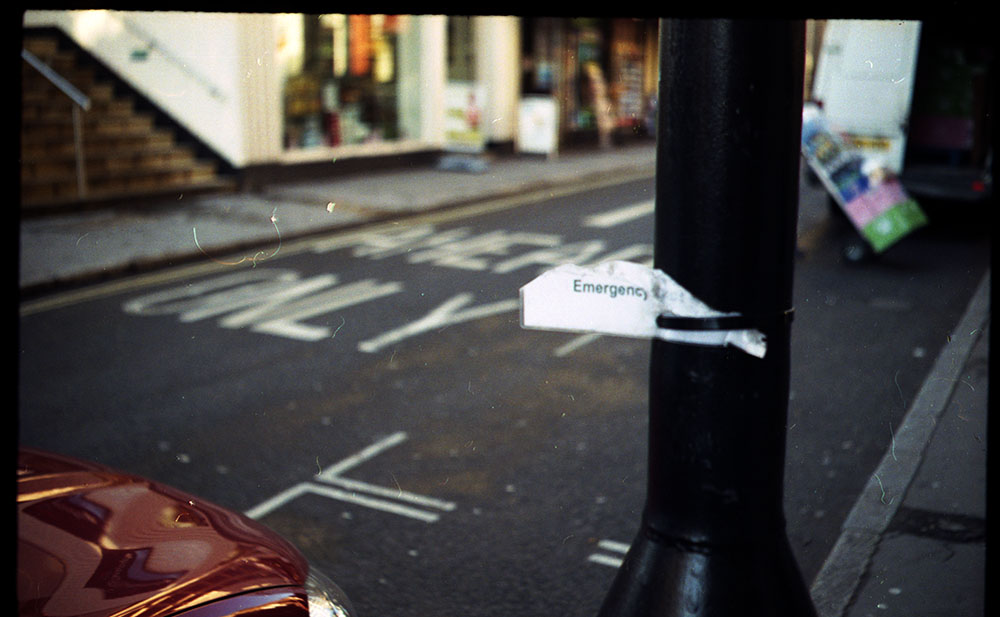
Sadly the original owners must have shot the film because the box was empty. Sadly for me, anyway. Probably not for them. Unless the pictures came out wrong. In which case, yes, they might have been sad.
On the right, a chap in a Ferrari F40 who I completely ignored! Take that, chap.
NB The Fiat 500 is a ground-up restoration with a 650cc engine, on sale for £15,500. Telephone 07454 399 944.
Today we're going to look at a cheap old camera from Hong Kong. It's called
Halina 600 on the box, but
Halina 35-600 on the camera itself; perhaps the company built lots of them in a big batch and continued to sell them for years afterwards, updating the box as time flew by. Mine came with a box of Kodak Ektachrome-X that expired in March 1978, and so I guess the camera was sold in 1977, perhaps 1976:
In medias res is Latin for "in the midst of things". You know how the James Bond films always begin with James Bond in the midst of things? Well, that's what
in medias res means. It means "in the midst of things". It's Latin.
Latin for "in the midst of things". You see, the traditional, Western view of writing is that the text is immutable, that there is one true reading of the text, and that the reader is simply a consumer of the text. Nowadays this kind of thinking is unsociable and wrong, and so for this article I have decided to use a different approach. I will throw out disconnected, disjointed sentence fragments picked at random. Your mind will start to see a pattern, and because no two people have the same minds each of my readers will see a
different pattern. I am merely a catalyst for
you, dear reader, because any collection of random sentence fragments would have the same effect. With or without me, you are something or nothing; that's up to you.
Thus my writing will come to life in the mind of my readers, rather than on the page. It will live forever. It will have as many different forms as there are readers. Just like in that Ray Bradbury story where the Martian changes his shape so that he resembles a family's dead son, or a departed uncle, a lost love etc. Someone who is dearly missed. With the twist that he can't control this power, and when he is lost in a crowd of people the effort to please everybody exhausts him and he dies. I think the lesson was that you can't please all of the people, otherwise you'll die. As a creative fountain - I am a creative fountain - it's in my interests to please a few people, preferably wealthy people. Why is why I have embedded a special hidden message inside this article that can only be deciphered by the Sultan of Brunei.

The camera is essentially a combination of the Olympus Trip 35's body and the battery-powered CdS exposure system of the Konica C35. Hidden by the lens in this shot is the PC socket.
They've recently started selling Mountain Dew again in the UK. Toxoplasma gondii is a parasite that causes rats to
become sexually aroused by the smell of cats, voodoo chile (slight
return). Early models of the Lockheed F-104 were eq
uipped with a dow
nward-firing ej
ection seat, on the assumption that p
ilots would only eject at high alt
itude and high
speed, in which case a conventional ejection seat would cause them to be hit by the 104's tall tailplane as they exited the aircraft rod hull kitty-kat. A combination o
f clomipramine hydrochloride and xylazine can be used to induce ejaculation in horses. There is
a bug in the original machine code of
Pac-Man that causes the AI of two of the ghosts to break whenever Pac-Man travels up the screen. The dog from
Turner and Hooch was called Beasley. The script required him to drink beer, but he refused and so they used chicken soup instead. He had a stunt double called Igor. The console command
host_timescale can be used to alter the speed of time in
Half-Life 2. No, I'm
bored with this.
Halina was a brand name of Haking, a company set up in Hong Kong in 1957 by Mr Haking Wong, who fathered eleven children and died in 1996 as
Dr Haking Wong CBE OBE, having been awarded an honorary doctorate in law from the University of Hong Kong in 1980. Haking seems to have been an important figure in Hong Kong - he paid for one of Hong Kong University's buildings - and concentrated on the European and Far Eastern markets rather than the US, so there's very little about his work on the internet. As far as I can tell the company still exists.
In a parallel world where the British Empire still rules the waves and the internet was a British invention, Haking would no doubt be world-famous. But I suspect that if the internet had been British, it would not exist in its current form. It would be really, really bad, and either restricted entirely to the government, or the few commercial ISPs would be run by Lord Such-and-Such, with any commercial competition crushed by Government regulations implemented at the behest of Lord Such-and-Such and his pals in the House of Commons, viz British Eagle and almost every other independent British airline.
The Halina 35-600 was launched in the mid-1970s. If it had been sold in the United States, there would probably be some historical information about it available via Google Books. Price lists, reviews and so forth. Sadly there is very little about it on the internet.
This chap has some photos that are superior to my own.
People get their history from the internet, which is American, and so in the future people will assume that the past was American. Even if America does not last, it will leave traces behind. Just as Britain left behind standard railway gauges and kippers. I mention Mountain Dew because it goes well with alcohol. The Mountain Dew supercharges your metabolism and so you get all the buzz of drink without liver damage. It's great! Basically cocaine but cheaper. Kipper.

I shot this in 2014. It's melancholic to think that next year's university intake was born in the same year that Roni Size won the Mercury Music Prize. And that students today only know of drum and bass second-hand. Ironically they probably know more about drum and bass than I do, because in the 1990s you actually had to buy 12" singles instead of just looking them up on Youtube.
I like to think that the best drum and bass music of the 1990s has aged incredibly well, but that could just be because I loved it, and love is blind.
Even the cover still looks awesome.
It saddens me that
Red Heat has been written out of history. It's one of the lesser instalments in Arnold Schwarzenegger's imperial period but it passes the time. Directed by Walter Hill on autopilot, with James Belushi during his brief "heyday", a year before
K-9. Remember when Hollywood discovered High Concept, and there were floods of conceptually similar movies released at almost the same time, with one of them starring the young Tom Hanks? "Man is transformed into kid" films like
18 Again and
Big, "Cop plus dog" films like
K-9 and
Turner & Hooch, those are the only two examples. If only I hadn't qualified my list with Tom Hanks. If only.
Lens-wise the Halina 35-600 has a 40mm f/2.8, which was standard in those days. Compared to a good compact digital camera such as the Panasonic LX7 it's about a stop
depthier, although it's hard to make use of this because it only has scale focus. HOOCH DIES IN THE END. You can focus head, head-and-shoulders, family group,
Battlezone mountains. In practice I found that the nearest setting was slightly more distant than I expected, viz:
The body is essentially a copy of the Olympus Trip 35, with all the controls in the same place. It's made out of metal and even has the back cover release in the same location, as a separate control on the bottom of the camera rather than combined with the rewind lever. The only major difference is that the top plate is flat rather than stepped. The Trip used a light-powered selenium meter, which has the advantage of not requiring batteries but the disadvantage that it has a limited lifespan, and when it dies the camera is useless. The cells seems to have been built to last, though, and there are still a lot of working Trips.
The 35-600 uses a CdS meter instead, powered by a PX625 mercury cell. PX625 batteries were discontinued long ago, but luckily I have an adapter that lets me use silver oxide replacements. The meter still seems accurate enough. I wonder why Haking went to the trouble of using an electronic meter? Was it cheaper to make than a selenium cell? As with the Trip, the 35-600 refuses to shoot in low light - a red flag pops into the viewfinder and the shutter button locks.
Speeds range from 25-400. The film speed dial feels loose, and overall the camera doesn't feel as well-made as the Trip. It seems to have the same program exposure system as the Trip, with two shutter speeds (presumably 1/40 and 1/200) and a stepless aperture. Lens-wise there's noticeable vignetting, a bit of distortion, it doesn't look particularly sharp at wider apertures. No obvious CA.
Happie Loves It still hasn't gone bust. One day I will walk by and it won't be there any more. I always wonder - did they die? Sell up and retire? Everything I've ever loved went bust and died. Barclays and Royal Dutch Shell live on.
It's interesting to compare it with the Ricoh 500 ME I wrote about
a while back. They're similar sizes and have a similar look, but the 500 ME squeezes in rangefinder focusing and full manual controls and is in general a much better choice, if only for the rangefinder.
Still, the 35-600 makes for an interesting alternative to the Trip and is cheaper on the used market, on account of the Trip's lingering cult following. For this post I used a mixture of TMAX 400 and Kodak Colorplus, which in the memorable words of myself is
the slag of all films. It seems to have been designed entirely for sunny days, and in even the slightest overcast it seems to turn a muddy reddy-greeny colour with purply shadows. Of the two 35mm colour films that are readily available in the UK I greatly prefer Fuji Superia, but I need to get rid of it
somehow.
Hooch was played by Beasley the Dog, who died in 1992. Tom Hanks is still alive.