

They say you learn something new every day. Today I learned that the cover photograph of The Supersuckers' 1995 album The Sacrilicious Sounds of the Supersuckers was a homage to the cover of Paul Weston's obscure 1960 light pop album The Sweet and the Swingin', viz:

Do you remember Citizen Kane? There was a monologue about seeing a girl on a ferry for a moment a long time ago. Never meeting her, never seeing her again, but remembering that moment forevermore. The internet doesn't remember the name of the lady model on the cover of Sacrilicious, but whoever she is I wish her well. The man who played the Devil was a lucky man.
Now that I've got that off my chest, let's have a look at the ThinkPad T520. It's a laptop from 2011, but such is the incremental pace of change in the computing world that it's still perfectly usable nowadays unless you want to play modern games, in which case it's not usable at all.
Most versions of the T520 relied on Intel's built-into-the-CPU HD 3000 GPU, but some T520s had a separate Nvidia 4200M that could be switched on and off as necessary. There's a dearth of solid information about the 4200M's performance on the internet but I surmise that eight years later it's probably more trouble than it's worth. One extra source of heat; one more component to fail.

Status: Malignant

It's been a while since Half-Life 2 was a state-of-the-art benchmark. It runs just fine on the T520 with HD 3000 graphics, continually butting against the game's native 60fps cap in the admittedly spartan early levels. Playing Half-Life 2 makes the laptop's fan start running.
A T520 recently fell into my hands, so I thought I'd write about it. Back in 2011 it was Lenovo's standard desktop replacement laptop, sitting above the less-robust L520 but below the W520 mobile workstation. It was aimed at employees who needed a computer but didn't warrant a permanent desktop machine. I have the impression that a lot of T520s spent their lives in a ThinkPad dock, chained to the desk, connected to the corporate network with an ethernet cable, running exclusively from mains power, which probably did nothing for the batteries.
T520s are widely available on eBay for very little money because the businesses that used them in 2011 have since upgraded. They mostly belong to the modern age - they have SATA III hard drives and can use SSDs without any issues, they take up to 16gb of memory - but a few things date them. They don't have USB 3.0, there's no touchscreen, and by modern standards they're very chunky. Even in 2011 they were very thick. On the other hand they're well-built. I have an ancient ThinkPad 600X from 1999 and it was interesting to compare them:

The 600X feels denser, as if it was a rubber brick, whereas the T520 has a hollow feel. The 600X has smoother hinges, impressive for something now twenty years old. They're both fingerprint magnets, but beyond that I don't have any complaints about the build quality.
Some T520s have a fingerprint sensor in the top case. Mine doesn't. It does however have a colour sensor that can supposedly be used to calibrate the monitor properly. It sounds oddly esoteric for a business laptop and I haven't tried to use it.

I have to admit I lost touch with CPU architectures when Intel switched to the i3/i5/i7 generation in 2008. I don't have the inclination to memorise the difference between Kaby Lake and Coffee Lake. Instinctively I think of the Core 2 Duo as "behind the curve but still usable in 2019 at a pinch" and the i5 and beyond as "the modern era". Desktop i5s are generally quad-core, but laptop i5s of 2011 were dual-core, as is mine.
The T520 has a 15" screen. It was sold alongside the T420, which had a 14" screen. Beyond the screen size, the only significant difference between the two was that the T520 could be specified with a quad-core i7. Most of the information in this blog post applies to the T420 as well. They share batteries and even use the same keyboard. The only notable physical difference, beyond the size, is that the T420's hard drive slides out, whereas the T520's doesn't, but read on.When it was new the T520 was typically supplied with a 64-bit installation of Windows 7 Pro, although Windows 7 Home Premium was an option. Lenovo arranged the hard drive with a recovery partition that can reinstall the operating system. My laptop came with a fresh recovery install, at which point I had to spend an afternoon installing masses of updates.

This is the T520's 1600x900 15.4" panel, the middle of the three screen options. It's matte, visible in daylight, with decent but not spectacular angles. The odd purple cast on the text is from the lens I used to shoot this image, not the panel.
Microsoft will drop support for Windows 7 early next year, but luckily the T520 runs Windows 10 without breaking into a sweat. A while back Microsoft offered a free upgrade for Windows 7 users via a downloadable tool. In theory this shouldn't work any more, but just for fun I tried it, and it upgraded Windows 7 into Windows 10, seemingly without any problems. EDIT: I wrote this post at the end of 2019, and Windows 7 has now been abandoned. Can you still upgrade it to Windows 10? Good question. END. The T520 comes installed with a bunch of Lenovo utilities that are mostly useless, although the battery manager is pretty good. You can set it to maximise the life of the battery by limiting the charge, and you can easily see the maximum number of discharge cycles for example.
Other operating systems? I haven't tried Linux but I can see no reason why it wouldn't work. The T520 can apparently be hackintoshed into a Hackintosh quite easily, although the wifi card might have to be replaced. I'm not sure if units with the Nvidia graphics chips are harder to hackintosh. Yes, hackintosh is a verb. It a verb now. Again, I haven't tried this, because I already have a MacBook.

Sadly no amount of tinkering makes the TrackPad good. Usable, but not good.
Historically the T520/T420 replaced the Westmere-powered T410/T510 (2010). The T520 was in turn replaced by the Ivy Bridge-powered T430/T530 in 2012. In terms of CPU performance the T430/530 generation is around 35-40% faster than the T410/T510, but they were not universally beloved by ThinkPad fans because they introduced a new keyboard design with smaller keys.

The T520 on the other hand has Lenovo / IBM's old-fashioned desktop-style keyboard. It's great - it doesn't flex, the keys feel nice and spring back easily, you can train yourself to get used to the odd position of the FN and CTRL keys. The T520 doesn't have a backlit keyboard - that was introduced with the T530 - but it does have a ThinkLight that shines down from the screen bezel.

The ThinkLight in action. If I was in charge of ThinkPad development I would make the light more yellow - the cold white daylight balance looks harsh.
The TrackPoint is an acquired taste. I love it, but the T520's TrackPoint feels less sensitive than other TrackPoints I have used. With my X61 I can whizz the pointer across the screen with a nudge, but with the T520 I have to press the TrackPoint continuously.

The touchpad isn't very good. Lenovo probably has a special name for it. I'll have a look. Oh yes. TrackPad. TrackPad.
I own a late-2008 MacBook Pro. It's three years older than the T520 but has a far better touchpad. It's large, two-finger scrolling gestures respond perfectly, it's glassy-smooth - it literally is glass, the touchpad is covered with glass - it hasn't worn down after eleven years of use, it's a superb touchpad. The T520's touchpad isn't in the same league. It has a knobbly texture that rubs my fingers the wrong way. Multi-finger gestures are jerky and intermittent. Perhaps it's a Windows problem, I don't know. I use the TrackPad as little as possible e.g. never.

The blue ThinkVantage button brings up support information, although in reality its only genuine use is to activate the BIOS screen when you boot up the laptop. It's a legacy of the days when laptops had special buttons that opened a link to a website. It was eliminated from the ThinkPad range circa 2013 or so.
The T520 was available with three different screen resolutions, poxy 1366x768, considerably better 1600x900, brighter and generally superior 1920x1080. Mine has a 1600x900 panel. The panels are interchangeable and are essentially drop-in replacements. The laptop will recognise them all and they have the same connectors.
Let's have a look at the ports:

From left there's a DisplayPort monitor connector, a VGA port, two USB 2.0 ports, a third USB 2.0 port - it looks different because it can be specified as an eSATA/USB port - a FireWire port, and a switch that turns off the wi-fi and Bluetooth.

Around the back is a powered USB 2.0 port and a blank for what would have been an internal modem. Even in 2011 modems and VGA ports were old-fashioned, but ThinkPads have traditionally been conservative. What was FireWire? It was an Apple thing. What was eSATA? It was essentially an external SATA port. Some T520's have a combined eSATA/USB port - an eSATAp port - that can supply power to SATA drives. Regular eSATA ports don't supply power, so you have to plug external drives into the mains. This was eSATA's major limitation. It never really took off and was superseded by USB 3.0.
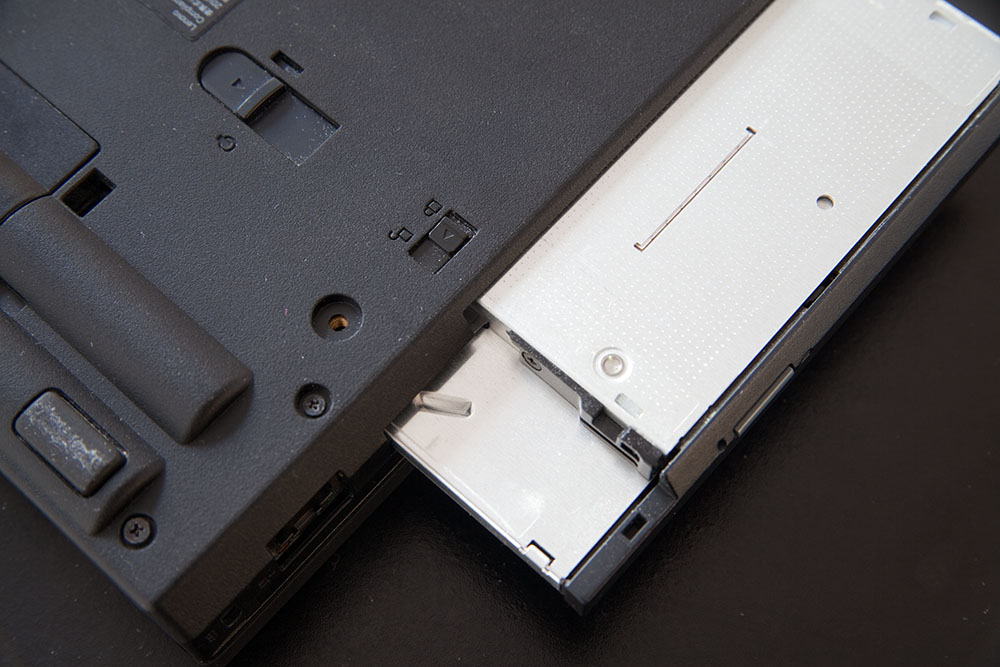
The UltraBay. The empty screw hole - with the brass thread - was for a security retention screw that locked the UltraBay's contents in place, handy if you had a second hard drive in the bay. Originally the screw was supplied with the laptop but from 2009 onwards it became a special-order item.
The UltraBay will take a variety of optical drives up to Blu-Ray, and also a hard drive caddy. It doesn't support an extra battery. The hard drive caddy strikes me as the most useful option. The T520 also has an mSATA slot underneath the keyboard, so in theory you could put the operating system on the mSATA card, put all of your data on an internal HDD or SSD, and use the removable hard drive in the caddy for bulk data transfer, or a second operating system. The sky is your playground.
Let's open up the T520:

That covers all the easy user-replaceable stuff. The T520 was sold with either a 6-cell or a 9-cell battery. The 9-cell battery extends beyond the back of the laptop; mine is a flush 6-cell battery. There was also a 9-cell "slice" battery that plugged into the base of the laptop and doubled the battery life. The hardware manual mentions a 4-cell battery, but I can't find any evidence that this existed. Perhaps it was an option for the slimline T420s that could also be used with the T520. I don't know.

The T520 has a standard 9.5" drive bay. I cloned the original 500gb hard drive onto a 120gb solid state drive with Macrium Reflect. Gone are the days of messing around with Norton Ghost. After chopping out most of Lenovo's pre-installed applications - good riddance, Corel MovieFactory - Windows takes up about 16.5gb.

The T520 uses 204-pin DDR3 PC3-10600/PC1333 memory. One or two sticks, up to 8gb per stick, to a maximum of 16gb, which is extravagant for a laptop. They don't have to be installed in pairs. Higher-speed memory is fine, it'll just run at 1333mhz.
The T520 has two memory slots. The easy one is in the base of the machine. The second slot is underneath the keyboard. To remove the keyboard you need to take out the two screws circled in red - you might need a magnet to lift the one at the top out of its channel. The odd metal object to the left of the picture is the base of the CPU cooler.
Incidentally this is a good spot to blow out dust. I blew some air across the CPU cooler, at which point a cloud of fine dust ejected from the left side of the laptop.
Once those two screws are removed you flip the laptop over, slide the keyboard gently towards the LCD, then lift it up from the front, taking care not to rip out the cable:


What a nice, simple layout. As you can see the second memory slot is hidden under a frosted plastic cover. In the top-right, underneath the copper-coloured keyboard cable, there's a black rectangle - this is the cover for the mSATA drive. This T520 doesn't have one. Towards the front of the laptop is the wifi card:

It's an Intel Advanced-N 6205. ThinkPads have a whitelist and so the only way to use another card, or at least a card that wasn't supplied by Lenovo, is to install a custom BIOS. I don't have a problem with the 6205 card so I'm not going to touch it.
Is that it? The T520 is something of a minor modern classic, because it was part of the last generation of ThinkPads with a desktop-style keyboard. The CPU can be removed and replaced, in fact Lenovo even tells you how to do it, but I suspect that for games the graphics chip is the limiting factor. For everything else a quad-core i7 is good enough. The W520 supported more powerful CPUs, but they ran hotter and drew more electricity, and in 2019 my hunch is that it's not worth pushing the T520 to its absolute limit.
The other popular "power user upgrade" is the screen, but in my opinion the leap from 1366x768 to 1600x900 is much more significant than the jump from 1600x900 to 1920x1080, so I'm not going to do that. On the used market in the UK T520's vary widely in prince, from around £70 without a hard drive or memory but with a charger to £150 or so in working order. ThinkPads tend to go through phases, and although they were common a while ago they're starting to become rare, as the more powerful T530 isn't much more expensive.
Is that it? I think I've said enough. Do you remember the parrot's last words? "You be good, see you tomorrow. I love you." Well, dear reader, I hope you are good. I will not see you tomorrow, or ever, but I love you all the same. Goodnight.


