

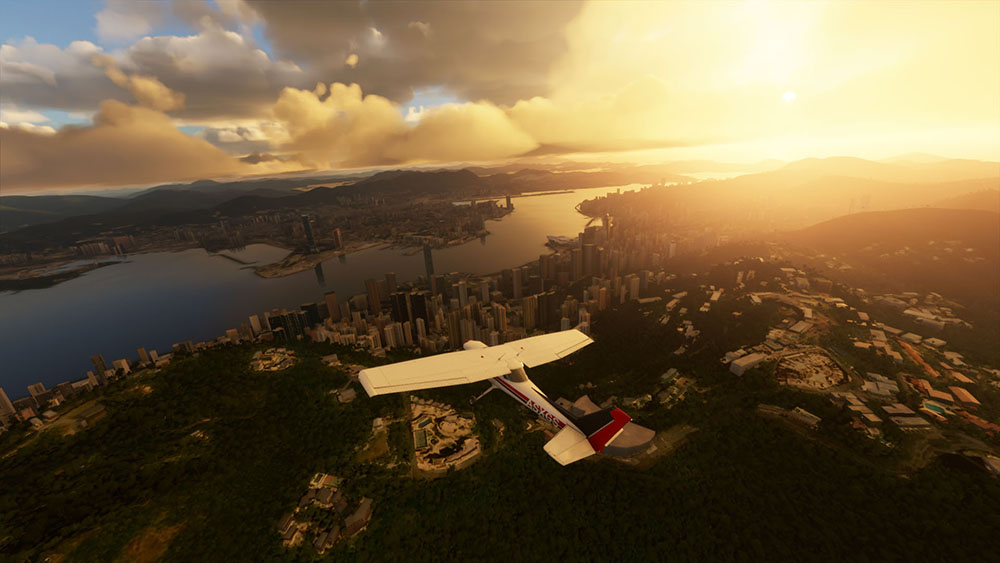
In theory it's the latest in a long lime of games that stretches back to 1982, via Flight Simulator X (2006), Flight Simulator 2004 (2004), Flight Simulator 2002 (2002) and all the other versions of the game that came out before anybody was born, but in practice it's a brand new title, created by hitherto-obscure French developers Asobo. It has won almost universal praise for its gorgeous visuals, which use a mixture of handcrafted buildings, procedurally-generated cityscapes, and map textures streamed from Microsoft's Bing Maps. The clouds are particularly nice. The reviewers have grumbled about the steep system requirements and an overall lack of polish, but the game has been a surprising commercial success, topping Steam's charts on pre-orders alone, so hopefully it will be patched and expanded in the future.
Its commercial prospects were no doubt helped by the fact that millions of people are now stuck at home, incapable of actually flying anywhere. Completely by accident Flight Simulator 2020 has a wistful, almost nostalgic air; it takes place in The Before Times, when we were all free as birds.
But was it an accident? Perhaps Bill Gates is responsible for coronavirus after all. Perhaps he arranged it purely so that Microsoft Flight Simulator would be a hit. He doesn't even work for Microsoft any more. But does he? No, he doesn't.
But does he? No.

Flight simulators were once a killer app for expensive PCs, but the genre entered a long, slow decline in the 2000s. They require a tonne of commitment from the publishers and have a limited market. The rewards are potentially very high - flight simulator fans are stereotypically flush with cash, willing to spend money on extra aeroplanes and scenery packs etc - but from a publisher's point of view why bother accurately modelling a Boeing 787 when you can raise more money with recoloured weapon skins and lootboxes? Microsoft tried to capture the casual market with the simplified, free-to-play Flight (2012), but it was neither fish nor fowl and lasted less than a year on the market.
The success of Flight Simulator 2020 is therefore heartening, because Microsoft and Asobo didn't have to bother. Instead they went the extra mile and made a game that works as both a serious flight simulator and an attractive scenery generator.
But let's get down to business. The game is currently PC-only, but it'll almost certainly come out for the next-generation XBox. It's available online via Steam, plus the Microsoft Windows Store, plus the PC version of the XBox Game Pass. However it's a massive download - around 120gb - so Aerosoft in Germany has signed a deal with Microsoft to sell the game on DVD. The physical box is slightly more expensive than buying the game digitally, but the package includes a manual and keyguide. And of course a bunch of DVDs.
The game still has to be registered with a unique key, and after installing from DVD it needs several gigabytes' worth of patches, and it requires always-on internet, so as a physical backup the DVDs are of limited value. I don't know if someone else can use the discs to install the game on their machine, using their own registration code.
The game comes on ten DVDs. I thought I'd go through the process of installing it so that people in the future can say "there was a man".

I began by inserting the first DVD into the DVD drive and closing the tray. The first disc includes the installation program, which uses InstallShield. That takes me back. It has been a long time since I saw that name.

After disc one was finished I removed it and carefully reinserted it back into the box and inserted the second disc into the drive and closed the tray:

At that point the cabin crew served the main meal. No, I'm joking. There were no cabin crew. There was no-one else. Just me and a DVD drive. Me, a DVD drive, and a lifetime of nightmares. After disc number 2 had finished installing I removed it and carefully put it back into the box - I slipped it gently into the cardboard case, hopefully without scratching it - and then I inserted the third DVD:

DVD number three. When it was finished I removed it and put it back into the box, making sure to rotate it so that the number was easily visible in case I needed to use it again. In a nice touch the discs were already like that in the box, or at least most of them were. Half of them had come out of their slots and were rolling loose inside the package.
Still, after carefully replacing the third disc I inserted the fourth disc, disc number four:

How long did it take to install each disc? Roughly twenty minutes apiece. After the installation routine had finished copying files from the fourth disc I removed it and inserted disc five:

At this point I was half-way through the process. In the pipe, five by five. After disc five had finished installing I removed it and inserted disc number six:


I always feel uneasy when I install something from multiple discs. Should I wait a few seconds for the drive to spin up and inspect the disc, or can I press OK immediately? Will the operating system recognise that the disc is spinning up, or will it demand that I insert the disc again? How long do I have to wait? These questions swirled through my mind as I removed disc six and inserted the seventh disc:

Okay, I admit it. The whole thing is a big shaggy dog story. I really am going to show you every single disc. Because I want you to feel the pain I felt from spending three hours of my life pulling discs out of a cardboard sleeve - carefully, so as not to scratch them - using a lint-free cloth so that I didn't leave fingerprints on them, then waiting half a minute for the drive to register the disc, then repeating the process nine times, or ten times. Nine times? I did it once, then repeated that process nine times. So, yes, nine times.
We're in this together, you and I, and after my computer had its way with disc seven I put it back in the box and inserted disc eight:

The eighth disc was much the same as the others. The villain in Bill and Ted's Bogus Journey was called DeNomolos because one of the writers was called Ed Solomon and he used his own name but backwards.
What does USK mean? It stands for Unterhaltungssoftware Selbstkontrolle, which is the German rating agency for video games. Why is the game PEGI-3? Why not PEGI-0? I suppose because you can dive an airliner into skyscrapers, although the game cuts to black when you crash. After disc number 8 had been sucked dry of its precious, precious juice I removed it and inserted disc #9:

Disc nine is the second-to-last disc. By this time the DVD drive was starting to feel warm to the touch, so I paused for a couple of minutes before inserting the final disc, which is disc number 10. I also did some research and found out that PEGI-3 is in fact the lowest rating. Why isn't it PEGI-0? Perhaps the people in charge of the ratings aren't keen on two-year-old children playing computer games:

That was the final disc. It worked. It didn't bomb out right at the end. It actually worked. Sometimes nothing goes wrong. If only I could savour those moments instead of forgetting them.
After the whole thing had installed I inserted disc one again, because apparently the game requires that you leave disc one in the drive as a copy protection measure:

For the record the discs installed 93.6gb of data spread across 59,119 SSD-crushing files:

However the game still isn't done. After disc ten had been sucked dry the Microsoft Store popped up and downloaded a bunch of support files:

And after that had finished downloading the game's own internal content engine sprang to life and downloaded a further 16.09gb of stuff, all the time playing a short loop of muzak that lasted for about a minute:


Why did I photograph the screen? Why not use print screen? I wanted to interact with the computer as little as possible in case I accidentally hit a button that cancelled the installation. Apparently if you buy the digital edition of the game you have to listen to the muzak and look at the game's installation screen for however long it takes to download 120gb of data, so buying the DVDs bypasses that. Also, waiting three weeks means that I benefit from patch 1.7.14, above. I can delete TBM 930 whenever I want and the game won't crash.
Luckily after all of the above nothing went wrong. The game finally did install:

I'm not sure why it thinks I have the preorder edition. I bought it brand-new from a major internet retailer about three weeks after the game had been launched. But perhaps Aerosoft only made a single batch of boxed sets and the few remaining units are left over from the preorder period. The game is also available in Deluxe and Premium Deluxe forms, with more content. Aerosoft only sells the Standard and Premium Deluxe editions.
At this point it was past my bedtime, so I opened the game, flew from Pisa to Lucca in a Piper Cub - technically a Zlin Aviation Savage Cub, a modern recreation of the original - and to make things real spicy-like the game uses real-time weather and real-time... time, it uses real-time time, so I flew in the dark, because it was midnight in Pisa. It was lifelike, in the sense that we are all flying through unfamiliar skies in the dark. We are all flying through unfamiliar skies in the dark. And ahead of us there is only more darkness, until the lights go out forever. Then I discovered that you can adjust the time and weather, so I flew around Hong Kong, thus:
What was the performance like? Of the game? I'll tell you later.


