Genoa, shot with a Moto G
You may find yourself in a museum, and you may find yourself in a public space, and you may find yourself in a restricted area where you cannot take a proper camera, and you may ask yourself "what is a proper camera anyway?", and you may ask yourself "how can I make do with what I have?", like everybody else in this sweet cesspool, because making your way in this world today takes everything you've got.
I've said it before, but the likes of Henri Cartier-Bresson and Eugene Smith and Robert Capa would have
killed to have a smartphone. Back in the Time of Giants they travelled the world with cute rangefinder cameras not because the cameras were cool, but because
they made sense at the time. Contax and Leica rangefinders were a lot smaller than Speed Graphic press cameras, and they could take several shots in rapid succession. The giants of the past would have killed for a portable camera that could upload images to a press agency instantly; that could shoot video and record sound. They would not have grumbled about smartphones, they would have snapped them up, packed their bags, and gone out to take pictures of people dying in dramatic ways.
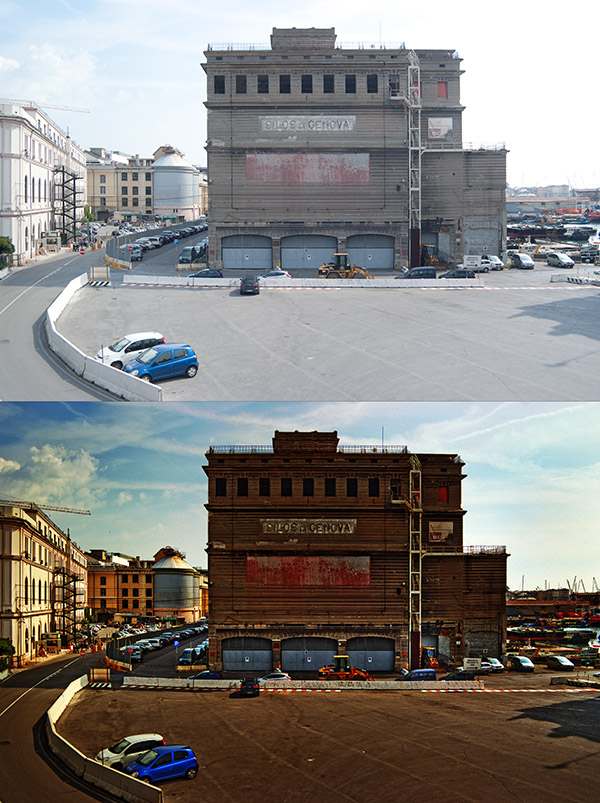
But mobile phone cameras have a couple of limitations. I'm not fussed about resolution; fixed focal length is something you have to deal with on the spot; having to use an LCD screen is a mixed bag. My biggest bugbear is dynamic range. Mobile phone cameras have narrow dynamic range. You can either shoot for the shadows and blow out the sky, or shoot for the sky and have an extremely noisy landscape. Narrow dynamic range is the difference between the following two images (straight from the camera at the top, with numerous tweaks at the bottom):
That was shot with a Fuji S5, a digital SLR with an unusually dynamic sensor. Mobile phones generally expose for the subject, so the sky tends to blow out, and there's little you can do to bring it back. But I have a few really simple tricks.
Trick One
Over the last few years I've shot a lot of film. Slide film has the same smooth colours and limited dynamic range as digital, but even when it blows out detail it still tends to retain a hint of colour. Consider the following, which is overexposed Provia 100, cross-processed:
Here's a crop of the top-left:
Even though the sky is basically blown-out, there are still some faint traces of colour. In this crop I've darkened the image so that you can see the grain. Or consider this, with the original scan at the top and the Photoshop remaster at the bottom, which looks ludicrously yellow in comparison, but natural in isolation (the sun was setting):
The detail in the church's frontage has been obliterated, but there was still some colour left, and with a bit of work the second example is the end result. It's terrifically simple to recreate this with Photoshop or any graphics package that has layers, masks, and graduated fills. The technique is simple. I feel ashamed. Those are two separate thoughts.
Consider the following, in which the sky has blown out:
Simply turning down the brightness doesn't make the sky better, in fact it makes it worse. The sky is
clipped in the same way that Iggy Pop's remaster of
Raw Power is clipped, e.g. the top end isn't just fuzzy, it has been shaved off. It has gone, so we must replace it.
Pop open the image in Photoshop. Layer - New Layer, and then just fill the layer with orange, and add a
Reveal All mask:
This has the effect of adding an orange wash over everything. Now use the graduated fill tool on the Reveal All mask thusly, and finally turn down the
Opacity to about 23% or so:
The end result doesn't restore the sky, instead it replaces it with an orange wash which is a lot more attractive. This kind of effect is incredibly simple, but it works. I suppose it's reminiscent of the old Hollywood trick of
preflashing, but instead of lifting the shadows it tames the highlights. Here's a shot from the film
Skyfall, in which Moneypenny shoots James Bond and then Adele starts singing:
At the top is how it appears in the film, and at the bottom is how I imagine it probably looked in real life. The film was shot digitally, and perhaps because of that the sky has blown out, so in post-production instead of matting in some clouds they instead chose to tint the frame brown. Once you notice this you start to see it on television shows a lot. Old-fashioned analogue video had the same problem.
In days of yore the cinematographer might have used a graduated neutral density filter, as in this shot from
Barry Lyndon, which looks a bit naff as a still but works perfectly well in the film (both times it appears, it is very quick):
But graduated filters only work when the camera is static, and what if the sky had been overcast? A graduated filter would have just made it darker, without bringing out any more detail. In any case, which is most important: a neat-looking sky, or Moneypenny shooting James Bond?
Trick Two
The answer is of course "Moneypenny shooting James Bond". Check this out:
Again the sun confounds me. Here's a closer look:
On the horizon the chimneys of Mestre, the industrial heart of Venice. Far in the distance, about thirty miles away, the Euganean Hills on the other side of Padua. It's a beautiful world, isn't it? We see it once and then never again.
How to tame the sun? As before, it's easy. Layer - Layer via copy. Apply a massive amount of Gaussian blur, so that the image is completely blurred out. Then add a Layer Mask, but this time use a
Hide All layer, and then use a circular graduated fill around the sun. In the following image I've been really sloppy with the mask, which looks unnatural in a bad way, as if the sun was floating on top of the picture:
In the following image I've toned down the
Opacity and worked a bit on the mask, and tweaked the brightness and contrast so that it looked more like the image in my mind:
There's a spot of green lens flare that I've left in. All of these images were shot with a
Motorola Moto G (Mark II), a solid Android smartphone with a decent camera that has a good-but-erratic HDR mode. The HDR mode won't help with blown-out highlights, though - it seems to lift the shadows instead.
The above trick works in the following case:
The phone captured all the details but the scene is too bright, as if it was shot earlier in the day. On the right, darkening the sky makes it look terrible. If we add a new layer and blur it, the posterised highlights are gone, but of course the image is blurry:
Saint Giorgio Maggiore looks like an angry gargoyle with two sharp teeth. Do you remember
They Live, where Rowdy Roddy Piper puts on a pair of sunglasses and sees the world as it
really is? If we could see the universe as it really is it would rock our faith, because even atheists have faith that the human animal possesses something special that separates it from other animals; that our brains are not just pattern-matching devices created by a process of trial and error, but instead vehicles for a soul. Thankfully our tiny minds cannot grasp the infinite.
If we use a graduated mask on the sky, we get this, which admittedly wouldn't work if there were clouds:
In this example the result is a little over-the-top, and the islands are a little blurred as well. And of course there's an artificiality to it, because there's a clean break between the sky and the water. If this was a shot of New York city, with skyscrapers jutting into the air, you would need to do a lot more work on the mask. Eventually your face would grow to fill the mask, and then you are the demons.
Mobile phone photography is a conundrum. As mentioned up the page it's fantastic; if you're the kind of person that moans about smartphones and instagram etc, I don't want to know you. A hundred years ago you would have moaned about this new fangled 35mm nonsense, and a few decades before you would have moaned about photography itself - it's not
creative, after all, a photographer is no better than a
surveyor. History will flow over you like a river, it will gouge you. The water itself is just a tool of gravity. Gravity uses water to slice through rock; it seduces water and holds it fast in giant pools. But gravity is not a
thing, it is instead a result of mass warping spacetime. Mass is the villain here, not gravity.
But, yes, there's a technological conundrum. In terms of dynamic range and light sensitivity mobile phones will always lag behind dedicated cameras, because the sensors are of necessity smaller; and any advances that improve mobile phone sensors would also improve camera sensors as well, so the gulf would be just as wide. There's no way to enlarge a mobile phone sensor without enlarging the optics, short of a revolution in optical design, and with huge optics a mobile phone is no longer a mobile phone, it is a talking camera. There seems to be no way to square the circle, but what if we take a lateral step sideways?
I've said it before, but I believe that in future people won't take photographs. They will instead trawl the internet for other photographs, or they will trawl Google Maps, and they will mash them up, repost them, edit them. The big star imagemakers of the future will be akin to the DJs of today, they will curate and collate, remix and repost. CGI has already conquered the Ikea catalogue, and has made inroads in the fields of pornography and landscape art; I predict that by the year 2020 H G Wells' vision of the Eloi - a future elite who sit in front of Pornhub all day - will have come true. I plan to be at the forefront of this new race. Photography will pass, just as all mediums pass.