Sunday, 1 December 2019

Eating a 17-Year-Old MRE: Menu 4, Country Captain Chicken


Let's have a look at another MRE. This one is Menu 4: Country Captain Chicken, but to make things real spicy-like the MRE was made in 2002. It's now seventeen years old. In theory it's old enough to get married, if it had parental consent, but that's impossible because MREs don't have parents. They're food, not people. You can't eat people.

MREs are only designed to last five years or so. Even if an MRE is refrigerated the dairy products become noxious within a decade. I have no idea how well my MRE was stored - I bought it from eBay - but I can confirm that it was not a delicious tasty crunch.

The date code on the toaster pastry is 2029, which means that it was packaged on the twenty-ninth day of the second year of the decade, 2002 in this case.

What is Country Captain Chicken? I learn from the internet that it's a curry-style dish popular in America's southern states. It's not widely available here in the UK. I've never had it before.


The meal includes country captain chicken, some noodles in butter flavoured sauce, a cappuccino mocha drink, a toaster pastry - e.g. a Pop Tart - a pair of crackers (not pictured), cheese spread, some M and Ms, a spoon, and an accessory packet.

Country Captain Chicken was added to the MRE menu pool in 2000, apparently as a tribute to General George Patton, who was a fan of the stuff. It was discontinued after just four years, but its time in the sun coincided with the invasions of Afghanistan and Iraq, so a lot of soldiers experienced it. It regularly appears in "worst MRE of all time" lists, which is why I wanted to try it out. How bad could it be?

The accessory packet has some Taster's Choice coffee, a teeny tiny Tabasco sauce bottle, some gum, salt, sugar, non-dairy creamer, matches, a moist towelette, toilet paper.

How bad could it be? Well, the universe is an entropic system inexorably degenerating into a state of uniform disorder. Our sun has a limited lifespan, as do all the other suns in the universe. New stars are created all the time, but more stars die than are created, and eventually the universe will consist of ashes floating in darkness. Even if we could extend the lifespan of our bodies and escape the death of our sun we would eventually find ourselves alone in the universe.

We could conceivably approach the problem of immortality from another direction. What if we could alter our perception of time, so that subjectively our lives would feel as if they lasted millions of years?

There are two problems with this. The practical problem is that time proceeds in discrete quanta. It is not a smooth, analogue flow. Instead it ticks and tocks like the second hand of a wristwatch, and as a consequence we cannot completely stop the subjective flow of time, we can only slow it down. We would still be mortal.


I assumed that sealed coffee would last forever. That it might lose its taste but still be drinkable. Internet sensation Steve1989 regularly drinks coffee from the 1950s, but this packet of Taster's Choice did not last.

The creamer looked okay but smelled odd, so I threw it in the bin.

The second barrier to an escape into dreamland is more philosophical. Imagine if the world around us was a simulation created by people who only live for six weeks, for whom three score years and ten is an incredibly long time. Imagine if their planet - in the "real" world - only coalesced from interstellar dust six hundred years ago, and that it will be consumed by its parent star in just two hundred years' time. Imagine if our world was their escape. Imagine if we already live incredibly long lives. The problem is that our perception of time is elastic, and if we could extend our lives so that they appeared to span millions of years it would still feel inadequate. It would all be over in the blink of an eye.

There is no future for any of us. No hope, no salvation. Even if God were real, it is just wishful thinking to suppose that he created an eternal afterlife for us. Why should he? Did he create an eternal afterlife for mosquitoes and viruses? Why us, and not them? No, there is no hope. The only escape is the oblivion of alcohol and drugs, and compared to that horror the unpleasantness of my 17-year-old MRE was relatively mild, although still bad.

I've shown you the coffee. Now you are forever broken. Let's have a look at the M and Ms, which I have to write as "M and Ms" because the Blogger platform messes up ampersands.


They look okay but smell wrong. I tried one. Just one. It was no good. The sugar coating was still edible, but the chocolate inside tasted stale. It tasted like a Hershey bar. Hershey bars are supposed to taste horrible but M and Ms are not, so I decided to throw the rest away.

I could conceivably take some along to London Zoo and test them out on the monkeys, but what if it takes several days for them to fall ill? How could I tell that it was the M and Ms, and not something else? What if the guards apprehend me and force me to eat the M and Ms? Too risky.

The packet's "Hit the Code" promotion apparently finished in April 2002. The grand prize was $1,000,000 in yearly $50,000 instalments for twenty years, so whoever won is still receiving cheques. Sadly the competition expired in 2003 and the website is long dead. The Internet Archive has a backup; it had a spy theme. It looks unusually bad even for 2002.

Let's try the cappuccino mocha, and remember that cappuccino is two-two, and Mississippi is three-three, and accommodation is two-two, and Philippines is one-two, and cappuccino is two-two. I didn't expect much of it so I put it in a bowl, which saves me having to sterilise a mug.


The powder smelled okay. The sugar must have kept. But when I added water it smelled off. I tasted a little bit and it was indeed off, in fact it tasted a little bit like the M and Ms. Down the sink it went.

I firmly believe that you have to face up to horror. You can cower and shield your eyes, but that will just make the horror more bold. At the very least people might be inspired by your sacrifice. Let's have a look at the cheese. The cheese. From 2002. Seventeen-year-old cheese.

Seventeen-year-old artificial MRE cheese. Let's do this. Rock and roll. Let's do this. In the pipe, five by five. No problem boss. Let's do this. One down, thousands to go. Even in death I still serve. Thank Mr Skeltal. Tryin to make a change. Let's do this. I'm psyching myself up by repeating internet memes. Let's do this. Dated internet memes from a few years ago. Mlem. Let's do this. But first the crackers.


The crackers smelled fine. Not even musty. I don't know if the recipe has changed over the years but these crackers felt tougher than modern MRE crackers - modern crackers tend to break into flakes.


The cheese smelled of feet, and not in a sexy way. It was slightly less bad than I expected. I was expecting an awful rotten room-filling stench of death, but it was no worse than some speciality cheeses I have encountered. It reminded me of those times I would take a week off work, and tell everybody I was going to the Cotswolds, but in reality I spent the week in bed drinking and occasionally rolling over to pee in a bottle. Was I happier then than I am now? The cheese did however give me a use for one of the MRE beverage bags I have accumulated, as an improvised body bag:


A body bag for cheese. MRE beverage bags are airtight and thus odour-tight. I don't like the idea of being assailed by the smell of cheese every time I open my pedal bin.

The crackers were just fine. Very mild wheaty taste. MRE crackers are light, dry, but a lot easier to eat than Polish hardtack. Let's drape a shroud over the corpse of the stinky cheese and move on to the next thing, which is a Pop Tart:


Or rather a "toaster pastry", but it's a Pop Tart. I assume it's supposed to be cooked in the flameless ration heater, but I microwaved it for thirty seconds instead. It tasted slightly off, but only slightly. Perhaps the apples had gone bad, but they made up such a tiny part of the ingredients that they hadn't ruined the rest of the Pop Tart. It was edible, not great, but edible, and I finished it off.

Moving on, let's heat up the noodles and the main meal.

There's a typo on the packet. Dehyrdrated.


My heart has a warning label on it as well. Do not overfill. No danger of that. No danger of that. The flameless ration heater had an unusual design. The heating element was in a little pocket that attached to one side of the bag. Modern FRHs have the heating element as a separate pad so that you can put it in between two packets of food - this FRH could only cook one thing at a time. It activated and got hot, but not hot enough to properly cook the meals, so I boiled them in a pan for a couple of minutes.


Consistent white balance? I've heard of it. The noodles smelled unpleasantly sweet but they tasted okay. There was a slightly strange aftertaste, but I couldn't tell if that was because they had gone off or if they were like that in 2002.

My impression is that modern MREs are of a consistently good standard. After thirty years of refinement the food technicians have finally cracked it. There have been a number of infamously bad MRE meals since their introduction in the early 1980s, but the most notorious - the vegetable omelette, the frankfurters, the country captain chicken - are no longer in production.

How would I describe the noodles? They didn't look like noodles. Here in the UK noodles are long stringy things. There was no buttery taste at all. Imagine really cheap pasta with a mild taste of plastic and cardboard. They were edible but I wouldn't want to repeat the experience.

Let's try the main meal. Let's try it. Let's try the meal.


Country Captain Chicken was widely disliked even when it was new, and this one is seventeen years old, so that's a double-whammy, but I was astonished, nay amazed to find that it smelled really nice. It had a distinctive, rich curry aroma, with a touch of southern-style sauce. Perhaps the curry preserved it. I stuck my finger in the sauce and it tasted great, so I threw caution to the wind and ate the rest of it. It was good!

It's essentially a piece of reformed chicken with a lot of curry sauce. Do Americans eat a lot of curry? Curry is huge in the UK. Perhaps it was unpopular because Americans aren't used to curry. Who knows. The sauce had raisins, bits of fruit, and almonds, although it all just tasted of curry.


Now, it's still MRE food. The chicken had the consistency of perished rubber, and without the curry sauce it would have been "food mass". There was enough sauce for two pieces of chicken; if I had designed the meal I would have added more chicken or taken away some of the sauce. It would have gone well with chips.

On the whole I liked the main meal. It's curry-lite with plastic chicken, on a par with a basic microwave meal from Iceland. I suspect that its infamy comes more from the target audience's unfamiliarity with curry than from its inherent naffness. Furthermore it survived to the present day without being frozen so the designers can congratulate themselves on a job well done.

Anything else? The gum took a while to dissolve, but it tasted okay. Vaguely minty gum, slightly better than modern MRE gum. From what I have read the little bottles of tabasco sauce tended to evaporate even though they were screwed shut and sealed. The MRE packet didn't smell of tabasco, and the bottle hadn't leaked onto the other meals. It had just dried up and evaporated into space:


And that was that. The main meal held up well, as did the crackers. The rest, not so much.

Friday, 15 November 2019

Kai Tak Airport in 2019


Today you will visit Kai Tak, or what remains of Kai Tak. Technically it was Hong Kong International Airport, even more technically HKG, but everybody called it Kai Tak. Now there is another HKG, several miles to the west, but the little strip of land on which Kai Tak sat still exists.

Where did the name come from? Back in the 1910s two local businessmen bought a patch of land in Kowloon in the hope of turning it into prime real estate. Their names were Ho Kai and Au Tak. They died long before the land became an airport but their names lived on.

But why did you go to Kai Tak? You've read about it. With the turny planes coming down through the skyscrapers. The airport closed in 1998 and now it is mostly a building site, but traces of its past life remain.

The memory of Kai Tak will fade and be replaced by a cartoon, but the same thing happened to Venice and Rome and will happen to the megacities of tomorrow. It will happen to Hong Kong. Humanity's past is a collective set of fantasy visions. You witnessed some of them during your lifetime. You walked past others without seeing them because they were not yet legends.


Runway terminology is confusing. Kai Tak had one runway, but it had two numbers - runway 13 ran from north-to-south, runway 31 ran from south-to-north, although it was the same patch of tarmac. Most aircraft landed and took off from runway 13, north-to-south.

I decided to write this article in the style of 1980s postmodern literature, partially because I was in a nostalgic mood, and also because it allows me to relax and let the subject generate most of the text.


That's Kai Tak in the photo above, in between the big ship and the skyscrapers. From a distance it almost looks as though airliners are parked on it, but in reality the airliners are little boats in a harbour between the former runway and the new waterfront.

The right part, the reflective part, you can see it, the metallic part, that's the cruise liner terminal. The cruise liner terminal, right there. It was deserted when you went there. Cruise liners visit Hong Kong from December to April, when the weather is cooler and less humid.

The buildings in the background were mostly built post-Kai Tak, particularly the mirrored buildings closer to the waterfront, but people who lived in the apartment blocks in the far distance had a grandstand view of aircraft landing at Kai Tak. During the final approach people on the top floors could look down on the aircraft. "That's awesome", he said.

The big ship in the middle distance looks like a cruise liner, but it's not. It's a casino ship. The Starry Metropolis. The only gambling allowed in Hong Kong is horse racing, so each night the Starry Metropolis sails a few miles out of Hong Kong bay into international waters, where there is no law. The guests dance and gamble and have fun, and perhaps you will join them one day.


Now the strings begin to swell. Ken Morse's rostrum camera pans over vintage photographs while Bob Peck narrates. Kai Tak is as old as airports. In the 1920s it was a grassy field on the mainland operated by Britain's Royal Air Force, but in 1941 the Japanese invaded and took over. During the rest of the war they upgraded the facility with concrete runways. This did nothing to stop the Allies from obliterating Japan's navy and levelling Tokyo with firebombs and nuking Hiroshima and Nagasaki, so in 1945 they handed it all back.


The cruise terminal has a mixture of nautical and aviation iconography. Even though it has been defunct for over twenty years the airport has far more cachet than the cruise line terminal, so most of the design details make reference to the airport rather than ships and anchors etc. Little flutes chase each other.

I wasn't sure if the lifebelts were actual functioning lifebelts or a design detail. They seem too elaborate to be set-dressing. Sadly you can't sprint off the end of the runway into the water; there are fences, a steep drop, and some rocks in the way.


In 1946 a group of businessmen who owned a war surplus DC-3 tried to set up an airline in mainland China, but after harassment from the Chinese authorities they decamped to Hong Kong and parked their DC-3 at Kai Tak. The airline was renamed Cathay Pacific, because the founders dreamed that one day they might fly planes across the Pacific to the United States. And they did! They did, and Cathay Pacific still exists.


Apropos of nothing, Hong Kong's pre-1997 coins are still legal tender today. Coins minted before 1992 have Queen Elizabeth II on them, but after that date the handover was inevitable so 1992-1997 coins had a flower on the other side. The contactless Octopus card was very successful and so from 1998 until 2011 the Hong Kong government stopped minting coins altogether.

Do you remember the advertising slogan? "Singapore Girl, you're a great way to fly"? That was the advertising slogan for Singapore Airlines. I can't remember Cathay Pacific's advertising slogan.

Look at the people having a picnic in the plane's shadow. Aren't they cute? This is essentially one-quarter of Kai Tak Runway Park, at least in 2019, and they're sheltering under the aeroplane because the only other sources of shade are enclosed benches.


I was too small for the coming wave of turboprop and jet airliners, so in 1958 I was given a whole new runway built on a reclaimed strip of land sticking out into the harbour. Suddenly I was mighty! In 1975 I was extended once more, to cope with jumbo jets and Concorde, although in practice Concorde rarely visited me. It didn't have the range to fly non-stop from Europe, and it was forbidden from reaching supersonic speeds over land, so I was an awkward destination.

Singapore Airlines flew a leased Concorde to Hong Kong briefly but only for a year. Charter flights visited me every so often, but even so Concorde rarely appeared on my radar screens. I had mixed feelings about Concorde. It was very noisy, but it weighed a lot less than the other aircraft, so I was happy to let it taxi across my tarmac. I miss it.


This is what he will write. "By the 1990s, Kai Tak was one of the busiest airports in the world, but it had overwhelmed its design capacity and there was no room for expansion. In 1991 construction began on a new airport off the north coast of Lantau Island to the West of Hong Kong. The new airport was finished on 02 July 1998, and on the morning of 06 July Kai Tak closed and the new Hong Kong International Airport opened, and that was the end for Kai Tak." That is what he wrote.


Since then redevelopment of the location has proceeded slowly, not helped by the Asian financial crisis that rumbled on as the new airport was opening. As of late 2019 the area inland of the airport - the site of the pre-war Kai Tak - is still mostly a construction yard.

There are plans to build a hospital, a metro station, housing, a sports park, and even a river, because rivers are so hot right now. The men and women who are determining Kai Tak's fate are presumably trying to emulate Cheonggyecheon, the uncovered river in the heart of Seoul. Cleggypop.

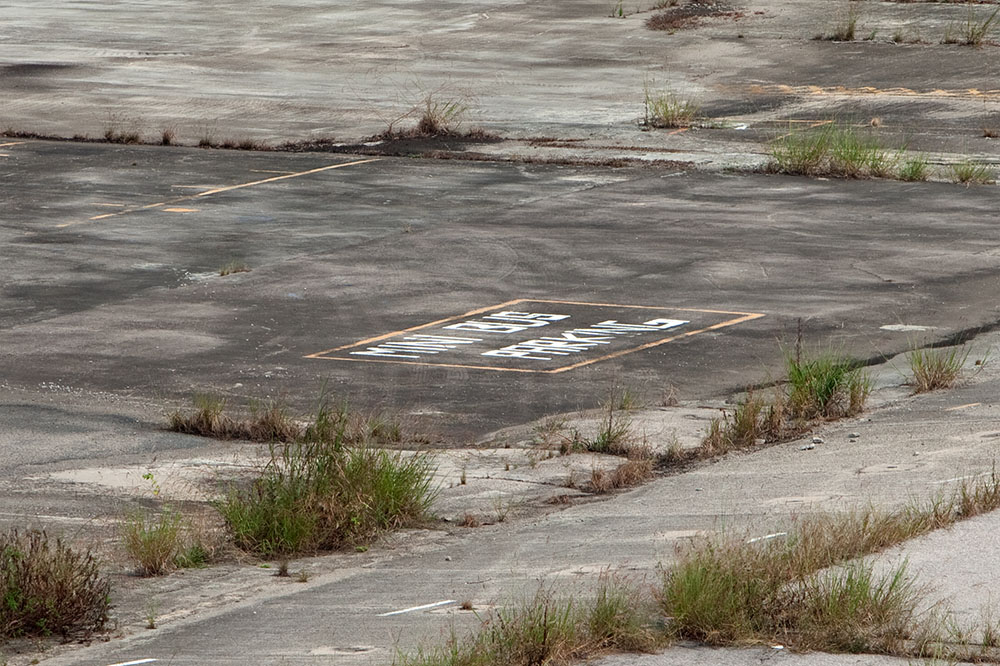
Some of the tarmac survives. The only aircraft ever likely to use it again are helicopters.


"Mini Bus Parking" 


The cruise terminal has not been the smash hit the authorities expected. Kai Tak is in an awkward location. The MTR station isn't finished yet, and even when it opens in early 2020 it won't link directly to Kowloon and Hong Kong island. Passengers will have to go in the other direction and change lines. The only regular public transport is the bus. There are apparently special shuttle buses when liners disembark, but it must come as a shock to go from a cruise liner to a bus. It wouldn't be much fun to walk from Kai Tak into town, and it would be impractical to walk back with shopping.

Cruise passengers want to hop off the ship and do some shopping in Sogo or Lane Crawford or Harvey Nichols in Kowloon and Hong Kong island, in which case it doesn't make sense to park the ships at Kai Tak. Why not turf out the small boats from Yau Ma Tei typhoon shelter and build the terminal there? Mini bus parking seismic weed.


Part of Kai Tak's legend is Chequerboard Hill. The hill was at the landward end of the runway. It had an ILS beacon and a painted chequerboard. Pilots were supposed to follow the beacon until they saw the chequerboard and then make a sharp right turn for touchdown.

Let's zoom in and enhance.

The hill is still visible from the other end of the runway, here looming over the distinctive pink facade of the Holy Family Canossian College. The chequerboard however has been eroded by the elements and obscured by greenery. The skyscrapers are all post-1998 - when the airport was in operation buildings along the glidepath had a height restriction.


Kai Tak was of course famous for its approach. That's what you really wanted to write about. You should have started with that, you bloody idiot, but you didn't, because you didn't realise you were the writer until this paragraph. That's right! You're the writer of this blog. Not them, you. Kai Tak was famous for its approach. That's a good start. Kai Tak was famous for its approach.

For a variety of reasons aircraft were rarely directed to use runway 31, south-to-north. Airliners didn't take off over Kowloon because there was a hill in the way, and there were nasty crosswinds on the approach from the south. How did you know that? Because you looked it up. Just now, you looked it up. Google.

Furthermore in order to keep the flow of traffic moving quickly it made sense to have all the aircraft land and take off in the same direction. Kai Tak was extremely busy, especially with cargo traffic; in the last year of operation it was the world's busiest cargo airport. There's a famous photo of a 747 coming in to land at the northern end of the runway while a second 747 simultaneously takes off from the southern end.


And so pilots had to approach from south-west of Hong and ride the ILS beacon until they could see the chequerboard, then hang a right onto the runway and do a manual landing. Difficult in daylight, harder at night, even harder during bad weather, and Hong Kong has a lot of bad weather.

Surprisingly there were very few accidents. The most famous was in 1993, when a China Airlines Boeing 747 ran off the end of runway 13 into the water. There was a typhoon, and the pilot didn't brake in time. No-one was seriously hurt although the aircraft was a write-off. People tend to remember that accident because the view of a 747 resting in the water was visually striking, but it was the only time a passenger jet overshot the runway on landing. Several cargo flights and military aircraft crashed, but during the jet age there were only three fatal incidents involving passenger airliners - the botched landing in 1967 of a Thai Airways Caravelle that killed 24, an aborted takeoff in 1967 of a Cathay Pacific Convair 880 that killed one, and the crash of a Chinese Trident in 1988 that killed seven.

Legend has it that only the best pilots were allowed to operate from Kai Tak, and they had to undergo special training to do so, which might explain the relative lack of accidents. Kai Tak still has an air of glamour, although it can't have been much fun for the local residents who had to put up with the noise. Conversely the construction work for the new airport has transformed the unspoiled wilderness of the northern edge of Lantau Island into a sea of concrete and glass, so what the people of Kowloon gained in sleep the people of Lantau lost.

If you want to visit Kai Tak the easiest, most scenic way is to pop along to Kowloon Tong MTR and find the number 22 bus. It's in the basement of Kowloon Tong's shopping mall. It goes to the terminal and takes about half an hour but the ride is nice. The park itself is, as mentioned, just a patch of grass with no shade, but the terminal has plenty of benches. There's not much else to see in the local area, but I combined my visit with a trip to Bleak House Books, a cosy bookshop on the twenty-seventh floor of an office building, and the Kowloon Walled City Park, which sits on the site of the former walled city.

Kowloon's walled city was another part of Hong Kong you never had a chance to see; another part of Hong Kong fetishised by outsiders that the locals probably don't miss.