Off to Greenland. It has the surface area of central Europe, with
a human population that would only half-fill Wembley Stadium. Imagine if one of Level 42's songs was featured in Stranger Things, so the band decided to reform with Mark King's son on bass, and they did a concert in Wembley Stadium. That's about how many people live in Greenland. From October to
March Greenland is one of the few places on Earth where you can step out of
the main international airport and have your nose freeze off in five minutes and die of hypothermia shortly afterwards.
Greenland is a fascinating place. It has one cinema. One! The language looks like ammassassuaq and erinarsortartoq and naalakkersueriaaseq and ullaakkorsiutit. Geographically it's a giant puzzle. It rarely makes the international news. With such a massive area you'd think it would be the battleground of empires, but its chief resources are rocks, peat, permafrost, and ice, so the world has largely ignored it. Famously Donald Trump tried to buy it a few years ago, for reasons known only unto himself.

What to do with it? Why remain? Why not evacuate
the population to Denmark? From a British perspective Greenland is mind-boggling because we have nothing remotely comparable. The Falkland Islands? St Helena? But they're tiny. Greenland is massive. Canada? Not technically ours any more. Australia? But Australia has television programmes and skyscrapers and famous people. Greenland is silent and mysterious. About the only Greenlandic thing that most British know is the word anorak, which is Greenlandic for anorak.
Oh, and the short film. The one from Gravity. What was it called? Aningaaq. It was set in Qaarsut, a couple of hundred miles north from Kangerlussuaq, which is Greenland's main international airport:
A couple of years ago
I visited Hong Kong. It was my first long-haul flight. And my last! Because the world was struck by a global pandemic a few months later. In 2019 the thought of global air travel grinding to a halt sounded like the plot of a techno-thriller, but it actually happened in real life. On the eve of the pandemic I wrote an article on
ultra-long-haul air travel - one of the most popular articles on this blog - but with the passage of time the article now feels like a relic of a bygone era. A time when travel bloggers criss-crossed the world so that they could write about criss-crossing the world.
In response to the pandemic the world's airlines eliminated their long-haul
services. British Airways sold off its once-mighty fleet of Boeing 747s.
Airbus ceased production of the giant A380, which was economically marginal
even at the best of times. A few airlines still fly the four-engined Airbus
A340, but a mixture of COVID and economic reality killed off the large quadjets. Their day has passed, just as the days of tri-jets
passed in the 1990s. The future belongs to twins of various sizes.
I was going to say "various shapes and sizes", but unless you're very
attentive most modern airliners look the same. They are safer, more
efficient, generally better than their ancestors, but there's something
slightly dull about them.
Air Greenland's one and only long-haul airliner, an Airbus A330-200. No
matter how bad your job is, you don't have to load cargo containers into
an Airbus A330 on the apron at Kangerlussuaq Airport in the snow. Unless
that *is* your job, in which case you walk tall.
I thought I'd write about my trip. I flew from Copenhagen in Denmark to
Kangerlussuaq with Air Greenland, on 16 May 2022. My goal was to try the
Arctic Circle Trail, a hiking route that runs from Kangerlussuaq to Sisimiut.
In particular I wanted to see what it was like in May. I'll write about it
separately but for the record I made it about twenty miles before realising
that people who go in July and August have the right idea. On the positive side there were no
mosquitos.
Air Greenland's livery is fantastic. I'm not sure if the bright
red paint is designed to make the aircraft stand out against snow, but it can't hurt. The bulk of Air Greenland's fixed-wing fleet consists
of short-haul turboprops that shuttle between Greenland's scattered
settlements, sometimes in appalling weather. The country has no motorways, very few roads, very few navigable inland waterways. A giant ice cap covers the middle of
the landmass, splitting off the major towns from the few settlements on the east coast. In winter the temperatures are occasionally low enough
to freeze water in mid-air, so Air Greenland is an essential public service.
At the airport I spotted this plane. It's a modernised Douglas DC-3 owned by Kenn Borek Air. Technically it's a Basler BT-67, a turbopro conversion of the DC-3. It might be part of NASA's Oceans Melting Greenland project, but I can't be sure. Air Greenland's fleet is mostly helicopters, which are used for passenger
flights and search and rescue. The company also has a sleek Beechcraft King
Air as a flying ambulance - Greenland's only hospital is in Nuuk, the capital
- and seven DeHavilland Dash-8 turboprops, which seat 37 and are essentially
flying buses. Flying trains? Every day they shuttle between Greenland's
settlements, sometimes several times a day. They're a vital part of
Greenland's infrastructure, akin to the local flights that criss-cross
Australia. I learn from the internet that Air Greenland's last fatal accident
was in 1973, a helicopter crash, so they obviously don't hire dummies.
The flight to Greenland was packed. This is Air Greenland's bag drop /
check-in area at Copenhagen Airport. The airline suggests that you arrive
three hours before the flight, and that's a good idea - the people of
Greenland have a lot of luggage.
Air Greenland's only large airliner is an Airbus A330-200, which was brought
into service in 2002, alongside the company's existing Boeing 757. The 757 was
sold off in the early 2010s, leaving the A330 to soldier on by itself. As of
this writing Air Greenland is awaiting a brand-new A330-800 as a replacement
for the -200. It was ordered back in December 2020 so it should arrive
imminently.
The A330-200 is a longer-range variation of the original A330-300, with a
shorter fuselage but the same amount of fuel. However Air Greenland's -200 has a
passenger-dense configuration, with 30 business class seats and the remaining
258 economy, so it carries more or less the same amount of passengers as any
other A330 but over a greater distance. I assume Air Greenland needs the extra
range in case Kangerlussuaq Airport is snowed-in, because the nearest
diversions are Keflavik, in Iceland, or alternatively Gander in Newfoundland,
which are both about 800 miles away. Greenland doesn't have any other civilian
runways long enough to accommodate the A330.
Air Greenland's A330-200 has a standard 2-4-2 layout. From left to right
AC, DEFG, HK. This is the flight back to Copenhagen, which had a lot of
empty seats. Obviously no-one wanted to leave.
What is the A330? It's Airbus' small transatlantic model, akin to the Boeing
767. Introduced in the late 1980s. I like to think of it as an updated A300,
with a similar configuration but a much longer range. About the only thing the
A330 is famous for is the fact it shares its wings and fuselage with the
four-engined, super-long-range A340, which was designed alongside it.
While I flew across the snowy wastes of Greenland did I crave "4 engines 4
long haul"? No, I did not. Instead I imagined how I would survive on the ice,
given that I had a bunch of hiking gear but no fuel. Could I power my stove
with human fat? Could I skin the other passengers and make a suit out of their
remains? Would a human suit scare off polar bears, or attract them? These
thoughts and many more swirled through my mind.
To date the A330 has had two fatal crashes in thirty years of airline service.
One of them was Air France Flight 447 of 2009, which was caused by a iced-up
speed sensor during a flight over the Atlantic at night. The rest of the
aircraft was functioning perfectly, but in the absence of any kind of visual
reference the pilots became convinced that the aircraft was plummeting
nose-first into the ocean. In reality it was flying straight and level, so
when the pilots pulled the stick back they made the aircraft stall, so it essentially belly-flopped into the sea from a starting height of 35,000
feet. There were no survivors.
Air France 447 is often used as a case study in over-reliance on automation,
and although professional sources are non-partisan, internet people tend to
use it to bash Airbus in particular. From their point of view Airbus pilots
are computer operators, not pilots. That narrative has waxed and waned over
the years, although Boeing's recent troubles with the 737MAX have made it
abundantly clear that overreliance on automation is an industry-wide
phenomenon. I'm digressing here. Let's talk about Greenland again.
Air Greenland's big jet operations are unusual. The flight from Copenhagen to
Greenland felt more like a small regional hop than a trip across two-thirds of
the Atlantic. Greenland is a dependent territory of Denmark, so
the flight exists in a grey area whereby it's simultaneously internal and
international (they stamped my UK passport; I'm not sure if that happens if
you're a member of the EU). As you can see the A330 at Kangerlussuaq has
stairs rather than a jetbridge.
Air Greenland has a simple app - Club Timmisa - but I checked in
at Copenhagen and Kangerlussuaq the old-fashioned way, face-to-face, and ended
up with a printed boarding pass.
The flight leaves Copenhagen at 10:00 and arrives in Greenland at 10:40 local time,
almost but not quite catching the sun. On the way back it leaves at 11:55 and
arrives at 20:55. What was the flight like? Internally the A330 has the same
look and feel as the A320, e.g. light and airy, with colour-changing mood
lighting. After putting away my carry-on bag I settled down and had a look at
the in-flight entertainment system, which felt more advanced and was more
responsive than the seatback unit in British Airways' A380:
It had an odd selection of films that included the above, plus
Batman Begins and some kind of romantic comedy. Is Christian Bale
a good fit for Batman? Only time will tell. I wondered if
Tolkien consisted of J R Tolkien shouting "no, I will not let you
make a film of my life" for ninety minutes. Or if it was ninety minutes of J R
Tolkien painstakingly reconstructing the proto-Celtic word for "carry" by
studying ancient historical texts from Ireland and Wales. Who knows.
There were also some albums. Queen's Greatest Hits, off the top of my
head. And some mobile games. The one I tried hadn't been ported properly - it
was designed for a portrait screen - but in general given that the flight was
only four hours I didn't bother with the entertainment system. On the way out
the moving map didn't work:
And yet the pilots managed to find their way, so perhaps they had their own
map. After settling down the stewards offered me a drink and a rye bread
snack, and then on to the main meal, which was a cold pasta salad:
As far as I could tell there was no
other choice of meal in economy - this was it, although I imagine there was a
tick-box during the booking process if you were vegetarian. Greenland is
perfectly fine if you're vegetarian, but the terminal area is unsentimental
about hunting:
You don't get displays like that at Bristol Airport. I can imagine some people seeing the UNESCO WORLD HERITAGE logo and thinking
"this is good", and then seeing a man holding a dead deer and thinking "this
is bad", and then realising that the people are Inuit, so "this is good", but they're hunting, so "this
is bad" and, bang, that person's head would explode. Incidentally the little sideways H-shape in the bottom-left is a traditional Inuit knife, which is used by the ladyfolk to scrape meat from musk ox skins. Imagine having to tell your wife and kids that they won't be having tea for the rest of the week because daddy was a bad shot. That must hurt.
Was the salad any good? Some of the chicken was a bit tough. Beyond that it
filled a hole; I can barely remember it. On the positive side it was nicer
than British Airways' "full English breakfast", which was a heck of a thing. As I hiked through Greenland I pondered the chain of work involved in assembling that salad, and the airliner, and the infrastructure that supports it all. There's something primeval about Greenland. It's a glimpse of a world where humanity never appeared, where animal life in general is rare.
Do I have anything to say about the seats? I don't remember if they reclined
or not. A chap across the way had a nap by resting his head against the
entertainment screen, so perhaps they don't. Which would make a
certain amount of sense given that Air Greenland's transatlantic flights take place exclusively during
the day.
How wide were the seats? I don't know, and Air Greenland doesn't say. BA's A380 seats were noticeably wider than a typical low-cost airline, but the A330's seats felt
quite tight with the tray table down - I was essentially immobilised in my
seat - and I wouldn't have fancied being in the middle row.
I was lucky to sit in the right-most row of two seats, with a window seat on
the way back to Copenhagen.
The bulk of Air Greenland's fixed-wing fleet consists of these
DeHavilland Dash-8 turboprops. Qarsoq is Greenlandic for "arrow".
The airstrip is also home to the Dansk Arktisk Kommando, and is regularly
used by C-130s of the US and Canadian Air Forces, including this C-130 with skis. There's also a
substantial USAF airbase at Thule, seven hundred miles north. Incidentally Tulugaq is
Greenlandic for "raven".
After arriving in Greenland I went to Greenland:
Greenland is real. There's no land ownership, so you can in theory walk
anywhere you like and pitch up a tent. But the terrain is a lot tougher than
it looks, and a lot of it is boggy. The supermarkets sell .22 rifles and there
are almost no major chain stores. I imagine that service personnel who are
stationed there for months on end must get sick of the place, but it has an
arresting ruggedness that's fascinating in short bursts. If nothing else it's
a fantastic destination if you're a photographer, wildlife spotter, plane
spotter, or you just like being out in the open by yourself, and you're
reasonably sturdy.
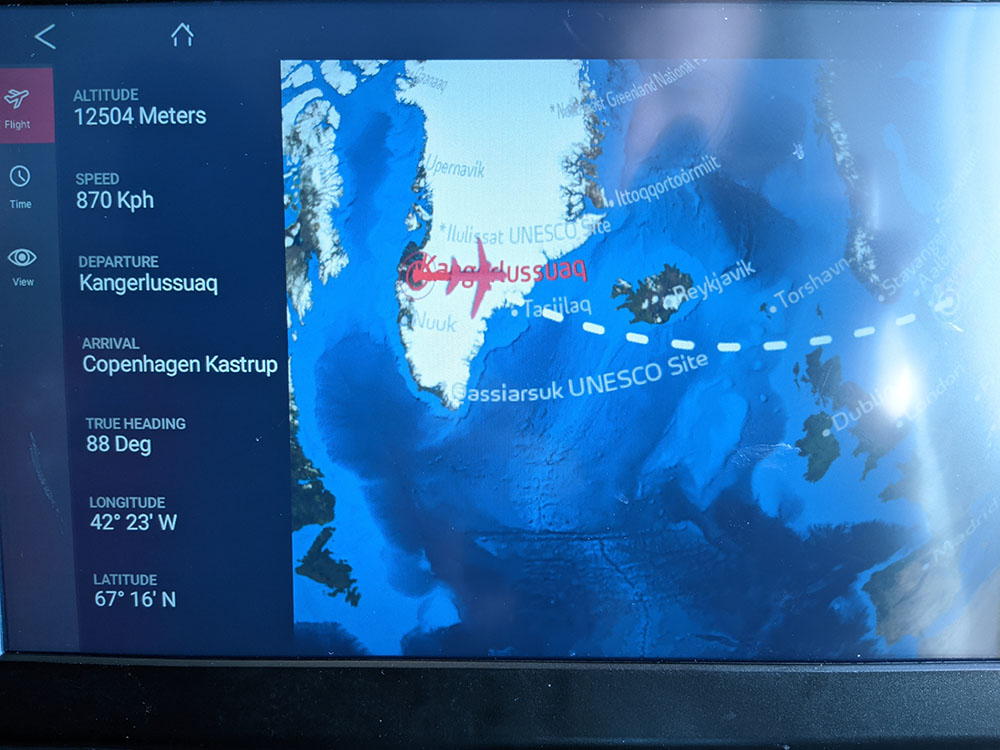
What was it like on the way back, a week and a bit later? This time the moving
map worked:
The meal was cold potato salad and some kind of meatballs:
A 500ml bottle of Coca-Cola costs 49DKK in Greenland, which is £5.60. That's
about $7. Not cheap. A word about the cost. Air Greenland is Greenland's only
scheduled airline, and return tickets from Copenhagen to Kangerlussuaq average
around £500, but if you want to go any further than Kangerlussuaq you also
have to budget another £200 for an internal flight. And of course you have to get to Copenhagen, or alternatively Reykjavik during the summer months, because Air Greenland also has a route from Reykjavik to Nuuk.
I was drawn by the Arctic Circle Trail - a hiking route from Kangerlussuaq to
Sisimiut, on the coast - so I didn't need to book an internal flight, but if
you want to see the icebergs at Ilulissat, for example, you'll have to
add on this expense. Plus the hotel, which is not cheap.
I didn't begrudge Air Greenland's prices. The company must run on a very narrow
economic margin, moreso than other airlines, with the complicating factor that
if it goes bust Greenland itself will collapse; presumably the Danish
government would have to step in and provide some kind of basic air service.
What happens if the airline's A330 has a hard landing and is out of service
for two months? No more Coca-Cola, and anybody in Greenland will be stuck
there.
I'll write about Kangerlussuaq separately. The airport is a legacy of the
Second World War. When Demark was overrun by Germany in 1940 Greenland technically became part of the Third Reich. But the Danish ambassador to
the United States took it upon himself to sign a defence pact between
Greenland and the US, which resulted in the US having an extensive military
presence in Greenland throughout the Cold War.
The US eventually pulled out of Greenland in the 2000s, and there has long been a plan to
nix Kangerlussuaq Airport in favour of extending the strip at Nuuk, the
capital. Greenland's main tourist destination is Ilulissat, on account of the icebergs, but a scenic ferry runs up the coast, so tourists who enter via Nuuk could save a bit of money on internal flights by taking the ferry instead.
Without the airport Kangerlussuaq wouldn't have much of a raison d'être, but it seems a waste to abandon such an extensive facility. But when I
visited there were several large empty buildings, including the defunct Polar
Bear Inn, so I imagine a mixture of COVID and general economic malaise hasn't
been kind to the local economy. Kangerlussuaq has all the problems of a
typical remote town in the UK or US, magnified by the fact that you can't
simply get on your bike and look for work because the nearest town is a
ten-day hike across a boggy wasteland.
The Arctic Circle Trail doesn't necessarily require a major international
airport. Hikers could just as easily land at Nuuk, then fly to Kangerlussuaq
internally, or take the ferry to Sisimiut and walk the trail in reverse. Furthermore Kangerlussuaq doesn't have much in the way of natural resources. The major local attraction is a glacier, but aome tourists might be uneasy with the idea of taking a major international flight to see a glacier. Will they bulldoze Kangerlussuaq, or just leave it to the elements? If nothing else it will be a fascinating ruin. A real frontier town, like in the Wild West.
Greenland is a conundrum, too large to abandon, but what to do with it? Air
Greenland's in-flight magazine is surprisingly ambivalent about climate
change:
The terrain isn't conducive to trees - there's a small proto-forest just
outside Kangerlussuaq, but it was planted into the 1970s and will not be an
actual forest for around two thousand years. The ice cap is slowly melting, which
will eventually play havoc with house prices in Bermondsey and Woolwich, but
ironically Greenland itself will escape most of the flooding.
It's entirely possible that after the rest of the world has destroyed itself the Inuit of Greenland will rise to become masters of what remains of the planet. For the next post I'll write about the Arctic Circle Trail.