Let's have a look at a couple of old audio interfaces. From top to bottom the
MOTU 828 Mk1 and the
MOTU 2408 Mk3. They were both released around the turn of the millennium, give or take a couple of years, and I never thought I'd have to remember how to spell the word millennium in the year 2020 but here we are. It's two-two, like accommodate or embarrass. Two-two. Millennium.
Around the turn of the millennium my accommodation was embarrassing, but an acquaintance helped me acquire a driving licence and, concomitantly, a car. Thus equipped I committed to liaisons and although the 828 and 2408 are ancient they're still useful today. They're multi-channel, multi-format devices with balanced 1/4" audio jacks and a bunch of digital interfaces that I will probably never use.
A bunch of digital interfaces that I will probably never use, just like the box of condoms I bought back in 2008, when it seemed that I might finally get lucky. They've probably perished by now. I would check, but the last time I went downstairs I upset a bottle of pee and it took ages for the smell to die down. If however you are an attractive young lady and you would like to "hook up" please get in touch via the comments.
You might be familiar with the 828. MOTU still sells a version of the interface today. The modern 828x and 828es connect to a computer with Thunderbolt and USB 2.0, but the original 828 from 2001 had FireWire 400 instead. The 828 was apparently the first professional audio interface to use FireWire (the smaller, self-powered Metric Halo 2882 was announced earlier but didn't ship until 2002). Over its life it has consistently sold brand new for around $800, which becomes £800 when translated into GBP because that's the way things are.
The 2408 predated FireWire. It was launched in 1998 and used a PCI card to connect to the host computer. There were three generations, released in 1998, 2000, and 2002; the final, Mk3 version remained on sale until the mid-2000s, by which time FireWire 800 and USB 2 had made PCI audio interfaces obsolescent. During its life the 2408 system sold for around $1,000 with the card or $700 without. The PCI card could run four 2408s simultaneously so MOTU sold standalone 2408s as expansion units.
They're both physically tough 19" rackmount units. Brand-new the two interfaces above would have cost £1,800 for the pair, but I paid around one-tenth that amount because there are lots available on the second-hand market. MOTU's vintage interfaces are particularly interesting because the company still updates the
drivers for its vintage gear, and
even hosts the manuals, which are full of charming photos of musicians installing PCI cards into their Power Macintosh G4s and running software with OS9.
NB I have no commercial relationship with MOTU; other audio interfaces exist.
To paraphrase Oscar Gamble, no matter how much you think things will be like they are, they don't.
I've written about FireWire before. During the entire lifespan of FireWire, roughly 1999-2012, I didn't use it. Not once. I didn't own an iPod or an Apple Macintosh, and yet eight years after Apple gave up on FireWire I now own four FireWire cables. I am using FireWire right now. As a young man I never dreamed that I would use FireWire, or that I would ever type out a paragraph that had the word FireWire in it seven times, and yet I did and I did, in that order.
How does it feel to use FireWire? It feels good. It feels good to connect my PowerBook G4 to a MOTU 828 with a FireWire cable. It feels good. When I plug the cable in I imagine what it must be like to be an animal, such as a horse or pig. They do not understand the practical purpose of copulation; they do not understand that copulation ensures the continuation of the species. The only thing animals know is that it feels good to penetrate, and be penetrated, and I feel that same sense of fulfilment when I use FireWire. In. Out.
Good.
I have always associated USB with cheap cables and cheap MP3 players and cheap broken USB interfaces and cheap USB hubs and cheap USB card readers. USB is cheap and dirty, but not in a sexy way. Cheap grotty broken plastic. In contrast FireWire is the impossible dream, the impossible thrill. It's even satisfying on a technical level. Instead of squirting data down the cable in weak spurts, FireWire transfers information in a solid flow, as if its prostate had been bored out by one of the machines that dug the Channel Tunnel. FireWire has a good flow. It is healthy, engorged, its tissue is pink.
But I'm digressing. What's an audio interface? It's a posh sound card. It connects to your computer and lets you record and play back audio, just like a sound card, but audio interfaces have three things that make them special.
Firstly the audio quality is generally better than a computer's built-in soundcard, in part because the components don't have to share space with a 600 watt power supply and an overclocked GPU. The audio out jack of my 2009 Mac Mini has noticeable electrical noise, because the mini's closely-packed internal components interfere with the sound chip. OSX tries to mask this by muting the sound whenever nothing is playing but it doesn't help much.
The Asus Xonar U3 USB soundcard in the picture at the top of the article sounds much better, but it still has a light background hiss. In contrast the 828 and 2408 are whisper quiet. I can't tell if they're switched on until I play something. Purely as a sound card an audio interface is overkill, but there's no reason why you can't use one just to play music.
Audio interfaces also have industry-standard sockets for guitars and microphones, whereas built-in soundcards typically only have 3.5mm jacks. The 828 in particular has combination XLR / 1/4" plugs that can power a microphone. They're visible in the top-right, here:
They're dual-purpose - they accept a 1/4" jack in the hole in the middle, or an XLR jack in the three prongs that surround the hole. All the analogue connectors on the 828 and 2408 are balanced, which reduces electrical noise, but only if the cables and the source instrument have balanced connectors as well.
The 828 has ADAT in, and the 2408 adds TDIF on top of this. What is ADAT? It's a digital optical interface originally designed in the early 1990s by Alesis for their eight-track ADAT digital recorders, but nowadays it's used as a general optical interface. TDIF is similar but was devised by Tascam. They both transmit eight channels of audio down a single cable. It's very unlikely that you'll use either nowadays. I bought both units purely for their analogue inputs.
The 828 and 2408 were designed in an age of rackmount digital samplers and ADAT digital tape recorders, but that kind of digital outboard gear was killed off by computers running software instruments in the early 2000s. Alesis stopped making ADAT tape recorders in 2003 and TDIF never took off. Analogue inputs remained because they're a universal standard. The analogue synth revival of the last few years has even seen CV/Gate and sync pulses make a comeback, so plain old analogue audio will be around for a long time.
The other thing that makes audio interfaces special is that they tend to have several inputs, not just a stereo pair. The 828 has eight channels of analogue audio plus another eight channels of ADAT plus two RCA sockets for S/PDIF (another digital interface, designed by Sony and Philips). The 2408 supports twenty-four channels of audio drawn from a mixture of analogue, ADAT, and TDIF banks.
Multi-input audio interfaces are a bit like mixers, but instead of combining the inputs into a stereo output they pass the audio input channels into the host computer, where the mixing is done with the sequencer's mixer panel. If you only plan to record a single instrument a multi-channel audio interface is unnecessary, but suppose you want to record a small band, or you buy some more instruments?
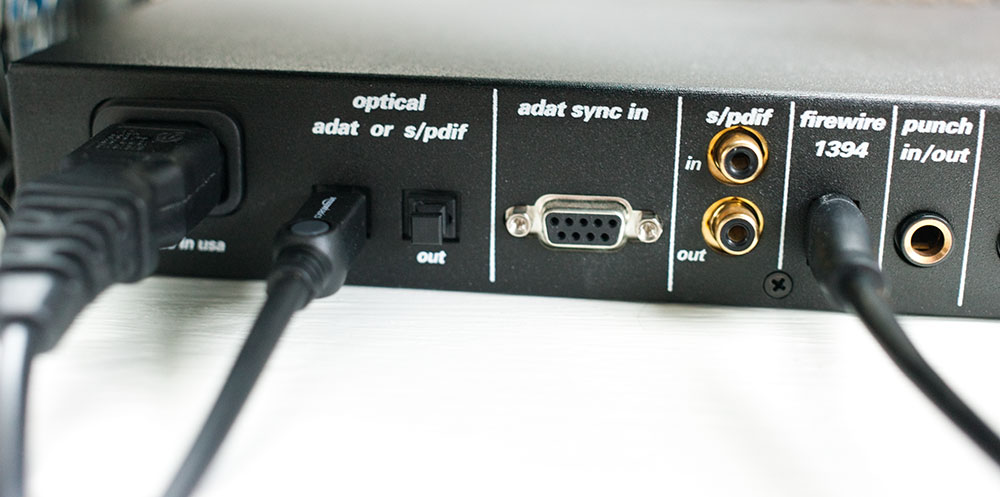
The backs of the two machines are not pretty unless you are a male audio cable, in which case this image is pornography.
As mentioned earlier the 828 connects to the host computer with FireWire 400, but the 2408 uses a PCI card. It connects to the card with a proprietary MOTU
AudioWire cable, although by coincidence it uses the same physical cables as FireWire. They're supposed to be slightly different but all the standard FireWire 400 cables I have used worked well.
There were four versions of the PCI card - the
PCI-324 plugged into a standard 5v 32-bit PCI slot and only had three AudioWire connectors, the
PCI-424 was similar but had four AudioWire connectors and a built-in DSP that could directly route inputs to the monitoring outputs, the
PCIX-424 was designed to plug into the 64-bit PCI-X slots in the Power Macintosh G5, and the
PCIe-424 used modern-day PCIe slots.
I'm not an expert on the finer points of PCI card keying. I can confirm that my PCIX-424 works in the standard PCI slot in my Asus H67M-GE and in the 64-bit PCI-X slots in my Power Macintosh G5. MOTU offered the PCIe-424 as a cut-price upgrade for registered 2408 owners, but that was a long time ago and is probably no longer an option.
Modern computers are slowly moving away from PCI slots entirely, so in the long run the 2408 will become harder to use, but it still works to an extent in standalone mode, which I'll cover shortly.
A PCIX-424 card. It plugs into one of my Power Macintosh G5's PCI-X sockets, but it's also backwards compatible with standard PCI ports; MOTU later upgraded it to PCIe, which was handy because later G5s and Intel-powered Macintosh Pro models used PCIe exclusively.
There was a small family of MOTU PCI equipment, including the
MOTU 24I/O, which had 48 balanced 1/4" jacks, 24 inputs and 24 outputs, and the
MOTU HD192, which was similar but had 24 XLR jacks instead. The 2408 seems to have been the most popular, or at least it's by far the most common on eBay nowadays.
The three models all had eight analogue inputs and outputs plus three ADAT connectors and three TDIF connectors. They were otherwise slightly different:
- The
MOTU 2408 Mk1 (1998) recorded at 44khz or 48khz at 20-bit resolution. The analogue inputs were unbalanced RCA connectors.
- The
MOTU 2408 Mk2 (2000) increased the resolution to 24 bits and had balanced 1/4" jacks for analogue audio.
- The
MOTU 2408 Mk3 (2002) added sampling at 88khz and 96khz and SMPTE synchronisation, which is useful if you plan to score a major motion picture, less so otherwise. Internet wisdom has it that the Mk2 and Mk3 versions had noticeably better digital-analogue converters than the Mk1.
If you don't have a PCI card they can all be used as standalone D/A converters. I'll show you how you can use a 2408 to add eight extra analogue inputs to an 828 through one of the 828's ADAT inputs. You'll need an ADAT optical cable:
Firstly I plugged a sound source into one of the 2408's analogue inputs. I picked channel 7, just to make sure it was transmitting discrete channels, not just a stereo mixdown. I also made sure to connect the ADAT optical output of bank one into the 828's only optical input:
The 2408 in standalone mode. It pipes the analogue inputs to the digital outputs.
The 828, with one of the 2408's eight-channel optical outputs plugged into its optical input.
I then set up the 2408 to use its own internal audio clock by cycling through the front panel options with the SELECT and SET buttons, and I set the 828 to use the 2408's clock signal by using the MOTU audio driver software on my Mac mini. The 828 then synchronised itself with the 2408's internal clock. The key thing here is to wait a few seconds for the 828 to catch up:
The 2408 is set to 44khz, internal clock, transmitting via ADAT.
The 828 has to be set up with software - later versions of the 828 had a more comprehensive front panel. In this shot it has synced up to the 2408 at 44khz, which is indicated by a steady light. If it doesn't find a sync source the 44.1/48 lights blink.
Why do you have to bother with synchronisation? I'm not an expert, but my understanding is that unlike computer networks the digital audio interfaces used by samplers and audio interfaces don't have any form of error-checking or parity bits or anything like that. They don't transmit discrete packets, they simply grab an incoming data stream and chop it into 16-bit 44khz eight-channel audio, and if the clocks aren't synchronised the samples have the wrong data in them and the end result sounds bad.
At this point I doubled-checked the 2408 to make sure that audio was going into channel 7, which it was, so I fired up Logic. The 828 is designed up so that channels 1-8 are analogue audio, 9-16 are ADAT, and 17-18 are S/PDIF, but Logic doesn't know any of this. It just presents the user with a single big group of eighteen channels from 1-18. In order to select ADAT channel seven I had to pick input 15 (8+7).
Curiously
Sound on Sound's review from July 2001 says that the 828's input are set up as 1-8 analogue, 9-10 S/PDIF, and 11-18 ADAT, but that doesn't seem to be the case in practice. Perhaps MOTU changed the firmware later in production.
This is how Logic sees the 828. As mentioned in the text inputs 1-8 are analogue audio, 9-16 are the eight ADAT channels, 17-18 are the stereo S/PDIF channels.
And lo and behold it worked! The standalone 2408 piped audio into the 828 and then into Logic. Just to make sure everything was okay I switched the audio source to analogue input 8 on the 2408, at which point the audio was then routed to input 16 on the 828.
In theory this means that if you have an ADAT interface for your computer you could plug the 2408 directly into it and use it as an eight-channel audio interface, but unfortunately standalone ADAT interfaces are extremely rare. If however you have an audio interface with spare ADAT sockets doing nothing you can use an old 2408 to turn one of the sockets into eight analogue audio inputs.
That's enough about the 2408. What about the 828? To date there have been five models and a couple of variants:
- The
828 Mk1 was launched in 2001. It recorded at 44khz or 48khz at 24-bit resolution, with eight analogue audio inputs (two powered combo XLR / 1/4"), plus eight-channel ADAT and two-channel S/PDIF. It connected to the host computer with FireWire 400.
- The
828 Mk2 was released in 2003. It added 88khz and 96khz sample rates and standalone operation with MOTU's CueMix software as per the contemporary 2408. It also included a pair of MIDI ports so that you could use it as a MIDI interface. In 2005 MOTU released the
828 Mk2 USB 2.0, which was exactly the same but with a USB 2.0 interface instead of the FireWire 400 port.
- The
828 Mk3 was released in 2008. The only significant upgrade over the Mk2 was an increase in the maximum sampling rate to 192khz for analogue signals. In 2011 MOTU released the
828 Mk3 Hybrid, which replaced the FireWire 400 ports with FireWire 800 and added a USB 2.0 port as well.
- The
828x of 2013 replaced the FireWire 800 port with Thunderbolt and greatly expanded the internal mixer.
- The
828es of 2017 is similar but has an upgraded mixer system with complex built-in effects that can be controlled over the internet with an app. Does it leverage blockchain synergies? I'm not sure. I'm writing this in the present tense because it's the current generation of 828.
Over the years the changes have been incremental, but in general the modern 828 is a jack-of-all-trades audio interface that has mutated into a digital mixer. It's essentially aimed at two types of musician; home studio people who want to record several tracks of audio at once with excellent sound quality, and live bands who want to plug their instruments and speakers into a flexible multi-effects box.
If you just want inputs and outputs the Mk1 is sufficient. I've run out of things to say. They've aged far better than the computers for which they were made.