Today hello let's going to have a look we're The Bramante Staircase, although it's not actually the actual staircase; the actual Bramante Staircase was built in the early 1500s by Donato Bramante but isn't publicly-accessible whereas the thing that everybody calls the Bramante Staircase (not the real thing) was built in the 1930s by a chap called Giuseppe Momo, no relation, so I suppose technically it should be called the Momo Staircase (real thing), but there's already a museum called the MOMO and it would confuse people.
The not-really Bramante Staircase is in the Vatican Museum, which is where I was. I went there. I was there. I knew about the staircase and decided to photograph it with the Peleng 8mm fisheye lens covered in this post here, because the staircase is a big swirly enclosed thing that lends itself to a fisheye lens.
I'm a man! As a consequence the staircase's enormous symbolic value immediately jumped out at me because it's basically feminine, isn't it? It's a gigantic vagina. I explored its smooth walls; a man and his camera, sucked into the spiralling feminine vortex.
If I was in charge of the Vatican I would fill a bunch of barrels with pig's blood and pour them down the Bramante Staircase so that all of the visitors using the stairs would arrive at the bottom screaming and covered in blood, as if they had been born again. Some of the older tourists would die of heart attacks but that's okay because women are lethal. This post isn't going to be like the others because I'm taking more painkillers than usual.
The Bramante Staircase is duplex - it's essentially a pair of staircases arranged in a double helix, so that people going upstairs don't have to pass by people going downstairs. Catholics probably understand why. I'm not Catholic. Probably something to do with sin.
Unfortunately the uphill staircase is blocked off, so the whole thing is just a big waste of time and money. Giuseppe Momo is probably turning in his grave, but he did get paid (hopefully) and that's what matters. It would not be the only thing in Italy or indeed the world that doesn't work and was created entirely so that money could be transferred from one institution to another.
Kids are like that. Parents have kids purely so they can qualify for a council house, or so they can parade them on Instagram for "likes". The kids themselves are just a means to an end; no-one cares about them. Kids get to have their revenge when they grow up, but by that time their parents are senile old dead people, so instead they take out their rage on their kids, and ultimately the world is just a series of people trying to scratch their itch by taking revenge on blameless victims. And yet humanity continues, and will continue, so on a fundamental level it works.
NB There are other parts of the museum. Not just a staircase. It's quite big. I'm not a huge fan of classical art; the artists were commissioned to illustrate a narrow range of topics, either to impress the plebs or make the clergy feel good about themselves; the context is so distant as to be unknowable to contemporary audiences, with the result that the original meaning of the art is lost; if I approach the relics in a post-modern death of the author sense it still doesn't work because classical art is frustratingly straight.
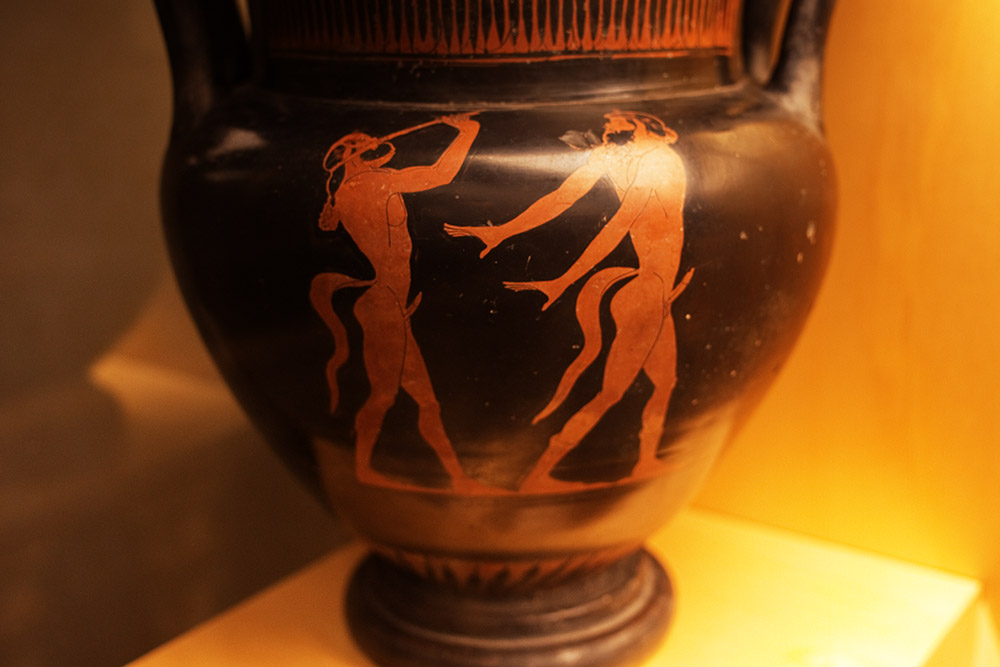
I learn that the ancient Greeks believed erections were caused by an accumulation of air within the penis, a view challenged by Leonardo Da Vinci, who after dissecting a man who had been hanged came to the conclusion that erections were actually maintained by blood. Surprisingly for something of enormous vital importance the physiology of erections wasn't fully understood until the 1980s.
Entry is €17. There was no queue whatsoever when I arrived. Although the main entrance is signposted for tour groups only, it's the main entrance for everybody. You have to put your bag through a metal detector. When I was there the ticket counters didn't accept cards, so just in case I advise bringing some old-fashioned physical currency. There is at least one small cafe. I had a coffee, which was unexceptional, shown here with a spoon because I crave a measure of control over my life:
I have no sentimental illusions about Italy. The country has been gouging tourists for literally thousands of years. I imagine the modern Italians are irritated that so many people come to see the rubble of their past, as if modern Italy had nothing to offer; except of course it does have a lot to offer, e.g. pizza, nice scenery. The Vatican Museum(s) has(ve) an assembly line please-move-along quality. I found myself sandwiched between several tour groups, unable to break out of the trap, but isn't that true of life in general? We're boxed in by strangers in an unfamiliar environment, unable to break out.
I think I've finally calmed down. The museum has some contemporary works, linked by the theme of Christianity, although sadly Jeff Koons' Michael Jackson and Bubbles was absent. Because he is a modern Christ. The Jackson family gave him to the world, but smashed his sword before they threw him into the arena, and we watched him die.
Off to Rome's MACRO museum to see Pink Floyd: Their Mortal Remains, an
exhibition of relics left behind by the popular psychedelic young person
drug band Pink Floyd.
Following the deaths of original frontman Roger "Syd" Barrett and keyboardist
Richard Wright - who floated off down the endless river in 2006 and 2008
respectively - the exhibition forms a kind of final cut of the band's
story. In theory the band still exists, but it's now very unlikely that they
will release new music.
Which is a shame, because the band's two most productive songwriters are still
alive. Unfortunately in the 1980s they fell out, fighting like animals to
gain control of the Pink Floyd name, but despite the band selling far
more that was a reference to More
despite the band selling far more records than any of the members
individually they were unable to surmount the wall, that's right,
the wall that had built up between them and even though they're now
grown-ups they still can't stand each other. The exhibition ends with footage of
the band performing at the Live 8 charity event in 2005, which reveals
that the band can still kick out the jams but guitarist David Gilmour has become
physically allergic to bassist Roger Waters.
Their Mortal Remains was originally staged at the Victoria and Albert
Museum back in 2017, but I missed it because my path was
obscured by clouds. How I wished, how I wished I was there! But fate gave
me a second chance. While on holiday in Rome I saw posters for the exhibition,
as if it was following me around. I thought to myself "ummagumma go", and
so I went. Without further meddling I had a momentary lapse of reason saucerful
of secrets division bell piper at the gates of dawn dark side of the moon
delicate sound of thunder a nice pair.
I've missed out Atom Heart Mother. I always forget that one. Reason being
that the lengthy title track feels a bit amateurish compared to what came later
and the rest of the album is insubstantial. Terrific cover though. I can confirm
as an English person born in England and having spent my entire life speaking
English I have never, not once, not ever heard anybody use
the word "ummagumma" outside the context of Pink Floyd. Perhaps it was a synonym
for sex in the Cambridge area a long time ago. Not outside Cambridge.
I grew up in the 1980s, so for me Pink Floyd has always been top guitar wizard
David Gilmour and his fat friend Nick Mason, plus twenty-five session musicians
including an entire second drummer, all dressed in scrunchy oversized jackets
like extras from the later seasons of Miami Vice, and they all looked
incredibly pleased with themselves. Pink Floyd equals slap bass solos and
saxophone; slinky backing vocalists in little black dresses.
Famously the original booklet for
Momentary Lapse of Reason had the photo above, but with Rick Wright cropped out, because he hadn't been formally readmitted to the Pink Floyd corporate entity:
On a commercial level the 1980s was a great decade for heritage bands. The
likes of David Bowie and The Rolling Stones were finally free from the
lopsided management contracts they signed in the 1960s, and a combination
of mega-tours, CD reissues, a 1960s nostalgia boom and an ageing pop
audience ensured that the rock dinosaurs who survived finally had the
opportunity to make and keep a huge pile of cash, Pink Floyd
included. The irony is that the band began the decade better than most of
their contemporaries, with The Wall, which was both intensely
personal and very popular. As with Peter Gabriel and David Bowie they went
into the 1980s with an effective balance between artistic integrity and
commercial clout, but it didn't last.
I'm conscious of The Division Bell and Pulse being a thing,
but for me Pink Floyd is a band I learned about in retrospect, long after
it had all happened. I'm familiar with their music but I'm not a fan; I
don't own any of their records. I went into Their Mortal Remains as
an ordinary man suffering with foot pain and a trapped nerve in my right
shoulder but I can report that the exhibition entertained me for two
hours. If you have even a passing interest in the band you will enjoy it,
although if you've read Nick Mason's Inside Out you won't learn
anything. As with that book it avoids any hint of controversy and glides
over certain parts of the band's history. In the world of
Their Mortal Remains Pink Floyd is a band consisting of four or
five chums who love each other very much, and always have.
A while back
I saw David Bowie Is at the Victoria and Albert. That was in 2013,
which frighteningly is now half a decade away. I have no idea if the
MACRO's staging of Their Mortal Remains is on the same scale as the
Victoria and Albert's original version of the exhibition; the captions are
in Italian but everything else is in English. I like to think that a giant
foam refrigerator filled with maggots transcends language.
A Farfisa Compact Duo MkII with a Binson Echorec tape delay unit. A
lot of classic 1960s and 1970s synth music was actually recorded
with electric organs and guitar effects, notably Mike Oldfield's
Tubular Bells (no synth), Terry Riley's A Rainbow in Curved Air (no
synth), Tangerine Dream's Zeit (a little bit of synth) and
surprisingly Jean Michel Jarre's Oxygene and Equinoxe (less synth
than you'd expect). The entire Krautrock genre was, with a handful
of admittedly highly visible exceptions, surprisingly un-synthy. Floyd's most synth-heavy album of their classic period was Wish You
Were Here, but most of the synth sounds on that record were actually
made with a "strings synthesiser", a kind of electric organ that
approximated a strings orchestra.
A VCS 3.
If David Gilmour is ever short of cash he can sell the band's
collection of vintage analogue gear. The VCS3 in the middle was a
huge positive influence on experimental electronic music - it was
relatively cheap, and whereas most synthesisers were sold as
conventional albeit complicated keyboard musical instruments, the
VCS3 was marketed as a non-tonal sound generating source. It forced
musicians to think about pure sound rather than melodies.
Back to the text. For the exhibition you have to wear location-sensing
headphones, which feels appropriate given that Pink Floyd were a headphone
band. The exhibition tracks your location and feeds audio into your head
depending on where you stand. One problem is that you have to stand next
to the thing you want to listen to, which is difficult if the exhibition
is crowded; I remember gazing at the funky bit in
Live at Pompeii while hearing someone drone on about the making of
Dark Side of the Moon, which saddened me because I wanted to hear
the funky bit from Pompeii. If the exhibition's creators were
really on the ball they would work out which parts were most popular, and
tweak the detection range of the headphones to suit, but I'm being
picky.
The exhibition has the same basic problem as David Bowie Is. There
isn't a simple "this is what happened next" narrative. Instead the
exhibition is a series of individual mini-presentations devoted to each of
the band's albums, with a bit at the beginning and end for context, and a
bit about the band's live shows. David Bowie Is had more about
Bowie the man; Their Mortal Remains has very little about the band
themselves, perhaps understandable given that their personal lives
consisted mostly of collecting cars. The sad thing is that the band's most
interesting member is dead, and was a recluse for many years beforehand;
the band's second-most interesting member has already said everything he
wanted to say. As a consequence the exhibition sometimes feels like a
Hypgnosis / Gerald Scarfe / Mark Fisher / Jonathan Park exhibition rather
than a Pink Floyd show.
Battersea Power Station was marked for closure in the mid-70s. It
finally stopped generating power in 1983. For the next
quarter-century it was a derelict shell, occasionally used as a film
location. Plans to redevelop the site came to naught (or half a page
of scribbled lines), until 2013, when work started to turn it into a
large shopping mall with some luxury flats.
Over subsequent years the iconic chimneys were slowly demolished
and then rebuilt - a nail-biting process, because what if the
developers went bust? What if it had been a big scam?
But in October 2022 it reopened, so all is well.
One consequence of the redevelopment is that the iconic cover of
Animals can no longer be recreated; the view is blocked by new
buildings.
While I'm in a grouchy mood the exhibition's third problem is political.
There's nothing about the Waters-Gilmour split, and nothing about Richard
Wright's dismissal from the band around the time of The Wall. Once
you move beyond The Final Cut - which is presented as a postscript
of The Wall - a big sign reveals that PINK FLOYD IS BACK! but when
did they leave? Why are there now only three people in the band?
I'm suspicious of the long-haired person sitting on a block in the
bottom-left. He don't look right to me. Who let all of this
riff-raff into the room? I have no idea how Italian audiences
reacted to The Wall, given that some of them in 1979 could remember
genuine fascism. Thankfully in 2018 we've got over that sort of
thing; a combination of tight censorship, constant surveillance,
correct education and strong anti-terror laws have destroyed fascism
forever.
Syd Barrett wrote most of Pink Floyd's debut album. He was their
original creative lead, but he became increasingly withdrawn until
the band decided not to pick him up for a gig in 1968. They helped
him record a pair of solo albums but lost touch in the early
1970s. In 1975 he popped into Abbey Road studios during the sessions for
Wish You Were Here; he had put on a lot of weight and shaved his
hair, and at a first the band didn't recognise him. He died in
2006.
He remains a tragic figure. Most rock casualties were basically
wasters who over-indulged; it's hard to feel sorry for them, but
Barrett shared with Skip Spence and Peter Green an underlying mental
problem that derailed his life and career.
Also, that's a lot of cigarettes.
There comes a point when the captions are too large to read comfortably
and should be folded into the main text. Do I have anything else to say
about Their Mortal Remains? It rushes past the pre-Dark Side
albums but devotes a whole room to the combination of
Momentary Lapse of Reason and Delicate Sound of Thunder,
presumably in an attempt to give post-Waters Floyd a bit of weight.
Dark Side itself is surprisingly under-represented.
Did I learn anything? Gerald Scarfe drew a picture of the band in 1974,
years before working with them on The Wall. During the development
of Alan Parker's film of The Wall there was a plan to use concert
footage of the band. This was abandoned, but not before some of the
Wall concerts at Earl's Court were filmed in 35mm with a
professional team. The exhibition shows some of the footage on a monitor.
The film hasn't officially been released, which is a shame because it
looks absolutely awesome:
It stood out in particular because of the lens flare; the distinctive
horizontal Panavision anamorphic lens flare is a massive digital cliche
nowadays, and it's odd seeing the actual genuine thing in footage shot
almost forty years ago. The exhibition also has footage from the obscure
Final Cut video EP, which was also shot on film and looks pretty
good as well.
I've never been keen on the message of "Another Brick in the Wall Part 2".
The members of the 1960s anti-establishment movement never seemed to
realise that the education they so despised gave them the tools to express
their frustration; the fight against ignorance and oppression is a
fight, a constant unending struggle, and it requires discipline and
a mastery of weapons.
Aw. That's Roger Barrett, not Waters.
Mark Fisher and Jonathan Park's architectural drawings give a taste
of the complexity of The Wall tour, and also the difficulty of drawing
circles in three dimensions.
As mentioned in the text I grew up at a time when Pink Floyd
belonged to the past. The same was true of Hipgnosis; my design
heroes as a young man were Peter Saville, David Carson, and The
Designer's Republic, all stars of a later age. Hipgnosis' work has
always looked dated and kitsch to my eyes, and I'm not being
particularly mean to Hipgnosis. Leading-edge visual design rides on
a knife-edge of cultural context. Hipgnosis' ideas
simply don't work on me as they might have worked on people in the
1970s.
What else? The exhibition runs from 16 January until 01 July 2018 at the
MACRO in Rome. In theory you're supposed to book tickets online for a
certain timeslot (that's how David Bowie Is worked), but I just
bought a ticket from the front desk and strode into the exhibition. It
costs €18. The MACRO is north of Rome Termini; I walked; there don't
appear to be any other exhibits at the museum; the gift shop had vinyl
represses of Pink Floyd's albums for €36 apiece, which is more expensive
than buying them from Amazon; photography is allowed, but not flash
photography.
The exhibition ends with a Sennheiser-sponsored room that has a
quadrophonic stereo setup. A screen plays a video of the band's debut
single "Arnold Layne" followed by "Comfortably Numb" at Live 8, which was
their final performance together. Pink Floyd circa "Arnold Layne" were
jolly people who touched each other; Floyd circa 2005 stood many feet
apart on a large stage and looked very professional. The room has
miniature little lasers and a smoke machine that try to recreate the
band's live show, but the room was much too small for it to work and it
felt a bit silly.
Pulse was a live album packaged in a little box with a flashing LED
in the spine. The LED was powered by one or two AA batteries
depending on the pressing; the exhibition's copy still flashed, but
the LED pulses for only a fraction of a second so I couldn't
photograph it.
It struck me that Their Mortal Remains is like a set of DVD extras
without the main feature. If I had been in charge, firstly I would have
had all of the attendees put up against a wall and shot - purely to
demonstrate my power - and secondly I would have split it into a two-hour
documentary film of the band, plus a separate exhibition of relics, and I
would have raised the price by £4/€4. The exhibition attracted 300,000
visitors in London and the extra money raised from the price hike would
pay for the documentary. The film would be played on a loop; the visitors
would be able to browse the relics until the film begins, or leave the
film and browse the relics depending on their whim. It would need a really
big screen and awesome sound, and I would have the smell of marijuana
pumped into the theatre so that if anybody does light up, no-one
would notice. At the entrance I would have the security guards ask the
attendees if they had brought marijuana with them. If they said "no" they
would be admitted, the end.
Although David Bowie was an obvious choice for a lengthy
retrospective the Victoria and Albert was originally going to base their
exhibition on another, unidentified artist. Back in 2013 I wondered who it
might have been instead; Pink Floyd was an obvious choice, but there are
others, and I wonder who will be covered next. Bob Dylan has a lengthy
track record but from the 1970s onwards he seemed to lose interest in the
visual side of things and there are any so many times the audience can
look at battered guitars.
The Tea Set, a proto-Floyd, did indeed record a cover of Slim
Harpo's "King Bee". It's odd hearing Syd Barrett telling us that
he's young and able to buzz all night long.
Madonna is the next obvious example. Her career has a rich visual history
spread over several decades, but it would be brave of the museum to cover
her. The newspapers would inevitably moan that she wasn't a
serious artist and that she was cheapening the museum. Elton John
and Elvis Presley would face the same criticism. Bjork stands
out, but the exhibition has to attract a huge worldwide audience and Bjork
has never sold records in the United States. A Bjork exhibition at New
York's MOMA in 2015 was a notorious flop.
The Pet Shop Boys would be interesting, but do they have a warehouse full
of props? Napalm Death could easily carry an exhibition
but they don't have mass appeal. But why stop with individual artists? The
Blue Note record label could fill a hall with awesome record covers;
Krautrock is long overdue a large-scale retrospective; the likes of
electro and early hip-hop lend themselves to an interactive approach, the
end and it really is the end this time.