Showing posts with label tlr. Show all posts

Wednesday, 15 December 2021

Mamiya 180mm f/4.5 Super: I Intend to Ride a Horse

Let's have a look at the Mamiya 180mm f/4.5 Super. It's a slightly long-ish lens for Mamiya's long-running TLR system. And it's super. Here's what it looks like:
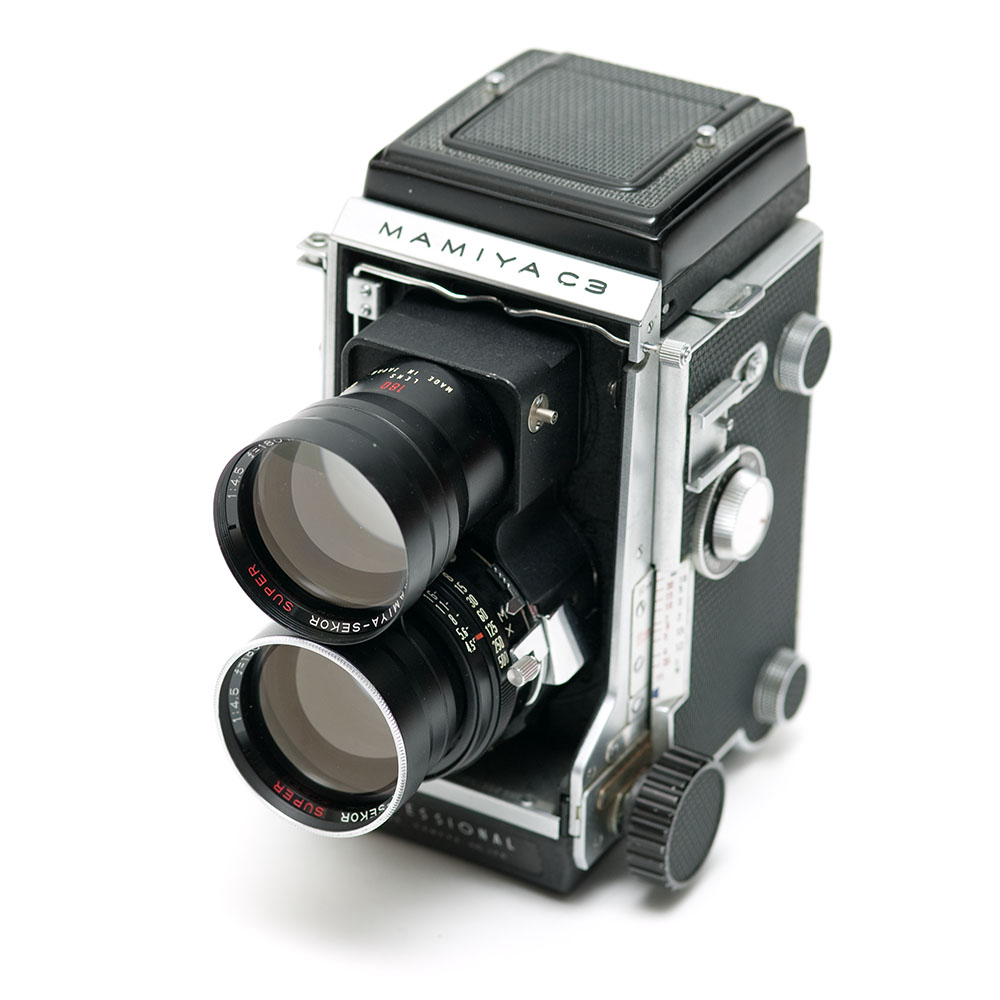
The Mamiya TLR system is fascinating. As far as I know it didn't have a name, but nowadays people call it the C-System or C-Series because the cameras were all called C2, C3, C33, C330 etc.

Mamyai launched the system in the 1960s and continued to develop and sell it until the mid-1990s, by which time twin-lens reflex cameras were a massive anachronism. Nonetheless a handful of TLR designs remained in production because they had a niche. The YashicaMat and Seagull were cheap ways of trying out medium format, the Rolleiflex had an excellent lens and bags of class, the Lubitel was popular with hipsters.

The C-Series on the other hand was aimed at professional photographers who wanted to shoot 6x6cm medium format without the expense of a Hasselblad or Bronica. By the 1980s there were other options, such as Mamiya's own 6x7 and 645 cameras, but long before Instagram came along some people preferred 6x6 square.


For the shots in this blog post I used a Mamiya C3. I also have a C33, pictured above, but the winding mechanism is fussy, and I didn't want to risk it. As you can see from the picture the lenses come off as a single unit.

The C3 was discontinued in 1965, so my camera is over half a century old, and yet it still works and still appears to have some of the original grease. It's essentially a metal box with some simple gears and a bellows system, so there isn't much to go wrong. As of 2021 C-series cameras are still widely available on eBay, alongside the cheaper, simpler C2/C22/C220, which had a winding knob instead of a crank.

Is it my favourite camera? If my camera heart was a pie chart the Olympus XA and Pen F would have the largest slices, but the Mamiya C would be close behind. Medium format in general is great fun. Even if you have a cheap flatbed film scanner the negatives scan well, because they're so large. The surface area means that dust and scratches are less of a problem, and furthermore medium and larger formats have a certain "look".

The Look comes from a combination of low vignetting, good central sharpness, smooth tones, and clear background-foreground separation combined with a normal field of view. The best medium and larger format photography often reminds me of Disney's multi-plane camera system - I mentally imagine that the image is composed of layers of glass stacked on top of each other. It's the elusive "3D Pop" that people on the internet talk about.

The last C-series camera was the C330S, which was launched in the early 1980s. The range was discontinued about a decade later, apparently because the tooling used to manufacture the cameras was starting to wear out. My hunch is that if I had to use one professionally, as a job, I would quickly grow to hate the size, the difficulty of changing film, the difficulty of composing through a reversed viewfinder - TLR viewfinders mirror the image from left-to-right - plus the constant need to remind people to look at the bottom lens, the need to stand on a stepladder in order to capture people's faces straight-on instead of shooting up their nostrils, etc. But for casual use none of that matters.

Besides which this is 2021 and nostrils are sexy.


The C-Series had a range of interchangeable lenses, which was extremely unusual for a TLR camera. There was even a complete system, with interchangeable viewfinders, focus screens, a pair of different handgrips, a sheet feed back - surprisingly there doesn't appear to have been a Polaroid back - and a parallex-correcting tripod mount. And an aluminium case! I learn this from Mamiya's official C330 accessories booklet, which the company still hosts on its website.

Does Mamiya still exist? The company surived into the digital age but was bought by Phase One in 2015. The website is dated 2019. It seems to be one of those entities, like Atari and Vivitar, that only exists in a legal sense. It's a nice name, it sounds happy.

The C-Series had a modest range of lenses. The widest was a 55mm f/4.5. I have one! I've written about it before. In 35mm terms it's a little bit like a 28mm, perhaps a bit narrower. The longest was a 250mm f/4.5, which is a little bit like a 135mm lens for a 35mm camera. There were no third-party Mamiya TLR lenses, no special effect lenses - no fisheye, no soft focus - and the fastest was the standard 80mm f/2.8. They all had clockwork leaf shutters mounted inside the lens. The shutters are robust, and will synchronise with flash at all speeds, but after half a century they tend to gum up.

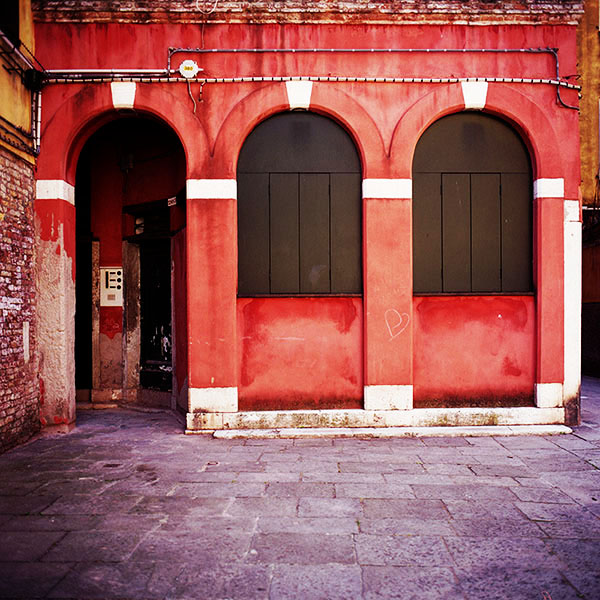
The speeds tended to range from 1/500 down to 1/s plus bulb. For almost all the shots on this page I stuck with 1/125th, occasionally 1/60th. Ordinarily it's bad form to use slow speeds with long lenses, but the C3 is heavy, and there's no mirror bounce - the shutter just goes PING - so luckily 1/60th was fast enough. The aperture closes down to f/45, forty-five, but I shot almost everything on this page wide open. It was November and I was using slow film.

The lenses are relatively easy to open and clean out, and the viewing and taking optics are almost always the same, so if one lens element is damaged it can be replaced by its twin. I was lucky to find a good 180mm on eBay so I haven't had to open mine up.

The original 180mm f/4.5 non-Super was part of the first batch of lenses. My C3 has a focus scale marked out for it on the bellows:

As you can see infinity focus requires racking out the bellows a little bit, which makes street photography with a 180mm f/4.5 even more awkward than it would be otherwise.

Also pictured is a stiffening ring, which screws into the 49mm filter thread. The filter threads are very thin, and given the weight of the camera it's easy to bash them. The stiffening ring is supposed to keep them safe. It's not a UV filter, it doesn't have any glass in it.

A big metal TLR is an odd choice for street photography. On the downside my C3 is heavy and hard to carry, and only takes twelve shots per roll, but on the upside I have the impression that most passers-by don't recognise a TLR as a camera - it's a boxy mechanical thing - and furthermore TLR focusing doesn't involve eye contact, so people don't perceive it as a threat.
A word about focal lengths. Focal lengths. Let's talk about focal lengths. I'm going to assume you're familiar with the idea of a crop factor. On a full-frame digital SLR or 35mm film camera a 180mm lens is a mild telephoto, a head-and-shoulders portrait lens. Not long enough for wildlife or sport. On a digital SLR with a smaller sensor however a 180mm acts almost like a 300mm lens, which is great for sports but still not long enough for wildlife, unless you're in a zoo.

Medium format on the other hand goes the other way. It has a reverse crop factor, because the 6x6cm negative is larger than the 36x24mm negative of 35mm film. To work out the 35mm equivalent of a medium format lens I always divide the focal length by two and add ten, so the 180mm f/4.5 acts a bit like a 100mm lens in 35mm terms.

Contemplate the following image, in which a sculpture of a man who has a pigeon on his head puts the finishing touches on a sculpture of a man while observed by another man (me) who is in turn sculpting a scene of a sculpture of a man with a pigeon on his head putting the finishing touches on a sculpture of a man:


In the universe of this sculpture the man with the chisel is supposed to be "real", and the sculpture he is working on is supposed to be a sculpture, but they're both sculptures and in fact the only real living creature is the pigeon, who doesn't belong in the same universe. The pigeon is an interloper from another world.

Isn't that true of animals in general? While we go about our business the animals are engaged in a struggle for survival that can only end in death. They hope to survive long enough to pass something of themselves into the future, but ultimately it's futile, because our sun will not last forever. All of life is a dead end, pigeons especially so, because the chances of them ever developing space travel are very low.

Millions of years from now, when the sun begins to swell, the surviving animals will gradually evolve to cope with the heat. But there will come a point when the great analogue computer of evolution will  have to throw in the towel and admit defeat. The problem is that evolution is entirely reactive. It cannot plan for the future, only react to the present, and if you've ever played XCOM: Long War you'll agree that it's not enough just to react.


But, anyway, the red rectangle - which is exactly the same size as a frame of 35mm film - represents the field of view of this lens if you could somehow mount it on a 35mm camera.

Ultimately the 180mm f/4.5 behaves a little bit like the Canon 100mm f/2 I wrote about a while back. It's slightly too narrow to be a walkabout-type lens. At least for my taste. Conversely it's not long enough to pick out background details. For head-and-shoulders portraits it would no doubt be super. That's something I need to try out.


I have the impression, based on intuition, that most C-Series owners back in the day opted for the 105mm f/3.5 instead. I mention this because there isn't much on the internet about the 180mm f/4.5. This chap loved his. Beyond that there's very little.

What's it like? I've put this off to the end because there isn't much to say. It has a little bit of pincushion distortion, and the corners at f/4.5 are slightly smudgy, although it's hard to pass a definitive opinion because at f/4.5 the corners are often out of focus. The aperture isn't really wide enough for the full hardcore medium format look although the bokeh itself is typically lovely, a common trait of all the Mamiya TLR lenses I have used.

Incidentally I used a mixture of Fuji 160 colour film, which expired back in 2016 - shot at ISO 50 - and some brand-new 400-speed FomaPan that I shot at ISO 200.


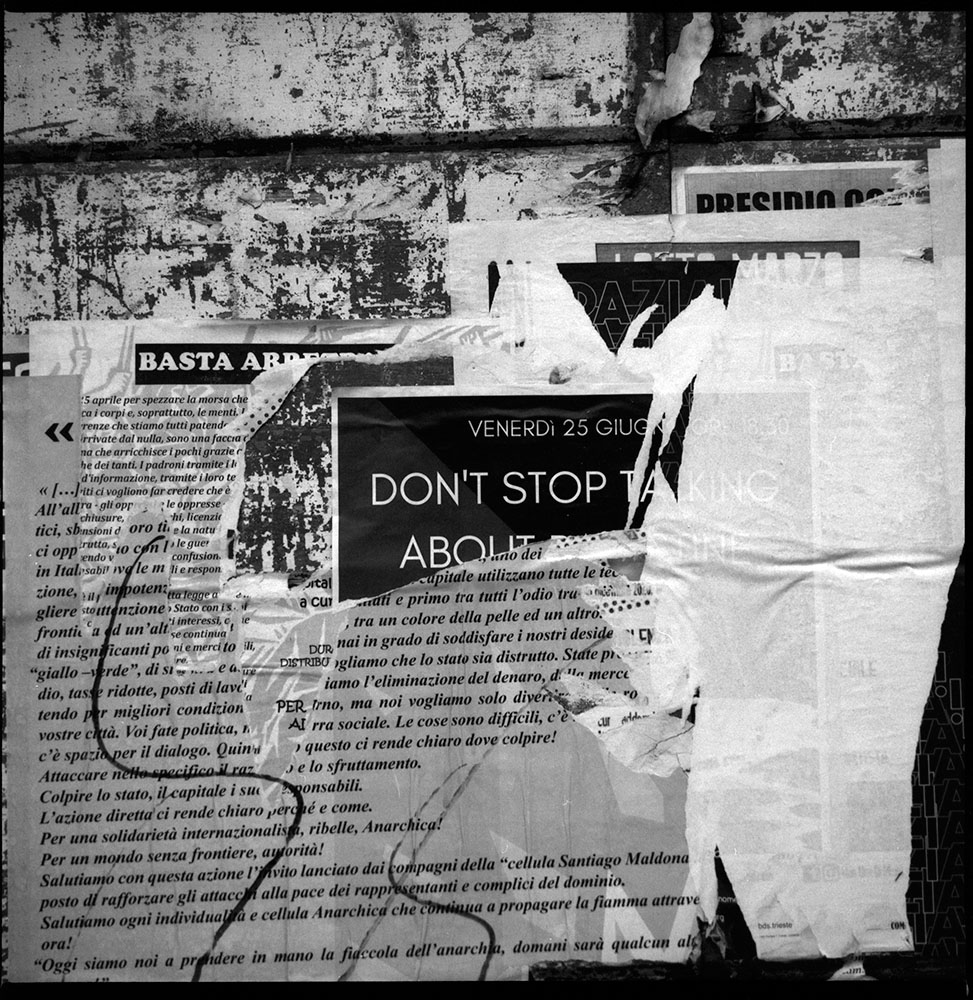
I have no problem with central sharpness. Here's an example shot with 400-speed FomaPan at f/4.5, and then with a 100% crop that hasn't had any noise reduction or sharpening, scanned with an Epson V500:


My hunch is that at f/8 under studio strobes it would be excellent. As for contrast and colour balance, I have no idea. I'm using expired negative film and I run everything through PhotoShop.


Ultimately the 180mm is an awkward fit for street photography, although I imagine as a portrait lens it would come into its own. As with all C-Series lenses the bellows will focus very closely, turning the 180mm into a quasi-macro lens, but when the bellows are extended the controls are pushed far away from the body and the camera becomes unbalanced.


Anything else? There were at least three different 180mm f/4.5 lenses for the Mamiya C-Series. The first version had a chrome body; from the late 1960s the chrome lenses were replaced with all-black lenses that had a different shutter; the final iteration - the Super version - had a different optical design, and yet another new shutter. How old is my lens? I have no idea!

None whatsoever. The serial number is 13828. What does that mean? I have... no idea. The internet doesn't have many images of the 180mm f/4.5 Super. I can't find one with a lower serial number. The range seems to top out at the 50000 mark. Did Mamiya really make 40,000 lenses, or was there something funny about their serial number system? The mind boggles.

It it calculator writing for boobies? No, that's 5318008.

Sunday, 26 August 2018

Mamiya 55mm f/4.5: The Phantom Itch


Let's have a look at the Mamiya 55mm f/4.5. It's a wide angle lens for the old Mamiya C twin-lens-reflex mediun format system. In the past I've used the Mamiya 65mm f/3.5, which was the other wideangle lens for the Mamiya C, and I was always curious about the 55mm. The focal length is very wide for medium format but the relatively narrow aperture bothered me, but I had to find out what it was like, so here we are.


There were several Mamiya C cameras throughout the system's life. I used a Mamiya C3, one of the earliest. The C3 shoots 6x6cm negatives on medium format film. Medium format is a very different world in which the equipment is big and heavy, the lenses are slow, focal lengths behave differently and the photographers are angry men who despise you. The focal lengths are all different. You know how some digital cameras have a crop factor, and other digital cameras are full-frame? Well, medium format has an anti-crop factor. It has an expansion factor. Because the negative is larger than 35mm. Focal lengths that would be short telephoto or normal on a 35mm camera are normal and wide angle in medium format terms. In the medium format world 80mm is normal, 180mm is short portrait, 55mm is akin to 28-35mm or so, 40mm is about the widest you can get without straying into panoramic or fisheye territory.


In my experience 55mm feels like a narrow 28mm with more at the top and bottom on account of the square format. Contemplate the following image, which shows the full 6x6cm frame with a red box indicating the 3.6x2.4cm outline of a 35mm negative:


If I crop the negative down to that red box the result is a 35mm-sized film frame shot with a 55mm lens, which is what you'd get if you could somehow mount the Mamiya 55mm f/4.5 on a full-frame digital SLR:


Sadly it doesn't go the other way; you can't use 35mm full-frame lenses with medium format gear because the lens-to-film distance is all wrong, and they don't project a large enough image circle to fill the frame. The exception is shift lenses, which are essentially medium format lenses made for 35mm full-frame cameras with a mechanism that allows the lens to shift around the frame, but I'm digressing here.

I like to think that Rick Astley never went away; we are the ones who strayed. He was there all the time. We just had to open our hearts and let him in.

I've written about the Mamiya C before. The system was launched in the late 1950s and remained in production right up until 1994. Uniquely for a twin-lens reflex it was a complete system, with interchangeable lenses, focusing screens, eye-level viewfinders, flash bracket-stroke-carry handles, a special parallax-correcting tripod mount, lots of other stuff. Most other twin-lens reflexes had a fixed lens, usually 75mm or 80mm, occasionally with an accessory optic that screwed onto the taking lens, but none of them were as well-thought-out or easy to use as the Mamiya C.

A 55mm f/4.5, sitting next to a 65mm f/3.5. My 65mm is one of the older, chrome-bodied models. The 55mm was launched later in the system's lifecycle and has a black body. The very last C-system lenses had a blue dot on the shutter cocking lever although I've never seen a photo of a 55m with this dot.

For the images in this post I used the Mamiya C3 on the right. It's over fifty years old but still works. On the left is a Mamiya C33 with the lens removed; the lens is held in place with a bent piece of wire. It's crude but effective.
In the shot above the 55mm f/4.5 is set at 1/125th and f/11, which is about right for ten-year-old 100-speed negative film in bright sunshine.

Mamiya TLR lenses had the shutter and aperture mechanism built into them, with focusing done by the camera body. You see the knobs at the bottom of the cameras in the picture above? When you turn them the whole front of the camera slides in and out. That's how the lens focuses, and it can focus very closely, almost as closely as a proper macro lens.

On a mechanical level Mamiya TLR lenses are easy to open up - the front elements usually screw right off - which is handy if you want to blow out the dust or un-gum the shutter. With I think just one exception the viewing and taking lenses were the same, so if the viewing lens has a scratch you can just swap over the elements. In theory the lenses were calibrated at the factory with little metal shims but in my experience any impact on image quality that comes from swapping lenses isn't apparent.


I shoot a lot of film, but I'm not blind to its flaws and limitations. If I could take pictures by blinking my eyes I would do that instead of carrying a camera; the only thing that really matters is the end result.
This image does however demonstrate one of film's few killer features, or at least one of negative film's few killer features; it's very hard to blow out highlights. Even if you overexpose a lot, highlights retain some colour, which is terrific if you shoot backlit subjects.

The last and best of the Mamiya TLRs was the C330f, which was launched in the early 1980s. It had some plastic components and weighed less than its predecessors. By 1994 the system was an anachronism - it was an anachronism in the 1970s - but it still sold a trickle of units because there was a niche for it. If you wanted to shoot 6x6 medium format a Mamiya TLR was objectively better than a Holga or a Lubitel; more flexible than a YashicaMat; cheaper than a Bronica SQ; much cheaper (and more flexible) than a RolleiFlex; much much cheaper than a Hasselblad; more reliable than a Russian Pentacon / Kiev, I think I've covered all the bases.


My impression - and I have to say I have no evidence for this, it's just my hunch - is that 6x6 fell out of fashion with camera manufacturers in the 1980s in favour of 645 and 6x7, both of which fit more naturally into magazine pages and portrait frames. By the time digital cameras came along the majority of medium format systems were 645, and even today most medium format digital backs are 645, or cropped 645. I mention this because one thing the Mamiya C lacked was interchangeable film backs; a 645 or 6x7 back might have extended the system's life a bit.

Ironically the rise of Instagram has made square incredibly hip with young people, to an extent that Fuji actually launched a square version of their Instax instant film camera a few years ago, thus demonstrating that the universe is contracting, or that it's a rubber band or something.


What's the 55mm f/4.5 like? Pretty good. There's very mild barrel distortion, but it's easily fixable with Photoshop and invisible unless you're a fan of geometric purity. I tried to shoot at f/11 all the time. At f/11 it's basically razor-sharp across the frame.

I scanned these images with a plain old Epson V500 desktop scanner, by no means the last word in film scanning, so I can't pass authoritative judgement on the 55mm's image quality, but my impression is that wide open it's sharp in the middle with slightly murky extreme corners and from f/8 onwards it's sharp across the frame.


A crop from the top-left, shot at f/11.

f/4.5 isn't as big a limitation as it seems. Mamiya TLR bodies are heavy, and the leaf shutter just goes SNICK (it makes a metallic CHING! sound) and I had no trouble hand-holding it at 1/15th of a second. Weight is nature's image stabilisation.

Wideangle with 6x6 is however problematic. As mentioned in my article on the 65mm, square format forces you to think about framing; if you shoot square as you would rectangular 35mm, you'll end up with empty patches at the top and bottom of the image.

In the next two images I've tried to spread the scene across the whole of the frame, but in the third image there's a big empty space at the bottom, albeit that it would be easy to crop out. Cropping was one of medium format's killer features back when medium format was a thing.


This was shot at f/4.5 - the extreme corners aren't that hot but the middle of the image is fine.

I shot all of these images with some Fuji 160 that expired in 2009. I exposed at ISO 100 and then added a bit more exposure just for good luck. When it comes to negative film, light is a bit like wine - it doesn't hurt to have some more.

An example of cropping. This is a distant view of the Miramare Castle, plus some young ladies who paddled into view. As I stood on the jetty, peering through the viewfinder at a landscape I could never possess and some women I would never have, I contemplated the fact that as men age they become physically repellent, and that even when I was younger all of this was beyond my grasp. And yet I keep going because I am driven by a satanic rage.

This was underexposed. The negative was thin. A leaf has fallen on the car's bonnet. Just in front of the car is a heart-shaped leaf on the ground, aligned with the car's direction of travel. That's the great thing about photography. It's a lot more detailed than real life. You can savour it.

The big problem with the Mamiya C is its bulk and weight. It's awkward to handhold and takes up a lot of space in a bag, and furthermore you need to carry a separate lightmeter. In the 1950s and 1960s photojournalists used twin-lens reflex cameras for news photography but as soon as they were allowed to use 35mm SLRs they switched and didn't go back.

There's another issue as well. The 55mm f/4.5's relatively narrow aperture. Not because of its speed but for the depth of field. Medium and large format photography has a distinctive look. It comes from a combination of shallow depth of field, razor-sharp middle, and zero vignetting. All of this makes the subject pop out, as if it was mounted on a glass plate held in between the camera and the background - or as if the subject was poking his or her face through a wall of water.

Sadly this effect isn't very pronounced with the 55mm f/4.5. The depth of field is such that everything is usually in focus. Sized down to 1000 pixels you end up wondering why you didn't shoot with a digital camera instead, cropping the image square with Photoshop. It's interesting to compare the results with images shot with a Holga, which has a 60mm f/8 lens; the Holga's aperture is even narrower, but the extremely blurry edges mimic the out-of-focus look of medium format so Holga images often end up looking more "epic".

Vesuvius, shot with a Holga


Nonetheless the the 55mm f/4.5 is the easiest, cheapest, most reliable way to get wide angle coverage in 6x6 medium format today, just as it was in the 1970s. It was the widest lens available for the Mamiya C and commands a price premium because of it; the Mamiya C's lens range was small enough that it's not too hard to collect them all, and perhaps one day I will.

Sunday, 21 April 2013

Mamiya Twin Lens Reflexes

Kodak Portra 400NC / Mamiya C33 / 80mm f/2.8

"There are some four million different kinds of animals and plants in the world. Four million different solutions to the problems of staying alive." So began David Attenborough's classic documentary series Life on Earth. I only remember it from repeat showings, although I'm old enough to have seen its sequel, The Living Planet when it was first broadcast.

The 1980s was, on the whole, not a bad decade for television; but David Attenborough's documentaries strode the landscape like a colossus. They were the Half-Life of television programmes, and came around just as infrequently. Please, in a world where no-one can be trusted, please let it be that David Attenborough is not a sex fiend.


A Fairlight CMI - there is no reason why

Just as there are millions of different solutions to the problem of staying alive, there are millions several different solutions to the problem of accurately focusing and composing an image with a camera. The twin lens reflex was an evolutionary step along the path that led from direct viewing with a ground glass screen, through scale focus and rangefinders, and ultimately to single-lens reflexes and electronic viewfinders.

What will come next? Lytro light field cameras? Probably not. Some kind of Google Glass interface where people focus just by looking? Now that every square inch of the entire world is constantly being photographed from every angle, the future of photography will probably be one of editing, shot selection, and presentation rather than actual taking. People will browse Google Earth, winding forwards and backwards through history, rather than going outdoors.


Mamiya TLR lenses have lovely bokeh. This is the 80mm f/2.8 at probably f/4.

TLRs had their heyday in the middle of the 20th Century, a period interrupted by the Second World War; and so, although Rollei launched the popular Rolleflex TLR as early as 1929, I tend to associate the TLR with the 1950s. TLRs jostled with 5x4 Speed Graphic press cameras and Leica rangefinders for supremacy, before being shoved aside by the SLR in the 1960s. By then the TLR was an antique. The basic idea of using two separate lenses for focusing and composing was literal and effective, but awkward, and once Hasselblad launched their SLR system the TLR was doomed. Professions gravitated away from the TLR to the SLR, and remained orbiting around it like a captive moon.

Such as Siarnaq, the largest irregular moon of Saturn. Siarnaq is an Inuit goddess of sea creatures who "withholds seals, walruses and whales from their Inuit hunters", the horrible woman. But from her point of view the Inuit hunters are the baddies and the seals etc are her children. If she's a goddess, why doesn't she just melt the ice and drown the hunters? Why doesn't she give the sea creatures armoured shells, immune to Inuit arrows? Or, better still, give them arms and legs and make them the hunters, so that they could hunt the Inuit instead?


But perhaps the god or goddess that watches over the Inuit is stronger than the goddess of sea creatures, and that is why the odds are stacked in the Inuit's favour, and not the other way around. It has to be said that human supremacy is only a recent phenomenon; for many thousands of years the Inuit led a harsh, dangerous life. Were it not for the petrol engine and the rifle, human beings would still cower in fear from seals, walruses and whales.

Also, twin-lens reflexes or twin-lens reflexi or just twin-lens reflex? Yes, I know that reflexes is the plural of reflex, but in this case I'm not talking about a bundle of reflexes, I'm talking about several individual twin-lens reflex cameras. There's a subtle difference.


Post-the-1950s there were still a few niche markets for TLRs. Yashica continued to sell the popular Yashica Mat into the 1980s, targeting the curious amateur who wanted to shoot medium format with an affordable camera that was a cut above the Lomo Lubitel. Yashica Mats are still popular on the used market for this very reason. They are a cheap, good-quality entry into the medium format world. They have an emotional appeal; they're cute to look at, and for many photographers who went on to buy Hasselblads, they were the first kiss.

The Lubitel itself was a bargain-basement option aimed at students. It seems to have made little impression on the First World until eBay came along in the late 1990s. The few references in Google Books suggest that Ritz Camera imported a batch of Lubitels into the US in 1984 and then gave up.

Rollei's Rolleiflex followed the same path as Leica's rangefinders, gradually transitioning from professional tool to collector's item, before the line came to an end in 2000. Rollei's successor company still sells the f/2.8 model, which - as of 2013 - is the only non-toy TLR still being made. At a price of $5,000+ it targets a very small market.


Mamiya trod a different path, across the fresh snow in mukluks, the traditional shoe of the Inuit. The early Mamiyaflex TLRs were nothing out of the ordinary, but from the 1960s onwards Mamiya took the unique approach of building their TLR as a system camera, with interchangeable lenses, finders, backs, grips and so forth. By the 1970s the Mamiya TLR range was part of Mamiya's extensive medium format line-up, which covered all of the popular medium format frame sizes, from 6x9 via 6x7 and 6x6 to 645. Mamiya still exists, although it is now part of the Phase One / Leaf concern, and sells digital medium format gear.


This is my C33:


Mamiya's TLRs were solidly built and resembled part of an industrial lathe rather than a camera, although in my experience the film winding gear needs a bit of care and attention after all these years. Both of the Mamiya TLRs I own have sticky winders. That's why mine has a non-standard paint scheme - you have to rip off the mock leather coating in order to open up the side, and I decided to paint it white rather than stick the leather back on. Here's what the innards of the winding mechanism look like:


The turny thing with the numbers is the film counter. The other turny things with the pointy bits are called gears. They go round and round. There is also a green pointy thing. How did I fix the winding mechanism? Firstly I looked at it - I literally just looked at it - and then I sprayed WD40 over it, wound it a few times, left it to dry, and then wound it some more and presto, it works again. The whole mechanical thing with gears and so forth is really before my time.

As of 2013 it costs less to buy a new C33 than to have it repaired, so presumably as time goes on the pool of cheap Mamiya TLRs will wither. There will come a time when the last Mamiya C33 seizes up and is put in a cupboard forever, although no-one will have space for cupboards by then. We'll all be living five to a room and it will be a daily struggle to stop the other residents from stealing things.


The TLR range was discontinued in the mid-1990s. As legend has it the company only stopped making them because the tooling was starting to wear out. The December 1989 issue of Popular Photography profiles the C330 in a fascinating feature that rounds up the state of the camera market at the end of the 1980s, here:


At a shade under $1,000 with a lens it's the cheapest medium format camera in the list by a considerable margin - cheaper than the 645 cameras - and half of the price of a Canon EOS-1 35mm film SLR with a 50mm f/1.8.

The list ends with the Canon Xapshot and the Sony Mavica MVC-C1, amongst the first still video cameras sold to the general public. Still video cameras were not the future - in fact they died far harder and more thoroughly than film - but they helped usher in the modern age. Their children are the reason why the $710 Canon EOS 630 further up the article now struggles to fetch $15 on eBay.


The C33 was one of the transitional models, sold between 1965 and 1969 - I also have a C3, which was sold from 1962 to 1965, and was the first of the Mamiya C system cameras. The C33 was followed by the C330, which had a lighter, more plastic body. This mutated into the C330S and C330F, which had very minor modifications (slightly different knobs, and in the case of the C330F a different focus screen). The C3 has a plain focus screen, the C33 has a split-image, and both cameras have a flip-up magnifier which is essential for accurate focus.

There was a slightly cheaper C2 range - encompassing the C2, C22, and C220 - which was similar but had a winding knob instead of a crank, and a fixed back. The C3 models had a removable back that could be swapped out for a sheet film holder (and presumably there was a Polaroid option).


Here's what the body looks like with the lens taken off:


In this case the lens is a 65mm f/3.5, a general-purpose semi-wide. In 35mm terms it's roughly equivalent to a 35mm f/2.8 (in terms of depth of field, rather than speed - it's still f/3.5).

The lenses were upgraded over time. In general the originals had silver bodies, and later versions were painted black, with a blue dot on the shutter cocking lever. Later lenses are supposedly better, but it doesn't matter. None of the photographs on this page would have been improved by a fractionally sharper lens. These cameras are bought by curious people as toys. Incremental improvements in image quality are neither here nor there. If you're buying Mamiya TLR lenses, make sure they're in good nick and the shutters work.


The shutters were mounted in the lens bodies, and typically ran from 1s-1/500, with flash sync at all speeds.

Oh please do keep thy lovely eye / on all poor creatures born to die


Focal lengths ranged from 55mm at the wide end to 250mm at the long end, which is roughly equivalent to 28-135mm in 35mm terms. There were no exotics - no fisheye, no mirror lens, no soft focus, no dedicated macro. There's a neat comparison of the different focal lengths here, which shows off the system's absolutely gorgeous bokeh - it seems that every lens had fantastically smooth background blur that rendered point highlights beautifully.

In terms of depth of field the 6x6 format is essentially two stops depthier than 35mm, e.g. the standard 80mm f/2.8 behaves like a 50mm f/1.4, except that it's much better wide-open than a 50mm f/1.4. All of the indoors shots in this article were taken wide open, my rationale being that if I'm going to stop down, what's the point of using a medium format TLR? I could get the exact same effect with a digital camera just by cropping the edges so that the picture is square. You would never tell the difference.

I say no dedicated macro. Mamiya's TLRs used bellows focus, and the shorter lenses went almost to 1:1. Macro photography with a TLR is difficult. The bellows requires a boost in exposure, and the parallax error produced by the lens displacement is considerable at close distances. To solve this problem Mamiya sold a device called a paramender, which was a tripod baseplate extension that cranked the camera up and down, so that the viewing lens and the taking lens were in exactly the same position. Here's what the bellows looks like at full extension:


Once you factor in the difficulty of calculating depth of field, using the C-series TLRs as close-up cameras is a pain. The Mamiya RB67 SLR also had bellows focus, and is much more practical as a macro camera because it had through-the-lens focusing. Still, looking at price lists in 1970s issues of Popular Photography the C330 would have been a tempting choice; $350 bought you a medium format camera with a good standard lens that could almost do proper macro photography. The same money would have bought a Pentax K1000 and one extra lens, or it would have bought one-half of a Hasselblad 80mm f/2.8 (but no body to go with it).


That's a wooden model of the Balfron Tower, which was designed by Hungarian ex-pat Erno Goldfinger. Goldfinger fled Europe in the 1930s and moved to Britain, having shrewdly married the heiress to the Crosse and Blackwell fortune. After the Germans did their best to smash London to bits in the 1940s Goldfinger decided to make amends with concrete tower blocks and the like. He is a melancholic figure nowadays; Brutalism seemed to benefit the movement's theorisers more than the practitioners, who were stuck with the reality of making their dreams work, in Britain. If he had moved to France in the 1950s the government would probably have created an institute that he could run (with a tortuous abbreviation, such as L'Ecole Pour l'Architecte Technique aux Brutalisme (EpATB), or something). Instead his name is more famous than him, and it's very hard to explain to people that such-and-such a tower was designed by a man called Goldfinger. "You're having a laugh, surely?"


So, if you've learned one thing from this essay, you've learned that you should never cross Ian Fleming. Or he'll muddy your legacy and gradually erase you from history, and replace you with his own creations. Take for example top 1930s light opera singer Frank Scaramanga. Or once-legendary, now-forgotten radio comedian Ernie Blofeld. Or top Silent Hollywood actor Johnny "Shady" Drax. Who speaks of them nowadays?