More of the lovely Helen Diaz, from a few weeks ago, looking almost entirely to the right, but not in the following image, where she is looking at you. Also, for no reason whatsoever than because I liked it, a statue from the Victoria & Albert Museum that lots of people have photographed, including me (scroll down).
Eve, by Sir Thomas Brock (1899)
Brock made several different copies of the same basic sculpture, perhaps because there was a market for life-sized naked women in the late Victorian era. History does not record the name of the model, no doubt a poor urchin girl who was used and tossed aside; that is the fate of models. History does however record Thomas Brock's name. He spent his professional life sucking up to the British Establishment, and he was knighted for it, and showered with government commissions.
He also sculpted the lady in the middle here, at Admiralty Arch, shown next to a statue of Yuri Gagarin that was put up recently just next door:
On the left, Gagarin is catching a helicopter. Brock's sculpture represents the spirit of navigation. A second sculpture on the other prong of the arch embodies the spirit of gunnery; she carries a flintlock and wears a suit of armour. Ultimately that's what the British Empire was built on. Navigating around the world and blowing it up, or threatening to blow it up.
I've always assumed that Eve would be a sturdier lady, 'cause although everything was laid on in the Garden of Eden, they still had to at least forage, and that means nettles equals pain. Brock's Eve would have moped around being self-absorbed, and if there's one thing men don't like it's mopey self-absorbed women. So perhaps Adam was glad to be cast out of Eden. I don't know.
A while back I bought a cheap, second-hand Sony NEX 3, and I've been trying it out with some of the lenses I have. The NEX system is pretty dismal as a system, but the bodies are lovely and can accept almost every other lens ever made by using cheap metal adapter rings. The result is relatively bulky, but still smaller than a conventional SLR. In this post I'll have a look the Samyang 14mm f/2.8, and I'll keep it brief because there's not much to say, and all of it good. Here's Tom Waits' new single, which has nothing to do with this blog post at all, but is awesome nonetheless:
I've written about the lens before, on a full-frame camera, but although I've used it extensively on an infrared-converted APS-C SLR, I haven't really seen what it's like on a conventional, visible light camera. The NEX 3 has an APS-C sensor with a 1.5x crop factor, roughly the same as Nikon, just slightly wider than Canon, and a 14mm lens becomes a 21mm, which is no longer eye-poppingly wide but still very wide. In this context the Samyang lens is almost exactly the analogue of a Carl Zeiss 21mm f/2.8 Distagon on a full-frame camera, with performance to match, albeit that there's one fly in the ointment. On a physical level I bought mine in May 2010 and have since taken it to Barcelona, Italy (including Venice), and Tunisia, as per this infrared shot of a statue of the young Habib Bourguiba in Monastir, taken back in March of this year:
But first, the scene, at f/2.8, of beautiful Culver Street Car Park, rendered with ACR, with no sharpening or other corrections:
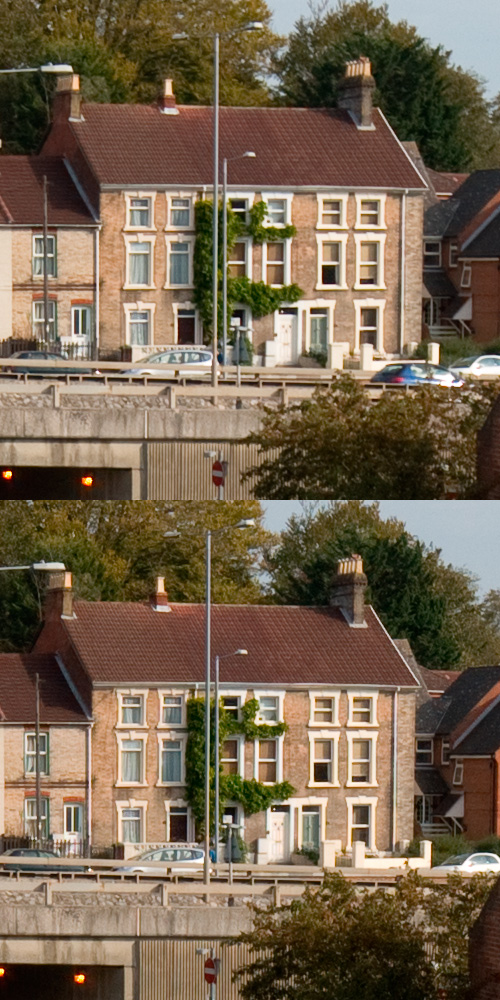
Here are 100% crops from the middle, f/2.8 at the top and f/8 at the bottom:
One of the cars has moved. I think there's a person in a blue top, obscured by lamp-posts. Apart from that they're very similar identical. The lens is perhaps just a tiny but sharper at f/8 but it's only noticeable if you zoom in. Here's what the bottom image looks like run through my secret, very mild unsharp mask settings:
Here's the extreme bottom-right corner of the frame, same deal as before, f/2.8 at the top and f/8 at the bottom, with auto contrast (the wall is in shadow):
The difference is, er. As before, the lens is sharp wide open and doesn't seem to improve stopped down. This seems to tally with Photozone's findings; their chart shows an infinitesimal improvement from f/2.8, which is excellent, to f/5.6, which is more excellent. Looking at the same site's tests of the different APS-C ultra-wide zooms, such as the Canon 10-22mm and the Tokina 11-16mm f/2.8, they all seem to be as good as or slightly better than the Samyang lens in the middle at 14mm, but not as good in the corners; and none of them are as good at f/2.8 (few of them even go that wide). In Nikon-land the physically similar 14-24mm f/2.8 seems to pip it, at six times the price.
There is one problem, though; extreme barrel distortion. On a full-frame camera the distortion is hard to correct, bulging in the middle and flaring out at the edges, although PTLens has an effective profile for the lens that works brilliantly. On an APS-C camera it has conventional barrel distortion, which is easier to correct, although again PTLens will do this. If you wave your mouse over the following image you can see what happens when the original picture is corrected with PTLens:
And for the curious, here's what the corner looks like after the correction has been applied (compare with the f/8 corner crop above):
A bit of the edge has been cropped off (it's more like a 22mm lens now) and the image quality should be slightly less impressive, because it has been stretched a bit, but I can't see it. Ultimately I conclude that the lens is a very, very good 21mm f/2.8-equivalent on an APS-C camera, if you can stomach having to focus manually, and you don't mind the size. It's worth pointing out that there aren't really any dedicated APS-C ultrawide primes - lots of zooms, no primes - so if you want an excellent 21mm-equivalent there aren't many alternatives.

 More of the lovely Helen Diaz, from a few weeks ago, looking almost entirely to the right, but not in the following image, where she is looking at you. Also, for no reason whatsoever than because I liked it, a statue from the Victoria & Albert Museum that lots of people have photographed, including me (scroll down).


 Eve, by Sir Thomas Brock (1899)
 On the left, Gagarin is catching a helicopter. Brock's sculpture represents the spirit of navigation. A second sculpture on the other prong of the arch embodies the spirit of gunnery; she carries a flintlock and wears a suit of armour. Ultimately that's what the British Empire was built on. Navigating around the world and blowing it up, or threatening to blow it up.