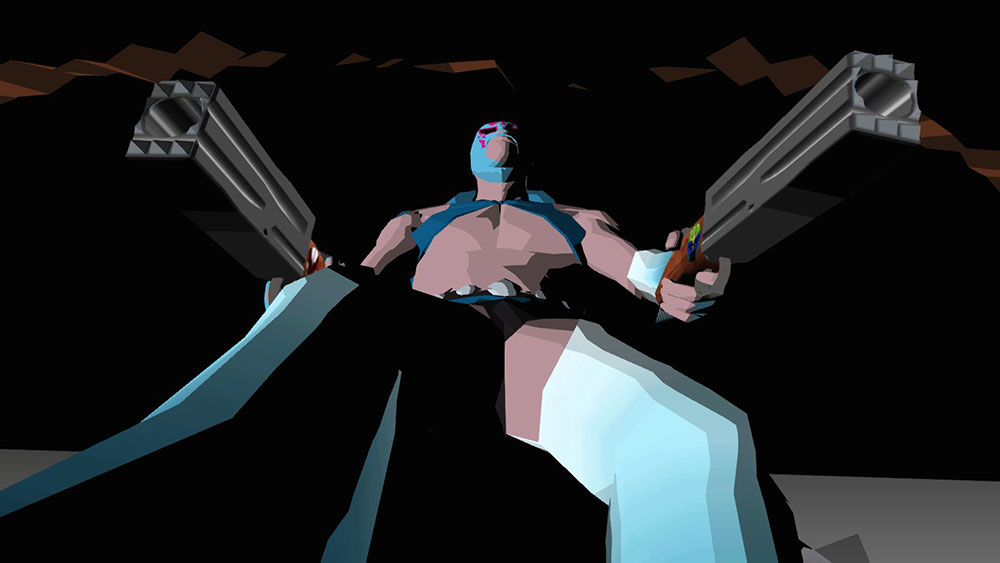
For a long time I thought it began life on the Sega Dreamcast. It has all the
hallmarks of that console's best titles - the stylish cel-shaded graphics and
eclectic soundtrack of Jet Set Radio, the constrained movement of
Rez, the general fin-de-siècle attitude etc. But it was actually
developed for the Nintendo GameCube, several years after the Dreamcast had
been discontinued, so you learn something every day.
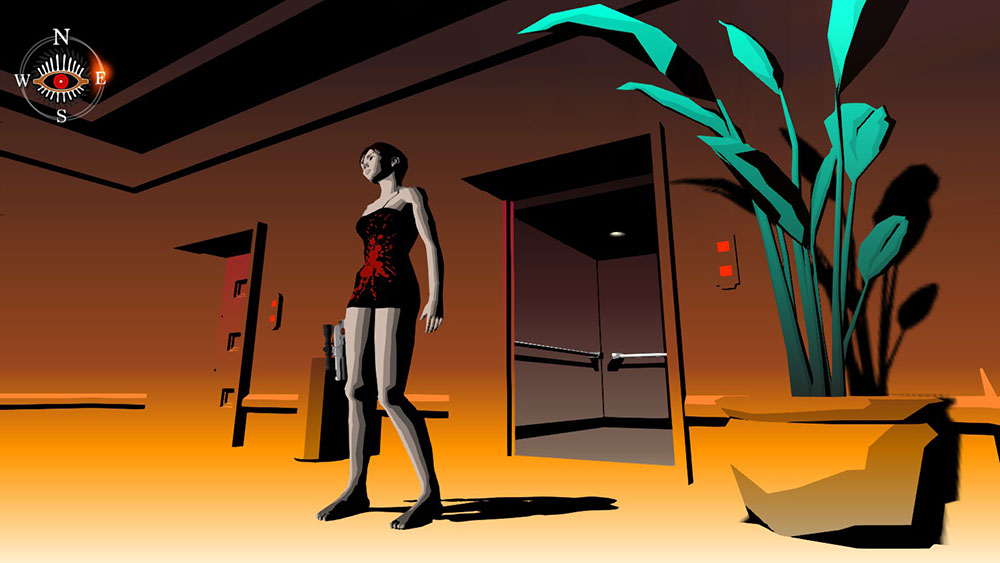
Killer7 was part of a batch of games produced by Capcom
exclusively for the GameCube. The plan was to boost third-party
support of the console by giving it a bunch of titles aimed at a more
mature audience than Nintendo's own games. Unfortunately the first
title, PN03, sold poorly, so Capcom gave up and decided to port
the rest of the games to the PlayStation 2 as well, or alternatively
cancel them outright. Thus Killer7 was simultaneously released
in 2005 for the GameCube and PlayStation 2, and for many years
afterwards it was only available for those two platforms.
The general consensus at the time was that the GameCube original was
the best, with more detailed graphics and quicker loading times. The
2018 PC remaster is based on the GameCube version, albeit that there
are a handful of technical differences.
Why is there a PC remaster? I'm not sure. Lead developer Goichi Suda
went on to bigger and better things with No More Heroes, but
even that game wasn't particularly popular. Perhaps Capcom found the
source code in a filing cabinet somewhere and thought "why not" and
"yes" and "let's do it" and "yes" and "hahaha" and "shall we do it"
and "why not" and "yes" and "we're doing it" and "we're really doing
it" and "this is funny" and "hahaha" and "yes" and "we're doing it".
Perhaps Capcom thinks that the GameCube still has the potential to be
a huge hit, despite the fact it was discontinued in 2007.
Perhaps it was really, really cheap and easy to do. I don't know. Do
you remember the GameCube? I was alive back then and I can only name
two GameCube games. Super Monkey Ball and
Super Mario Sunshine. And there was a Zelda game.
The Wind Walker. That's three games.
Except, get this. It was The Wind Waker. Not Walker. I
didn't realise until this very second. I've been wrong all these
years. Well I never. No-one disliked the GameCube. It just seemed a
poor deal compared to the PlayStation 2 because it couldn't play DVDs
and there were only a tiny handful of exclusive titles and no good
first person shooters. The hardware was indestructible, and nowadays
it makes a nice shelf ornament.
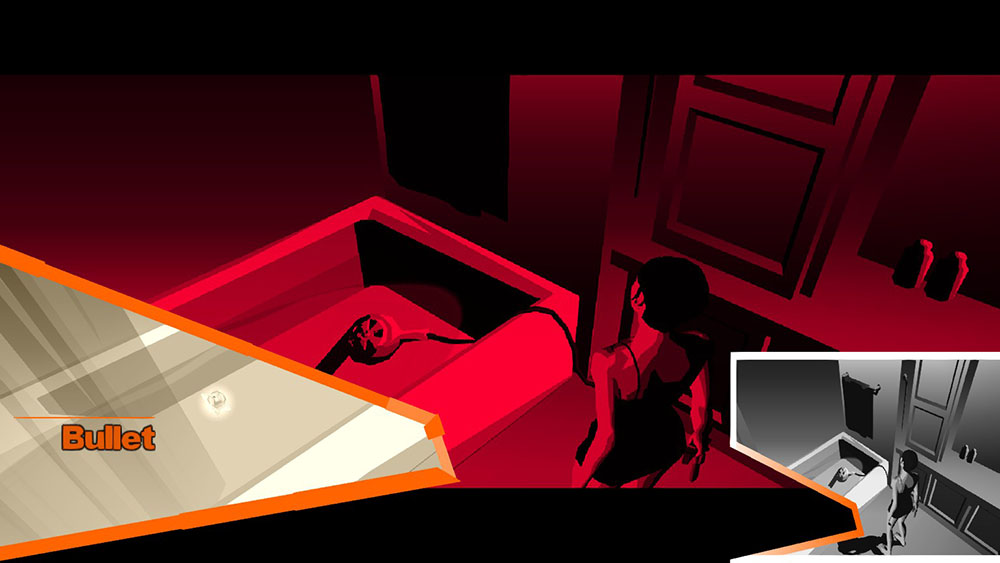

The PC remaster is mostly based on the GameCube version. One
exception is this graphical effect - in the GameCube original the
player character wasn't tinted red during scene transitions.

A surprise updated released in October 2024 fixed that,
though.
As of this writing Killer7 is only available brand new for the
PC. There were rumours of a Nintendo Switch port, but so far nothing
has come of it. If you have an original GameCube copy of the game it
should work on a Nintendo Wii as well, because the Wii was backwards
compatible. Is it available on Sony's PSNow streaming service? No, it
is not.
The PC remaster has support for widescreen monitors and HD
resolutions, plus mouse and keyboard controls. The levels, music,
cutscenes and so forth are unaltered, including the use of GameCube
button prompts.
There's some debate as to how the mouse and keyboard interfere with
the gameplay. Killer7 is fundamentally a shooting gallery
game, in which case mouse aim is a godsend, but unlike
Unreal Tournament the shooting is slower-paced, more
measured, so I'm going to assume that it plays for me much as it
played for people back in 2005 with a GameCube controller.

Let's talk about the plot. Killer7 takes place in the near
future, at a time when the world is threatened by a mysterious plague
that turns people into explosive zombies called Heaven Smiles. For
reasons that are not readily apparent the United Nations decides to
fight this threat by hiring a bunch of top assassins, the Killer7. The
Killer7 are led by a chap called Harman Smith, who delegates
responsibility to his second-in-command, Garcian Smith; you spent most
of the game playing as Garcian Smith.
Garcian has operational control of the Killer7. He's a relatively weak
fighter, but he has the power to resurrect any of the seven if they die.
Each of the seven has a different set of skills, and part of the gameplay
involves switching from one character to the other to solve puzzles. Con
Smith, for example, is small, so he can fit through gaps:

Coyote Smith is a petty thief who can pick locks, Mask De Smith is a
masked wrestler who can blow down destructible walls, Kevin Smith is a cat
burglar who can turn himself invisible, and KAEDE Smith can uncover hidden
messages by spraying walls with her blood. Each of the seven also has a
signature weapon. KAEDE has a scoped pistol that can hit distant targets,
for example, and Mask has grenade launchers that can take down giant
mutants.
The odd one out is Dan Smith, who is the plain vanilla Killer7. His only
special power is a twelve-shot, double-barrelled revolver, and he's very
handy with it.


At this point I was going to make some sweet references to top 80s indie
band The Smiths, because the characters are all called Smith, but the game
already has a lot of references to The Smiths, so that joke would be
redundant. The game has several references to 1980s and 1990s indie guitar
bands, which dates it a bit. The hip kids of today are into L'Rain and
Jazmine Sullivan, not Dinosaur Jr and the Melvins.
The story is told with a mixture of in-game cutscenes and cartoon
animations. At the outset of the game Japan finds itself under attack from a
long-range missile strike that may or may not have been launched by the
United States. In theory this is the game's overriding plot - you're racing
to save Japan - but in practice the game forgets about the missiles almost
immediately and divides into three unrelated episodes, in which you deal
with a cult leader, a rogue cartoonist, and a competing assassin
(respectively).

When it was new Killer7 attracted so-so reviews. The critics praised
the style and atmosphere but were unimpressed with the monotonous gameplay.
My dim, dim recollection is that there was a fad at the time for auteur-led
games that had massive, lengthy cutscenes, such as Metal Gear Solid 3, or alternatively minimalist genre experiments such as
Shadow of the Colossus and Okami, in which case
Killer7 was right at the cutting edge of the games-as-art debate.
Unfortunately it's just not that good, either as a game or as art.
I'll talk about the gameplay first. Killer7 has an unusual control
scheme. The levels are divided into a series of tracks, with junctions; you
can run back and forth down the corridors and turn left and right at
junctions, just like Pac-Man, but you don't have complete freedom of
movement. Interactive objects are pointed out to you, as if they were
junctions as well.

I was surprised at how well it works. The scheme eliminates the problem in
tank-style 3D games whereby your character keeps bumping into the scenery.
After a couple of minutes I found I could fluidly navigate the maps, which
are generally not very complex. Apart from a few obtuse puzzles the gameplay
involves exploring the levels, flicking switches along the way, and
collecting special bullets that you can use to access the final boss arena.


The combat is distinctive as well. Periodically you hear laughter in the
background, which is the sign that there's a Heaven Smile lurking around. To
fight them you bring up your gun, scan the area for Heaven Smiles, then
shoot them. You can in theory just pump them with bullets until they expire,
but they all have a weak spot, and if you hit that spot the Heaven Smile
dies with a single shot. Alternatively you could shoot off their legs and
finish them off as they crawl towards you.
Some Heaven Smiles have a hidden weak spot, outlined in green. As the game
proceeds you encounter ever-more-outlandishly-mutated Smiles - ranging from
shambling zombies with enlarged limbs to giant tentacle monsters with eyes
that you have to pick off individually. In the image above the Heaven Smile
is an armoured ball. I'm just about to shoot its one and only vulnerable
face.

Every time you kill a Heaven Smile you are rewarded with some blood, and if
you kill the Smile by hitting its weak spot you get special, thick blood
that can be processed into character upgrades. The upgrade system is mostly
useful for players who just pump the Heaven Smiles full of bullets; with my
mouse I found it fairly easy to hit the one-shot-kill weak spots, so the
upgrades weren't so useful. Oddly I found that KAEDE's slow-firing scoped
pistol was more of a liability than a help, because it feels as if the weak
spots get smaller when you zoom in.
Periodically you come across ghosts of the Killer7's past victims, who
usually have some helpful hints, although often they're just there for
background flavour.


That's pretty much the entire gameplay. You run through a series of simple
mazes, collecting objects, solving puzzles, and listening to ghostly
characters drone on. One particularly annoying chap uses the same template
for all his speeches, which gets boring very quickly. I eventually ended up
ignoring him, which was unfortunate because he's essential in one level.
There are some little minigames, and a brief parody of side-on fighting
games, but on the whole you run around a lot and shoot Heaven Smiles.
You have to stop and scan the area before engaging the Heaven Smiles, and
you can't fire while moving, so the combat feels slightly old-fashioned. You
know what Killer7 reminded me of? Gauntlet, remember that?
"Elf needs food, badly"? The 1980s arcade machine? Killer7 is
essentially Gauntlet, with seven characters instead of four, and it's
in 3D, but the gameplay isn't really all that different. Seriously, if
Killer7 was viewed from the top down it would essentially be
Gauntlet. Single-player Gauntlet, because it's strictly a
single-player game.
Is the gameplay any good? The puzzle aspect annoyed me. One half of the
puzzles involves equipping a special ring in order to blow out fires, light
candles etc, which is easy. The other half of the puzzles involves
memorising background details and answering questions about them, which
isn't fun at all. It's not difficult, it's just that it's not entertaining.
Did the developers expect me to take notes with a pencil and paper?
The final puzzle is even more aggravating, because it involves listening to
a bunch of dull audio logs over and over again until you pick up on a bunch
of uninteresting details about a character you've never met before.

The boss fights generally have a puzzle aspect as well, although in almost
all cases I found that overwhelming firepower carried the day. Perhaps the
mouse control helps. The PC version also gives you hotkeys to switch
characters and heal, which speeds things up.
On the whole the puzzles range from uninteresting to annoying. The shooting
is much more entertaining, although again it's really just a slow-paced
shooting gallery. It's no more sophisticated than
House of the Dead or Time Crisis. The vast majority of the
baddies are melee-only. They walk up to you and explode, although each of
the Killer7 has a desperation defence that activates at short range. Given
the fact that two characters have quiet weapons - a suppressed pistol and a
knife - I wonder if there was originally going to be a stealth element, or
at least some more complexity.
The combat isn't awful, it just isn't very sophisticated. You shoot monsters
that slowly walk in a straight line towards you. The monsters tend to
respawn right up close, so you have to time your movements carefully, and
there are monster generators that try to overwhelm you with numbers, so you
have to carefully balance your shooting and reloading, but it never gets
complicated. Unlike for example Left4Dead there's no dynamic element
to the monster spawns, they appear in the same place every time.
Later on the game introduces baddies that can only be killed by Mask De
Smith's grenade launchers, but this just means that you have to either play
as Mask all the time, or continually switch back and forth, back and forth
from Mask to your favourite character. The downside to Mask's firepower is
that he can't collect any blood from the enemies, so if you want to heal him
or upgrade his weapons you have to switch to someone else first.

Given that fact that you can heal at any time, and Garcian can resurrect the
dead, it's hard to lose Killer7. It has a checkpoint system, so death
just sends you back a little bit. The early trailers sold the game as a
fast-paced bullet-fest, but the actual gameplay is much more sedate.
Unfortunately the plot has exactly the same problem. It moves slowly and
intermittently, and it just didn't grab me. It touches on some of the same
themes that the developer explored in No More Heroes, but not as
effectively. For example, at one point you fight the mask-wearing,
submachine-gun-toting henchperson of chief nastyman Curtis Blackburn:


In fact you fight her twice, and in both cases she isn't a pushover. The
climactic battles against Ayame Blackburn play like a parody of boss fights,
but the game makes it clear that Ayame has been tortured into fighting you,
and when you kill her the music goes quiet and she just lies there dead.
There's no sense of triumph. It's one of the few things that works, but it's
not enough. The ending sequence has a similar sense of futility, but it
doesn't have enough build-up to be truly effective.
Killer7's story really has two problems. It occasionally reaches
peaks of surrealistic mania, but they're few and far between, and it doesn't
sustain that pitch because the pace is all wrong. For every "like a flower that blooms in the soil of our carnal and corrupt
society" and "I'm talking about guys who beat off four times a day" there are hours of obtuse burbling about the relationship between Japan
and the United States. The climactic revelation that the United States'
political system is built on a lie feels far more prosaic than was obviously
intended, and I was left wondering if it was a reference to
The President's Analyst or not.
The visual style has aged well, but the storyline and overall ethos are
stuck in the 1990s. The emotionless, slick, postmodern 1990s, when nothing
meant anything and everything was just a symbolic reference to something
else. It feels like a student art project made by someone who was terrified
of making a substantial point about the real world. The world's problems
seemed to be over in the 1990s, so the art world shunned social issues in
favour of a decade of laughing at the past by recontextualising symbols.
Apart from Gauntlet, Killer7 reminded me a lot of Matthew
Barney's contemporary Cremaster films, which were big news at the
time of Killer7's development. The Cremaster films were
essentially an attempt to capture the magic of David Lynch without plot or
characterisation, but they didn't work because they were just feature-length
music videos. The kind of boring music videos that start off with five
minutes of dialogue, and there's a story about finding some lost tapes or
something. Killer7 feels like an imitation of the form of a
socio-political thriller without any of the substance. If nothing else it
made me appreciate David Lynch's Lost Highway and
Inland Empire even more, because Lynch had a knack for that kind of
thing.
The grand finale divides its time between a meditation on the political
process and a considerably more interesting psycho-drama in which the
history of the Killer7 is explored, and in my opinion the game would have
been a lot better if it had concentrated on the latter aspect.


That's a pretty harsh take, but Killer7 disappointed me. It's not much
fun as a game. The parodies of superhero comics and cults are like Frank
Zappa's jokes, e.g. they feel like references to humour rather than actual
humour. That might have been excusable if the plot had been interesting.
FAR: Lone Sails
didn't have much gameplay, either, but what it did have was thematically
consistent with the plot, which was subtle and emotionally engaging, with a
bittersweet ending. But because Killer7 was born of the 1990s it has no
emotional engagement at all - it deliberately undercuts it - and purely as a
thriller it doesn't work because everything is a reference to something else,
and nothing has meaning because quote meaning unquote itself is a
construction.
Other problems? The ending reveals that the Killer7 are not what they seem,
but it doesn't have any impact because none of the Killer7 are fleshed out.
You'd think there would be seven levels, with each of the seven given a moment
in the spotlight, but in practice only Dan is given any characterisation. The
rest have as much characterisation as the assassins from
The Pink Panther Strikes Again, e.g. none, which is a shame because the
character designs are striking, Kevin and KAEDE in particular.
And so ultimately I was disappointed with Killer7. I'm glad I played
it, because it looks great and now I know what the fuss was all about, but at
the same time it's just not all that good.