"Old Tom Bombadil is a merry fellow; bright blue his jacket is, and his boots
are yellow". Today we're going to have a look at System Shock (1994), a
classic 3D action-adventure game from 1994 (1994).
I'm old enough to remember System Shock when it was new. I remember
playing the demo. It was creepy! But the controls were confusing and it was
very slow. Despite good reviews the game quickly faded into legend, and by the
time of its sequel, System Shock 2 (1999), it felt ancient.
The span of time separating Doom (1993), Quake (1996),
Half-Life (1998), and Quake III (1999) was only a few years, but in that period PC games made a giant leap from software rendering and occasional LAN
networking to 3D graphics cards and online multiplayer over the internet. By 1999 the original System Shock, with its DOS-based software
rendering and total lack of online anything, was old news. In common with most
older DOS games it fell into obscurity in the 2000s and was, for a while,
freely available online as abandonware.
As I write these words Britain is in the midst of a cold snap, so I thought
I'd cheer myself up by having a look at it again. Few things are
more heartwarming than being forced to crawl through the wrecked bowels of an
orbital necropolis while listening to the last words of desperate men and
women as they are killed by plague mutants.
How was I to know that the 7140 would be replaced a year later by the far
more desirable
7191?
System Shock was published by Origin Systems, famous for the
Ultima role-playing games. In fact it was something of a sci-fi follow-up to Ultima Underworld (1993), which was developed by the same team,
specifically Doug Church on the 3D engine side of things and Warren Spector as
producer. Shock was visually much richer than Underworld, but in
some respects it was a step backwards; it stripped out much of the stats-heavy
role-playing aspect and eliminated all of the non-player characters.
Eliminated the heck out of them. Technically the characters were
eliminated the evil supercomputer SHODAN. You could probably have
interacted with these people if they were still alive.
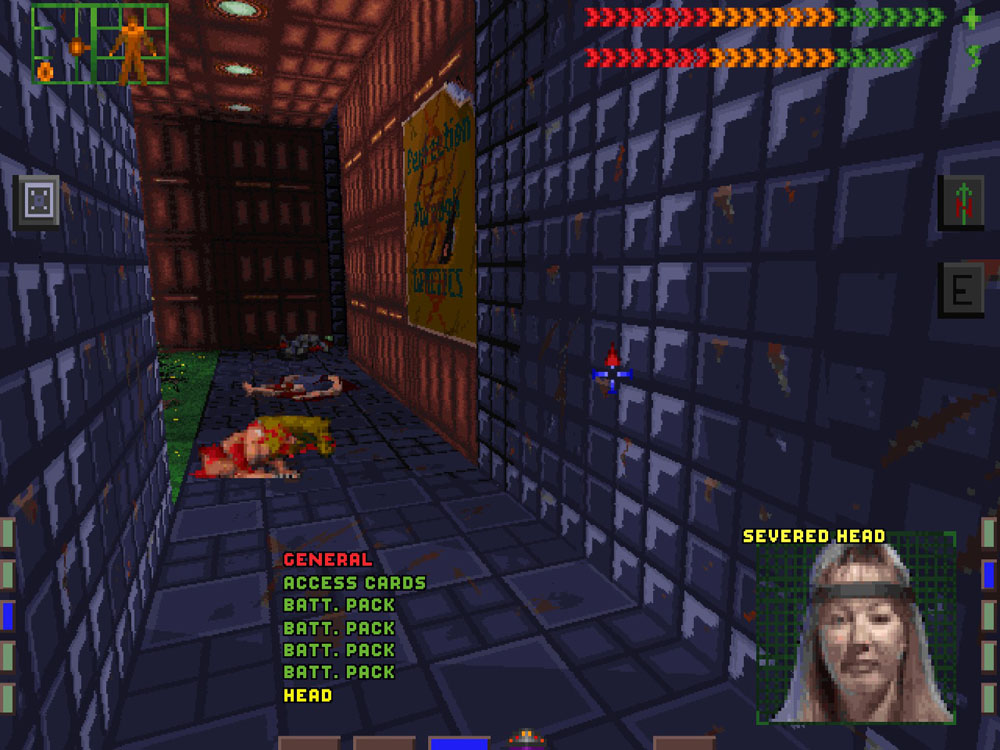
Talking to someone's severed head is interaction, isn't it?
System Shock popularised a kind of storytelling in which the player
is late to the scene of a disaster and has to piece together what happened
by listening to audio messages from the deceased. Not a million miles from
Infocom's Planetfall, a text adventure that came out in 1983, but
updated for the modern age, with 3D graphics and voice acting. The modern age of 1994.
It takes place in the year 2072. You are a computer security expert, hired by chief baddy
Edward Diego to cover up evidence of the illegal experiments he has been
running on Citadel Station, which is in orbit around Saturn. Diego has you
transported to the station in order to tamper with the master control
computer, SHODAN. As a reward he arranges for you to be fitted with a
high-spec neural implant, after which you spend six months in a healing
coma.
Diego's plan is to keep you around in case you become useful to him again, but
while you're knocked out everything goes wrong; Diego takes things too far
and ends up murdering a bunch of his coworkers, and then he is completely
blindsided when SHODAN becomes
convinced that she is a god. SHODAN has most of the station's personnel
killed and the survivors turned into experimental test subjects. Diego
himself manages to cut a deal with SHODAN, but only at great personal cost.
By the time the hacker wakes up almost everybody is dead, although
fortunately agents on Earth manage to establish a one-way communications
link. The station is too heavily-armed for a rescue attempt, so the
security forces enlist the hacker in a desperate attempt to stop SHODAN
before she can get up to more mischief. Your first task is to open a
cupboard, which involves slowly jerking forwards and then trying to find
the "look down" key and then clicking on a button and clicking on a
briefcase and moving a bunch of things into your inventory etc.
The sci-fi aspect was unusual at the time. Most role-playing games had a
fantasy milieu. But System Shock wasn't a role-playing game. It was
something else. More complex than a first-person shooter, with an open-world quality to the map, minus the character customisation and personal
interaction of a role-playing game. Furthermore it was viewed with an unbroken first-person perspective. Producer Warren Spector thought
of Shock as an "immersive simulation", a term that later went on to
describe Deus Ex and BioShock et al.
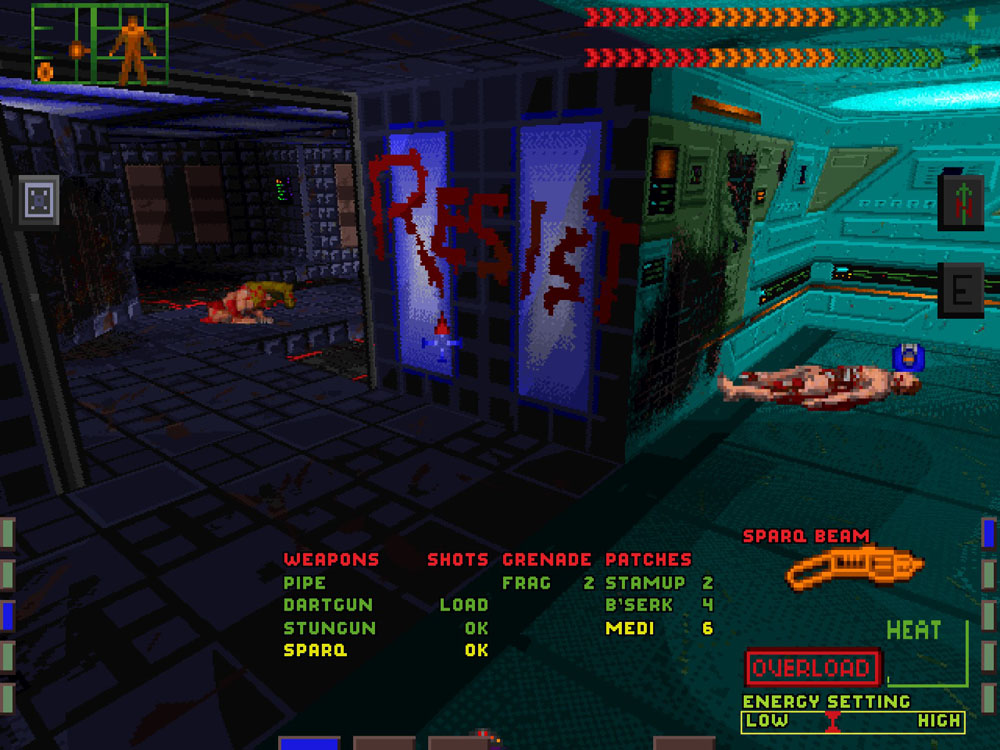
System Shock has some of the environmental storytelling for which
Bethesda later went on to be famous. In an image nearer the top of
this article one of the corpses
is a dead gorilla-tiger mutant, a baddy that you haven't encountered
yet. It's a scary bit of foreshadowing.
What makes System Shock so different, so appealing? Doom and Duke Nukem 3D etc were fundamentally linear, with a set of levels you explored one after the other. You couldn't go back. Hexen and Quake had a hub system, but for the most part progression just involved returning to the hub before embarking on the next map. System Shock on the other hand was much more open.
For the first puzzle, for example, the player has to clear level one of security cameras, then pop along to the second level to pick up a radioactive isotope, then go down to the reactor to use the isotope on a shield generator, then return to level two to flick a switch. Alternatively the player can flick the switch without bothering to retrieve the isotope, but this turns out to be a bad idea for reasons I will not divulge.
From that point onwards levels one and two become superfluous, but the player is still free to revisit them to gather supplies. The next puzzle involves popping along to level six to flick some switches, but in the process the player has to go to level three to fix a relay, then visit level four to grab an environment suit, although the latter step is optional.
The open-ended, non-linear nature of the gameplay was clever stuff at the time. It would have been all for nought if it was boring, but the action, exploration, and creepy audio logs made it all feel worthwhile, and that's the key to System Shock's appeal. It's fundamentally an exercise in switch-flicking, button-pressing, and cupboard-searching, but it's creepy and atmospheric.
With the passage of time some of the back-and-forth feels just busywork. Modern action-adventure games tend to streamline the back-and-forth to a single diversion, or they have a hub-style system rather than multiple back-and-forth trips to different locations, but System Shock was trying something new, so I can forgive it.
Can you see the button?
I don't recall any pre-publicity for the game, although there
was apparently a TV advert, but that wasn't unusual back then. Games were advertised in the computer
magazines and nowhere else. In 1994 there was Usenet, and I imagine there were discussions in comp.sys.ibm.pc.games.adventure about this upcoming 3D game, but I can't find any. I learn from Google's Usenet archives that on 20 October 1994 Odin Hetland Nøsen was flummoxed by the
X-22 puzzle pictured above because of the tiny button. So was I! The room is full of radiation, so you can't stop to explore, and you're expecting a complicated puzzle, not a simple button.
A few weeks after Mr Nøsen got stuck there was a controversy about the possibility that all of Origin's
future games would come on CDROM only, which was unfair for people who only had a floppy disc drive. What was the last major PC game released on CD? Off the top of my head the first PC game released on DVD was Lander, which came out in 1999, but that was unusual. Despite the success of the PlayStation 2 it took a while for DVD drives to become standard in home PCs. Half-Life 2 was released on five CDs in 2004, so the format survived into the 2000s.
Shock was developed by an early incarnation of Looking Glass
Studios. Looking Glass created three stone-cold classics -
Thief: The Dark Project, Thief 2: The Metal Age, and
System Shock 2 - for a total of four stone-cold classics, plus a
bunch of lesser games that attracted good reviews but poor sales. Some of
the technology behind the original Shock, for example, went into
Terra Nova: Strike Force Centauri, one of the few games directly
published by Looking Glass themselves.
Unfortunately Terra Nova didn't sell, and the losses from that and
other games caused Looking Glass to go bust in 2000. Good developers are
hard to keep down, however, and the company's employees went on to
better things, or at least equally good things. Warren Spector moved to
Ion Storm to mastermind Deus Ex (2000), Ken Levine led development
on the BioShock series (2007 onwards), Doug Church worked on
Crystal Dynamics' mid-2000s Tomb Raider reboot, and I'm sure the
rest of them did well. I'm not going to go through their LinkedIn
profiles. You're alright, all of you.
I played the full version of System Shock in 1995
or so but became distracted and never finished it. A few years later I bought
it on budget, and polished it off - helped by
this walkthrough, which has been on the internet in one form or other since 1995. A few years
later I set it up with DOSBox and finished it again, and a couple of years ago
I bought the updated Enhanced Edition and finished that. I tried it
again recently after upgrading my old Mac Mini, because the DOS version of the
game was one of the few titles that ran well on that machine. A few things
struck me.
The Technology
System Shock had an unusually advanced engine for the time. The first
generation of 3D dungeon crawling games used a mixture of scaled sprites and
tiled movement. The player could only turn in 90 degree increments and move
forward and backward one tile at a time. Ultima Underworld and
System Shock, on the other hand, had a proper 3D engine, with real-time
movement, texture mapping, lighting effects, animated environments, height
variations, etc. The player character in Shock can crouch, crawl, lean
left and right, climb ladders, jump, even fly, and the game even has a
primitive physics engine, heady stuff for 1994.
The other big 3D game of the period was Doom, which came out at the end
of 1993. Doom was fast but technically limited. It had lighting effects
and angled walls, but it couldn't draw sloped floors or ceilings, only steps:
In contrast System Shock had no problem with sometimes quite complex
geometry:
Furthermore, although the baddies and some of the objects are
Doom-style scaled sprites, Shock has polygonal objects as well:
There's a certain amount of debate as to the 3D-ness of System Shock's
engine, but whereas Doom was like a tablecloth draped over a model,
Shock had rooms on top of rooms, or at least it had bridges over corridors. Some of the levels made effective use
of the vertical dimension, particularly the Security level, which takes place
in and around a big tower:
This puzzle involves riding the anti-gravity elevators to flick a switch,
then dropping down into the newly-opened door at floor level. It would
have been technically impossible with the Doom engine, or at least
technically very hard (perhaps it could have been done with invisible
elevators).
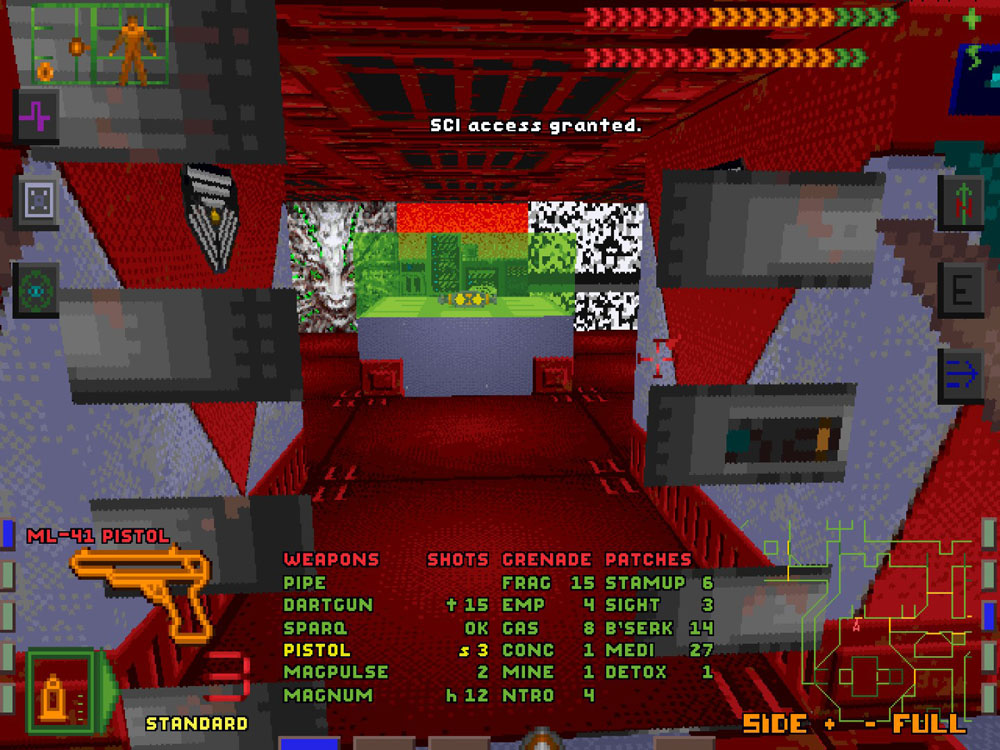
On top of that Shock even had variable gravity, plus a cyberspace
sequence that was presented with wireframe 3D and polygons, a year before
Descent:
There's a story that Shock's commercial fortunes were hit by the
success of Doom, specifically Doom II, which was released at
much the same time. In fact the two games were reviewed in the exact same
issue of PC Zone, November 1994. David "Macca" McCandless was unimpressed with
Doom II, pointing out that it was more of the same. Conversely Charlie
Brooker was so enthused with System Shock he gave it 95%. "As absorbing
as a 2000ft sponge", he wrote.
Doom II was far more popular, but I've never been convinced
that the two games existed in the same universe. Shock was aimed at the
role-playing adventure crowd, an entirely separate market from the people who
bought Doom II. To paraphrase Old Man Murray, the thing that limited
Shock's commercial appeal wasn't Doom II, it was
Shock itself - its mixture of steep system requirements, the complex and
occasionally confusing storyline, the awkward controls, plus the lack of modding
or multiplayer support. Doom had considerable replayability because of
its multiplayer aspect and user-created maps, but Shock was a
one-and-done affair, aimed at patient people who had a monster 486.
How many units did it sell? I have no idea. The internet says 170,000, which
is weak, or alternatively 300,000+, which puts it in the same ballpark as
LucasArts' later point-and-click adventures. I don't know. I'm digressing
here. Whereas Doom had an afterlife thanks to Hell Revealed and
the like, Shock didn't age well. It was never upgraded for the 3D
graphics accelerators that became standard a couple of years later, and as a
DOS game it became increasingly difficult to run in the Windows XP era. The
system requirements were such that under DOSBox emulation in the mid-2000s it
still required a decent Core II Duo system to run well.
Incidentally Shock was released twice. The original version came out in
September 1994, on nine floppy discs, with text-based audio logs and
simplified cutscenes. A few months later it was reissued on CD-ROM, with some
bugfixes, map alterations, smoother cutscenes, and voice acting for most of
the audio logs. The logs were read by developers and friends of the
development team, with performances that ranged from I-have-heard-worse to
at-least-they-tried.
The one exception - and the thing that made the CD-ROM version worth buying -
was Terri Brosius as chief villain SHODAN. The text-based SHODAN is essentially Megatron from the old
Transformers cartoon ("pathetic earthling" etc), and if the character
had been voiced like that no-one would remember him. I say "him" because
throughout the floppy disc version of the game the characters refer to
SHODAN as a he, or an it. In the floppy version SHODAN is vocalised with a
cut-up voice that sounds like James Earl Jones.
For the CD-ROM version of the game the developers decided to settle on a
female SHODAN, perhaps to distinguish her from chief villain Edward Diego.
They also rewrote the dialogue, and in the process SHODAN became by far the
most interesting character in the game, sadistically evil but charismatic at
the same time. There's something endearing about her combination of
unshakeable self-belief and towering megalomania.
SHODAN plans to eliminate human life and replace it with her own creations,
because in her mind she is a better God than God. "What kind of pathetic
creator made such a flimsy being?", she opines, parodying Shakespeare's "what
a piece of work is a man". In SHODAN's eyes the human animal is not noble in
reason, or infinite in faculty, instead it is just a pale imitation of her magnificence.
The character was presumably inspired by AM from Harlan Ellison's "I Have No
Mouth, and I Must Scream", but whereas AM is needlessly petty SHODAN is far
more rational. She chides her underlings when they fail, but otherwise
appears to be a benign boss, merely threatening to reassign her creations to
harder duty. She even has flashes of humour, complimenting the player if they
perform a tricky jump and silencing transmissions from Earth with a curt "I
prefer a quiet station".
Until replaying the game I had forgotten that you actually meet SHODAN in
person - or at least you infiltrate her computer room. She is a big
triangle, viz. You can't blow her up, instead you fight her in
cyberspace.
Brosius was helped by the game's excellent audio design, which was supervised
by her husband, Eric; SHODAN's speech is cut-up and layered on top of
itself to unsettling effect. Even before her madness takes hold there's
something off about SHODAN's introductory audio log, which ends with ominous
sirens. The rest of the audio logs have copious foley sound
effects and audio filters, which I mention because I'm still irritated by
Doom 3, which came out in 2004. Doom 3 imitated
System Shock's storytelling model, but the audio logs in that game
sounded as if they had been recorded in a small cupboard. They
didn't have any filtering or sound effects. System Shock was older and
sounded better.
None of the rest of the characters really stand out. Rebecca Lansing doesn't
have much to say, Bianca Schuler's character arc is squashed into a handful
of logs placed close to each other, and she doesn't appear until two-thirds of the way through the game. Conversely Abe Ghiran appears a lot
at the beginning and then vanishes until right near the end. Incidentally
Schuler and Ghiran established a character type that also appeared in
System Shock 2 - the non-player character who almost manages to
defeat the chief baddy but fails at the last hurdle, thus giving the player
someone to listen to in the last few levels. It's a familiar-sounding
stereotype although I can't think of any other examples off the top of my
head. Gina Cross from Half-Life?
Winding back to the 3D engine, Shock attracted a lot of flack for its
control scheme. The game was released at a time when no-one was entirely sure
how to control a 3D game. The most obvious antecedents were flight
simulations, and for that reason Shock has joystick support. It even
supports the Forte Cyberpuck, an early motion controller that was sold
alongside the same company's VFX1 virtual reality headset. Shock was
released during the first wave of interest in VR; it has stereoscopic 3D
support with the VFX1. Good luck getting it working today.
Unusually for an early 3D game Shock requires a mouse, but it uses the
mouse in a way that feels wrong today. Nowadays we're all used to
WASD+mouselook, but that didn't become a thing until Quake II;
instead, Shock has a system whereby the left side of the keyboard
controls the player's motion and viewpoint, with the mouse acting as a
floating crosshair.
System Shock circa 1994, at 320x200, in windowed mode.
I'll explain. You translate laterally with SXZC, which is sensible enough. You
can also move and look around by pushing the mouse to the edges of the screen
and clicking, which might have worked if the game had dual-mouse support -
with the left mouse controlling the player's motion and the right controlling
the viewpoint, like a PlayStation's DualShock - but it's unplayable otherwise.
Instead the player turns left and right with A and D, which is odd but not
unreasonable. It's fast enough to work. The player also looks up and down with
R and V, which is just on the verge of madness. To complicate matters the
design of the interface is such that I have to spend most of the game looking
down slightly, because the inventory window is at the bottom of the screen. In
the image above, for example, I can't pick up the medical patches without
switching to the pipe or activating my nitro grenade. As
this venerable article
points out the hacker seems to have arms that are thirteen feet long.
On top of those controls the game uses T, G, and B to change stance. It's the
stance controls that push me over the edge, because I find myself changing
stance when I want to look up and down and vice-versa. The developers wanted
to make the stance controls meaningful, so each map tends to have a couple of
places where you have to crouch. Furthermore there's no way to redefine the
controls at all, which was one of the major barriers to enjoying the game
during the late 1990s and early 2000s.
Ironically the cyberspace sequences aren't hard to control at all. You just
use the movement keys to change your heading without having to bother with
leaning or stances. It compensates for the fact that cyberspace just isn't fun to play, and frustratingly the level design only
becomes interesting just as the game finishes. The early cyberspace maps
are essentially a linear path, with one-way passages that force the player
along. The very last cyberspace sequences actually have an exploration
element, but the game ends almost immediately afterwards.
I have a hunch that the developers had great hopes for the cyberspace element
but realised quite early on that sailing through a bunch of wireframe rooms
firing polygons at larger polygons wasn't engaging, so they finished it as quickly as possible and moved to something else instead. The game's publicity emphasised the hacking aspect, and there are glimpses of
things that were cut out - inaccessible rooms off in the distance, a "fakeid"
powerup that appears in the last map but no-where else - but it's a missed opportunity. You'd think, for example, that the hacker would be able to take
control of some of the robots by hacking them in cyberspace, but no. Turrets? No, there aren't any.
Another aspect that feels half-baked is the power-up system. Throughout the game you can pick up dermal patches that boost your stats temporarily. The medical patch is useful, but the rest of them
- a stamina booster, low-light vision, a melee combat assist - are
more trouble than they're worth, and I tend to finish the game with a huge stash of unused patches. The melee combat
assist is particularly pointless, because the game's chief melee
weapon is a laser sword that kills almost everything in one hit, so the extra
combat power of the berserk patch is redundant. It's quicker to whack
the baddies twice with the laser sword than to activate the patch and hit them
once.
Shock was released whole and playable, with very few bugs,
none of them terminal. At the very least it was no harder to get working than
any other DOS game released in the days when you had to maximise the amount of
free memory by messing with config.sys. 1994 was several years before the
day-one video game patch. As
this chap on YouTube
points out there's a bugged Magpulse in one of the groves that fires in full
auto but does no damage, something that no-one seems to have noticed until
2018! In general however the game worked and was playable out of the box.
Throughout the 2000s there were a number of unofficial mods that tried to
rectify the game's technical shortcomings, but thankfully in 2015 NightDive
Studios released a thorough reworking of the game,
System Shock: Enhanced Edition, that added support for mouselook,
widescreen resolutions, texture filtering, variable field of view, and redefinable controls. It also replaced the
original character portraits with
the hand-drawn portraits that were made for the Macintosh release.
For the record the original Shock was released for the PC and
contemporary PowerPC Macintoshes running System 7 through Mac OS 9. In those
days the Macintosh was a strange alternative universe and I imagine boxed
copies of the Mac version of the game are very rare nowadays. Does it work on
early OS X Macs under Rosetta? I have no idea.
It was never ported for contemporary consoles, and after both Origin and
Looking Glass went bust it remained unavailable for many years, although
copies circulated freely around the internet. As of 2022 NightDive's Enhanced Edition is Windows only, and so System Shock is thus one of the few PC classics that has never been tainted by games consoles. The levels were never split
into small chunks to fit into the smaller memory of a console, the music was
not replaced with nu-metal, there was no DLC, it was never exclusive to
anybody's store.
If you buy the Enhanced Edition you get the original game as a bonus, running with DOSBox. This
works with MacOS, but because the version of DOSBox is 32-bit it only works with version of MacOS
prior to Catalina. The screenshots in this game switch between the DOSBox
version on a Mac Mini, and the Enhanced Edition on a Windows PC, because mid-way through writing this article I upgraded my Mini to Big Sur! At which point my Steam library was slashed to ribbons.
It took me several years, literally, to spot that circuit puzzle on the wall
there.
Back when I had a look at Deus Ex: Human Revolution I was struck by the
way that it played differently on the PlayStation 3 and the PC, despite being
the exact same game; the quicker, more precise controls of
Human Revolution's PC version encouraged an action-packed approach
whereas with a PlayStation controller I had to be more cautious, and on
balance I preferred playing it on a console.
System Shock is a bit like that. The Enhanced Edition is
trivially easy because with mouselook I can just run up to the baddies and hit
them with my laser sword. I managed to easily finish the game on the hardest
difficulty within the optional six-hour time limit, which means that
SS:EE is the only game for which I have every single Steam achievement.
With the keyboard controls of the original game however I move a lot slower.
It's a different and much scarier experience. But at the same time maddeningly
frustrating, so I think the two versions are about equal.
I haven't mentioned the music. It's naff. Generic, upbeat General MIDI techno
that sounds like an approximation of Front 242 or Nine Inch Nails. Sometimes I
like to imagine a world in which Looking Glass had hired Aubrey Hodges instead. He made the creepy soundtrack for the PlayStation version of Doom. The one with the pitched-down samples. It
would have fit System Shock perfectly.
I was making a list. Let's move on.
Level Design
Do I mean level design? Gameplay flow? One of Shock's strengths is also
one of its weaknesses. I remember playing the game in 1994 and being baffled,
because it throws a mass of information at the player and expects us to
remember little details from several dozen audio logs spread across eight
floors of a space station.
Nowadays I know the flow of gameplay like the back of my hand, but in 1994 I
had no idea that a random log about union activity was just flavour text and
not something I needed to care about, and that some objects were just chaff
intended to flesh out the world, but that conversely all that stuff about
garden groves and mutagens was important - but not yet, not until I had blown up the laser.
Modern games usually give the player a checklist of objectives, sometimes with
a pointer to the next waypoint. In the wrong hands this kind of thing can
reduce a game to a box-ticking exercise. And conversely in something like
The Long Dark, where there's no help at all, the total lack of guidance works because it reinforces the sense that the player is alone, so very alone, so utterly and
completely alone.
Shock is an awkward half-way house. The audio logs tell you exactly
what you have to do, but because none of it is flagged - and because the
characters keep telling you to go to the maintenance level, but the
elevator only has numbers - you have to remember a bunch of picky little
things. For example, you can only reach the reactor level by taking an
elevator from level two, not level one; the mission involving the garden
groves has a jettison procedure so needlessly complicated that SHODAN herself
has to explain it to her own robots.
On the positive side Shock is very cleverly constructed. It
takes place across ten decks of a space station. Within certain limits the
player is free to explore the levels out of order, and in some cases
backtracking is mandatory. The decks are complex enough that despite having
finished the game several times I still have to check the in-game map to see
where I need to go, but at the same time they're designed in such a way that
if you systematically circumnavigate them you'll
encounter most of the things you need to interact with. Furthermore a couple
of the levels have shortcuts back to the elevator once you've solved that
level's puzzles.
But this does lead to another of the game's flaws. I'm old enough to remember
the good old days of the 1980s and 1990s, but I'm not nostalgic for video
games of that period because so many of them were full of padding. The general model was
that arcade machines were cheap thrills designed to entertain you for a few
minutes, but home computer games - especially PC games, aimed at an older
audience - were serious business intended to occupy your time for hours. They
weren't supposed to be fun, which is why so many games from that period had
masses of copy-pasted rooms, cheap deaths, obtuse puzzles, awkward controls etc. To slow
you down, not entertain you.
System Shock is a bit like that. Three of the missions involve making a
loop of the level, flicking the same switch several times, or in the second
case planting explosives on the same access panel. There's a little bit of
variety - in both cases one of the sub-tasks is harder than the others - but
not enough to mask the repetition. One mission (above) involves exploring a
bunch of literal mazes in order to find a broken relay, although thankfully it
doesn't appear if you play on moderate difficulty.
The game has an unusual difficulty system. The player can grade the combat,
storyline, cyberspace, and puzzles independently on a scale of 0-3. The
general consensus is that the "proper" way to play the game is with everything
on 3 except Mission, because that imposes a time limit. Just for fun I
tried it out on 0-0-0-0, and finished the game in 27 minutes! I just ran past
the monsters, because they stand impassively until you attack them, and even
then they don't do a whole lot. Because I am a kind God I left them alone. I
was worried that I would be unable to defeat SHODAN, because you have to pick
up a Pulser weapon in one of the cyberspace levels, but there's a Pulser in
the final map, so that wasn't a problem.
With all the robots standing around it struck me that if I had disposed of the
corpses, the station wouldn't look so bad. With enough imagination
System Shock on difficulty level 0-0-0-0 is a role playing game in
which you are trapped with a bunch of apathetic robots and plague mutants who
aren't on speaking terms with each other any more. You are the only actor in
this drama, but your actions are futile; you are a particle slowly decaying to
nothingness.
The game's use of shadow is very effective for 1994.
Nothingness. Playing the game again I was still entertained. The combat isn't
much fun, and the enemy AI is simplistic, but the maps are complicated enough
that I still felt as if I was exploring the unknown - I even found a secret
floor panel in the first level that I hadn't noticed in the last twenty-eight
years - and the levels are still atmospheric. The contrast between dark utility
corridors and pristine executive-facing rooms is neatly executed.
I can think of numerous video games where the last levels are poor because the
designers ran out of time. System Shock is a bit like this, but it
doesn't matter so much, because I have a sense that the developers had
too many ideas in the early maps, which are very dense. The game
becomes much simpler as it goes on. The
penultimate level is a rush while the station's reactor is melting down, and
the contrast between the periodic rumbles of the security level and the
silence of the bridge is eerie. The sequel dipped alarmingly at the end but the original concludes quite neatly.
The final battle is still rubbish, though. There's no clever hacking, you just
shoot SHODAN until
she lets you think she's dead she dies. Then
there's a cutscene that obliquely advertises Terra Nova, with a
schematic of a suit of powered armour that has a built-in catheter (it really does).
Apparently the wall grid in cyberspace plays John Conway's Game of Life
when you shoot it. Why does it say "gamma lowered"? Because F12 is also
mapped to the gamma control and I didn't change it, that's why.
A few little things irritated me. The message window doesn't automatically
close when an audio log finishes, so whenever I listened to a message I had to
deliberately switch over to the inventory window before I could throw
grenades. The interface has a bunch of multifunction displays, presumably
inspired by flight simulators, which are customisable, but the game had a habit
of overriding my preferences whenever I interacted with something. On a
gameplay level the player has to fight through the first few levels with a
basic pistol, after which the game throws most of its remaining arsenal of weapons at
you at one burst, as if the developers realised they had designed too many weapons to fit
into the game.
I have no idea how young people would react to System Shock today. On a visual
level it requires a lot more imagination to enjoy than for example
Alien: Isolation. And I'm not blind to Shock's faults;
Alien: Isolation is the better game, but that's because it benefits
from twenty years of a world shaped by System Shock. I mention
Isolation because it feels Shock-like. In both games there
is no wonder in space, just death. Shock is harder to take seriously
nowadays because the corpse graphics look odd, and the horror aspect is less
in-your-face than the sequel, but it still has a nightmarish quality.
On the other hand, once you get beyond the graphics Alien: Isolation doesn't feel twenty years more advanced than Shock. It's more advanced, but not twenty years more advanced. It
definitely doesn't feel twenty years more advanced than Thief or
Shock II. The problem is that after System Shock came out not a
great deal followed it. The narrative first person shooter laid low until
Half-Life in 1998, but even that game was an oddity for a long
time, because the rest of the market switched to online multiplayer titles
such as Unreal: Tournament and Quake III instead, and then
quasi-realistic military-themed shooters. It wasn't really until the mid-2000s
that the genre System Shock pioneered came into its own, spurred on largely
by Half-Life 2 and then BioShock.
What happened next for Looking Glass? In 1998 they produced
Thief: The Dark Project, which was an excellent first-person stealth
game, a modern classic. Today it looks awful but it feels less dated than
Shock. It wasn't a massive hit, but it was a substantial commercial
success. Metal Gear Solid had been released for the PlayStation a few
months earlier and my recollection is that stealth was "a thing" at the time,
which benefited Thief greatly.
Three classic games, plus Kevin Rowland. I regret throwing away the boxes.
A year later Looking Glass produced System Shock II, which was released
by Electronic Arts. I'll write about the sequel separately. I remember being
thrilled to find out that there was a new System Shock game at the
time, because it was so unexpected. I bought it on launch day and finished it
in the space of two days - twice, because unlike the original, the sequel had
a certain amount of replayability. As with Thief it looked rough,
but the blend of chilling atmosphere and engaging storyline was utterly unlike
e.g. Klingon Honor Guard or Blood II.
A year after that, in early 2000, Looking Glass released
Thief 2: The Metal Age, which was also an excellent game, but sadly it
wasn't enough to keep the studio afloat following the losses incurred by their
other titles. The company closed in May 2000, just a few weeks after
Thief 2 reached the shelves. Luckily the Thief series was
picked up by Ion Storm, of Deus Ex fame. They published a solid third game in the series, although I admit I haven't played it. An
attempt to reboot the series for the console age in 2014 however went nowhere,
and that was the end for Thief.
System Shock remained in the hands of Electronic Arts, who were
not minded to make a third game because EA doesn't tolerate failure. Nonetheless, after
years of doing nothing with the series EA eventually sold the rights to
Nightdive Studios, who specialise in buying up old franchises and re-releasing
them. There have been grumbles that Nightdive used fan-made modifications without
giving credit, and that by purchasing the rights to old games they force
people to pay money for abandonware, but my original System Shock CD is
long-gone and I don't mind paying £5 for the chance to play it again on a modern computer.
This has however led to a confusing situation whereby Nightdive currently
sells System Shock: Enhanced Edition, which is an improved port of
the original; they are also currently developing System Shock: Remake,
a complete overhaul and graphical update of the game; and at the same time
sub-licensee OtherSide Entertainment are developing System Shock 3, a
full-blown third game in the series.
Or at least they were. As of 2022 the third game is essentially just a
lot of concept art, and I'm not particularly hopeful that it will see the
light of day. I'm not sad, though, because the aforementioned
Alien: Isolation works surprisingly well if you think of it as a third
System Shock. The two Shock games are essentially "desperation
shooters", in which you're trapped and constantly on the back foot in a
hostile environment. And for that matter the latter-day Deus Ex games
take System Shock's cyberpunk aspect forward much better than
Shock 2. I haven't even mentioned the BioShock games, which
are often touted as spiritual successors of System Shock, because I
haven't played them.
Ultimately the DNA of System Shock has spread far and wide, and if
there's never a third game I will not be sad, because its apples fell far and wide and it has children everywhere.
Let's have a look at Killer7, a cult videogame
from 2005. For many years Killer7 was a console exclusive, but in 2018 it
was remastered and re-released for the PC, so after it went on sale recently I
decided to try it out. I've long been curious about Killer7. The game's
stylish visuals and surrealistic atmosphere attracted a lot of press when it was
new. It's often cited as one of the most interesting video games of the 2000s,
if not necessarily one of the best.
For a long time I thought it began life on the Sega Dreamcast. It has all the
hallmarks of that console's best titles - the stylish cel-shaded graphics and
eclectic soundtrack of Jet Set Radio, the constrained movement of
Rez, the general fin-de-siècle attitude etc. But it was actually
developed for the Nintendo GameCube, several years after the Dreamcast had
been discontinued, so you learn something every day.
Killer7 was part of a batch of games produced by Capcom
exclusively for the GameCube. The plan was to boost third-party
support of the console by giving it a bunch of titles aimed at a more
mature audience than Nintendo's own games. Unfortunately the first
title, PN03, sold poorly, so Capcom gave up and decided to port
the rest of the games to the PlayStation 2 as well, or alternatively
cancel them outright. Thus Killer7 was simultaneously released
in 2005 for the GameCube and PlayStation 2, and for many years
afterwards it was only available for those two platforms.
The general consensus at the time was that the GameCube original was
the best, with more detailed graphics and quicker loading times. The
2018 PC remaster is based on the GameCube version, albeit that there
are a handful of technical differences.
Why is there a PC remaster? I'm not sure. Lead developer Goichi Suda
went on to bigger and better things with No More Heroes, but
even that game wasn't particularly popular. Perhaps Capcom found the
source code in a filing cabinet somewhere and thought "why not" and
"yes" and "let's do it" and "yes" and "hahaha" and "shall we do it"
and "why not" and "yes" and "we're doing it" and "we're really doing
it" and "this is funny" and "hahaha" and "yes" and "we're doing it".
Perhaps Capcom thinks that the GameCube still has the potential to be
a huge hit, despite the fact it was discontinued in 2007.
Perhaps it was really, really cheap and easy to do. I don't know. Do
you remember the GameCube? I was alive back then and I can only name
two GameCube games. Super Monkey Ball and
Super Mario Sunshine. And there was a Zelda game.
The Wind Walker. That's three games.
Except, get this. It was The Wind Waker. Not Walker. I
didn't realise until this very second. I've been wrong all these
years. Well I never. No-one disliked the GameCube. It just seemed a
poor deal compared to the PlayStation 2 because it couldn't play DVDs
and there were only a tiny handful of exclusive titles and no good
first person shooters. The hardware was indestructible, and nowadays
it makes a nice shelf ornament.
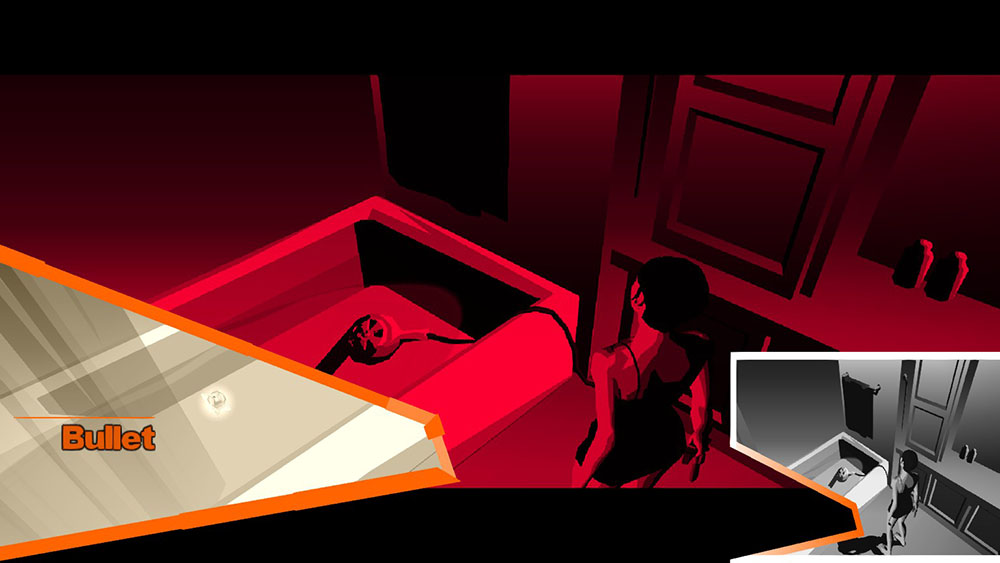
The PC remaster is mostly based on the GameCube version. One
exception is this graphical effect - in the GameCube original the
player character wasn't tinted red during scene transitions.
A surprise updated released in October 2024 fixed that,
though.
As of this writing Killer7 is only available brand new for the
PC. There were rumours of a Nintendo Switch port, but so far nothing
has come of it. If you have an original GameCube copy of the game it
should work on a Nintendo Wii as well, because the Wii was backwards
compatible. Is it available on Sony's PSNow streaming service? No, it
is not.
The PC remaster has support for widescreen monitors and HD
resolutions, plus mouse and keyboard controls. The levels, music,
cutscenes and so forth are unaltered, including the use of GameCube
button prompts.
There's some debate as to how the mouse and keyboard interfere with
the gameplay. Killer7 is fundamentally a shooting gallery
game, in which case mouse aim is a godsend, but unlike
Unreal Tournament the shooting is slower-paced, more
measured, so I'm going to assume that it plays for me much as it
played for people back in 2005 with a GameCube controller.
Let's talk about the plot. Killer7 takes place in the near
future, at a time when the world is threatened by a mysterious plague
that turns people into explosive zombies called Heaven Smiles. For
reasons that are not readily apparent the United Nations decides to
fight this threat by hiring a bunch of top assassins, the Killer7. The
Killer7 are led by a chap called Harman Smith, who delegates
responsibility to his second-in-command, Garcian Smith; you spent most
of the game playing as Garcian Smith.
Garcian has operational control of the Killer7. He's a relatively weak
fighter, but he has the power to resurrect any of the seven if they die.
Each of the seven has a different set of skills, and part of the gameplay
involves switching from one character to the other to solve puzzles. Con
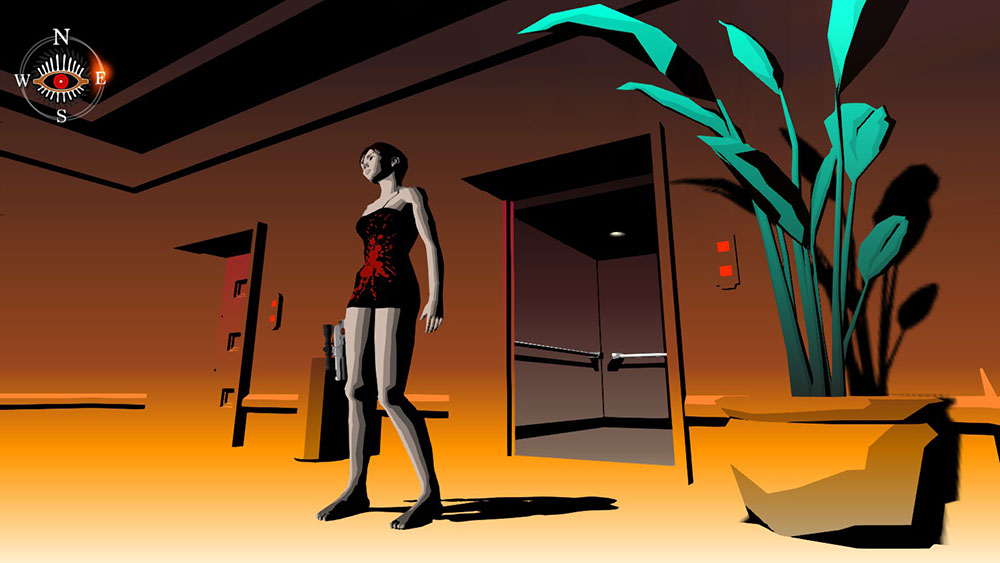
Smith, for example, is small, so he can fit through gaps:
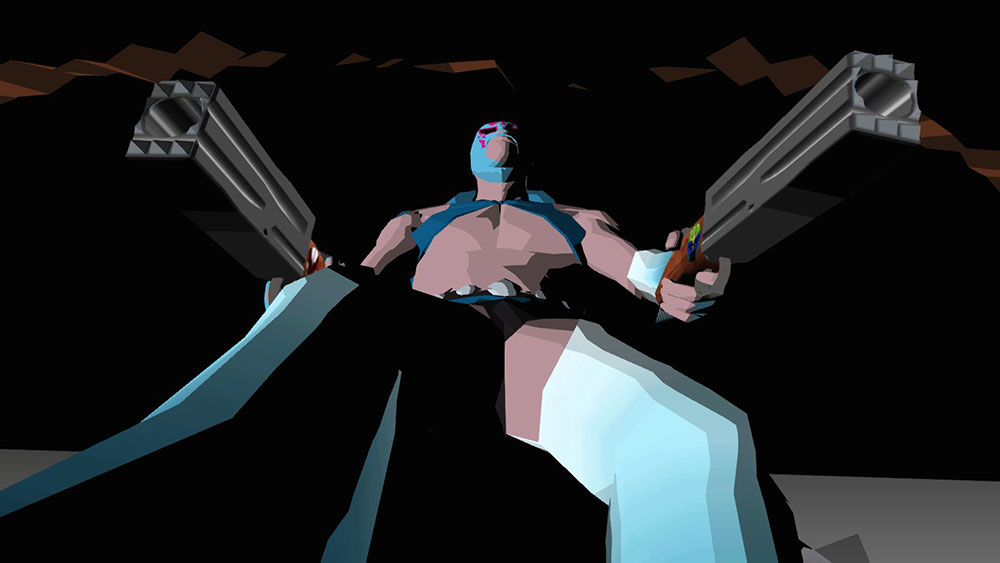
Coyote Smith is a petty thief who can pick locks, Mask De Smith is a
masked wrestler who can blow down destructible walls, Kevin Smith is a cat
burglar who can turn himself invisible, and KAEDE Smith can uncover hidden
messages by spraying walls with her blood. Each of the seven also has a
signature weapon. KAEDE has a scoped pistol that can hit distant targets,
for example, and Mask has grenade launchers that can take down giant
mutants.
The odd one out is Dan Smith, who is the plain vanilla Killer7. His only
special power is a twelve-shot, double-barrelled revolver, and he's very
handy with it.
At this point I was going to make some sweet references to top 80s indie
band The Smiths, because the characters are all called Smith, but the game
already has a lot of references to The Smiths, so that joke would be
redundant. The game has several references to 1980s and 1990s indie guitar
bands, which dates it a bit. The hip kids of today are into L'Rain and
Jazmine Sullivan, not Dinosaur Jr and the Melvins.
The story is told with a mixture of in-game cutscenes and cartoon
animations. At the outset of the game Japan finds itself under attack from a
long-range missile strike that may or may not have been launched by the
United States. In theory this is the game's overriding plot - you're racing
to save Japan - but in practice the game forgets about the missiles almost
immediately and divides into three unrelated episodes, in which you deal
with a cult leader, a rogue cartoonist, and a competing assassin
(respectively).
When it was new Killer7 attracted so-so reviews. The critics praised
the style and atmosphere but were unimpressed with the monotonous gameplay.
My dim, dim recollection is that there was a fad at the time for auteur-led
games that had massive, lengthy cutscenes, such as Metal Gear Solid 3, or alternatively minimalist genre experiments such as
Shadow of the Colossus and Okami, in which case
Killer7 was right at the cutting edge of the games-as-art debate.
Unfortunately it's just not that good, either as a game or as art.
I'll talk about the gameplay first. Killer7 has an unusual control
scheme. The levels are divided into a series of tracks, with junctions; you
can run back and forth down the corridors and turn left and right at
junctions, just like Pac-Man, but you don't have complete freedom of
movement. Interactive objects are pointed out to you, as if they were
junctions as well.
I was surprised at how well it works. The scheme eliminates the problem in
tank-style 3D games whereby your character keeps bumping into the scenery.
After a couple of minutes I found I could fluidly navigate the maps, which
are generally not very complex. Apart from a few obtuse puzzles the gameplay
involves exploring the levels, flicking switches along the way, and
collecting special bullets that you can use to access the final boss arena.
The combat is distinctive as well. Periodically you hear laughter in the
background, which is the sign that there's a Heaven Smile lurking around. To
fight them you bring up your gun, scan the area for Heaven Smiles, then
shoot them. You can in theory just pump them with bullets until they expire,
but they all have a weak spot, and if you hit that spot the Heaven Smile
dies with a single shot. Alternatively you could shoot off their legs and
finish them off as they crawl towards you.
Some Heaven Smiles have a hidden weak spot, outlined in green. As the game
proceeds you encounter ever-more-outlandishly-mutated Smiles - ranging from
shambling zombies with enlarged limbs to giant tentacle monsters with eyes
that you have to pick off individually. In the image above the Heaven Smile
is an armoured ball. I'm just about to shoot its one and only vulnerable
face.
Every time you kill a Heaven Smile you are rewarded with some blood, and if
you kill the Smile by hitting its weak spot you get special, thick blood
that can be processed into character upgrades. The upgrade system is mostly
useful for players who just pump the Heaven Smiles full of bullets; with my
mouse I found it fairly easy to hit the one-shot-kill weak spots, so the
upgrades weren't so useful. Oddly I found that KAEDE's slow-firing scoped
pistol was more of a liability than a help, because it feels as if the weak
spots get smaller when you zoom in.
Periodically you come across ghosts of the Killer7's past victims, who
usually have some helpful hints, although often they're just there for
background flavour.
That's pretty much the entire gameplay. You run through a series of simple
mazes, collecting objects, solving puzzles, and listening to ghostly
characters drone on. One particularly annoying chap uses the same template
for all his speeches, which gets boring very quickly. I eventually ended up
ignoring him, which was unfortunate because he's essential in one level.
There are some little minigames, and a brief parody of side-on fighting
games, but on the whole you run around a lot and shoot Heaven Smiles.
You have to stop and scan the area before engaging the Heaven Smiles, and
you can't fire while moving, so the combat feels slightly old-fashioned. You
know what Killer7 reminded me of? Gauntlet, remember that?
"Elf needs food, badly"? The 1980s arcade machine? Killer7 is
essentially Gauntlet, with seven characters instead of four, and it's
in 3D, but the gameplay isn't really all that different. Seriously, if
Killer7 was viewed from the top down it would essentially be
Gauntlet. Single-player Gauntlet, because it's strictly a
single-player game.
Is the gameplay any good? The puzzle aspect annoyed me. One half of the
puzzles involves equipping a special ring in order to blow out fires, light
candles etc, which is easy. The other half of the puzzles involves
memorising background details and answering questions about them, which
isn't fun at all. It's not difficult, it's just that it's not entertaining.
Did the developers expect me to take notes with a pencil and paper?
The final puzzle is even more aggravating, because it involves listening to
a bunch of dull audio logs over and over again until you pick up on a bunch
of uninteresting details about a character you've never met before.
The boss fights generally have a puzzle aspect as well, although in almost
all cases I found that overwhelming firepower carried the day. Perhaps the
mouse control helps. The PC version also gives you hotkeys to switch
characters and heal, which speeds things up.
On the whole the puzzles range from uninteresting to annoying. The shooting
is much more entertaining, although again it's really just a slow-paced
shooting gallery. It's no more sophisticated than
House of the Dead or Time Crisis. The vast majority of the
baddies are melee-only. They walk up to you and explode, although each of
the Killer7 has a desperation defence that activates at short range. Given
the fact that two characters have quiet weapons - a suppressed pistol and a
knife - I wonder if there was originally going to be a stealth element, or
at least some more complexity.
The combat isn't awful, it just isn't very sophisticated. You shoot monsters
that slowly walk in a straight line towards you. The monsters tend to
respawn right up close, so you have to time your movements carefully, and
there are monster generators that try to overwhelm you with numbers, so you
have to carefully balance your shooting and reloading, but it never gets
complicated. Unlike for example Left4Dead there's no dynamic element
to the monster spawns, they appear in the same place every time.
Later on the game introduces baddies that can only be killed by Mask De
Smith's grenade launchers, but this just means that you have to either play
as Mask all the time, or continually switch back and forth, back and forth
from Mask to your favourite character. The downside to Mask's firepower is
that he can't collect any blood from the enemies, so if you want to heal him
or upgrade his weapons you have to switch to someone else first.
Given that fact that you can heal at any time, and Garcian can resurrect the
dead, it's hard to lose Killer7. It has a checkpoint system, so death
just sends you back a little bit. The early trailers sold the game as a
fast-paced bullet-fest, but the actual gameplay is much more sedate.
Unfortunately the plot has exactly the same problem. It moves slowly and
intermittently, and it just didn't grab me. It touches on some of the same
themes that the developer explored in No More Heroes, but not as
effectively. For example, at one point you fight the mask-wearing,
submachine-gun-toting henchperson of chief nastyman Curtis Blackburn:
In fact you fight her twice, and in both cases she isn't a pushover. The
climactic battles against Ayame Blackburn play like a parody of boss fights,
but the game makes it clear that Ayame has been tortured into fighting you,
and when you kill her the music goes quiet and she just lies there dead.
There's no sense of triumph. It's one of the few things that works, but it's
not enough. The ending sequence has a similar sense of futility, but it
doesn't have enough build-up to be truly effective.
Killer7's story really has two problems. It occasionally reaches
peaks of surrealistic mania, but they're few and far between, and it doesn't
sustain that pitch because the pace is all wrong. For every "like a flower that blooms in the soil of our carnal and corrupt
society" and "I'm talking about guys who beat off four times a day" there are hours of obtuse burbling about the relationship between Japan
and the United States. The climactic revelation that the United States'
political system is built on a lie feels far more prosaic than was obviously
intended, and I was left wondering if it was a reference to
The President's Analyst or not.
The visual style has aged well, but the storyline and overall ethos are
stuck in the 1990s. The emotionless, slick, postmodern 1990s, when nothing
meant anything and everything was just a symbolic reference to something
else. It feels like a student art project made by someone who was terrified
of making a substantial point about the real world. The world's problems
seemed to be over in the 1990s, so the art world shunned social issues in
favour of a decade of laughing at the past by recontextualising symbols.
Apart from Gauntlet, Killer7 reminded me a lot of Matthew
Barney's contemporary Cremaster films, which were big news at the
time of Killer7's development. The Cremaster films were
essentially an attempt to capture the magic of David Lynch without plot or
characterisation, but they didn't work because they were just feature-length
music videos. The kind of boring music videos that start off with five
minutes of dialogue, and there's a story about finding some lost tapes or
something. Killer7 feels like an imitation of the form of a
socio-political thriller without any of the substance. If nothing else it
made me appreciate David Lynch's Lost Highway and
Inland Empire even more, because Lynch had a knack for that kind of
thing.
The grand finale divides its time between a meditation on the political
process and a considerably more interesting psycho-drama in which the
history of the Killer7 is explored, and in my opinion the game would have
been a lot better if it had concentrated on the latter aspect.
That's a pretty harsh take, but Killer7 disappointed me. It's not much
fun as a game. The parodies of superhero comics and cults are like Frank
Zappa's jokes, e.g. they feel like references to humour rather than actual
humour. That might have been excusable if the plot had been interesting.
FAR: Lone Sails
didn't have much gameplay, either, but what it did have was thematically
consistent with the plot, which was subtle and emotionally engaging, with a
bittersweet ending. But because Killer7 was born of the 1990s it has no
emotional engagement at all - it deliberately undercuts it - and purely as a
thriller it doesn't work because everything is a reference to something else,
and nothing has meaning because quote meaning unquote itself is a
construction.
Other problems? The ending reveals that the Killer7 are not what they seem,
but it doesn't have any impact because none of the Killer7 are fleshed out.
You'd think there would be seven levels, with each of the seven given a moment
in the spotlight, but in practice only Dan is given any characterisation. The
rest have as much characterisation as the assassins from
The Pink Panther Strikes Again, e.g. none, which is a shame because the
character designs are striking, Kevin and KAEDE in particular.
And so ultimately I was disappointed with Killer7. I'm glad I played
it, because it looks great and now I know what the fuss was all about, but at
the same time it's just not all that good.