Let's have a brief look at The Elder Scrolls V: Skyrim, although at this point in time Skyrim has so completely overshadowed
the rest of the Elder Scrolls franchise it might as well just be called
Skyrim. Not Something Something Skyrim or
Skyrim Something, just Skyrim.
The ironic thing is that
Skyrim is one of the few Elder Scrolls games with an actual
Elder Scroll in it. Skyrim Skyrim Skyrim. Are you sick of reading Skyrim yet?
The huge success of Skyrim raises the question of what Bethesda will
call the sequel. The Elder Scrolls VI: Whatever will just confuse
people. People want Skyrim! They want more Skyrim! They don't
want The Elder Scrolls: Whatever. It's just confusing. The Elder Scrolls VI: Skyrim 2 sounds like a football score. Will it be called The Skyrim Chronicles: Skyrim? Skyrim: Ages of Skyrim? Skyrim and Knuckles and Knuckles and Skyrim Featuring Knuckles and Knuckles
and Skyrim?
Seriously, I have the impression that most fans of Skyrim aren't even
aware there are other games in the series. The lamers! The fourth episode,
Oblivion, was a big hit on the PS3 and Xbox 360 way back in 2006, but
that was a long time ago. The earlier games were pretty obscure.
Morrowind sold well back in 2002, but Daggerfall and
Arena were PC-only role-playing games of no great distinction.
Skyrim on the other hand is one of the best-selling games of all time,
with sales of over sixty million copies, more than the entire rest of the Elder Scrolls franchise put together.
What is Skyrim? It's a first-person open-world role-playing game by
Bethesda Software. It takes place in a generic fantasy world based heavily on Norse mythology. It has dragons,
magic, swords, simple technology etc. Bethesda's games have the same basic
template. There's a relatively dull main quest accompanied by masses of short
side-quests - players often ignore the main quest entirely, in favour of the
side-quests - plus a bunch of busywork. In the case of Skyrim the
busywork includes cooking, making potions, mining for ore, building houses, none of which
are essential, but they pass the time. The cooking minigame is particularly pointless, and yet I found myself compulsively hoarding piles of salt (an essential ingredient), because the food looks so attractive, and it made me feel hungry. If nothing else Skyrim captures the feel of chopping wood on a cold winter's day before going indoors for a hot bowl of soup.
Bethesda's role-playing games tend to have a "never mind the quality, feel the
width" element. Skyrim itself doesn't have a particularly lengthy
main quest, but it has dozens of hours worth of dungeons to explore and
mysteries to solve. On top of which it's fun to just explore the map. It takes place
in a large open world that has a day-night cycle, weather patterns, plus several hundred independent non-player characters who live their own lives.
I'm old enough to remember the likes of The Hobbit on the ZX
Spectrum and Midwinter on the Atari ST, and in theory
Skyrim should blow my mind, but it's easy to take it for granted.
One of the most popular sports on the internet is Bethesda-bashing, whereby
fans who have played Bethesda's games for thousands of hours compete with each
other to insult Bethesda as harshly as possible. In their minds Bethesda
sucks, Starfield is the worst game of all time, and Todd
Howard - the public face of Bethesda's games - is a moron, a liar, a lying
little speck of a man. And yet they can't walk away, because they're addicted.
Todd Howard has the last laugh.
Skyrim was originally released in 2011 for the PC, Xbox 360, and
PlayStation 3, and then again in 2016 as Skyrim: Special Edition for the PC, Xbox One, PlayStation 4, and then again in 2017 for the
Nintendo Switch, and again a year later as Skyrim VR for virtual
reality headsets, and again in 2021 as
Skyrim: Anniversary Edition for the PC, Xbox Series X, and
PlayStation 5. Did you get all that?
As of 2024 Skyrim is still available at full price. In theory
£40 or so, although it frequently goes on sale. Along with Grand Theft Auto V and Minecraft it's one of a handful of games that has been
on sale continuously at full-price for over a decade, which is an impressive
feat given that it has spanned three whole console generations.
Incidentally I played it on the PlayStation 4, because it was on offer for the PlayStation. The screenshots in this article are taken from the unmodified
PlayStation 4 version of the game. I found the fixed field of view frustrating when indoors, and aiming arrows is awkward with a controller, but otherwise the experience of playing the game on a console felt painless. The game did make my PS4 chug air, though, so be sure to leave a lot of space around your console for ventilation.
This character is voiced by Lynda Carter - the actual Lynda Carter, of
Wonder Woman fame. There's something immensely gratifying about being
praised by Lynda Carter.
Why is Skyrim so popular? The obvious answer is that it's a
good-looking, good-sounding game that builds on Oblivion without
doing anything particularly wrong. I'm not a fan of role-playing games, but I
quickly picked up the gameplay mechanics. Combat consists of stepping forward,
swiping, then stepping back again, and you can go a long way just with those
moves, but there's enough depth to allow for flexibility.
Unlike Dark Souls the gameplay is mostly mellow, and one upside of
Skyrim's pervasive narrative blandness is that it never becomes
emotionally overwhelming. As pictured throughout this article the graphics are
still attractive today - everything is blocky, but the colours and lighting
are lovely - and during the COVID years Skyrim even had a second
wind as
ambient entertainment for people who couldn't leave the house. At a time when people were flocking to
Microsoft Flight Simulator 2020 for their travel fix, they
also
binge-watched 84-year-old Shirley Curry
as she gleefully power-smashed raiders and giant spiders in, yes,
Skyrim.
It has aged well. Oblivion was in theory an A-list title,
but it felt janky. It had roughly a dozen voice actors for a cast of over
eight hundred non-player characters, so the characters ended up sounding the same. The AI mostly worked, but the results were often bizarre. The
combat became tiresome at higher levels, and on a visual level it was all over
the place, as if the monsters had been sourced from a bunch of different
public domain libraries.
Furthermore the pervasive use of bloom locked the game visually into the
mid-2000s. Skyrim has a side-mission that sends the player
back into the past, at which point the graphics, amusingly, turn into
Oblivion:
In contrast Skyrim is visually, tonally, literarily-ly,
writer-il-lilly restrained. It has none of its predecessor's camp excesses.
The writing and voice acting are low-key, almost dour, as if the
developers made a conscious decision that Skyrim should be
less camp and more grown-up than its predecessor. The landscape is rendered in
autumnal tones. The character models have a deliberately stylised look that
resembles wood carvings.
The supernatural elements are also toned down. Skyrim still
has mysterious underground cities, and the player can major in
magic, but it has none of the deep lore of Oblivion, with its multiple
planes of reality and occasionally baffling excursions into the minutiae of
the Elder Scrolls franchise. Did you know that the moons in the
sky are actually the decaying corpses of dead Gods? And the sun is actually a
hole through which magic enters the mortal plane? None of this troubles
Skyrim.
The player can role-play as a cat person, or a lizard, but those races appear
only fleetingly in the game itself. For the most part the baddies are
generic barbarians or more-or-less realistic wild animals, with the occasional
zombie. There's a stereotype that fantasy games are full
of Playboy models wearing chainmail bikinis, but
Skyrim has none of that beyond the occasional bare arm.
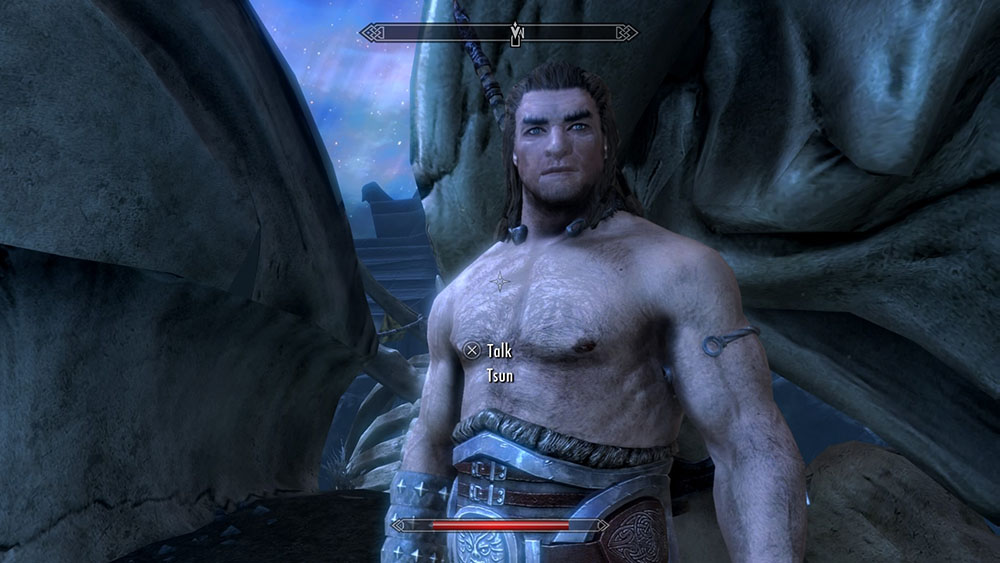
Now, I'm 100% heterosexual, but if Tsun here ever needed someone to plait
his chest hair I would happily volunteer.
Chest hair. Even the main plot feels more grown-up. The Empire of Cyrodil is
being pressured by its more powerful neighbour to give up its old
superstitions. The Emperor agrees, but this causes the most
traditionally-minded part of the Empire to break away. A civil war seems
inevitable - a war that the Empire can ill afford - but just as
Skyrim gets going a more pressing issue arises. Dragons! They were
killed off long ago, but now they are returning, led by a particularly bad
dragon who wants to use the people of Skyrim as food.
The player is an amnesiac drifter who begins the game under
arrest, on pain of imminent execution. I decided to role-play as Robert Plant,
lead singer of Led Zeppelin, because the game is full of Vikings, and the main
character has a special power whereby their voice can knock dragons out of the
sky, which is true of Robert Plant as well.
Skyrim is full of books. They're mostly just flavour, although
some of them can boost the player's skills. I was amused by the presence of a
fighting fantasy / choose your own adventure book:
Is that postmodern? I think it is. The developers intended for the civil
war to be a dynamic wargame along the lines of STALKER: Clear Sky,
but for whatever reason most of it was cut during development, with the result
that the war only amounts to a pair of mission chains. I have to admit that I
wasn't even aware Skyrim had a civil war until I started playing
the game. I thought it was all about dragons. Dragons in Norway, because the
map, the accents, the buildings are all based on Old Norse mythology.
Skyrim suffers from erratic writing. Sometimes it's good. The
rebel leader, Ulfric Stormcloak, is a particularly interesting figure. He has
some dubious followers who believe that the province of Skyrim should be
Vikings-only, but the Empire itself is no better, forcing the aforementioned
cat-people to conduct their business outside city walls and only grudgingly
allowing the lizard-people to enter cities. But on the other hand Ulfric's
actions weaken the Empire at a crucial time, and yet if the Empire continues
to give concessions to the baddies, why does it exist?
None of this is highbrow, but it's surprisingly nuanced. In the
hands of lesser writers Ulfric could have been a cartoon villain. Instead he
comes across as a tragic figure, doomed to long-term failure no matter how the
war goes. In a nice touch his home city is, as he points out, run-down and
neglected, because the Empire doesn't care about its distant provinces, insert
political shoehorn here.
In contrast the main plot, with the dragons, is much simpler. Which leads to
the game's biggest problem. For all its size, for all the things that exist to
divert the player's attention, none of it feels meaningful. It doesn't have an
emotional payload. I didn't care much about the civil war, and the dragons
don't come across as a particularly dangerous threat - after the player has
levelled up a few times the periodic dragon attacks lose their shock value and
become slightly irritating interruptions. The chief evil dragon, Alduin the
World-Eater, has an awesome name, but I never had a handle on his character. He's just a big mean dragon. For
gameplay reasons the side characters tend to be interchangeable, so
despite the mass of NPCs Skyrim often feels empty.
Fleetingly, intermittently, I felt things. One side-quest in which I helped a
ghost find justice stood out because the voice actor -
Babylon 5's Claudia Christian, no less - really sold the role:
And another sequence, in which I infiltrated a cult that had committed ritual
suicide, stood out for the following terse note:
Followed by the horrible realisation that the small steps I had just trodden
on were not steps:
But for the most part the quests blend into each other. Each one involves
clearing out a dungeon, or the lair of an undead dragon priest, and although
the environmental storytelling is much more elaborate than it was in
Oblivion, it's not on the same high level as the
Fallout games. After a while it felt as if the game was washing
over me.
Now, Skyrim is still great fun, and as mentioned earlier
the lack of emotional grip means that it's easy to dive into the game
periodically, but even the Fallout games had an underlying story,
an underlying theme. Skyrim doesn't have that. It's not about
anything. There are no twists, just mission after mission.
Skyrim also continues the Elder Scrolls tradition of
having some high-profile voice actors who are barely featured in the publicity
materials, which raises the question of why the developers bothered.
Oblivion had Patrick Stewart and Sean Bean, who admittedly was very good in his role.
Skyrim has Christopher Plummer as an old man, and Max Von Sydow as
another old man. They both have one big speech apiece. Great actors in real life, but
they don't stand out in Skyrim.
The game also features Joan Allen, who gives a good performance in a difficult
role. She plays Delphine, leader of an outlawed sect who quickly realises that
the player character has hidden potential. She illustrates both the strengths
and the weaknesses of the game's writing. Most of the decisions she makes are
wrong, and as with Ulfric Stormcloak she comes across as a doomed figure,
fated to spend the rest of her days trapped in an isolated monastery with a
bunch of followers who no longer have a raison d'etre.
Which could have been the basis of an interesting storyline - everything seems to
be leading to the conclusion that Delphine's dogmatism has no place in the modern world - but it never resolves,
presumably because the developers wanted her to remain in the background as a
source of radiant quests. The overall lack of character growth or change is
disappointing, but again the developers had to build a world that worked
equally well for a low-lever player powering through the main quest, and a
high-level juggernaut just chilling, so the opportunity for character change
is very limited. The civil war ends with one set of local functionaries being
replaced with another set, but the new bosses are more or less the same as the old
bosses.
The game also has Lynda Carter, as mentioned above. In the 1980s Carter
married the co-owner of the company that now owns Bethesda, and she appears in
several Bethesda games, presumably as a favour, dating back to
Morrowind in 2002. One mission in Skyrim involves
accompanying her character into battle against a particularly tricky foe,
after which she praises the player to the skies. It struck me that this is one
of the things that makes video games so appealing. They're a wish-fulfilment
fantasy in which the universe revolves around the player, and Lynda Carter thinks you're terrific. Is that so bad?
Do I have anything else to say about Skyrim? The music is lovely.
There's masses of it. I was particularly struck by a simple piano piece, which
I learn from the internet is widely beloved. It's called "Secunda" and it has
a clever bit where the piano goes down. That's right. Instead of staying the same, the piano goes down.
At times the combination
of lovely music, butterflies, the wind in the trees etc made me wish there was
a mod that could turn off the monsters, turning Skyrim into an
ambient wandering experience. And perhaps there is, because on the PC at least
there's a popular modding scene. This mostly seems to involve turning the
characters into anime dolls, but that's because most people are manko, a word that I just invented.
Anything else? Ice-T once said "don't hate the player, hate the game". Every
baller on the street is searching for fame. Skyrim has been indirectly responsible for some of
the least entertaining internet content ever. A handful of NPC stock phrases
have been turned into unfunny internet pseudo-jokes. "I took an arrow to the knee",
"something something cloud district", "never should have come here". None of
those lines are funny in the game, and they aren't funny otherwise. So much
internet humour is based on the simple repetition of stock phrases. It's just no good. Youtube is also full of
multi-part Skyrim "let's play" videos that usually begin with the
narrator saying "hi youtube be sure to like and subscribe what's up".
"But at least some of this content must be good" - if there's one thing I've
learned from being on the internet for thirty years, it's that you can
comb through the creative efforts of millions upon millions of people, and
still find nothing of value. You know what's the worst? Blog posts. They are
horrible.
There are also entire websites dedicated to scraping content about
Skyrim, notably GameRant, which regularly reposts messages from
Reddit's Skyrim subreddit as news stories. "This Player Found a
Crazy Detail in Skyrim", "These Players Miss This Thing That
Skyrim Doesn't Have", "Here are Ten Insane Things You Might Have
Missed in Skyrim", that kind of thing. Skyrim has been
responsible for some of the most worthless content on the internet, but that's
not the fault of Skyrim. Who is to blame? People. It's our fault. You and me.
Still, in summary Skyrim has a mass of content, and as per
Bethesda's other games it works as role-playing junk food. But it doesn't mean
anything, and I didn't feel anything, so after finishing the main quest and a
scattering of side-quests it has started to drift from my mind. Nonetheless as a form of
ambient entertainment it is tops, and it looks and particularly sounds
wonderful.
Can you guess what I'm doing? That's right, I'm riding a motorcycle. Obviously
this makes more sense if you're watching the video version of this blog post.
Just pretend.
A few years ago I didn't own a motorbike, but then I saw this video by top
Canadian motorcycle channel FortNine:
That led me to Itchy Boots, a motorcyclist who drives up and down Africa and
South America, and RevZilla, who are a bit like FortNine but from the United
States, and now I own two motorcycles. If you aren't careful it will happen to
you.
Why did I bother? I've managed to avoid learning how to drive a motorised
vehicle well into middle age. If you're an urbane hipster living in London
there's really no point. However I now live in the countryside, and although I
don't have a pressing need for motorised transport it's nice to get around. In
the UK the quickest way to get hold of a motor vehicle is to do a half-day
Compulsory Basic Training course, at which point you're allowed to drive a
125cc motorbike or scooter for two years, so I did that. One year
later I saved up for a series of proper training courses, and in March 2024 I
passed my test...s, tests, plural, because there are two.
Well, technically there are three. I'll get to that. One thing struck me
throughout the process. My motorcycle training establishment had no
shortage of students, and there were at least five other people taking their
final test on the same morning as me, but outside the training grounds they
all seemed to vanish. Where did they go?
Motorcycles: The Case Against
The fact is that motorcycling just isn't all that popular in the UK.
Motorbikes are outnumbered thirty-to-one by cars, which is sad because
motorbikes have a lot going for them. I've always assumed they had their
heyday in the UK in the 1970s, the decade of Barry Sheene, Chris Spedding, the
hot summer of 1976, Junior Kick Start etc. All those punk
leather jackets had to come from somewhere. But
according to this academic paper
motorcycle ownership in the UK actually peaked in 1960, a decade earlier,
having more than doubled since 1950. That paper links to a fascinating report
from 1975,
Strategy Alternatives for the British Motorcycle Industry, which is a dry read, but informative.
The report points out that motorcycles had two heydays. In the post-war years
they were a viable alternative to the car as cheap transport for the masses.
They weren't very practical, but they were a lot more convenient than a horse.
As a consequence the first generation of post-war motorcyclists tend to be
associated with the working classes, and in the United States with
the Hollister Riots, which were blamed on uncouth service personnel and working-class louts on
their weekend off. That plus Marlon Brando in
The Wild One cemented the image of motorcyclists as rough, tough,
devil-may care rebels, which is hilarious nowadays because the average
motorcyclist nowadays is middle-aged.
Ownership declined in the 1960s in the face of stiff competition from the car
- according to
this article
car registrations increased more than five-fold from 1950 to 1968 in the UK,
with an awful lot of those people ditching their motorbike for a BMC Mini. But
sales recovered in the late 1960s and 1970s, because the motorcycle was cool!
People who were too young to participate in the Hollister Riots or see
The Wild One at the cinema were suddenly hit with
Easy Rider and Electra Glide in Blue. The motorbike took
off as a lifestyle accessory for people who already had a car, thus the
popularity of Barry Sheene, Chris Spedding, Kick Start etc.
As Strategy Alternatives points out the market had by the
mid-1970s become saturated, and a combination of that and stricter licensing
sent motorcycle ownership into decline again in the UK, reaching a nadir in
the mid-1990s. Luckily sales have recovered again over the last twenty years,
and I like to imagine that YouTube hasn't hurt. I have the impression that the
1970s was the last decade when British people were prepared to buy a motorbike
instead of a car, as practical transport, but given current economic
pressures, who knows? I actually bought a bike purely as a commuting tool,
because it's cheaper than a car - in particular petrol and parking are much
cheaper, although on the flipside insurance is steep.
I mentioned licensing. Before 1982 the UK motorcycle test consisted of driving
around the block a few times and doing an emergency stop. There was no
requirement or even expectation for formal training, so it was easy for
youngsters to hop on a motorcycle and admittedly kill or seriously injure
themselves. From 1982 the test involved a riding-around-cones element, and
from 1990 it was made harder still, which has greatly reduced motorcycle
deaths, but has had the side-effect of excluding anyone under the age of 22
from driving a full-sized bike. As of 2024 a motorcycle test is just as
complex as a car test, so why bother with it?
As a consequence the average age of a motorcyclist in the UK is apparently 54,
according to Honda, which jibes with figures from the United States, where the average is
apparently 49. Part of the reason for this is the the full A-class licence is
only available at the age of 24, or 22 if the rider has progressed through
from the A2 licence. Another part of the reason is that older riders tend to
own more than one motorcycle, which skews the figures upwards; anecdotally,
London seems to have plenty of young riders buzzing around on L-plates, but
they only own one motorcycle.
The ageing population of bikers is
a major pain
for the likes of Harley-Davidson, who are stuck between a desire to appeal to
a dwindling pool of ageing riders while simultaneously appealing to new riders
who have grown up with TikTok and internet memes. Hanging over everything is
the spectre of electric bikes, which generally appeal to a young, tech-savvy
generation that can't legally ride them.
On the other hand the population of old people is growing all the time, and
every so often a young person grows old, and short of a major plague or solar
flare I suspect that old people will be with us forevermore. One day we will
all be old.
Putting the Boot In
There are a number of other reasons why motorbikes are a hard sell in the UK.
The climate doesn't help. There's a widespread perception that they're
deathtraps, or at the very least that a motorcyclist can do everything
correctly but still be killed through no fault of their own. There's also the
fact that British cities are smaller than their counterparts in the United
States, with superior public transport. And the most popular type of
motorcycle in the world, the 125cc type, is a frustrating fit for British
roads, being just slightly too slow to comfortably ride on motorways and
faster A-roads. In Africa, India, and South-East Asia, where the roads are
jam-packed, a 125cc is perfectly sufficient, but I can't imagine it being much
fun to drive on the A303 with a 125.
People will always want cheap transport, but that need is increasingly being
met by electric scooters and electric bicycles, neither of which require a
two-part test and a load of expensive safety gear. Did I mention that you
can't take your mates out to the beach on a motorbike? At least not without a
sidecar, which you can't legally use unless you've passed your full test. And
there's insurance. In the major cities insurance is enormous, because bikes
are theft magnets.
But
Motorcycles do have some things going for them. The days of oil-spewing
two-strokes are long-gone, and all modern motorcycles are EURO 5 compliant.
Even the absolute highest-performance street superbikes will do over 40 miles
to the gallon, with 125cc models double and sometimes triple that. Road tax is
£24 a year. Parking is in most places free. Motorcycles can squeeze through
gaps that confound cars, and in the UK filtering between lanes is perfectly
legal. Furthermore if you've ever wanted to have a conversation with a
middle-aged man about parking, a motorcycle will break the ice. And they're
fun to ride on the rare days the UK has sunshine.
If you're a speed freak motorcycles also have an incredible price-performance
ratio. A Suzuki Hayabusa costs around £18,000, but it will accelerate from
0-60mph in under three seconds, a second faster than an Audi S3 (around
£50,000). It has an electronically-limited top speed of 184mph, slightly
faster than a BMW M2 (£65,000), or indeed a Lotus Carlton, although I I'm showing my age again
Admittedly a car will also carry luggage, and a car is much less likely to
send the driver flying hundreds of feet through the air in the event of a
crash, but if you only have £18,000 and terminal lung cancer (for example)
there are fewer more spectacular ways to end it all. And there are plenty of
bikes much cheaper than a Hayabusa that will outpace a mid-range Ferrari.
The Point, At Last
But how do you get to ride a motorcycle in the UK, in the modern age? As
mentioned earlier, before 1982 the test involved driving around the block a
couple of times and doing an emergency stop. The majority of riders didn't
bother with formal training. From 1982 a ride-around-cones element was added,
and from 1983 the 250cc training limit was reduced to 125cc. A loophole
whereby trainee riders could own a high-capacity bike as long as it was fitted
with
a tiny vestigal sidecar
was closed at roughly the same time. The modern system came into being in
1990, although there have been tweaks since then.
As of 2024 there are four elements, technically five:
0. You have to own a helmet. This isn't part of the testing regime, but
it is the absolute legal minimum amount of safety gear you need to own in
order to ride a motorbike. Ideally it should be a government-approved helmet
with a SHARP rating. I
bought an Airoh Valor, which has a five-star SHARP rating. It set me back
around £110.
In addition you will also want a pair of gloves, preferably with some kind of
armoured palm protector, plus a tough jacket, tough trousers, tough boots,
ideally boots that prevent your ankle from being crushed. I ended up buying a
bunch of second-hand gear from eBay. Getting hold of safety gear is one of
those unpleasant hidden costs of motorcycle ownership, but on the other hand
it lasts forever and you're treating yourself to some cool new duds. If you're
a woman, don't forget to flip your hair whenever you take off your helmet.
1. A
Compulsory Basic Training (CBT) course, which takes four hours or so and has a mixture of riding-around-cones,
navigating junctions, and riding on the road. It's a miniature version of the
full-on motorcycle test. A CBT costs around £150 although prices vary
depending on the school.
In order to book a CBT you need at least a provisional driving licence. It can
be done on either an automatic scooter or a geared motorcycle, up to 125cc
capacity, but it doesn't lock the rider into a particular category. I did my
CBT on an automatic scooter, but I bought a geared motorcycle and taught
myself how to change gears while riding on my CBT certificate.
16-year-olds are restricted to a 50cc moped, and having briefly ridden a 50cc
moped during my own CBT I don't recommend it. In the UK they're restricted to
30mph, which strikes me as dangerous. I have to admit that I was absolutely
terrified before doing my CBT, because I'd never ridden a motorbike of any
kind before, but I have spent most of my life riding a bicycle, and the basic
principles are similar. A motorcycle feels like a big, heavy bicycle with lots
of luggage. Motorcycles tend to balance themselves with a bit of throttle, so I
quickly learned that if I felt slightly wobbly I just had to twist my right
wrist a little bit.
Once the CBT is over you are entitled to ride on the roads for two years with
front and rear L-plates, but not motorways, and you can't carry a pillion
passenger or fit a sidecar. You can however use dual carriageways, which are
bracing. After the two years are up you can, in theory, book another CBT, and
there's nothing to stop you from riding indefinitely with back-to-back CBTs.
This appears to be how Deliveroo drivers manage things, which explains why
there are so many scooter drivers buzzing around on L-plates. If you want to
progress to a full licence you need...
2. A
theory test, which
costs £23 and is booked via the government's website. This consists of a
mixture of Highway Code-style questions, plus some short CGI videos. During
the videos you have to hit a button whenever there's a developing hazard, as
if you were playing Dragon's Lair in the arcades. That dates me. I
passed by a single point, largely because of the hazard section. The two parts have
separate qualifying scores, e.g. you can't ace the multiple-choice questions
and then give up on the hazard perception section, you have to do well on
both. When that is done you have two years to book...
3. The dreaded Mod 1, technically the
Module 1 Off-Road Test. The name is slightly confusing. It doesn't involve driving up hills or
through country paths. Instead it takes place in a flat area covered in grippy
tarmac that is literally off the public road. The Mod 1 test involves weaving
through cones; doing a couple of figure-8s through some more cones; riding at
walking pace to a stop line; performing a controlled U-turn; driving around an
imaginary bend in the road before performing a controlled stop; driving around
the same bend before performing an emergency stop at a speed of at least 50kmh
/ 31mph; driving around the same bend before performing a swerve around an
outlying cone, again at 50kmh / 31mph.
One thing it doesn't test is riding up to, and pulling away from a junction.
The test is closely-monitored, and it is possible to fail even before entering
the arena, if the instructor judges that the student isn't in control of the
bike. In particular the tests involve a certain amount of role-play - the
student has to pretend they're on a public road, performing mirror
checks and lifesavers as necessary.
After a year commuting in slow traffic I had no trouble with the cones. The
U-turn was difficult because in real life I would put my foot down, which you
aren't allowed to do on the test. Getting up to 31mph on the training course
was hard, but at the actual test ground it was easy. I wonder if the training
course was deliberately made slightly smaller?
I passed my Mod 1 with one minor fault, observation. There's a general
consensus that it's the hardest part of the process, because it feels
artificial, and there are no second chances. If you knock over just one
cone you fail. Put your foot down? Fail. Momentary lapse of reason? Delicate
sound of fail.
On the other hand it's a defined set of manoeuvres with no traffic, no chaotic
elements, obvious pass/fail requirements, and I found it the easier of the two
tests. Perhaps because I grew up playing computer games, where you either win
or lose, and if you touch the sides you die.
You can in theory book the Mod 1 test yourself, and turn up with no training
at all. It costs £15.50. Bear in mind there are a limited number of test
venues - in my experience the hardest part of the test was the thirty-mile
ride to the test centre - and you have to supply your own bike. The Mod 1
is the point at which you are locked into a certain class of motorcycle, and with a
CBT you're restricted to a 125cc, so in theory the only bike you can ride to
the test centre and take the test on is a 125cc.
In theory you could hire a full-sized 650cc bike and have it delivered to the
test venue. Perhaps a friend could ride it there. But you would need to be
insured during the test, which strikes me as not a trivial ask, and bear in
mind that the DVSA is literally the DVSA; they won't turn a blind eye. But on
the other hand perhaps you really do just want an A1 125cc licence, in which
case my tips are (a) do shoulder checks compulsively (b) and a lifesaver
during the U-turn.
With the Mod 1 under your belt the final step is...
4. The Mod 2, the
Module 2 on-road test. Some riders find this easy, and if you're an experienced car driver who
knows the roads I imagine it's not hard at all. But I don't drive a car, and
the local area has some tricky roundabouts, so I dreaded it. But I passed. The
test involves reading out a numberplate from a distance, then answering some
technical questions, then navigating the local area for around forty minutes
under test conditions, so you can't skimp on over-the-shoulder lifesavers and
shoulder checks. The instructor follows you in a car or motorcycle,
communicating directions via radio. Sometimes the directions are "turn left"
or "turn right". Sometimes they're "follow the signs to X". If you take the
wrong turn that's not a fail, unless you do so dangerously, although if you
consistently refuse to navigate a roundabout - let's say you take the first
exit all the time - the instruction will eventually fail you.
On three occasions the instructor asked me to pull over to a safe spot at the
side of the road, which was nerve-wracking - was that it? was it all over? -
but no, I pulled off again. The first two times there was no traffic; the
third time there was. In theory there's a hillstart, but I didn't notice one.
I assume it was part of my regular riding. The Mod 2 test doesn't include a
U-turn or emergency stop, presumably because they would be far too dangerous.
In the end I was convinced I failed in the first ten minutes, so I relaxed.
And then later in the test I was convinced I failed again - I passed very
close to a person getting out of car - but I carried on. Ultimately I had six
minors, but they were spread across the different riding categories. You're
allowed a total of ten minors, but no more than four in a certain category, so
it pays to be averagely bad. If you crash, or cause another road user to take
avoiding action, or the instructor has to intervene, the test is an instant
fail, although the instruction might continue until you return to home base
before telling you the bad news.
The technical questions are available
on the government's website. Your instructor will go through them, and bear in mind that some bikes have
an oil level window, other bikes have a dipstick. It's called a show-me,
tell-me test, because some answers involve demonstrating the procedure while
others merely involve describing them. You are allowed, nay expected, to
answer literally. When do you use the emergency engine cut-off? In an
emergency. That is the correct answer.
And that's it. Having passed your CBT, your theory test, your Mod 1, and your
Mod 2, you are now a motorcyclist. After passing my Mod 2 I was reminded of
the final shot from Lawrence of Arabia:
I remember thinking "was it worth it" and "what now" and "how much would it
cost to ship my bike to Peru" and "how much is a drone" and "if I'm going to
be a YouTube star, what will be my gimmick" and "do I need a gimmick? can't I
just be really, really good" and "we should send cows to Titan, the
methane-rich moon of Saturn, to show them the error of their ways".
Is there anything else? There are complexities. In the UK there are
four different licence categories, split into automatic and manual pathways. A manual licence entitles the
owner to drive an automatic in the same category and below, but not
vice-versa, and you have to do your Mod 1 and Mod 2 tests on (a) the same
category of machine (b) the category of machine you intend to ride. One thing
worth mentioning is that no matter which licence you go for the tests are
identical, so if you're over the age of 24 you might as well go for an A-class
licence.
AM is for 30mph mopeds, scooters, three-wheelers and light
quadricycles. It's the only category available to 16-year-olds and it strikes
me as a very narrow niche. A1 is for 125cc motorcycles up to 11 kW / 14
bhp, or 20 bhp and any capacity for tricycles, although as far as I can tell
no such vehicle exists. You have to be 17 to qualify for an A1 licence.
A2 is for machines up to 35 kW / 47 bhp, which is actually a useful
power range. Most of Royal Enfield's motorcycles are A2-compliant, for
example. It also covers bikes that have been electronically restricted to 35
kW, but only if the original bike has a power output of less than double that,
e.g. 80 kW. The idea is that you can complete your A2 test at the age of 19,
and then when you do pass A-class test you can use the same bike, but destrict
it. I proof-read these posts a day after I publish them, and I'm going to leave "80 kW"
as a warning to my future self to never again attempt to multiply two numbers.
The A licence has no limits. It's available from the age of 24,
but there's also a progressive access scheme whereby if you've been driving on
an A2 licence for two years you can pass the test at the age of 22. And
there's also an A1-A2 progressive access system, but I'm fuzzy on the
details.
I admit to not being sure about the regulations regarding sidecars. The
popular
Ural motorcycle/sidecar
combo is A2-compliant, but the government's website implies that only
A-licence holders can use them.
One thing that struck me throughout the process is that there's no separate
test pathway for automatic scooters. The law treats them as motorcycles
with an automatic transmission, but they're almost a separate category of
vehicle. I mention this because if you want to ride a scooter with a capacity
over 125cc - such as a 300cc Vespa GTV - you're almost railroaded into
an A-class geared motorcycle licence. A-class, because why bother with A2? And
geared, because there are only a handful of automatic motorcycles, and very
few riding schools have access to A2-compliant automatic scooters. This is probably
the main reason why the Suzuki Burgman / Yamaha X-ADV maxi-scooters
are so rare in the UK. If you're going to go the whole hog, why not go the
whole hog?
Do I have any tips? The first time I rode a geared bike I held the handlebars in a death grip. But that is not the way. You are instead supposed to grip the bike with your thighs, so that when you go over a bump you don't jerk the throttle. This is one area where knowing how to ride a bicycle was useful.
You will stall in embarrassing situations, e.g. after waiting for ages at a roundabout, just as a small gap appears. Always remember that "slow is smooth, and smooth is fast". Formula One icon Pastor Maldonado was fast, but he wasn't smooth, and in his career he only won a single race. It's tempting to slowly release the clutch until the bite point, and then just let it open the whole way, but you have to be smooth.
At every stage in my training I remember thinking "who am I kidding" and "what am I doing" and "never again will I criticise the man in the arena" and "is that sexist" and "no-one can see inside my mind" and "that's okay then" and "am I saying this out loud" and "echo echo echo echo".
How did I cope with the gnawing, nagging fear that I was out of my depth? I thought about royalty, and world leaders, and people who are born into wealth. As children they have a personality. There is a little boy or girl or person within them. But they are taught from an early age to bury their personality. To act in a certain way, dress in a certain way, hold certain opinions, as in a Bret Easton Ellis novel. They are taught to obliterate their animal self and instead become a construction, and that is how I coped with the nerves. I put my personality into a box and told it to wait until later on. At some point I will have to retrieve it.
And with that I bid you adieu. After hitting "post" I will drink myself senseless,
and at three o'clock in the morning it'll dawn on me that I've left out a
crucial detail. But it will be too late, the damage will be done.