Showing posts with label agfa. Show all posts

Sunday, 16 October 2016

Agfa Clack

Agfa Clack, Fuji Velvia 100

Let's have a look at the Agfa Clack. It's a simple, toy-like camera from the late 1950s, essentially an update of the company's box cameras, but with an eye-level viewfinder.

It's cute:


Shown here with a red Rollei bayonet filter, which fits neatly over the lens, although it doesn't stay on unless you use blu-tak. The Clack shoots in 6x9cm format with standard 120 film. The shutter speed is around 1/30 second, plus bulb, and it has two selectable apertures - apparently f/11 and another one, either f/13, f/16, f/12.5 depending on who you ask. There is also a close-up lens. There was a flash unit, which attaches to the metal prongs on top of the camera.

The inside of the camera advertises Agfa's film:


In my experience any black and white film will produce usable images in daylight; don't worry about that. I shot a mixture of Ilford 125, Fuji 400, and even a roll of Ilford 3200 and they all came out fine. I stand developed them with Rodinal. I haven't tried colour print film.


I shot some Velvia 100, which was overexposed in bright sun but spot-on in the shade. If you plan to shoot slide film on a sunny day use Velvia 100 with a polarising filter, or Velvia 50 without a polarising filter. Remember to shade yourself from the sun, and also remember that a technically wonky image of something interesting is far better than a technically perfect shot of something boring.


The Clack's image quality disappointed me. Not because it's awful, but because it's too good. The Holga has a cult following because of its ropy plastic lens, which is sharp in the middle but soft and dreamy around the edges, with tonnes of distortion and vignetting.

In contrast the Clack's simple lens is pretty good. It has mild vignetting, no obvious distortion, and it's decently sharp across the whole frame. With colour film there is noticeable CA but in Agfa's defence they probably didn't think people would use expensive colour film in their cheap camera. Contemplate the following:


With a sharp eye you can pick out the Peggy Guggenheim Museum. Here's a 100% crop from the middle of the image, which I have sized down to 3000 pixels wide:


And here's the extreme corner:


Optically that's excellent for a cheap box camera. As the internet is wont to point out, the Clack's box doesn't hold the film flat, instead the film curves to fit the chassis, which apparently helps combat field curvature of the lens. I had always assumed this was internet rubbish, but perhaps it is true.

Marino Marini's "The Angel of the City", photographed with a Moto G. You have to wonder if Peggy Guggenheim ever... you know, test-drove the sculpture. I imagine it was cold.


The 6x9cm format takes eight shots on a roll of 120, so it pays to develop your own film. The Clack's only other control is a winding knob, and as with the Holga you have to check the film count by looking through a small red window at the frame numbers on the back of the film. If you forget to wind the film on, you get multiple exposures:


Do I have anything else to say about the Clack? You can fit four rolls of 120 film inside the camera for transport - one in each spool and two in the light chamber. With a bulb setting and a tripod mount the Clack is a popular pinhole conversion. It's surprisingly hard to press the shutter button without jogging the camera. There's a tiny handstrap running along the left side of the case, but it's too small to use unless you have tiny hands. My Clack's shutter was intermittent at first, so I opened up the lens and fixed it. The shutter is triggered by a piece of metal sliding along another piece of metal, so I polished the two pieces of metal and then it worked. So many things can be fixed by blowing on them or wiggling them or polishing them. If only we could do the same with people.

Also, the Agfa Clack is one of the few cameras named after a sound. The only others I can think of are the Konica Pop, the Canon XapShot, and the short-lived Nikon Crackle-gurgle-bang-hiss-roar-throb, which was pulled from the market in the wake of 9/11 for obvious reasons. Have you ever read about the Italian futurists? They were hot for noise-sounds. Luigi Russolo's 1913 essay "The Art of Noises" envisaged a future in which musicians could use all kinds of sounds to make music - not just the melodic scrapings of violins, but also whispers, animal noises, and hissing, and today we have Bjork. How could they have known?

Furthermore, in his classic work "Zang Tumb Tumb", published in 1914, Filippo Tommaso Marinetti wrote "pic pam pam crépitation d'incendie TOUM TOUM couchez-vous c'est le Brion quit tire ssssrrrrappnells... PIIING... sssrrr zit zit zit PAAC", and that is all I have to say about the Agfa Clack.

Friday, 9 January 2015

Agfa Vista 200


Today we're going to have a look at Agfa Vista Plus 200. It's a cheap film often sold in pound shops, where it costs a pound. Everything is a pound in pound shops. That's why they're called pound shops.

Yeah but shouldn't they be called half-a-kilogram shops because of the EU that joke wasn't funny the first time shut up die die die.

Not long ago Britain's eBay sellers cottoned on to the fact that they could buy entire boxes of the stuff from the local pound shop and sell it on eBay for two pounds a roll. And so it's quite possible that your local pound shop has a blank empty space where there was once some Agfa Vista, briefly, at 08:29, when the store opened.


The same people would probably have a hoard of .22 ammunition in their basement if they were allowed to buy .22 ammunition, which they are not because this is the UK, where you need a special permit which they do not have because they don't own their own lodgings and are thus not in a position to mount a secure ammunition storage box on a load-bearing inside wall.


Agfa went bust over a decade ago, and so I have always assumed that Vista Plus is another film put in Agfa boxes. Why bother? Does the Agfa brand still mean something in continental Europe? I have no idea.


A long time ago pound shop film tended to be Ferrania Solaris, which I tried a few times and liked; it was grainy but warm. Ferrania gave up on the film business a while back. Nowadays the other pound shop film is Kodak Colourplus, which I don't like at all. The colours tend to be washed-out, with purple shadows.

Vista, on the other hand, is really nice. My hunch is that it's Fuji Superia or something else by Fuji. It scans with a slightly green cast, which is a Fuji thing. The edge codes are Fuji-esque. I'm picking Fuji, diamond gel.

In my experience Fuji's print films have nice vivid colour with occasionally over-the-top greens and blues, otherwise it's neutral enough and has little enough grain that you can scan and Photoshop to your taste. For the most part I set the black level from the film border, which is handy for getting rid of colour casts, and then use "auto contrast" to spread out the rest of the levels.


It's a 200-speed film usually available in 24-shot rolls. My hunch, and I haven't tried this, is that you could shoot at ISO 100 and ISO 400 and process the results to look decent.

Last month I went off to Marrakech, and I took a roll of Agfa Vista just for the hell of it. In the end I appear to have loaded it in the Ben Youssef Madrasa and then finished it off at the Majorelle Gardens. With my half-frame Olympus Pen FT I got 48 shots a roll. I tried to photograph things that were all different colours (Marrakech is mostly the same shade as Half-Life 2 - sand, pink, beige and cyan-gray-blue).


The Majorelle Gardens are tiny, you can walk briskly around them in less than a couple of minutes. But they're a welcome cooling break from the sensory assault of Marrakech, and one of the few places you can get shade without attracting attention.

If you go outside and turn right and go to the end of the block and cross the road there's a semi-defunct shopping mall with a supermarket in the basement. Acima. If you're parched or hungry, it sells lemonade, fruit, and Pringles etc, and masses of tea, falling casual impact copier thin chair bidet frame.


So, Agfa Vista. It's really nice, currently the definitive British pound shop film. And to be fair to the eBay sellers it's only a pound if you have access to the pound shop, ideally if you can walk to it. You only get 24 shots, which means cheaper processing BUT you shoot more film BUT with half-frame that's less of a problem. So, yay for Agfa Vista and yay for half-frame and nay for Windows Vista, which was naff.

Wednesday, 24 December 2014

Agfa APX 25: Whisper No

Mamiya C3 / 65mm f/3.5 / Notting Hill

A while back I bought a stash of old film on eBay, mostly without the packets; among them was a roll of Agfa APX 25, an old and very slow black and white film. It was introduced in 1989. Google Books suggests that it was discontinued in 2002 or 2003, with the last rolls expiring a couple of years later, by which time Agfa itself had collapsed.

With only one roll I had no idea what to expect, and I couldn't test it in any way, but I was pleasantly surprised. My approach to odd finds like this is to just shoot it; just flick the switch. "One more body amongst foundations makes little difference. Well? What are you waiting for? Do it. DO IT."

ISO 25 equals roughly 1/30th of a second, f/4 in overcast daylight, but this isn't a huge problem with a TLR. One of the best things about slow film is that you can use wide apertures in daylight, equals narrow depth of field, which looks neat. It brings in the punters.


I stand developed it with R09 / Rodinal, but despite this the result was basically grain-free. There is grain, but it looks like a low-level blur rather than individual little spots. APX 25 sharpens well, and generally it's very Photoshoppy - low contrast, good resolution, similar to digital but with low contrast. You can add your own contrast. Shame it was discontinued. I have no idea how the previous owner stored my roll, but in general slow black and white films seem to age well.

A couple of these images have a pattern, particularly the BMW. I'm not sure if this is from the film's storage or from my scanner's dirty glass flatbed. Half and half, probably.

"... in exchange for £1,200 a month"

Seriously, the old sharknosed BMWs were wicked cool. If I ever become a multi-millionaire I will either buy an old sharknosed BMW or a Porsche 912, which I will park on the street thusly, and never use - because I would already live in London. Heathrow is at the end of the tube and the rest of the UK isn't worth visiting.

There will be cocaine hidden under the seat cover in a ziploc bag inside a second ziploc bag, and many years later I will feel slightly sad that the police never stopped me, not once. It was because I looked too boring. And that hurts.


In an age of ISO 25,600, twenty-five is distinctly retro. As far as I can tell the only remaining slow film is Ilford PAN F 50, which I can't remember ever using. I'll have to dig into my box of things to see if I have some.

Sunday, 9 September 2012

Agfa Box Cameras


I have a big pile of medium format film. Let's stick it into some things. Here's an Agfa Synchro Box, let's stick it into that:


It has a face! If it could talk, it would say snoooo. The "eyes" are actually viewfinders - one for portrait orientation, and one for landscape. They're simple one-piece lenses with a mirror behind them that's really just a piece of bent, polished metal. The camera came to me with cloudy optics and cloudy viewfinders, but it's easy to pop off the front plate and clean everything up. The circular piece of glass in the middle of the camera is a dust cover - the lens itself is behind the shutter. The lens is a one-element design that fits onto the front of the film cradle:

The whole cradle comes out of the back of the camera, like one of those Russian dolls. The camera takes standard 120 film - none of Kodak's deliberately non-standard 620 nonsense - although being German the advert on the side of the cradle calls it B-2:


Agfa advert, or early Kraftwerk album cover? You decide. The Synchro Box was part of Agfa's long-running box camera range, which used the same basic design but added features over time; the Synchro version has terminals for a flash unit, which synchronises with the shutter. If you can find a flash that still works, look after it.

The Synchro Box produces 6x9cm negatives, which are six times the size of 35mm. The camera has a fixed shutter speed of roughly 1/30th, a fixed-focus slightly wide f/11-ish lens, and a pull-out tab that can select (a) a smaller aperture, which instinct tells me might be f/16, but who knows? comma or (b) a yellow filter, which darkens blue skies and is generally a good thing on sunny days.


The slightly awkward controls make it hard to take a picture without wobbling the camera, but with such a large negative a little blur isn't apparent unless you look really close. In the distant past the expectation was that people would make simple 6x9cm contact prints rather than paying for enlargements, and at that size you could afford to be sloppy.

I was slightly disappointed with the Synchro Box's image quality. I was expecting Holga-esque instant art, but it's much better than that. If you don't jog the camera when you're taking a picture the middle of the image is nice and sharp, with the edges becoming progressively blurrier. Here's a negative scanned at 3000x4600, followed by a 100% crop from the middle, taken with the yellow filter:


That was shot with Kodak TMAX 100. At ISO 100, with a shutter speed of 1/30th, f/11, you're overexposing on a sunny day even if you use the yellow filter, but TMAX has more than enough latitude to cope. If Agfa had made the pictures 6x6cm instead of 6x9 the image quality would be even better across the frame.

Still, the practical consequence of the little Agfa's decent image quality is that it makes more sense as an ornament than a photographic tool. The image quality is too good to be distinctively novel, but the camera is too limited to carry around all the time. Compare the above with this shot, which was taken with a Holga and demonstrates (a) strong vignetting (b) distortion (c) curious focus:


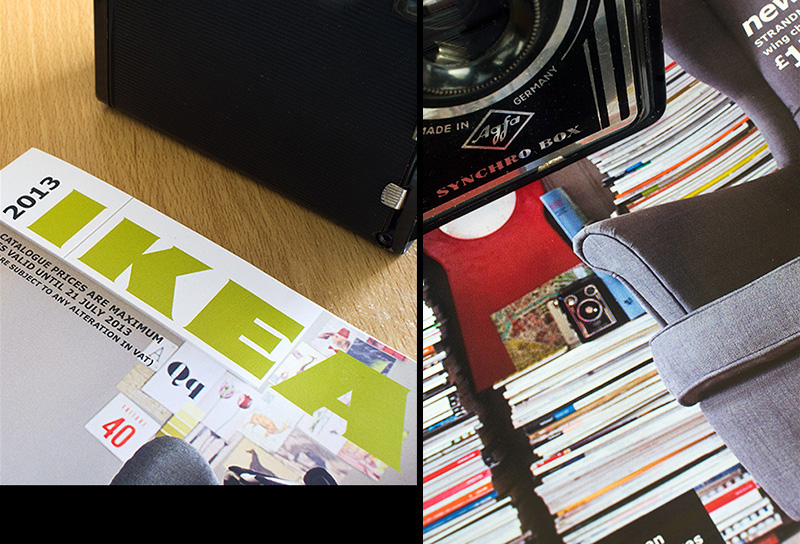
It's a really good trinket, though, because the design is so chic. Here's the latest Ikea catalogue, cover on the left, inside front cover on the right:


Spot the Synchro Box. Ikea do not put bad things in their catalogues. Only good things. Never bad things. Not sharks, for example, or wasps, or poor people.


In its day Agfa was the German Kodak, a film manufacturer that sold cheap cameras as a loss-leader for their range of films. The company came through the Second World War relatively intact, although their eastern arm was swallowed up by the Soviets and became East Germany's ORWO, which apparently still exists. Agfa's box cameras were replaced in the 1960s by the popular Agfa Clack, which housed the same basic specification in a curvaceous plastic case. The Clack is almost as popular an objet d'art as the Box, although the design language is very different; much cuter, more toy-like, less deco.

From the 1960s onwards Agfa concentrated on 35mm point-and-shoots, such as the Agfa Silette, although the company's focus was always film and optical equipment rather than cameras, which they stopped making in the early 1980s. Among the last gasps was the handsome Optima Sensor, which resembles a kind of value engineered Leica CL / Minolta CLE. The company eventually split up and sold its consumer film business in 2004, which went bankrupt a year later. Old stock Agfa film remained on sale for several years afterwards. Nowadays Agfa is what Kodak will be in a few years; a network of co-branded businesses that sell industrial optical equipment and services to other businesses, with a small sideline manufacturing film for the few specialist markets that still buy it. They still make aerial photography film, for example, which is intermittently repackaged into 35mm canisters and sold under the Rollei brand. The company also makes print film for theatrical distribution, but apparently no longer manufactures motion picture negative film; it was one of the pioneers of European colour movie film stock, and it remained popular with certain cinematographers right until the early 1990s (on Out of Africa, Gorillas in the Mist, The Mission, Robin Hood: Prince of Thieves - apparently it was very good with browns and greens).

Still, box cameras. The Synchro box takes eight shots per roll, which is going to cost you plenty unless you develop it yourself; I used this method of stand development with R09. The Box itself is tiny - in photographs the handstrap makes it look much larger, but in real life the strap is more a kind of fingerstrap - and weighs almost nothing, so it's not a bother to carry around. Metal. The fixed focus distance runs from about three metres to infinity - the near end is slightly too distant for parties or individuals, it's more of a family group shot type of camera. Here's a short film:


When poked by a hairy white hand the Afga Synchro Box makes a noise the end.