Showing posts with label c3. Show all posts

Wednesday, 24 December 2014

Agfa APX 25: Whisper No

Mamiya C3 / 65mm f/3.5 / Notting Hill

A while back I bought a stash of old film on eBay, mostly without the packets; among them was a roll of Agfa APX 25, an old and very slow black and white film. It was introduced in 1989. Google Books suggests that it was discontinued in 2002 or 2003, with the last rolls expiring a couple of years later, by which time Agfa itself had collapsed.

With only one roll I had no idea what to expect, and I couldn't test it in any way, but I was pleasantly surprised. My approach to odd finds like this is to just shoot it; just flick the switch. "One more body amongst foundations makes little difference. Well? What are you waiting for? Do it. DO IT."

ISO 25 equals roughly 1/30th of a second, f/4 in overcast daylight, but this isn't a huge problem with a TLR. One of the best things about slow film is that you can use wide apertures in daylight, equals narrow depth of field, which looks neat. It brings in the punters.


I stand developed it with R09 / Rodinal, but despite this the result was basically grain-free. There is grain, but it looks like a low-level blur rather than individual little spots. APX 25 sharpens well, and generally it's very Photoshoppy - low contrast, good resolution, similar to digital but with low contrast. You can add your own contrast. Shame it was discontinued. I have no idea how the previous owner stored my roll, but in general slow black and white films seem to age well.

A couple of these images have a pattern, particularly the BMW. I'm not sure if this is from the film's storage or from my scanner's dirty glass flatbed. Half and half, probably.

"... in exchange for £1,200 a month"

Seriously, the old sharknosed BMWs were wicked cool. If I ever become a multi-millionaire I will either buy an old sharknosed BMW or a Porsche 912, which I will park on the street thusly, and never use - because I would already live in London. Heathrow is at the end of the tube and the rest of the UK isn't worth visiting.

There will be cocaine hidden under the seat cover in a ziploc bag inside a second ziploc bag, and many years later I will feel slightly sad that the police never stopped me, not once. It was because I looked too boring. And that hurts.


In an age of ISO 25,600, twenty-five is distinctly retro. As far as I can tell the only remaining slow film is Ilford PAN F 50, which I can't remember ever using. I'll have to dig into my box of things to see if I have some.

Tuesday, 9 October 2012

Life in Venice

Boy with Frog, Venice, with a cruise ship passing in the background
Mamiya C3, 65mm f/3.5, Kodak Ektar 100

In the last post I had a look at the cemetery in Venice. Venice doesn't just have dead people, though. It has living people as well, passing through. The main island is probably the most-photographed patch of land on Earth if you think in terms of photographs-per-square-foot. Not counting the Lido it's roughly the same size as Heathrow Airport, a quarter the size of Manhattan, and almost every squre inch has been photographed hundreds of times. Unlike either of those places it doesn't have a Starbucks.

In fact, Italy doesn't have Starbucks at all, anywhere. There's a Starbucks clone in Milan called Arnold Coffee, which uses the same iconography, but it's not a national chain, just a few shops. Can you imagine that? A whole country without coffee?


This was underexposed a bit - blue shadows are apparently an Ektar thing.


In the UK Starbucks is all over the place. Britain is famous for its instinctive debasement of the finer things in life, Italy not so much. According to this article in the New York Times Starbucks has tried hard to penetrate France but without making a profit so far, and it has shied away from Italy. There are plenty of international fast food chains in Italy, I guess they just don't like coffee.


Venice is a bubble. A bubble within a bubble, because northern Italy traditionally pooh-poohs the poorer, more rural south. A short while after I came back there was a small rally for the cause of Venetian independence. "Activists want to carve out a new country in north-eastern Italy which would comprise Venice, the surrounding region of Veneto and parts of Lombardy, Trentino and Friuli-Venezia Giulia", which has a population of about five million people, almost as many as Scotland. They would have an international airport and no shortage of places to berth ships. Can five million Venetians build a nation more effectively than five million Scottish people?

Fuji Velvia 100


Ektar again, with a photograph that countless millions of people have already taken
Here's more or less the same scene from 1952

For my trip I took along my Mamiya C3 TLR and a box of Kodak Ektar 100. Kodak could do with the money. The company is down to its last $345m. The most recent film they have discontinued is T-MAX P3200, a 3200-speed black and white film. No great loss; it was expensive, no-one used it, and it made everything look like oil. Which of Kodak's eight remaining films will go next? Portra 800, I reckon.

It's fascinating to go back and look at Kodak's website circa 1996, via the Internet Archive. Odd, mystical names such as VericolorEktapress, and Advantix, which was Kodak's range of APS films. All of these things are gone. TMAX and TRI-X are there, of course, and will presumably live as long as film.

Kodak's advertising signs, dotted all around the world, will stay up, fading away until people can be bothered to climb up a ladder and take them down; until people on the other side of the world realise that Kodak no longer sends them things. Kodak will go the way of IBM, but much smaller; it will still be there, but for the man in the street it will be a memory of something that was around in the 1960s.


Venice, meanwhile, won't notice. It will carry on being Venice.

Friday, 5 October 2012

Death in Venice

The Isle of San Michele, Venice / Original by Mario Vercellotti

The islands of Venice only have a small resident population, but there still remains the problem of burying the dead. There isn't enough room for the bodies, and there isn't enough acid to dissolve them, besides which where would the acid go? Into the lagoon, but what of the fish? And so in the early 1800s the people of Venice picked the isle of San Michele as the designated dead person storage area, a function it retains to this day. It's a small, square island to the north of San Marcos, a short trip on the 4.1 or 4.2 to Murano. I decided to have a wander around with my Mamiya C3.

San Michele
Mamiya C3 / 65mm f/3.5 / Kodak Ektar 100

Mamiya C3 / Fuji Velvia 50

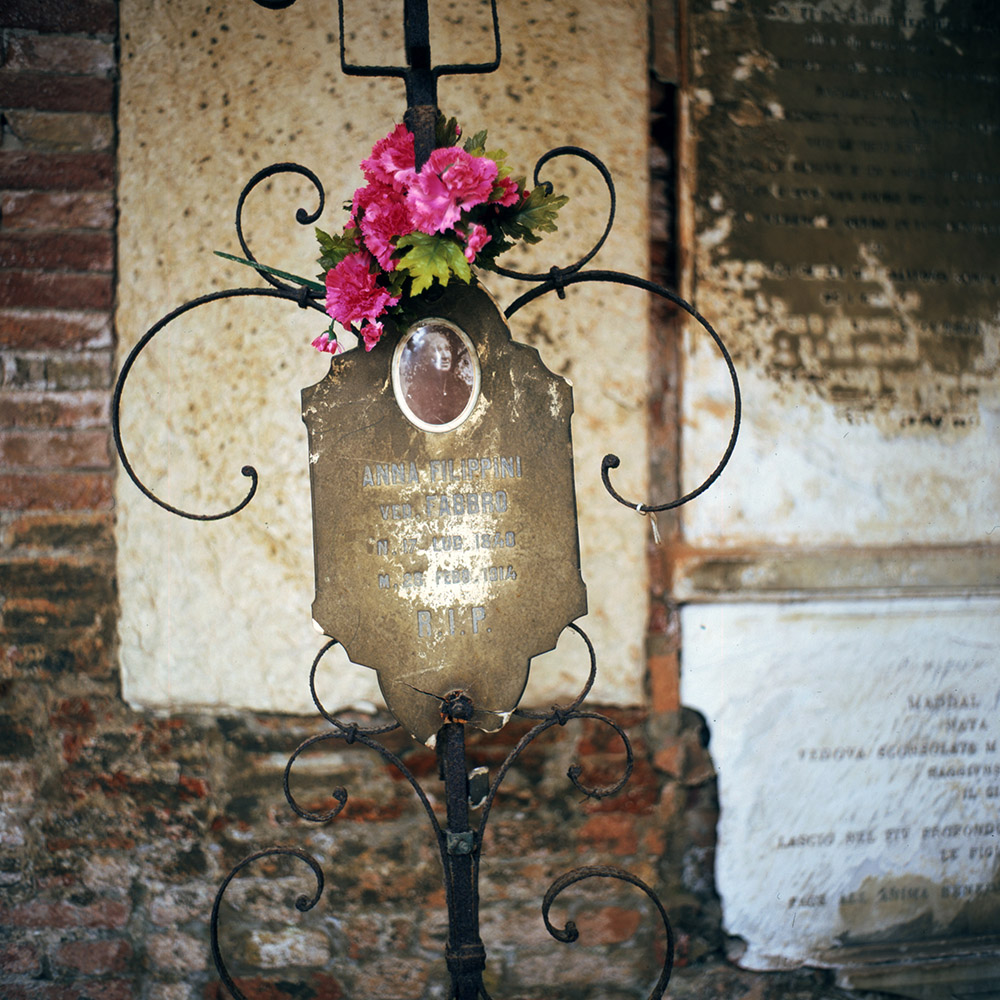
Death is forever; burial in San Michele is not, because the bodies are removed after a few years and transferred to the mainland. It makes for an odd tourist destination. The atmosphere is calm, vastly different from the hustle and bustle of San Marco, but it's impossible not to feel like an interloper. Much of it resembles Brompton Cemetery in London, overcrowded and in a state of elegant ruin, although there are obvious signs of work.


Some of the burial arrangements are similar to Manarola, on the Cinque Terre, with above-ground sarcophagi. For example, here are the burial plots at Manarola:

Manarola / Yashica Mat / Fuji Velvia 50

And here is an equivalent scene in San Michele:


There are also traditional gravestones in old-fashioned soil, and a modest chapel complex in one corner. The sculptures are seemingly designed to illustrate the ever-watchful presence of Death, who is not choosy about his next travel companion. Young, old; man, woman; he has a place for you within his cape.


Mamiya C3 / 65mm f3.5 / Kodak Portra 160VC

I mention feeling like an outsider. San Michele has a few famous graves, but the vast majority of people buried there are ordinary people like you or I, who admittedly lived in a much nicer environment and got to be buried in Venice, rather than dumped in a mass grave. The famous dead folk include top ballet pimp Sergei Diaghilev, classical upsetter Igor "what knockers" Stravinsky, and Ezra Pound, fascist. Stravinsky's wife is also buried there; if you stand on her tombstone you can get a better view of Igor's.


There's also a new, partially-empty section, which is still under construction. Death doesn't stop. He will never stop.


"We get to carry each other"

I come back to this picture every so often. There's the man, his wife, one two three four five six seven eight children. The girl on the left looks strong. Ten people, all gone.

Thursday, 4 October 2012

Kodak Ektar: Lecco

Lecco, Italy
Mamiya C3, 65mm f/3.5
Kodak Ektar 100

Friday, 28 September 2012

Milan Centrale

Milano Centrale
Mamiya C3
Fuji Acros 100

Milan Central is actually about two miles away from the middle of Milan. It's an enormous, squared-off block that was finished in 1931, after having spent twenty years as presumably a make-work project. It's often cited as an example of fascist architecture, but construction began many years before Mussolini came to power. Nonetheless it probably appealed to him because it's built on a monumental scale. The enormous platform hall and waiting area make a certain amount of sense, because it's a busy station; but the entrance hall (above) and plaza are just ridiculous. They're very photogenic though.


The station has been covered in construction work for years. It's always put me in mind of Berlin's now-defunct Tempelhof Airport. They're built to the same oversized scale, although the architectural style is very different. They belong to separate eras. Milan Central dates from a time when a nation's railways were its pride and joy; Templehof's mid-30s expansion was intended to demonstrate Nazi Germany's mastery of the air. The new frontier.


Is there a modern equivalent of these ancient temples? Flying is still the most advanced form of mass transportation, and nations still judge their economic health against the size of their airports, but air transport no longer has much romantic appeal. Too many people have spent too long going through security gates - taking off their shoes and belts, wondering whether Marmite is a liquid or not - to wax romantic about air travel any more.


And we're entering an age when people travel space and time whilst sitting at a desk in front of a computer. I can't imagine server farms becoming the new temples of human endeavour. There's Kennedy Space Centre, I suppose, but there's a fin de siècle air about it. And Baikonur, but I mentally associate it with commercial resupply flights rather than daring missions to defeat the Treen menace. Perhaps in the future we'll, like, worship each other, or worship nothing at all.


Or we could worship Lana Del Rey, because that's Lana Del Rey up there (for H&M) towering over the railway people of Milan. Imagine if she broke out of the poster and ran amuk in some kind of berserker frenzy. Think of the amount of tranquilisers you'd need to bring down a fifty-foot-tall Lana Del Rey, think about that. You'd need at least one gallon of tranquilisers. One gallon.

Mamiya C3: Milan


I've spent the last couple of weeks on holiday in Italy, because it's nice; specifically the north, around Milan. I took along a Mamiya C3, a 65mm f/3.5, and a bag of film. And a lightmeter, because the camera doesn't have one built in.

The Mamiya twin lens reflex system had two wide lenses, a 65mm and a more modern 55mm. I can't speak for the 55mm, but the 65mm is mighty fine, sharp into the edges at f/8 and beyond. In 35mm film terms it's roughly 35mm-ish, with an equivalent depth of field of f/2-ish. The 55mm was closer to a 28mm. The 65mm tends to be shunned nowadays - it's not much wider than the standard 80mm f/2.8, and of course it's one stop slower - but I found one going cheap. It takes standard 49mm filters. Sadly there isn't room to have individual lens caps over both the taking and the composing lenses.

The image above is of a sculpture in Milan's financial district. The building on the right is Italy's main stock exchange. Make of it what you will; at least it's honest.


Does Milan make sense in black and white? It's not really a gritty city; I'm sure that horrible things go on there, just as horrible things go on everywhere, but it's not an especially horrible place. Colour suits it more. Black and white makes sense for the industrial landscape of 1950s Pittsburgh, or the nightmare hellscape of New York. Not Milan, with its clean boulevards and masses of tourists and shops that sell expensive nick-nacks and women who look like Victoria Beckham, e.g. no hips.


The images were all stand developed with rodinal for an hour and a half. Fuji Arcos 100, a good solid film with no quirks. Street photography with a completely manual TLR is an odd experience. On the one hand, it's bulky and heavy and awkward to carry around, because it's a rectangular box without any ergonomic handholds. The chest-level viewpoint makes it awkward to photograph things that are at eye level, or below you, and as you can see from the images in this article it's easy to end up with lots of photographs where the camera is looking up at things from below.


On the other hand, no-one notices you. You just hunch over and there's a snick noise. It's as if you're taking a swig from a cup of coffee, or munching on a croissant, or whatever it is the hell they have in Italy. If you were a really hardcore street journalist you could, in theory, put the camera in a paper bag, and pretend to be drinking bum wine. Determining the correct exposure is easier than it sounds, because there are really only two values you need to remember; full-on sunshine, and in the shade. If the sun goes behind a cloud, check again. But generally the sun is the sun, it doesn't change.