Showing posts with label death. Show all posts
Friday, 30 December 2016
The Impossibility of Life in the Minds of the Dead
Contemplate the photograph. It's Audrey Hepburn posing for the press early in her career. It's not a very good photograph and no-one at the time expected it to survive beyond the immediate present, but it has survived. A few years ago the internet discovered it - the people discovered it - and now it is one of the classic images of Audrey Hepburn. The lighting is terrible and the pose is curious, but Audrey Hepburn is magnetic; the photograph is silly, slightly sexy. It endures while so much has passed from memory. There are far better photographs of Audrey Hepburn, but they lurk in the dead memory of books, where they will remain until there is a shift in public taste.
Ostensibly this blog is about photography, although in practice I find it hard to stay focused on one thing and there is only so much to say about pictures. The equipment doesn't move me any more; it's the art I care about, specifically the topic that drives all art. The desire to live beyond death. The human animal is unusual in that it is conscious of its unavoidable date with the inevitable. Death is the end of summer. It may be many months away, but it will happen and there is no escape. Stronger, braver, smarter, richer men than I, entire societies, they have all failed to find a cure. Nothing I have experienced convinces me otherwise; quantum entanglement, cryogenics, vitamin pills, shared consciousness, pathetic.
The inescapable laws of thermodynamics destroy our bodies, and even if we no longer needed bodies the same laws would destroy our minds, or transform us into a new form, which is also death. I take cold comfort in the notion that consciousness itself is an illusion. That we are not really conscious at all; that we do not have souls. We are just animals with a sophisticated brain that can store information, match patterns, and process audio-visual-sensory information in real time. Our consciousness is a byproduct of this. If we ascend to heaven when we die, what happens to people who have Parkinson's, or Alzheimer's? Do they spend the eternity of heaven with empty minds? The idea that heaven rewinds our mental clock back to our teenage years is absurd, and if our souls are separate from our minds, which of those two things is the real us? Both of them, or neither? Theology does not convince me. It's arbitrary.
Death holds two horrors. There is the cessation of consciousness for all eternity. An eternity of endless blackness and the knowledge that this is all there will ever be. It's difficult to visualise nothingness. We are going away and never coming back, and in the fullness of time the universe itself will collapse, and not a single thing will remain. The same will happen to our worst enemies, our greatest friends, our children.
The second horror is the idea that we will be forgotten, and that our works will be forgotten. This is the curse of everyone in the long term. In the shorter term, we know our parents; we are aware that we had grandparents; but until relatively recently, at least in the West, our great-grandparents were theoretical. Photography and the extended lifespan that comes with modern living have expanded our generational horizons, but there is still a generational cut-off point. The vast, vast majority of British people cannot name their great-great-grandparents. They are shadows, and if their great-great-grandchildren do not remember them, who will? Our great-great-grandchildren will not remember us.
No-one, is the answer. Within a few generations we are forgotten. The few names that live after death survive as twisted approximations of the past. This is a theme I have elaborated upon before. It is one of the fundamental themes of all art. On an idealistic level visual art is an attempt to communicate ideas and emotions with pictures, and on a practical level art is also a means of self-aggrandisement and self-enrichment, and furthermore it's a viable way of avoiding having to drive a bus for a living. Some artists are driven by a desire to get out of the house; others want to see a naked woman in real life; still others want to be the life and soul of the party. It's an excuse to do cool things with computers.
The wealthy mega-artists of today probably don't care about their legacy, although "the impossibility of death in the mind of someone living" was one of Damien Hirst's early themes. The ubiquity of artists in the media has given them a form of short-term immortality, but one of the fundamental principles of the postmodern movement is the impossibility of editorial control.
The people decide which things live and which things die. The establishment occasionally tries to push a thing; tries to make that thing immortal. Novels become set texts in university degrees, the works of certain photographers are cited in textbooks, artists are given government-funded institutes with which to promote their work, but fashions change, and both high and low art is subject to the whims of fashion. Even high art, once thought immortal, is just a record of a series of fads. The cathedrals of the past become theme parks and then ruins. Their stones are used to line pavements, which are built over with motorways.
During the twentieth century entire art forms fell out of fashion, poetry and painting most notably. Once upon a time schoolchildren were taught to idolise Tennyson and his works, but now the formerly high art form of poetry is dead. An entire art form. People still write poems, but poetry no longer establishes reputations. There are no poetic giants today. Poetry from the past is hard to take seriously; modern poetry has been obliterated by pop music.
Schoolchildren were also taught to idolise painters and their works, but although paintings are now highly-prised as safe investments, painting itself is too limited to be thought of as high art any more. Painters are no longer major figures as they were perhaps as recently as fifty years ago. As for music, when children of the future listen to classical music of our time they will listen to Philip Glass, and John Williams' Star Wars soundtrack, make of what what you will.
Poetry, painting, and music still exist; but they are no longer perceived by the public as a gateway to immortality, and in any case their hold was artificially bolstered by an establishment that insisted on forcing the public to respect high art even though most people were bored silly. From cradle to grave children of the past were told that they should respect the words of Tennyson, and that if they did not, they were idiots. Now the conditioning is gone, and the public must find its own way, which it has. It has found another way.
During the latter half of the twentieth century it was fashionable to treat popular art with the deference that had been shown to high art, and so for many years there was in this field a correct way of thinking, just as there had been with high art. The Beatles, as mentioned elsewhere on this blog, were the beneficiaries of this new orthodoxy, and then victims of a counter-orthodoxy in the punk years, and then beneficiaries again in the 1990s, and beyond fashions there are great sweeping paradigm shifts. The swift rise of hip-hop horrified the once-dominant white Anglo orthodoxy; it brought home the fact that none of us have a monopoly on legitimacy, and that for other people our lives and tastes are alien and inconsequential.
An enormous amount of popular art has sunk beneath the waves, never to return, but some of it bobs to the surface again. Some of it continues to intrigue the people. On a fundamental level popular art was created specially for them, the people. In the long term the people have power, because the people are persistent. The state establishment requires energy to function, but energy runs out, order breaks down into chaos. Individual people die, but the people remain.
Are we dead already? We are the animate corpses of our childhood selves, ghosts driven by inertia. As Epicurus pointed out a long time ago we have already been dead. For several billion years we were dead, until we came into being. We will be dead again. The problem is causality. The flow of time is not symmetrical. Our consciousness gradually grew from noting until we were self-aware. The same is not true at the other end of our lives.
Every so often the internet ponders the problem of teleportation. When Captain Kirk steps onto the transporter pad his body is analysed and destroyed by the teleporter's scanners; it is then recreated at the destination, but the recreation is not really Captain Kirk, it is instead a perfect duplicate that was brought to life in a microsecond. The original Kirk knows he is going to die when the teleporter activates. The new Kirk is presumably thrilled to have the gift of life. Before he arrived he did not exist.
It is surprising that instead of dropping to his knees at the realisation he has been brought into existence, the new Kirk instead carries on with his mission. Star Trek is a good example of popular art that died and was reborn, that died again and was reborn, and may periodically die and be reborn until we are sick of it. The original film series came to a dismal end in the early 2000s, but it has been successfully revived, and there is even a plan to expand the format into an episodic television show. It remains to be seen how well the Star Trek concept will translate to television. Will it work?
We view the past as a set of blocks. Homogeneous blocks of centuries and millennia in which nothing changed, during which people lived unchanging lives. The late nineteenth and twentieth centuries still have a personality, but in time they will become part of a larger block. Everyone who lived in those blocks had to deal with the reality of death. Nobody escaped. Trillions of years of nothingness await us, and even on a human timescale we cannot guarantee that our distress flares will be seen from afar. Even if they attract attention the rescuers still have their own problems, because they are doomed too. No-one will rescue them. Another year begins.
Wednesday, 9 April 2014
Windows XP: A Lifeline of Knuckles
Windows XP dies today. Spare a thought for its predecessor, Windows 2000
-
Though I am satisfied at first by my actions, I'm suddenly jolted with a mournful despair at how useless, how extraordinarily painless, it is to take a child's life. This thing before me, small and twisted and bloody, has no real history, no worthwhile past, nothing is really lost. It's so much worse (and more pleasurable) taking the life of someone who has hit his or her prime, who has the beginnings of a full history, a spouse, a network of friends, a career, whose death will upset far more people whose capacity for grief is limitless than a child's would, perhaps ruin many more lives than just the meaningless, puny death of this boy. I'm automatically seized with an almost overwhelming desire to knife the boy's mother too, who is in hysterics, but all I can do is slap her face harshly and shout for her to calm down. - Bret Easton Ellis, American Psycho (1991)
Patrick Bateman has slashed the throat of a small boy. As the child bleeds out Bateman pretends to be a doctor, and roughly pushes away anyone who tries to help. Eventually the boy dies, and Bateman runs off. In the next chapter he brutally murders a pair of escort girls whilst playing a CD of the Traveling Wilburys in order to mute their screams. To capture the event he uses a Minox LX, an "ultra-miniature camera that takes 9.5mm film, has a 15mm f/3.5 lens, an exposure meter and a built-in neutral density filter".
You've probably seen a Minox before, in spy films. The details are spot-on; the LX was the kind of luxury toy that Patrick Bateman might have owned, the camera did indeed take 9.5mm film, it had a 15mm f/3.5 lens, there was a built-in neutral density filter. The ND filter helped to regulate exposure, because the lens didn't have an aperture. With a top shutter speed of 1/2000 - not bad even in a contemporary SLR - the filter was probably overkill.
Bateman is a classic archetype. He is the upsetter, the mischief-maker who continually defies the established order. His type echoes in mythology. I assume that Ellis based the character on a mixture of Ted Bundy (the bland good looks) and Claus Von Bulow (the wealth and connections) plus the empty-headed preppies he had grown up with, and also himself. It's often supposed that the events of the book only take place inside Bateman's head, but I disagree; I believe that they're real in the world of American Psycho, but that American Psycho does not take place in our world.
In that respect the book is almost a work of science fiction. The documentary-style descriptions of corpses and consumer gadgets parallel that of the stereotypical hard science fiction novel, in which wooden characters talk and then there is a chapter where we learn about aerobraking and then they talk and then the pod fires its retrorockets and as it detaches from the mothership there is a cloud of ice crystals because water simultaneously boils and freezes in a vacuum. In fact Psycho reminded me of Arthur C Clarke's Rendezvous with Rama. The two novels are essentially descriptions of a series of processes rather than stories.
Bateman's killings are not individually implausible, and have become less easy to dismiss as fantasy in a world of podcasted beheadings and suicide cults. There was mass death and horror in the middle ages, too. Jesus was nailed to a cross and left to die by the authorities of his time. Wherever the human animal has trod murder has followed.
From a British perspective American Psycho is particularly fascinating. We had yuppies as well. They bought clothes in Chelsea and bought apartments on the newly-developed South Bank of the Thames. The nation build London City Airport for them, because they were our masters.
The big difference is that American murderers are glamorous, whereas ours are generally dull and grim. Some aspects of Bateman's story parallel that of British serial muderer Dennis Nilsen, who killed fifteen men and played with their bodies afterwards. He cared so little for his victims that he could barely remember killing some of them. But Nilsen maintained a dank existence in Cricklewood and Muswell Hill, and worked a dull job at an employment office, whereas Bateman lived and worked in opulent splendour. Nilsen's world was that of Norman Wisdom and John Christie, whereas Bateman was Miami Vice (but in New York) or Chancer (but in New York) or Wall Street (but in or Wall Street full stop close bracket full stop delete bracket.
Nilsen preyed on gay men, which is one of the reasons he got away with his crimes for so long. From the point of view of the police and society in general he was preying on people who didn't deserve to live. Who probably enjoyed strangling each other. He lured victims back to his home and strangled, bludgeoned, stabbed, and drowned them. Four of the men he attacked survived the ordeal and escaped, but although two of them went to the police nothing was done, and it seems that Nilsen was never even interviewed. He was only caught when his drains became clogged with rotten flesh.
Seven of Nilsen's victims remain unidentified. He either doesn't remember who they were, or never bothered to find out. Nobody else appears to have cared about them. There are presumably seven families whose brother, son, father or husband never returned home, never contacted them ever again. What became of them?
Shown here running Photoshop 5.5 on an old ThinkPad 600X
Nilsen preyed on people who would not be missed, and who were for the most part not missed. Psycho is told from the point of view of Patrick Bateman, and in his mind absolutely everybody is superfluous, including himself. Bateman does not value life, and the businessmen and socialites with whom he interacts are uncaring people akin to the villains of Robocop. No-one cared much when ED-209 blasted Kinney into oblivion, and American Psycho takes place in that world.
The child at the zoo and his mother are reduced to a Polo shirt, some jeans, a leaf-patterned black wool sweater. Bateman kills tramps, prostitutes, businessmen, hipsters, and although his murders are reported in the media there is a sense that New York will swallow them up, and in any case they are all history now because the novel is a period piece. A book in which the ultra-rich fill their homes with Laserdisc players, and go to work with brick-sized mobile phones. Psycho is a shopping-list of trendy gadgets that would have cost a fortune in the late 1980s but are now worthless junk.
Would any of it still be valuable today? The twentysomething yuppie bankers of the late 1980s are, I assume, still extremely wealthy, and would be in their fifties, sixties by now, some of them might still be working. Carl Icahn and Ivan Boesky, the "vulture capitalists", are very old men, but they were old men in the 1980s. The clothes might be worth something, but who remembers D F Sanders or Arnold Scaasi today? The restaurants, if they were real, presumably closed long ago.
The BMW E32 750iL might possibly have had the best engine around in 1991 - we have to assume Bateman was talking about the V12 - but it's a maintenance timebomb on the used market. The E32's target market in the late 1980s don't buy used cars; the kind of people who might want a used E32 probably can't afford to maintain it. High-end, but-not-classic luxury cars are poor investments.
It's not just men. Women have their handbags and shoes. Ellis' novel takes place in a world where objects have value and meaning but people are empty. There is some debate as to whether Bateman was supposed to be a personification of Reagan-era America, and his victims symbolic of that decade's bogeymen. He kills a homeless beggar and a gay man; the one person who catches him and seems likely to bring him to vigilante justice is a taxi driver who lets him go after robbing him of his Rolex, his Ray-Bans, and three hundred dollars in cold hard cash. A disappointing five hundred dollars in modern money.
Ellis' point is that even though the taxi driver seems pissed at Bateman for murdering (presumably) another taxi driver, he too lives in an unsympathetic world where human life is... if not exactly worthless, then not worth a great deal. "You're a dead man", says Bateman, to which the taxi driver responds that Bateman is a Yuppie scumbag, the implication being those two states are equivalent.
On another level the book defies serious analysis, because Ellis is clearly messing with our minds. At one point Bateman delivers a right-on tirade to a table of his fellow businessmen, who stare in shock as he waffles on about the need to "provide food and shelter for the homeless and oppose racial discrimination and promote civil rights while also promoting equal rights for women but change the abortion laws to protect the right to life yet still somehow maintain women's freedom of choice". It works far better as humour than satire, something that Mary Harron spotted when she turned the book into a film. (The scene implies that Bateman is immoral rather than amoral, and at the same time it sits oddly today, with the implication that bad evil bankers are in favour of crime and drugs and also illegal immigration, which is probably true but politically unacceptable). With its fetishistic portrayal of Christian Bale applying his beauty regime, Harron's film also emphasises one of Bateman's most-often-overlooked transgressions; his femininity. Bateman is a soulless, surface-obsessed cipher, and in that respect he is essentially a broad stereotype of a woman wearing the flesh of a man.
~
When I was very young I was aware that there was such a thing as a Yorkshire Ripper, a man with a terrible beard who had killed several women. In Yorkshire, which is far away. He targeted prostitutes, or at least that was the theory. It turned out much later that he had assaulted dozens of women picked simply because they were alone. Sutcliffe's fifth official victim was a 16-year-old shop assistant on her way home in the middle of the night. "He has made it clear that he hates prostitutes; many people do", said Assistant Chief Constable Jim Hobson, "but the Ripper is now killing innocent girls". Over time the phrase became infamous. Innocent girls.
The police investigation of the Ripper case remains notoriously awful; if there is a suspicion that the police did not care very much for his victims, it must be borne in mind that even after Sutcliffe began to kill "innocent girls" it took four years of blundering to catch him. It seems that the more women Sutcliffe killed, the more the paperwork mounted up; and the more paperwork, the more time the police required in order to process it, until eventually the investigation extended to infinity. He was only caught by a random check of car number plates and might have been released again - he had been questioned several times before - if he had not been carrying the tools of his murderous trade with him.
Win2K only had a short time in the spotlight; it was never aimed at the consumer market, and the XP-based Windows Server 2003 replaced it in the business world. Support ended in 2010. It's even riskier than XP nowadays but runs faster on old hardware. A brave soul has put together an unofficial service pack.
In most respects Bateman and Sutcliffe are polar opposites. Sutcliffe's life was even more grim, even less glamorous that that of Nilsen. As a child I associated Yorkshire with damp rain-sodden emptiness and old people, perhaps because television footage of the investigation always depicted disused garages and empty playgrounds, broken-up former youth clubs and decaying estates, with stone-faced rain-sodden men combing the ground for human remains. Specks of bone and bloodied hair.
When prostitutes are murdered there is always a dark thought that they brought it upon themselves, if not that they deserved it, but I have never had that impression from the Ripper murders. The prostitutes that Peter Sutcliffe murdered come across as pathetic, sympathetic, lonely people plying a bleak trade in a bleak cold environment for tiny sums of money. In a Hollywood slasher film - John Carpenter's Halloween (1978) was released in the midst of the killings - the victims would have been teenagers or young girls dressed in lingerie, or nude, having just had sex. Sutcliffe's victims were ordinary people.
The Ripper case echoes through British history. Ripper itself is an echo of the Victorian-era Whitechapel murders. In November 1975 26-year-old mother-of-two Joan Harrison was killed, her body found in a garage in Preston, but she was not killed by Sutcliffe. He was linked to the murder by a series of letters and a tape cassette sent to the police. Advances in DNA technology revealed in 2011 that the murderer was probably a man called Christopher Smith, a convicted sex offender who had died in 2008. "I am so sorry. God forgive me. I love you all forever" he wrote, in a note found after he died.
The hoax tape struck a chord with Assistant Chief Constable George Oldfield, who became convinced that it was the key to catching the Ripper. The voice spoke in a Wearside accent, and the tapes are now so infamous that a Google search for "wearside accent" only throws up documentaries about the hoax.
Oldfield was convinced that the Ripper came from Sunderland, and took early retirement when it became apparent that he was utterly wrong, that the tape had simply wasted police time and had given Sutcliffe breathing room and an alibi. For years afterwards rumours spread that the tape had been sent by a disgruntled former colleague of Oldfield, angry at the conduct of the investigation, but in the end it turned out that the culprit was a nobody called John Humble. He was also caught with DNA evidence, and in 2006 he was sent to prison for eight years, although he was eventually freed in 2009.
The irony is that Oldfield was almost right. He had correctly identified Humble's accent and placed it in the same area of Sunderland that Humble had attended school. He almost caught his man, albeit that it was the wrong man. Perhaps in another world he might be remembered as the genius who stopped the Ripper dead. Not in ours. In our world the best he can hope for is to be forgotten.
For most people in Britain the Ripper case is a diversion that occasionally resurfaces. The media digs things up, the public still has an appetite for it, so it goes. The Ripper case is unusual in that Sutcliffe himself is almost a non-entity. Unlike Hannibal Lector or Patrick Bateman, there is nothing impressive about him, nothing to identify with or secretly idolise. He is just mud and slurry. With his dark hair and scruffy beard he resembled a cheap Hammer Horror Satanist. He had no coherent motive, no master plan.
He left behind a trail of misery, and for a dwindling number of survivors and their relatives with ruined lives and ruined pasts there is no end, no closure, no exit.
"I'm left with one comforting thought: I am rich - millions are not."
Friday, 5 October 2012
Death in Venice
The Isle of San Michele, Venice / Original by Mario Vercellotti
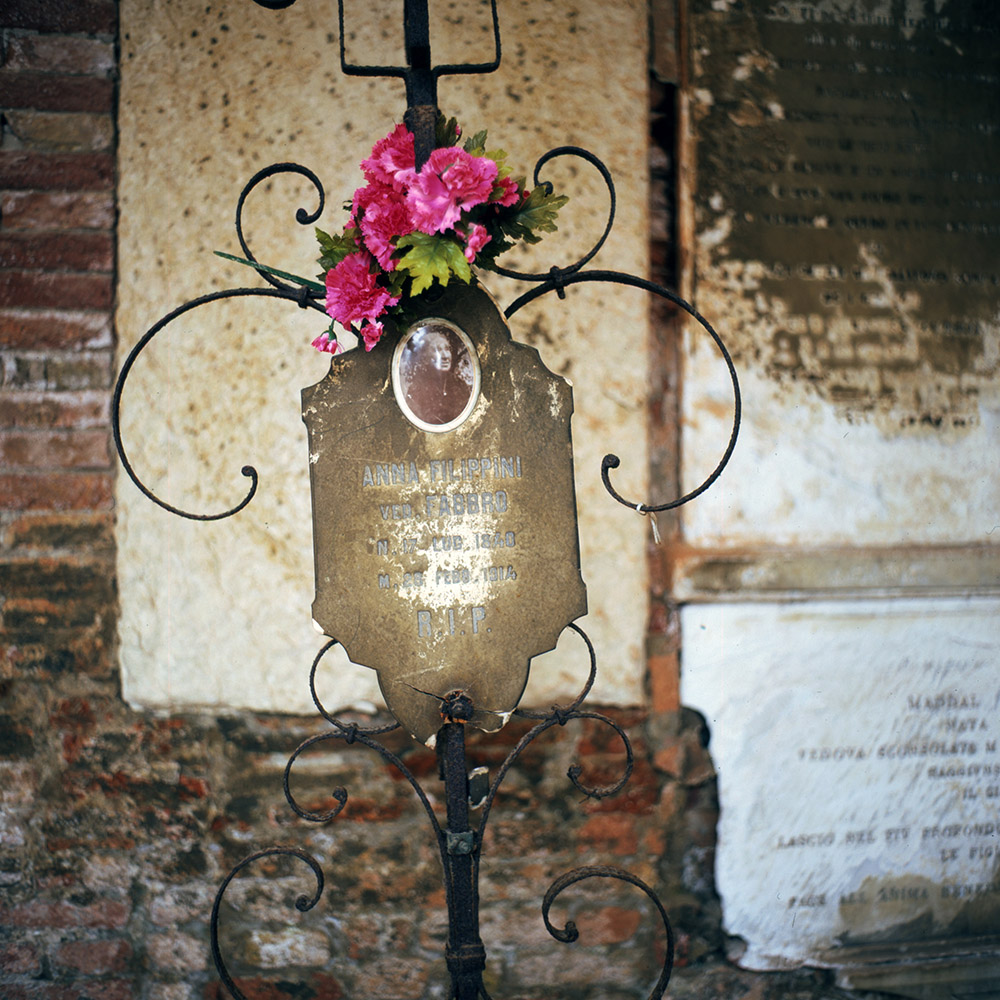
The islands of Venice only have a small resident population, but there still remains the problem of burying the dead. There isn't enough room for the bodies, and there isn't enough acid to dissolve them, besides which where would the acid go? Into the lagoon, but what of the fish? And so in the early 1800s the people of Venice picked the isle of San Michele as the designated dead person storage area, a function it retains to this day. It's a small, square island to the north of San Marcos, a short trip on the 4.1 or 4.2 to Murano. I decided to have a wander around with my Mamiya C3.
San Michele
Mamiya C3 / 65mm f/3.5 / Kodak Ektar 100
Mamiya C3 / Fuji Velvia 50
Death is forever; burial in San Michele is not, because the bodies are removed after a few years and transferred to the mainland. It makes for an odd tourist destination. The atmosphere is calm, vastly different from the hustle and bustle of San Marco, but it's impossible not to feel like an interloper. Much of it resembles Brompton Cemetery in London, overcrowded and in a state of elegant ruin, although there are obvious signs of work.
Some of the burial arrangements are similar to Manarola, on the Cinque Terre, with above-ground sarcophagi. For example, here are the burial plots at Manarola:
Manarola / Yashica Mat / Fuji Velvia 50
And here is an equivalent scene in San Michele:
There are also traditional gravestones in old-fashioned soil, and a modest chapel complex in one corner. The sculptures are seemingly designed to illustrate the ever-watchful presence of Death, who is not choosy about his next travel companion. Young, old; man, woman; he has a place for you within his cape.
Mamiya C3 / 65mm f3.5 / Kodak Portra 160VC
I mention feeling like an outsider. San Michele has a few famous graves, but the vast majority of people buried there are ordinary people like you or I, who admittedly lived in a much nicer environment and got to be buried in Venice, rather than dumped in a mass grave. The famous dead folk include top ballet pimp Sergei Diaghilev, classical upsetter Igor "what knockers" Stravinsky, and Ezra Pound, fascist. Stravinsky's wife is also buried there; if you stand on her tombstone you can get a better view of Igor's.
There's also a new, partially-empty section, which is still under construction. Death doesn't stop. He will never stop.
"We get to carry each other"
I come back to this picture every so often. There's the man, his wife, one two three four five six seven eight children. The girl on the left looks strong. Ten people, all gone.
Subscribe to:
Posts (Atom)