Let's have a look at Doom Eternal. I've written a poem about it. I'm
going to share it with you. Here is my poem about Doom Eternal. I call
it "Doom Eternal".
Doom Eternal
-
When it works,
it's Dieter Diercks!
But
when it fails,
it's Tony Sales (bassist with Tin Machine)
But success is relative. Doom Eternal was multi-platform, but it was at heart a PC game, or at the very least it came into its own with mouse and keyboard control. It was released for the Xbox and PlayStation as well, and a few months later there was a surprisingly slick Nintendo Switch port, but they were all controller-only. I have no idea why developers don't allow console gamers to use mouse and keyboard. Games consoles have USB ports. Do console owners not have tables? Can't they balance a plank of wood on their laps?
To that end I ventured out into the streets of south London. I asked a selection of random passers-by if they could balance a plank of wood on their laps. They all ignored me. Doom Eternal was released on the very same day as Animal Crossing: New Horizons, which was the latest in Nintendo's super-cute life simulator franchise. The press laughed heartily at the contrast between the two games. Doom Eternal's gameplay involves ripping demons limb from limb and also stabbing them in the head with a serrated blade, whereas New Horizons involves planting seeds. Doom Eternal ends with the player discovering that heaven is a lie, built on the suffering of the innocent, and that his god is a false god. New Horizons does not have that, and yet despite an almost total lack of gore and blasphemy it was the more popular of the two games by a huge margin.
See, New Horizons is a console game, released exclusively for the Nintendo Switch. It's a different world. Despite the fact that COVID caused a shortage of Switches, New Horizons went on to sell almost fifty million copies, grossing over two billion dollars. It's one of the most popular games of all. It has almost certainly outsold the entire Doom franchise single-handedly. Doom Eternal apparently shifted around eight million copies over the same period, which was excellent for such a niche title, but the relative sales figures do highlight the fact that PCs and consoles live in different worlds.

It must have been tempting for the developers to soften up
Doom Eternal and make it console-friendly. But if there is one
thing the developers learned from the fate of Valen, the Betrayer, whose
treason brought down the Night Sentinels of Argent D'Nur, it's that temptation
is a path that only leads to ruin. Instead they held firm.
They made Doom Eternal for us. PC gamers. You and I. We. Us.
The
Doom franchise has always been aimed at us. Now, Id
Software has never been prejudiced against games consoles. The original
Doom (1993) was ported to all of the popular consoles of its time, and
speaking as a PC person, the PlayStation port of Doom was
surprisingly clever. It had a spooky tone that gave the game an identity of its
own. In the thirty years or so that have passed since the release of the first
game in the series, Doom has been made to run on all manner of stuff, including fridges, fitness watches, pocket calculators, even Doom itself. But at heart it's a PC game, for PC gamers. You and I. We. Us.


The PC as a games platform has waxed and waned over the years. It costs just
as much to develop a PC game as it does to develop a console game, but sales
are lower, because PCs are expensive pieces of equipment that target an older
market. PC owners have to pay for their car, and childcare, and Nike Air Monarchs and so forth. PC developers
can ameliorate the cost of development by porting their game to consoles, but
this risks diluting all the things that make PC games special.
Furthermore
some games are more multi-platformy than others. Undertale? That's an easy port. But fast-paced first-person
shooters don't translate well to games consoles, because it's a lot harder to
move and aim effectively with a hand controller than it is with a mouse and
keyboard. As a result the first-person shooter has evolved into two distinct
forms. Old-school, PC-style first person shooters tend to be fast-paced, skill-heavy, and also very rare nowadays, because the PC market is relatively
small.
In contrast console shooters are slower, and tend to emphasise scripted action
setpieces and cutscenes rather than twitch-style gameplay. They sell in the
tens of millions. It's like the difference between Carcass and Def Leppard. In theory they play the same genre of music, and they both have their
strengths, but one is greasier and nastier than the other. It's ironic, in a way. Historically it was PC games that were slow and console games that were fast. The first-person shooter is a peculiar inversion.
There
was a time when it seemed that our kind might triumph. That we would win. But
it was not to last. The light faded. I like to imagine the light finally
dimmed towards the end of 2007, when Unreal Tournament 3 and
Call of Duty 4: Modern Warfare were released within a few days of each
other in November of that year. One of those games was the future, the other was Unreal Tournament 3. One of those games sold millions, and was remade a decade later into a title that sold tens of millions, while the other isn't available any more and can't be played online because the servers were shut down.
But sometimes the pendulum swings the
other way. In the 1980s the PC games market was dominated by role-playing
games and flight simulators. Meanwhile kids wanted to play Sonic the Hedgehog
and Street Fighter II. Then Doom came along, at which point the PC
abruptly and unexpectedly became the hippest gaming platform around. Kids
wanted 3D action, and the PC had the best 3D action game
around. Even after the launch of the original PlayStation and its
contemporaries the PC was the only platform that could play multiplayer games
over the internet.
Consoles caught up around the middle of the 2000s and went on to dominate the market, but every so often a new PC game comes out that reminds people of why they spent £1,000 on an ugly metal box that breaks every time the drivers are updated.

For example 2004 had Half-Life 2, World of Warcraft, and
Doom 3, all of which were popular, critically-acclaimed, extremely
influential PC titles. They were eventually ported to consoles, and although the OG Xbox version of the first and last were impressive technical feats they weren't the same. In 2007 STALKER and Crysis showcased the PC's raw
graphical power, and a few years after that Minecraft began its swift
march to global domination on the PC, before being ported to consoles a few
years later. PC-only hits are few and far between, but they haven't completely
gone away. Also, you can't bittorrent the entire Ice Road Truckers franchise with a PlayStation 4. You can download or at least view pornography on a PlayStation 4, but it feels weird. So the PC still has a niche.
Let's fast-forward to 2016. Id Software's new
Doom title didn't promise much. It had a troubled development and
good-but-not-great reviews. However word of mouth had it that the single-player
campaign was something special. At a time when the market was getting sick of
story-driven military shooters Doom 2016 was non-stop action. Sales
were modest, but the Doom franchise was back.
There had been
revivals of the meat-and-potatoes first person shooter before. As early as
2001 Croteam's Serious Sam was built around large-scale slaughter
arenas. The incredibly long-awaited Duke Nukem Forever (2011) was at
least initially intended as a return to 90s-style action, although the end
result was a peculiar mish-mash of essentially every gaming trend that had
appeared in the 2000s. Doom 2016 on the other hand was a polished,
A-list title from a major publisher, with a slick engine and great gameplay focused entirely on running around and shooting things. There were no physics puzzles and no driving sequences. Furthermore it was made by Id Software, the very company that
had invented the genre, although by 2016 most of the team that worked on its
1990s classics had left the company.

As a PC person I am fond of Doom (2016). How can I put it? Imagine that you're British, and you've resigned
yourself to the fact that Britain will never win Wimbledon again. And then
suddenly there is a flash of light, and Andy Murray appears, crouched over,
naked, transported from the future, covered in blood, as in The Terminator. He
pulls himself up to his full height and surveys the lights of London in the
distance. After ripping the hearts out of some punks and stealing their clothes
he goes on to win the US Open, and then Wimbledon.
And then he wins
Wimbledon again, thus proving that it wasn't a fluke. All of a sudden Britain is
back, and all the nations of the world want us to manage their affairs. India
gives ownership of its mineral resources to Britain in exchange for protection
from Belgium. The government of the United States realises that
monarchy is the way to go, and the United States becomes part of the British
Empire once again. We allow all of the States of the United States to retain
their names, but they are now counties.
Simultaneously Egypt
apologises for nationalising the Suez Canal. France admits that it is broken and wrong. Gemma Arterton becomes Queen, and an amendment to the Magna Carta compels
her to wear red leather thigh-high boots at all times, as in the video for Kylie
Minogue's "Padam Padam". Argentina admits it was joking about the Falklands.
Germany dissolves and freely gives its territory to Poland and the Netherlands.
Denmark finally sorts out the Schleswig-Holstein question.
Imagine
how you would feel, if you were British, and all of those things happened. You
would be overjoyed. That is why we must all vote Reform in the next general
election. Only they can make those things happen.
This is how PC gamers felt about Doom (2016). The game was a breath of fresh air. There was something uncompromising about it, because the developers were on our side. It was an old-school PC-style first-person shooter, a genuinely difficult game that rewarded skill, and it was made for us. What would Id do next? What was the sequel going to be like? Could Andy Murray win Wimbledon forever?
If you're reading this, Gemma Arterton, it took Rosamund Pike another twenty years to find her groove after Die Another Day. You still have time.

Still have time. I'm old enough to remember the original, original Doom, which
came out in 1993. It was technically mindblowing in a way that's impossible to
recapture nowadays, and for a few years afterwards Id Software was the world
leader in 3D action games. The sequel, Doom II, was more of the same, but
better, and the company's next project, Quake (1996), continued their
technical dominance over the competition.
But it didn't last. Id
was staffed with passionate assholes who quickly got sick of having to spend
fifteen hours a day in each other's company. By the end of the 1990s almost
all of the people who worked on Doom had left. As I write these words most of
them are still alive - morituri te salutant, Bobby Prince - and they
remain in contact with each other on Twitter, but the chances of them going
back into business with each other are nil. Id's technical leadership
continued until roughly 2004, with Doom 3, which had a clever engine
but controversial gameplay. From that point onwards the company's output
slowed down.
Amongst other things Id pioneered the idea of
licencing out their game engine to other companies, instead of keeping it all
in-house, but after some initial success the Id Tech engine fell by the
wayside. It had strong competition from Valve Software's Source, and latterly
Epic's Unreal Engine, which as of this writing is more or less the default non-mobile video game engine. Universities run courses on Unreal 5,
while Id Tech is only used by Id and a handful of Id's friends.
Id's
next big thing after Doom 3 was Rage, which was released in 2011
to a tepid reception.
I've written about it before.
Technically it was very clever, and visually it has aged well, but it had an
anonymous blandness to it and the story felt unfinished. A year later John
Carmack left the company. He was the chief technical guru behind
Doom and Quake and the Id Tech engine. From that point onwards
Id became the Sugababes of software development. The same name, a
similar style, but all the people were different.
And yet there was
a lot of residual affection for Id's games. In 2014 MachineGames had a big hit
with a surprisingly good reboot of Id's prototypical first-person-shooter
Wolfenstein, which spawned a long-running franchise of its own. Circa
2022 the updated re-releases of
Quake
and
Quake II
had a strong reception on consoles. I remember hating
Quake when it came out, but I grew it like it. Quake II was
sort-of mid when it was new, and it remains sort-of mid.
After Rage I have the
impression that most PC gaming fans wrote off Id. Without John Carmack, what
was the point? Was it even Id any more? Id's next project was a reboot of Doom, but development didn't
go smoothly. The original plan was for a military-style shooter set on Earth,
but after a couple of years' work the team realised that the game was boring,
so they decided to go back to basics and throw in demons and hellspawn and
serrated blades and so forth.

One good thing that came from the cancelled Doom 4 was the glory kill. When some of the baddies were mortally wounded but not killed they became stunned, at which point the player could close in and perform a close-quarters execution. This involved ripping open their chests or stomping on their heads or crushing their skulls. The basic idea of a glory kill is old as the hills, but it's an unusual mechanic for a first-person shooter, not least because it doesn't work well in a multiplayer game. The team designed the glory kill so that it would reward the player with health and ammo, which encouraged an aggressive, in-your-face playstyle. It was a simple idea but it worked incredibly well.
Doom (2016) was released to a
positive-but-not-rapturous reception. On a personal level I don't remember seeing any publicity for it at the time. I assumed it was a b-list title. The multiplayer game was an afterthought, but the
single-player campaign attracted praise, and although I don't have access to
official sales numbers I have the impression that it sold and kept selling.
Ultimately it was nowhere near as popular as contemporary hits such as Fallout 4
or The Witcher 3, but for a niche first-person shooter aimed at elderly PC
owners and heavy metal fans it was a substantial success.
I picked it up on budget in 2020 and enjoyed it. I couldn't quite put my finger on what made
it so much fun. It was slick, but it didn't seem to do anything new. I realise now that the glory kill mechanic was the key. Glory
kills were optional, but they encouraged the player to get stuck into the
fighting instead of staying away. They encouraged a dynamic style of gameplay
whereby the player had to close with the demons, deal massive damage, then dance
away before the bigger demons got too close. Speedruns of the ultra-nightmare
difficulty mode - where the game throws the player back to the menu screen if
they die - have the same bewildering, hypnotic quality as the old Quake Done
Quick videos.

There was another clever idea. Some of the baddies - shielded soldiers,
most obviously - were vulnerable to certain weapons and not others, which led to
a gameplay style that encouraged weapon switching. It was a little bit of extra
work that made the gameplay feel more complicated. It wasn't oppressive, and the
player could complete the entire game with the shotgun and super machinegun, but
it added a bit of depth.
The storyline and
characterisation were simple, but memorable, and there was a complicated
backstory that didn't get in the way of the shooting. In advance of this blog post I replayed it, and it holds
up. The platforming is still annoying, but there isn't much of it. The story
doesn't slow down the action. What is the story, by the way? In the future the morally flexible United
Aerospace Corporation finds a way to drain energy from hell, so they set up a
refinery on Mars, just in case something goes wrong.
Inevitably the
hell energy corrupts the staff of the Mars base and things go to pot. Luckily
the UAC had done a bit of archaeological work beforehand. They had found a
mysterious stone coffin containing the body of a man. A man who was both dead
and alive, human and not human. A man possessed of a steel-barrelled sword of vengeance. Shortly after the forces of hell began pouring into our dimension the man burst out of
his stone sarcophagus, on a single-minded mission to defeat the forces of hell. He is THE DOOMSLAYER, e.g. the player
character. An immortal, trans-dimensional warrior who hunts down and kills
demons. There's a backstory involving an order of holy warriors and giant
monsters, but the player doesn't have to pay any attention to it.
It's good to be The DOOMSLAYER. He's tough, but he isn't an asshole. He's disappointed with humanity, but he's on our side. He was one of us, once. He just wants to have a nap.
The
story treads a fine balance between serious and stupid. The opening narration
asks the player to rip and tear "until it is done", which sounds portentous, but
it's also a tongue-in-cheek reference to a notoriously awful promotional comic
for the original, original Doom. The sequel has overt references to
Repercussions of Evil, a poor-quality amateur short story based on the
original game. The rest of the Doom mythos combines serious mythology with the
occasional reference to tie-in novels and fan-fiction. It's basically a heavy metal concept album, but as a video game. Some of the skyboxes are basically gatefold heavy metal album covers.

Doom Eternal has a similar structure. It has combat arenas, punctuated by transitional bits. I have the impression that the
developers split themselves into three teams. One team worked on the combat
arenas. A second team worked on the transitional, linking sections, and a
third polished up the story. All three teams excelled themselves, and yet the
end result is like a mixture of meat and pudding, all on the same plate. Ice cream and mashed potato and gravy, coexisting awkwardly.
The combat is fantastic. It's absolutely superb. Full marks. If the
developers had stopped there I would love Doom Eternal. The combat
combines the hard-and-heavy up-close fighting of Doom (2016) with the more
fluid, acrobatic jumping and shooting of Quake III Arena or Unreal
Tournament. Do you remember how you could turn the gravity down in Unreal Tournament? It's like that. I would have been perfectly happy if the game had been just a
series of combat arenas one after the other. A single, enormous, unending
battle punctuated by the occasional loading pause. It would be like biting into an electrical cable. Numbing, and then transcendent.
The combat is tricky at
first. The game throws a lot of new mechanics at the player. Some of them were
controversial when the game came out. The game encourages the
player to use specific weapons against specific baddies, but this is presented
in a hamfisted way, as if it was mandatory. If the game merely pointed out that some baddies had destructible weapons, it wouldn't be so bad, but the game implies that the player will have to keep switching from one weapon to the next, targeting weak points until they go dizzy. In reality it's optional. Even on the hardest difficulty level it's just an optional bonus way of doing some extra damage, or knobbling a monster quicker than usual.

It left a bad taste in my mouth. At the beginning of the game I remember wondering if the gameplay was going to be a big memory test, whereby I would have to keep switching between two dozen different combinations of weapon and weapons mods. The rock-paper-scissors aspect also has the effect of making certain weapons redundant. I never bothered with the heavy cannon's micro missiles, for example, because the sniper scope was far more useful. The scope disables the weapons of three different baddies and also has added headshot damage against the smaller demons, whereas the micro missiles have no special use.
Ditto the shotgun's full-auto mod, which was far less versatile than the sticky bombs. Also ditto the plasma gun's microwave beam, which appears to have no special use at all in the base game. To make things worse the rock-paper-scissors aspect feels half-baked. The game emphasises it at the beginning, but gives up on it later on. The weapons that appear later in the game can't specifically target weak spots, and the more powerful baddies don't have any. By the time the player is confronted with Dread Knights and Tyrants the rock-paper-scissors aspect is a distant memory.
Furthermore the one gun mechanic I found myself using the most - the super shotgun's meathook -
is introduced almost in passing. It is by far the most memorable of all the new
ideas in Doom Eternal. It transforms the arenas into kinetic aerial ballet,
but the game treats it as just one of many extra weapon modifications. I was
expecting it to be used in the platform sections, for example, but no. Someone should have noticed during playtesting that the meathook was awesome, and encouraged the designers to exploit it more, but they didn't.
Mid-way
through the game I settled on the super shotgun for virtually everything. A
combination of flaming meathook, jump, aim down slightly, point-blank shotgun blast, blood punch, grenade, followed by jumping away carried me through most of the later levels. It's like Bionic Commando, but on speed.

The other new mechanic is a Predator-style shoulder-mounted projectile launcher. The concept sounds great, but in practice it feels tacked-on. It has three functions. It can fire a grenade, plus a frost grenade that freezes the baddies, plus a flame belch that sets the demons on fire. Each has a use, but the more I played the game the less I liked the projectile launcher. The plasma gun in Doom 2016 had a useful secondary mode that fired stun bombs. The new plasma gun replaces that with a microwave beam that I never used.
I put it to you, developers of Doom, that it
would have been simpler to just keep the stun bomb, and omit the frost grenade
entirely. Then the player wouldn't have to remember to use the G key now and
again.
The grenade itself overlaps with the
shotgun's sticky bomb, so why not be bold and get rid of that, too? It isn't
used for any puzzles. In practice it just increases the player's damage output
by a small amount every twenty seconds or so. As for the flame belch, why not
give the shotgun a weapons mod that fires incendiary shells? By implementing these three changes the projectile launcher could be removed, and thus I have
saved the player from having to remember the G, R, and CTRL keys, you can
thank me later. There's a fine line between a gameplay mechanic that makes the game more entertaining, and a mechanic that just gives the player more keys to press. The projectile launcher is firmly in the latter category.
The other big new thing is an expanded
emphasis on glory kills. In the first game the maps had plenty of ammo, and
the extra health and armour from a glory kill was a bonus. Doom Eternal
largely strips the maps of ammo bonuses and gives the player a much smaller
ammo load. The game expects the player to keep The DOOMSLAYER in business by
farming the demons. Thus the aforementioned flame belch, which makes the
demons drop armour, but has basically no other use at all.
On the one hand the flame belch feels like a missed opportunity. Who doesn't like the idea of fighting demons with a
flamethrower? Albeit that it raises the question of whether demons from hell would be vulnerable
to fire. Some of them are already on fire. Some of then are literally made of
fire. Wouldn't a flamethrower heal them? Hmm, Id Software? Wouldn't a
flamethrower heal them? Why is Arkansas pronounced like that? Why don't you answer me, Id Software? Why?
Why
don't you answer. Because you've mostly been laid off and you'd rather not
talk about Doom right now. I understand. I apologise. You did a good job. You
deserved better.

The DOOMSLAYER has a chainsaw. It spontaneously refills with petrol. Let's assume that the petrol tank is too small to cure humanity's energy crisis. In Doom 2016 it was mostly useful as a get-out-of-jail-free card that could kill the larger demons in one hit. In contrast Doom Eternal's chainsaw is mostly used to farm the lesser demons for ammo. It doesn't work against the tougher demons, so there's a new one-hit-kill weapon, the crucible, which is a giant sword. The crucible is disappointing. The developers didn't program thrusts and parries. There's no swordplay. It's just click-to-swipe, and although the weapon makes sense from a storyline point of view, I have the impression the developers didn't know what to do with it.
A plain glory kill restocks health, so the player has to work out what they need most, and either flamethrow the demons for armour, or chainsaw them for ammo, or hit them enough to stagger them for health, and also flamethrow them as a bonus, with the complication that the flamethrower and chainsaw take time to recharge. In addition the player has the aforementioned grenades, that also take time to recharge, plus a dash ability that recharges. The weapons have secondary fire modes that take time to recharge as well.
All of this extra stuff - this button-pressing and waiting for things to recharge - often feels like busywork. I found myself wondering what it actually added to the gameplay. In practice I gave up on trying to remember which thing had recharged and just periodically tapped the grenade key, the flamethrower key, or the chainsaw key, and I did manage to finish the game, once on hurt me plenty difficulty and a second time on ultraviolence. The game is apparently optimised for the nightmare difficulty level. Could I finish the game in nightmare mode? Perhaps, but it would be a slog.

I mean, I've been playing first-person shooters for nigh-on thirty years, and I really enjoyed Unreal: Tournament, which is faster-paced and more difficult than Doom Eternal, but I'm not as young as I was. On ultraviolence most of my deaths came about when I was trying to do something clever, or when I was trying to win a weapons mastery bonus. If I had knuckled down and actually used the BFG and crucible instead of perpetually keeping them in reserve I would have made much faster progress.
I have a
theory. Doom 2016 didn't have any mission packs or season passes. I have the
impression that the publishers didn't expect it to sell enough to justify any
extra content. As a consequence the developers ended up with a tonne of ideas
that all went into Doom Eternal, without a chance to playtest them all.
If there had been DLC for the original Doom, the developers might have had time
to work out which new mechanics were fun, and which were just busywork, but alas
that didn't happen. Instead they shoved all of it into Doom Eternal. All of it. Everything.
All at once.
What about the baddies? The array of demons
is much the same as it was in Doom 2016. Perhaps the developers didn't have time
to do a lot of new animation. There's an upgraded Mancubus, an upgraded Baron of
Hell, Doom II-style Pain Elementals and Arch-Viles, and some weaker Cyberdemons,
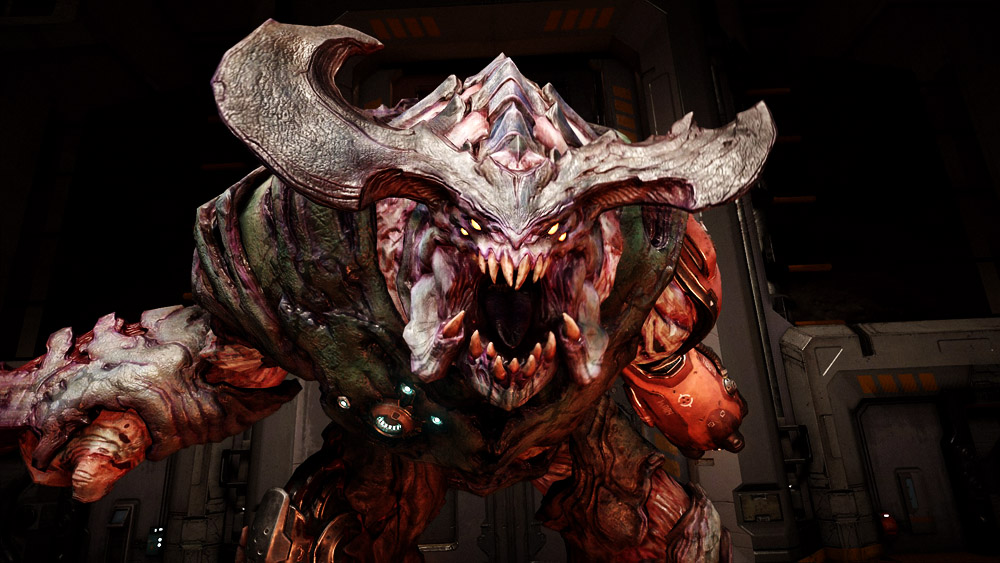
called Tyrants, who are surprisingly boring to fight. There's a new demon called
the Doom Hunter, who is introduced with great fanfare but feels like a reject
from Quake II. Plus a gladiator, who might have
been a fun challenge, but he only appears once, in a boss encounter. Doom 2016 had
some memorable boss encounters, but Doom Eternal is surprisingly low-key in that respect. One boss fight involves shooting some eyeballs and then punching a
brain, which was so trivial I remember wondering if it was a boss encounter or a
puzzle.


One baddie who does stand out, however, is the Marauder. He's introduced
as a boss, and then he reappears as a regular heavy later in the game.
He was and remains controversial. He's a bit like the shield soldiers, with
the difference that the player can't force him to drop his shield with
gunfire. Instead the player has to wait for the Marauder to charge, at which
point he is briefly vulnerable. If the player shoots his shield too early he spawns a golden dog who tries to flank the player.
There are two problems. Firstly the game encourages the player to use
weapon-switching to kill him, but every
time I tried it he just raised his shield. I couldn't tell if my timing was
terrible, or there was a bug, or if he was just naturally resistant to the ballista. Secondly, for all the hype surrounding him,
including a dedicated cutscene, fighting him is surprisingly dull. The player
just has to back off, wait for him to charge, shoot him, shoot him again, then
back off. In fact the super shotgun plus meathook almost makes him trivial. The first shotgun blast staggers him, then the meathook brings the player into range for a point-blank shotgun hit, and after three or four repeats of this process the Marauder is no more. It can get tricky when the Marauder is part of a larger wave of
baddies, but even then his high mobility means that he tends to leave the regular baddies behind.
That's enough about the combat. The game has some
Master Levels, which are essentially regular maps but with different enemy
spawns. My hunch is that the altered demon spawns were originally intended for the higher difficult levels, but the developers didn't have time, so they ended up using them as bonus maps instead. Here's a video of me playing one of the easier Master Levels, in
Ultraviolence difficulty, with "classic" weapons (e.g. new weapons are
scattered throughout the map, which is why I only use the shotgun and heavy
cannon). Notice how the balance of fighting, jump, and farming the baddies is
such that the battle attains a kind of hyponotic equilibrium. Of note the video is set to 18+ so you might need to pop off to YouTube to see it.
So, the combat is fantastic. Full marks. For the combat.
As mentioned up the page I like to imagine that the developers split themselves into three teams. They all did a good job. The combat is fantastic. The third team worked on the storyline. They also did a good job, but the game doesn't present the story very well. There's a big emphasis on hitting the TAB key to read text boxes, which may or may not be a deliberate throwback to the 1990s. There's a lot of backstory, but it slows the gameplay down, and conversely none of it is really worth the read.
Early in the game there's a short sequence where The DOOMSLAYER meets Valen, The Betrayer. There's a whole cutscene, although in practice he just gives the player a big battery. I remember thinking "who is that man", and "should I care about that man", and "will he re-appear", and "should I exercise restraint when using explosives", to which the answers are (a) that's explained in a text box (b) not really (c) no, he doesn't (d) no.
One level involves retrieving The DOOMSLAYER's special sword, but it's a shaggy dog story - it breaks, so he has to forge a new one - and as mentioned earlier it doesn't play much role in the gameplay. Yes, technically he uses it to kill a particularly significant demon, but it's just a McGuffin.


The story is told with text boxes, and the plot is mostly
go-here, collect-this, then-go-there, which was true of Doom 2016, but I
suspect the developers had higher hopes. It picks up towards the end. When it finally gets going, the story of how The DOOMSLAYER came to be, and
the story of how the gods of his universe turned out to be just as evil as the
demons, comma, was actually quite affecting. The heavenly expanse of Urdak has
an air of tragic grandeur, and it's a shame the story doesn't get into the groove until
the second-to-last level.
Which brings us to the third element. The
in-between sections. Doom 2016 was basically a series of combat arenas linked
with some corridors and a little bit of
platforming. Doom Eternal amps this up by removing the corridors and turning the platforming sequences into full-on platform hell. The mixture of double-jumping and
dashing reminded me of Ori and the Blind Forest, as indeed did the difficulty
level. Has there ever been a game that looked so cute, but was so maddeningly hard, as Ori and the Blind Forest? On the surface it's beautiful, but underneath it's evil. Just like communism or any political system devised by misanthropic, middle-class hipsters with beards. I don't want to be reminded of Ori and the Blind Forest. I loved that game, and also hated it. I don't want to feel anything. I just want to be numb.
Do you remember Mirror's Edge? I wrote about it a few years ago. First-person platforming is very hard to pull off, because the player
can't see their feet. Mirror's Edge was built from the ground up as a
first-person platform game and it mostly worked. The engine made the player feel like
an actual physical body, with hands and feet, clambering onto things and
bashing into walls, whereas most first-person games until that point made the
player feel like a remote camera hovering in a vacuum.
I don't know
if the developers of Doom Eternal ever played
Mirror's Edge, although the game was very influential so I have to assume they were aware
of it. Whatever the case, the in-between-sections of Doom Eternal feel a
lot like Mirror's Edge, but harder, because they're less grounded in
reality and there's lava. In isolation Doom Eternal's platforming
sections are well-executed, but they don't mix with the rest of the game.

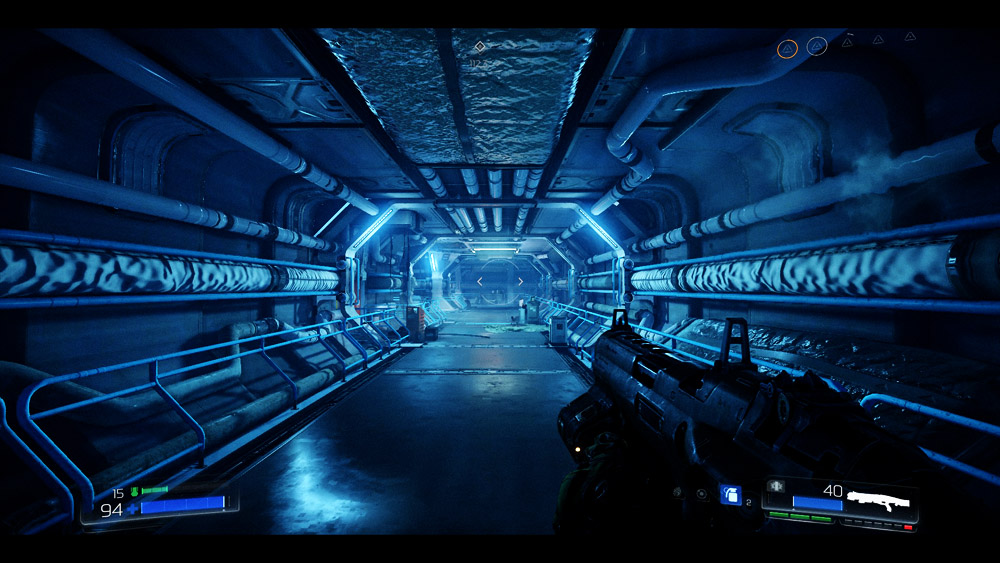
They don't mix well at all. I bought Doom Eternal when it came out on budget in 2022, but I didn't warm to it, and after five hours I gave up and went to Greenland instead. Part of the problem is that the early levels aren't much fun. They feel like glorified tutorials. But most of the problem is that - as with the rock-paper-scissors element - the game throws platforming at the player right from the start. The second level has a sequence (pictured above) where the player must drop down from a height, then dash through a gap, then double-jump-and-dash up the other side onto a wall, then jump from the wall and double-dash to a second wall. The same map has sequence where the player has to jump between collapsing platforms onto a swing-bar, then into a mid-air power-up that refills the player's dash ability, all above a sea of lava. I remember seeing this and thinking "what went wrong".

Later in the game I remember one particular jump that involved leaping from a wall, onto a jump pad, then pulling a 180 and dashing and jumping so as to avoid a huge piece of spinning debris. The problem with the platforming sections is that they're off-puttingly difficult until the player gets the knack, at which point they become a boring triviality. I'm reminded of The Last Guardian on the PlayStation 4, which has a similar problem. Once you know what to do, there isn't any challenge. Furthermore the combat and platforming are completely separate. Doom 2016's exploration sequences had a bit of action and a bit of exploration, but Doom Eternal separates the two flavours entirely. When there is platforming, there are no monsters, and vice-versa.
To be fair, if the player falls into oblivion they're returned to the start of the platforming section with a little bit of health taken off, but I still hated the platforming sections, and then I was bored with them. I never enjoyed them. They brought the game to a standstill when they appeared. The developers would probably argue that they exist to hone the player's mobility, but in the combat arenas I never had to drop down from a wall, then dash, then jump up, then dash, then grab a wall etc. In fact most of my mobility came from the super shotgun's meathook, which is never used in the platforming sections.
Also, do you know what else honed
my mobility? The combat arenas. I didn't need a separate set of
tutorials to learn how to navigate the combat arenas. The combat arenas themselves taught me that.
The platforming would
have been inoffensive if it was optional. The game has bonus elements in each
of the levels. Generally one or two extra combat encounters, plus a separate,
optional mini-arena that rewards the player with part of the key to a special weapon. If the
platforming had been a kind of bonus "show us your skills" element, I wouldn't
have minded. But it's mandatory. There are no short-cuts. The player has to knuckle down and learn
how to jump and shoot a switch then dash and wall-grab then double-dash and double-jump and so forth.
So, on
the whole, Doom Eternal has great combat, and the rock-paper-scissors element
is much less annoying than it could have been. Only one of the new enemies
requires a completely different gameplay style, and he only appears a few
times. However after every arena the game grinds to a halt, because there's
some unavoidable, unskippable platforming. The platforming is unenjoyable the
first time and boring thereafter. The story doesn't get going until the very
end.
The game has considerably more replayability than Doom 2016, with a bunch of Master Levels that add new monster spawns, plus some optional cheat codes that allow the player to indulge their power fantasies. One cheat code even dubs applause over the gameplay, with the occasional incongruous "yeah" during quiet moments and a dog bark. But I can't bring myself to max out all the secrets because the pacing is bitty and the levels are slightly too long to play casually.

Performance-wise Doom Eternal looks a lot like a predecessor, which is to say that it's a very attractive game. I would use the word chunky to describe the scenery. With my bog-standard Intel i3 / Geforce GTX 1650 combination it hit a steady 60fps at 1080 resolution. The game doesn't require ray-tracing or anything fancy. It has some occasionally quite epic scenery, but it never slows down. There is some odd pop-in, whereby objects at the edge of the screen appear from thin air when the player turns around - presumably they were being loaded from disc - but it was unnoticeable during the action gameplay. EDIT: Since writing that paragraph I bought a second-hand Geforce GTX 1080, which is ancient - it was released in 2016 - but still pretty slick today at 1080. It easily runs Doom Eternal at max settings at 60fps albeit that it can't do raytracing

What about the music? Doom 2016 had a fantastic electronic metal
soundtrack by Mick Gordon, who produced oodles of music for the game and then
edited it all down for the accompanying soundtrack LP, which was released on
double and quadruple vinyl. Gordon outdid himself. A joke going around at the
time was that Doom was a fantastic industrial metal album with a pretty good
free game.
Sadly Doom Eternal isn't in the same league. There's one
absolutely superb action theme, "The Only Thing They Fear is You", and the
ending credits music is brooding and atmospheric. Unfortunately the rest of the
soundtrack is a kind of aural wallpaper. It works well in context, but I don't
remember any of it.
But therein lies a tale. Shortly after Doom
Eternal's soundtrack was released there were complaints on the internet that the
mastering was poor, and that some songs appeared to be stitched together from parts of other songs. Furthermore the soundtrack was only available digitally, and at
over four hours it felt as if the producers had simply thrown together every
scrap of music from the game, whether it was meant to be enjoyed in isolation or
not.
Mick Gordon pointed out online that he had only tangentially
been involved in the final mixing, at which point one of Id's executives seemed
to take personal offence, posting a lengthy message on Reddit to complain that Gordon had missed deadlines, and that most of his music was atmospheric
noodling rather than hard action themes, and that Gordon should not have badmouthed the end product.
Gordon
responded with a lengthy essay on Medium.com. He pointed out that the soundtrack album was sold as Mick Gordon's Doom Eternal, and that the had every
right to criticise something that had his name on it. Secondly he revealed that Id had given him a deadline of two weeks to produce a suite of
music for each of the game's levels, with no time to bounce ideas off the team,
in part because he had to compose the music blind, because the levels and indeed
general shape of the game hadn't been designed yet. Ultimately he was contracted
to produce just over two hours of music, but ended up submitting double
that, because Id continually rejected his contributions.
Towards the
end of the process he was given an extra fortnight to create the soundtrack
album, only to find that Id had already asked one of their audio designers to
assemble it from Gordon's outtakes. The soundtrack album was
therefore a mixture of a dozen tracks that Gordon had managed to master for
release, plus an hour or so of Gordon's unmixed musical score, plus two hours of
outtakes that Id technically hadn't paid for.
As a consequence relations between Gordon and Id broke down, and Doom Eternal's mission packs were scored
by other composers. It seems unlikely Gordon will ever return to the series.
The Doom Eternal soundtrack itself never had a wide release. It was only ever available as a bonus for people who pre-ordered the game, although the
individual tracks are widely available on Youtube. As a happy postscript Mick
Gordon is apparently going to headline RADAR 2027, a Sheffield-based music
festival, where he will perform his music for the Doom games with a full band and
orchestra. Let's all cross our fingers and hope that Id Software doesn't set
their lawyers on him, or something.
Still, in summary, Doom Eternal
is basically one step forward and two steps back from Doom 2016. The combat is
more fluid, more jumpy, harder but just as fair. It has a steep learning curve
and the early maps aren't much fun, but once the player amasses an arsenal and
learns how to get stuck in it's one one the best first-person shooters I've ever
played, on a par with the original Unreal: Tournament. The expanded storyline is
at least mostly transparent, although it doesn't really get going until the end,
but the game as a whole is tainted by the platform sequences, which kill the
pacing and simply aren't fun to play. The end result is a real curate's egg of a
game.

What happened next? The game was a big hit. Enough to justify a pair of
expansion packs, The Ancient Gods 1 and 2, released in 2020 and 2021
respectively. The first is apparently more of the same, but harder. The second apparently dials things down a little bit, but has a convoluted plot. I have
no special desire to play either DLC.
A third game in the revival
series followed in 2025. Doom: The Dark Ages is a prequel that tells the story
of how The DOOMSLAYER came to be. It tones down the jumpy, weapon-swappy gameplay of Doom Eternal in
favour of straightforward blasting. The DOOMSLAYER now has a multi-purpose shield. Unfortunately it doesn't appear to have
sold very well. The publishers haven't released official numbers, but it was released essentially for free on the Xbox, as part of that platform's Game
Pass subscription service, and it had one-third Doom Eternal's Steam player
count at launch.
My hunch is that fans of Doom 2016 who were
alienated by Doom Eternal stayed away. A launch price of $70 / £70 / €80 didn't help. And the game
requires a graphics card that supports raytracing, so even if I wanted to buy
it, I wouldn't be able to run it. I would need to spend an extra £200 on a
suitable second-hand GPU.

To date The Dark Ages has had one expansion pack, Revelations, which was released in July 2026, just a couple of months ago. Unfortunately this coincided with a massive wave of lay-offs at Microsoft's gaming studios, including Id Software. It remains to be seen how this will affect the Doom series.
Nonetheless Id has a long history of shedding talent, but bouncing back. It lost Tom Hall during the development of Doom, John Romero and Sandy Petersen during the development of Quake, Adrian Carmack around the time of Doom 3, John Carmack post-Rage, and admittedly whilst this happened the company went from being the world leader in 3D action games to being an irrelevant has-been, but the point still stands, whatever it was. Id will probably rise again, and so will Doom, unless it doesn't, the end.