Showing posts with label italy. Show all posts

Wednesday, 2 October 2019

Feltre


Every time I stay in Venice I like to visit somewhere I've never been before, so that I might add another brick to the mass of LEGO® pieces that exist inside my head. When I have enough bricks I will be able to build an impregnable fortress inside my mind, with livestock and a well, and then I'll never have to interact with the world again.

So this year I popped along to Burger King®. It's just across the bridge from the train station. A few years ago there was a Burger King® in the middle of Venice, but it closed, and the new Burger King® was always packed so I avoided it.


"But", I hear you say, "when you go abroad you should eat what the locals eat", to which my reply is that Italians love fast food just as much as we do, and when they don't eat fast food they tend to cook at home, because they're a lot like us. The reality is that your view of the continent is an idealised imitation of someone else's dream. For the record I can confirm that Venice's Crispy Chicken® is much like Crispy Chicken® anywhere else.

I only visited Burger King® once, however, firstly because I didn't want to spoil the thrill of discovery and secondly because Venice now has a KFC®. It's hidden away in a newly-built shopping mall adjoining the train station. Venice's KFC® is just a few feet away from huge crowds of people, but it's quiet because it's out of the way. For the record I can confirm etc.


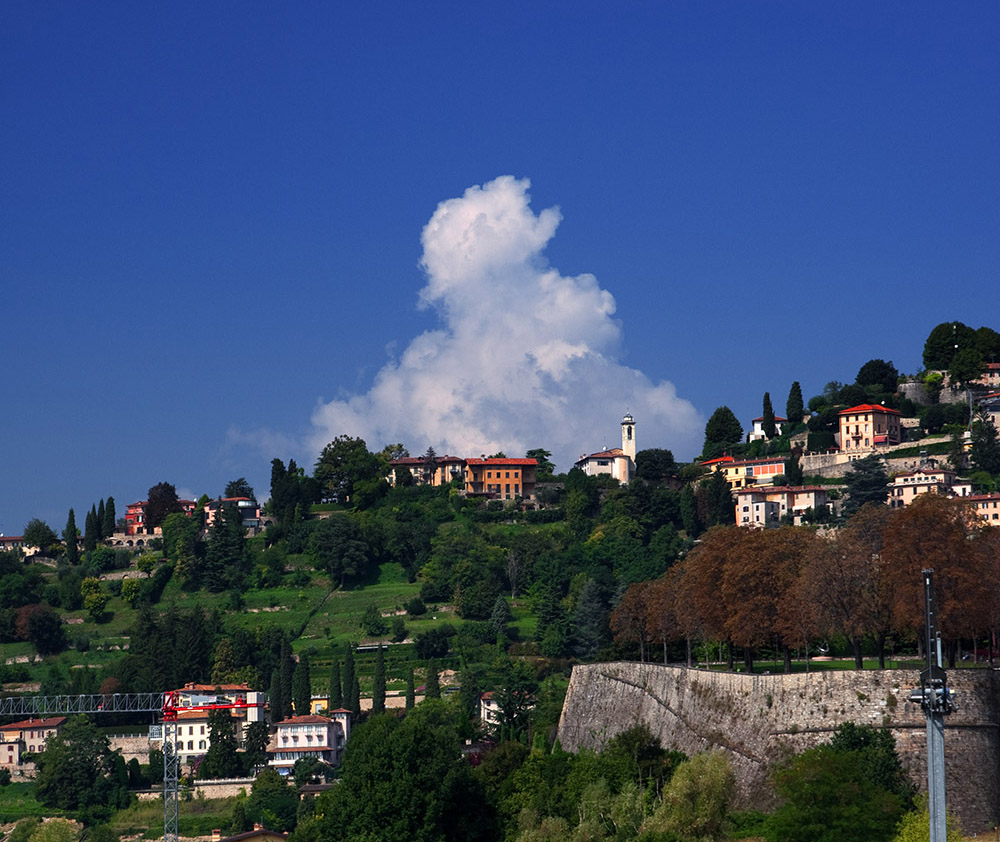
But what to do during the rest of the day? Feltre is an anonymous but very attractive small town in the foothills of the Dolomites. It's about two hours from Venice by train. There's a Lidl right next to the train station if you want to stock up on food. Why Feltre? It has a Wikivoyage page and if nuclear war broke out it would probably survive quite well given that it's surrounded by hills. The mountains mean that Feltre has some fascinating cloud formations.

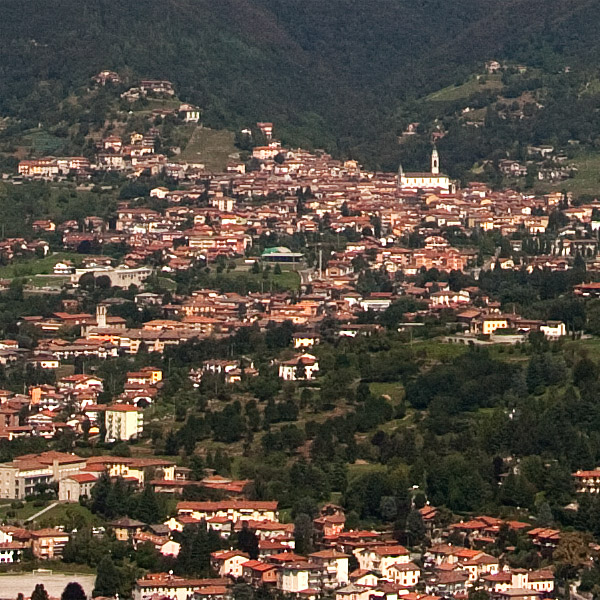
The suburbs. As an Englishman I'm used to suburbs that look like grim hellscapes, but Feltre isn't like that. The building in the bottom-left is a hospital. It's a big building with patients, but that's not important right now.


I went during a weekday and there were very few people about. Most photographs of the place on the internet show empty streets and deserted squares, which probably suits the locals fine. The whole town is built around a castle on a hill, and you have to do a bit of uphill walking to get there.


The rest of this post is mostly sarcastic, but Italy does suffer from a widespread small-town malaise; Feltre has a train station, but a lot of remote towns in the hills don't, and despite being picturesque they're difficult commutes, and traditional agriculture no longer pays the bills, so the young people move out and no-one moves in.
Feltre seems prosperous - everything was spotless and in good repair, despite the empty streets - so perhaps it's the Italian equivalent of those little villages in Somerset that are full of second homes.


There's a certain amount of "be careful what you wish for" with Feltre. Venice is packed with people, which is frustrating, but there's a lot to do. Feltre on the other hand doesn't have crowds, but there's nothing to do unless you're one of those creepy people who likes to sit down and read a book, or perhaps you enjoy peace and quiet or something like that.

So, as I sat on a bench in sunny Feltre reading Michael Collins' Carrying the Fire and munching on a croissant that had a sausage rammed through the middle, I remember thinking "what went wrong with my life". Later on I saw a first-generation Saab 900 Turbo, a rare sight now in the UK:


As a kid I thought they looked awkward - the back end is an angular Austin Allegro, the front looks like a duck's snout - but in 2019, as a grown-up, I think it looks awesome, especially in jet black. My hunch is that the cold, thin air in the Italian mountains is relatively benign on car bodywork but the steep gradients probably murder gearboxes, but then again the Saab 900 was famously robust so hopefully this one will survive for years to come.


I also saw a train. I learn from the internet that the Trenino Express Dolomiti cost the town €90,000 and links Feltre with Pedavina. Tickets are €3, it runs on Tuesday, Friday, Saturday, and Sunday, and it has a capacity of forty people, so if you have a calculator and you know the timetable and average passenger load and the cost of the driver's wages plus fuel and maintenance you could probably work out how long it will take to pay for itself.


Sadly the castle was closed. I learned from Carrying that Fire that at a temperature of 21c / 70f I would be able to sit on a bench for eleven days before dying of dehydration. People tend to measure out their retirement in terms of money, but you could measure it in water as well. Running the maths through my calculator, if I had 1,700 litres of water right now I could probably survive until the end of my days. How much would it cost? A one litre bottle of San Pellegrino is £1, so 1,700 litres of water would cost me £1,700.

And, I mean, if I consolidate my credit cards and borrow some money I could have £1,700 right now. Assuming I never do any exercise I can, right now, buy all the water I will need for the rest of my life. What about food? All I have to do is sleep with my mouth open and enough insects will crawl inside to keep me sustained. The big problem, of course, is shelter. That's a lot more expensive than water. If shelter wasn't a problem I could retire right now.


And that's Feltre. The last train leaves for Venice at 20:13, so I didn't get a chance to evaluate the nightlife. Feltre has been around since at least Roman times, when it was called Feltria. What does Feltria mean? I have no idea. Something to do with felt-making? Who knows. Its most recent brush with fame was in 1943, when Adolf Hitler of Germany visited Benito Mussolini of Italy to have a chat about the impending victory of fascism, but although they met at Feltre's train station the actual conference took place at Villa Gaggia, which is twelve miles north-east.

In 2003 the city was twinned with Newbury, I assume because someone in Newbury's council wanted an excuse to use public money to fund a trip to Feltre. I can't think of any other reason. I imagine if you found a list of Newbury's council members circa 2002-ish and went through what remains of their social media presence around that time you could probably pinpoint the individual council member who was responsible - perhaps AI could do that for you - but what would be the point?

Tuesday, 20 March 2018

Bomarzo, Monster Park II: Kodak Ektachrome

"Rah! I'm a monstah!"

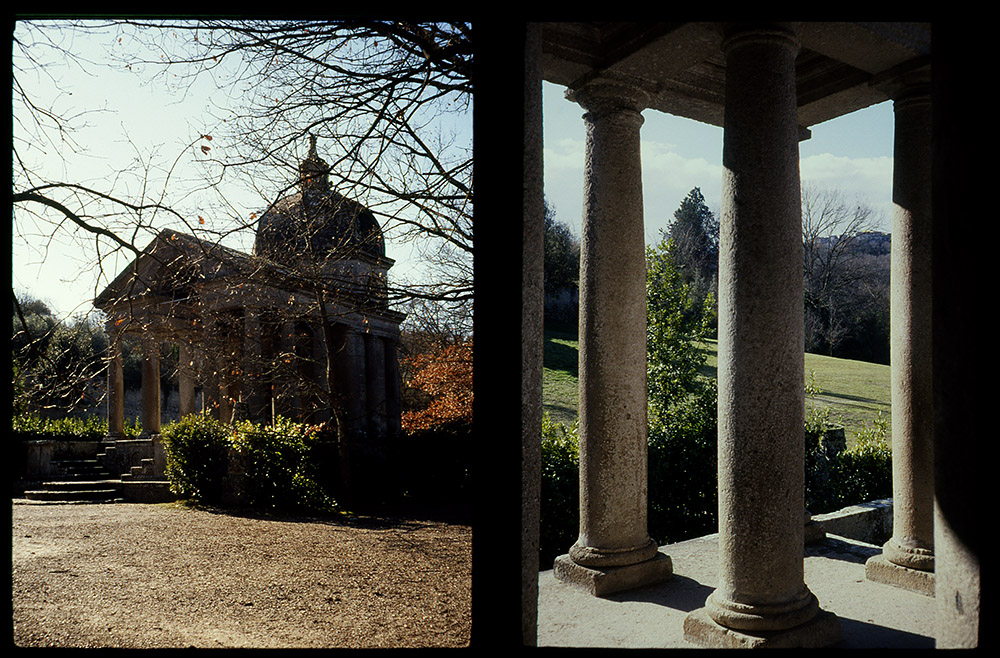
Last month I went off to Bomarzo in Italy to see the Parco dei Mostri, an attractive park dotted with monstrous stone sculptures created in the late 1500s. I took along my Fujica Half half-frame camera and some Kodak Pro Image film, and also some Kodak Ektachrome that expired a long time ago.


Bomarzo is an awkward day trip from Rome but entirely doable by public transport. I have done it myself, and now I can look myself in the mirror and say "I know de way", like Ugandan Knuckles. Do you remember Ugandan Knuckles? All the way back in January 2018 it became fashionable amongst young people to gatecrash a set of virtual communities with an avatar that resembled Sega's popular Knuckles character, but deformed, while delivering quotations from Who Killed Captain Alex?, a low-budget Ugandan action film. Thus Ugandan Knuckles. The fad flourished briefly in the first month of 2018. Two months later I almost feel nostalgic for it.


Uganda has a surprisingly productive albeit underfunded film industry, which seems to have embraced the audience participation elements of Rocky Horror and DJ toasting etcetera. Ugandan film-makers don't have access to much money, so inevitably they major in exploitation films, violent action and horror, and what's wrong with that? I grew up watching violent action and horror films on videotape, especially if they had nudity, such as for example The Howling or Lifeforce, and there's nothing wrong with me.


The mouth has a surprisingly big table inside. I changed film on the table.

Sadly the Ugandan government isn't keen on the other thing and has funded an anti-pornography committee to the tune of half a million dollars, which is probably more money than the total budget of all Ugandan films made in any given year. I learn that the Ugandan government has spent almost ninety thousand dollars importing a pornography detection machine from South Korea, which is ridiculous given that teenage boys will eagerly do the job for free.

As a consequence of this Uganda is badly underrepresented on Pornhub, indeed half of Pornhub's returns for "uganda" are actually Ugandan Knuckles uploads, which aren't even porn. I maintain that it's not government initiatives that bring people of different creeds, colours, and religions together, it is instead pornography and drugs and rock and roll and Counter-Strike and so forth. "We are two of soul".


The mainstream media was convinced that Ugandan Knuckles was bad because it was racist, and so if I do decide to look myself in the mirror and say "I know de way" I will make sure that no-one is watching me. History will look back at a time when Western society decided to ban a cartoon frog and wonder what went wrong.

After visiting Bomarzo, which I have described already and I'm not going to do it again, I returned to Rome, but the light was fading. There are continual rumours that what remains of Kodak is going to reintroduce Ektachrome - the company discontinued its entire slide film range several years ago, leaving Fuji as the world's sole remaining manufacturer of slide film - but I'll believe it when I see it and I won't rejoice all that much. Ektachrome itself was okay, essentially a budget alternative to Kodachrome that was easier to develop. When it was a thing it was often criticised for being a bit flat and pale, and when Fuji inroduced the dense, hypersaturated Velvia in 1990 landscape and advertising photographers switched to that instead. Kodak attempted to compete with "high saturation" versions of Ektachrome but it was too little, too late, and of course it was ultimately for nothing because the problem facing Kodak wasn't weak slide film, the end


Monday, 25 December 2017

Tamron 28-75mm f/2.8: The Threshold of Horror


Let's have a look at the Tamron 28-75mm f/2.8, or Tamron AF 28-75mm f/2.8 Aspherical LD XR Di SP if we're being precise. I was about to say that the Tamron 28-75mm f/2.8 has a longer name than top actress and film-maker Isabella Rossellini, whose full name is Isabella Fiorella Elettra Giovanna Rossellini, but that's not true because Isabella Rossellini's name is either three characters longer or exactly the same length, depending on whether you count / and . and - as characters, which I do, the end.


What do all those characters mean? Tamron is the name of the company. Tamron was founded in 1878 by a Peruvian man called Michael Simpson who had a dream in which snails could be harnessed to transport cargo. The company now makes lenses.

This particular lens isn't spherical, it's a tube. The rest of the name is something to do with assembly language programming. If you type LD XR Di SP into an industrial computer something happens. I don't know. It's just marketing bumpf. The lens is supposed to have special, digitally-integrated low-dispersion extra-refractive glass and one of the elements is aspherical and it focuses internally instead of expanding and it's special, but in a good way, but the same is true of every other lens Tamron makes so what's the point?


Dear reader, if you had letters after your name, what would they be? I would have the letters ST for super-terrific and K for knowledgeable and W for witty. In the real world some people have letters after their name to indicate that they have special properties, such as for example Sir Antony Arthur Acland KG GCMG GCVO, who is made of pottery, and Sir Colville Norbert Young GCMG MBE, who in addition to being governor-general of Belize can set things on fire with the power of his mind.


Was it Zeiss? With their T coating? Back in the early years of the previous century Zeiss and Leica gave their lenses names - Tessar, Summilux, Biogon, Elmar and so forth - and then Zeiss added T to indicate the special Zeiss multi-coating, and it snowballed from there and now lenses have largely meaningless strings of characters. Please stop talking.

The Tamron 28-75mm f/2/8 etc is a popular general-purpose zoom lens for film and digital SLRs, notable for its combination of full-frame coverage, f/2.8, and modest price. It's also notable for its surprisingly good performance, although the build quality is uninspiring. It focuses internally, but the inner tube / front element extends at 75mm and I'm always worried that a sharp tap will jam it. It's plastic, including the filter thread. My copy had some plastic flashes - little hairs of spurious plastic, a byproduct of the manufacturing process - around the rear element. I had to pluck them out (carefully).


The lens was launched in 2003. On a historical level it's a paradox - a cheap full-frame lens launched during the death whimpers of the 35mm film SLR, and yet Tamron's adverts pointed out that the coatings were optimised for digital sensors even though in 2003 there were only two full-frame digital SLRs*. Perhaps Tamron believed that there was going to be a market for affordable full-frame digital cameras in the near future, and wanted to get in on the ground floor. Nonetheless the 28-75mm's f/2.8 aperture seems to have been powerfully appealing to APS-C photographers, notwithstanding the odd 42-120mm range in that format.

* Three if you count the Contax N Digital, but the Tamron 28-75mm f/2.8 was never sold for the Contax N mount. The handful of Contax N users might have enjoyed it - the system never had a fast general-purpose zoom.

Zoomed to 75mm on an old Canon EOS 50E film camera. Nikon doesn't have a problem with third-party lens manufacturers but Canon refuses to hand over their lens mount data, so the likes of Tamron, Tokina and Sigma have to reverse-engineer it. Historically Tamron and Tokina have had better luck at this than Sigma.

I've owned my Tamron 28-75mm f/2.8 for six years. I was going to write about it a long time ago but I decided to take some pictures with it first. I went over the mountains yonder and kept going, and then I came back to find that my hometown was small, and nothing there would excite me any more. The lens appealed to me because firstly I hate spending money and secondly I'm not usually a fan of general-purpose zooms. General purpose zooms are portrait lenses that aren't long enough or fast enough; they're landscape lenses that aren't sharp enough or long enough; no amount of technical trickery will conjure the look of 35mm f/1.4 from a fast zoom; they're ungentlemanly; you have to spend a lot to get good performance. Next paragraph, bored with this paragraph.


What's it like optically? Sharp in the middle at f/2.8 at all focal lengths except 75mm, but even then it's pretty good, generally good in the corners stopped down to f/8. Here's a chunk of scenery at 75mm f/8, with a polarising filter, shot with a full-frame 21mp Canon 5D MkII:


One thing. The Tamron 28-75mm has a 67mm filter thread but I found that even a slim polarising filter vignetted, so I used a metal 67-72mm step-up ring and an ordinary 72mm filter instead. Given that the lens has a plastic filter thread this is probably a good idea in general. It saves wearing out the plastic.

Another thing - there are lots of reports on the internet of sample variation and inconsistent performance, with several reviews pointing out that one side of their lens was sharper than the other. I'm not surprised. The build quality isn't that bad, but at 75mm the inner tube wobbles a bit, and I wouldn't be surprised if the internal components have relatively loose tolerances. Mine is slightly softer in the left-mid-upper part of the image, which is tolerable because I usually don't put things in that part of the frame except sky and clouds. Here's a 100% crop of the centre at f/8:


You can see the radio mast, and a bit of grain. I shot it at ISO 200 with Canon's "highlight tone priority" setting, which seemed like a good idea at the time but in retrospect was not. Bear in mind that this isn't a test chart; we're looking through a polarising filter and a mile of turbulent air. Here's the extreme bottom-right corner, with no sharpening but a tiny bit of CA correction:


It's good enough for me. Two hundred years ago, before the invention of photography, I would have simply looked at that scene. I wouldn't have thought about how to present it for an audience of strangers on the internet. I would have looked at the scene and walked away and no-one would ever have known; or I would have sat and painted it. Painted the hill and the trees and the church and the empty fields around it. Think of how horrible it was before Facebook and Twitter. People lived lives without meaning, without value. They just lived and died and ended up buried somewhere and no-one remembered what they did. If I had been born two hundred years ago my gravestone would now be landfill beneath a housing estate.


But provided you subscribe to me and hit the like button and also donate to my Patreon, my life now has meaning, and so does yours! We're not just going to die and be forgotten. One thousand years from now my blog will still be cherished by an audience of millions, and so will you! Women will imagine what it must have been like to meet me. Men will wish they had been me. Also, I do voiceovers. I own a Neumann U47 FET and a pop-shield. The guy who does Forgotten Weapons doesn't own a pop-shield.

The lens focuses quite closely at 75mm, and the bokeh is surprisingly good at that aperture.

At 50mm or so the bokeh isn't as good, however. This is the thing with general-purpose zooms. You either use them at 24mm or 70mm, so why not carry an ultrawide zoom and a compact telephoto and a 50mm or 35mm f/1.4 instead? Because you'd be walking everywhere with a backpack, that's why. Unless you use a compact camera, but then the image quality isn't as good. But what does it matter given that some of the most iconic photos of the modern age are shot at close range with an iPhone? Depression, uncertainty and doubt are constant companions of the photographer.

More mountains at 28mm also f/8:


In the centre:


And the corner, which falls apart a bit in the last hundred or so pixels, but I have seen worse:


I have seen worse. I have seen so much worse. The threshold of horror has no lower limit. That's what keeps me going. The knowledge that no matter how bad things get, I am still at the top of the slope. Heading downhill, but the same is true of the other passengers. They are heading downhill as well. We are all heading downhill together. All of us, together.


Unusually for a thing featured on my blog the Tamron 28-75mm f/2.8 is still on sale. I think. Tamron's UK website doesn't list it, but it's still available online. Tamron also sells an image stabilised 24-70mm f/2.8 zoom, but it's a lot more expensive.


The 28-75mm f/2.8 is or was available in Canon, Nikon, Pentax, and Minolta/Sony full-frame lens mounts, the latter particularly odd given that neither Pentax nor Konica Minolta had a full-frame digital SLR in 2003 (Pentax had once had been having a full-frame digital SLR, but nothing came of it). The Nikon version originally had an aperture ring and screw-driven autofocus; a later revision took away the aperture ring but added an internal motor so it will focus on Nikon cameras that don't have a screw drive. This may be true of the Pentax version as well, I'm not sure.


Does the 28-75mm make any sense? Yes, provided you don't have a track record of bashing your lens against things. In the UK at least Tamron has a five-year warranty. Tamron reverse-engineers the Canon EOS lens mount system, but as with Tokina I've never heard of Tamron lenses failing to work with EOS cameras. This very lens focuses and works perfectly well in both ordinary autofocus and live view on my 5D MkII, and my old 10D, and for that matter my EOS 50e film camera. Brand new the lens sells for £300-400, on the used market it appears to halve in value before diminishing to zero if it breaks; of course two broken Tamron 28-75mm f/2.8s could have bought you a single excellent-condition used Canon 24-70mm f/2.8L but that's up to you, the end.