Showing posts with label lithuanian mre. Show all posts

Sunday, 1 March 2020

Lithuanian MRE: Meal 2, Beef Stew with Groats


Let's have a look at another MRE. This one is Lithuanian. It's Variantas Number 2: Stewed Beef with Groats in Sauce. It comes with hazelnuts, honey, orange juice, coffee, and two packets of rock-hard Polish SU-1 crackers, viz:


And a plastic spoon, some matches, some hexy fuel tabs, and a tiny hexy stove. The plastic spoon feels much more flimsy than US MRE spoons, but in its favour it has a sharper edge, which cuts through food more easily.

To paraphrase the Pet Shop Boys, I never thought I'd get to be the creature I was meant to be, but I hoped, in spite of dreams, I wouldn't end up writing about plastic spoons. But here we are.

Lithuanian MREs are made in Poland for the Lithuanian armed forces, which is why they resemble Polish MREs. I've tried a couple of Polish MREs, the SR-1 and SR-4, and they're really good. The main meal is meaty and filling. Lithuanian MREs are similar on a conceptual level - a tray of meat stew plus extras - but they're not as good. Less meat, slightly fewer extras.

Compared to an American MRE the Lithuanian variety is simpler. American MREs have a relatively small main meal, plus a sub-main-meal, plus a variety of accessories, designed so that you can mix the elements together in several different ways, but Lithuanian and Polish MREs are much more inflexible. You can smash the crackers into bits and put them in the main meal, but that's about as much as you can do in terms of culinary expression.


Here's what the hexy stove looks like, and bear in mind that if I was cooking the beans I would open the lid:


In my experience one tab is enough to boil a can of beans plus a can of water for coffee. Airlines don't allow the carriage of hexy tabs, so if you plan to take a Lithuanian MRE abroad you'll have to take out the tabs first. I mention this because, if all goes well, I will be tramping across [redacted] in a few months, and I thought about taking the hexy tabs as a backup in case I couldn't find fuel for my Trangia stove, but alas I can't.

In theory hexy tabs are great. They're lightweight and burn away, leaving behind no waste. In practice they smell, they cover everything in smokey residue, and they give off a lot of carbon monoxide, so if you're going to use one indoors make sure to open all the windows first. But enough of hexy tabs, let's tuck in:
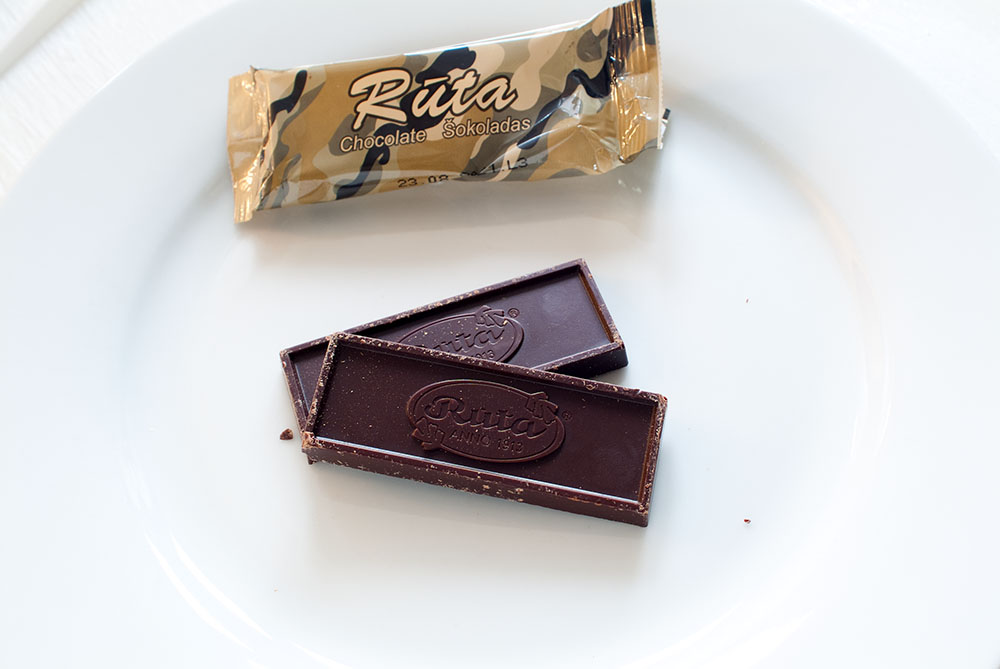
Firstly the chocolate, which is perfectly acceptable dark chocolate made by Ruta of Lithuania. It's indistinguishable from good-quality store-bought chocolate. The camo packaging is a nice touch.

I'm no coffee connoisseur. I'm British. I can only detect two types of coffee - hard, and soft. This was softer than MRE-style coffee. You don't get creamer, so I added a bit of milk. That might have taken off some of the edge.

The hazelnuts are hazelnuts. They're dry and there are lots of them, so I assume they're added as a cheap way of filling space.

Now it's time to start cooking the main meal. The flameless ration heater is super-effective. When I added water the heating element immediately swelled up and started giving off steam. It was frightening!
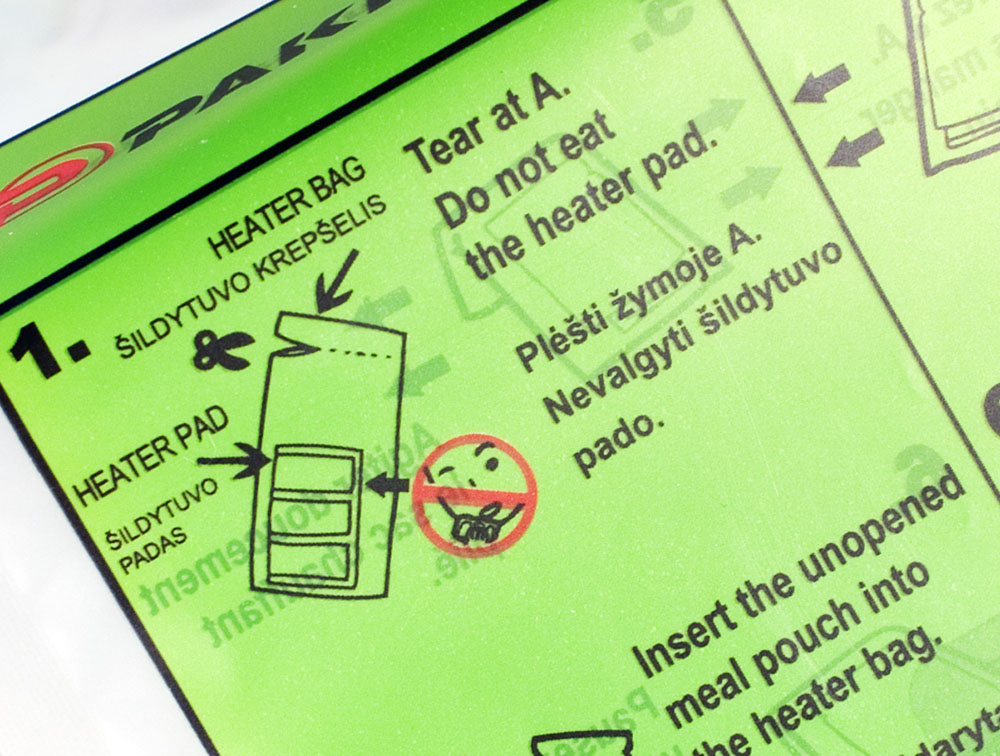
I wouldn't ordinarily think of eating a heating pad, but perhaps everyday life in the Lithuanian armed forces is so boring that the soldiers will do anything to amuse themselves. What if you wrapped one around your penis and poured water on it? The packaging doesn't warn against that.

I imagine that your penis would swell up, but not in a happy way.

While the main meal is cooking, let's try out the Polish SU-1 crackers. Rusks. Crackers. Hardtack. Rusks. They're legendary:


They have an unusual taste, apparently a result of caraway seeds. Slightly aniseed, but not so much that it's off-putting. Within a few bites you stop noticing it. The crackers are surprisingly clever. They take up little space; they keep forever; it takes a long time to eat them, so they feel more substantial than they are; you can eat them raw, or with the honey, or crush them up into the main meal.

You have to break them into bits with your hands first before eating them. They're far too tough to bite apart with your teeth. Your teeth would break first. Dunking is futile. Here's a shot of the crackers broken into bits, taken from an earlier article about a Polish MRE, which includes a little tin of meat:


Why are the colours different? Different camera, different lighting. At this point the main meal has cooked. Let's have a look:

Lithuanian MRE menus seem to change fairly regularly - most online sources say that menu two is chicken stew with an apple drink, but as you can see this brand-new-for-2019 menu is beef.


It's better than it looks, and bear in mind that what appears to be globs of fat are in fact groats. What are groats? They're coins, aren't they? From long ago? From Scotland? I don't know. I learn from the internet that groats are a form of wheatgrain, which makes a lot more sense. I can't imagine eating coins. It wouldn't help you go through an airport metal detector. They'd take you into a back room and pump you full of food until the coins came out the other end.

But perhaps you could use that to your advantage, if e.g. you were very hungry, but let's talk about the MRE. It's essentially a weak meaty stew. There's nothing wrong with it but it's insubstantial. The groats at least give it some variety, but it really needs a couple of slices of bread or some potatoes etc. As with a lot of MRE main courses it would be great dumped onto a plate of chips.

Compare it with the main meal from a Polish MRE, which has a much denser meat payload:
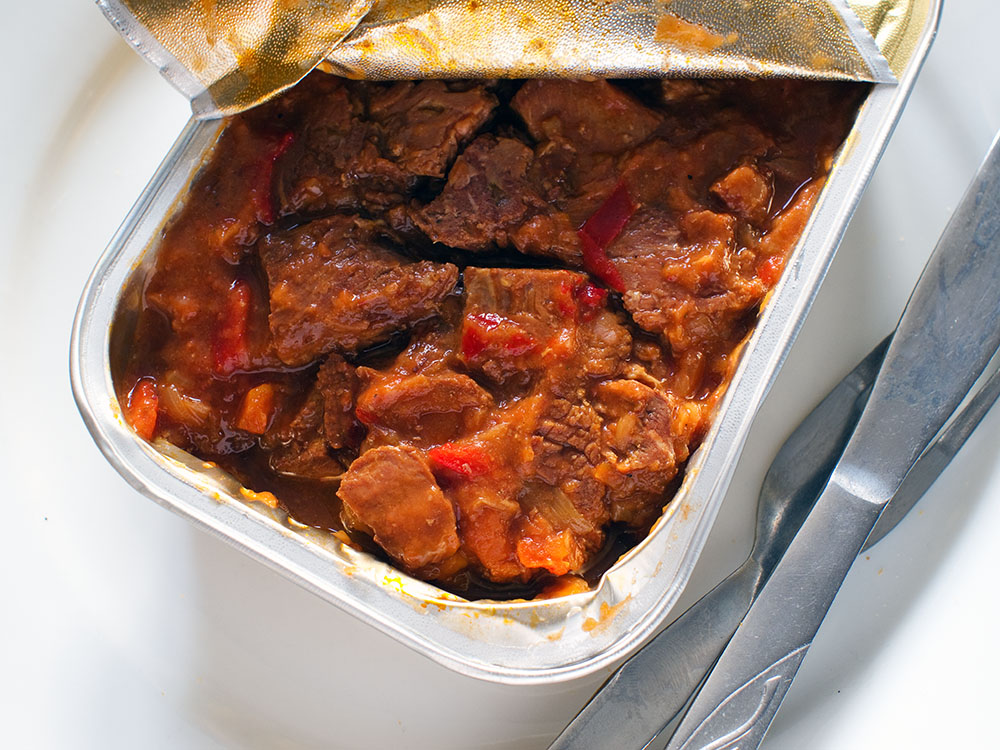

Not so much a meal as a statement. It dares you to adulterate it. It dares you to spurn or mock the power of meat. Meat Payload would be a good name for a heavy metal album. Which reminds me, there's one thing left, the orange juice:


Unfortunately I added too much water, so the end result was very thin. I imagine that with the correct ratio it just tastes of cheap orange juice.

Lithuanian MREs are widely available here in the UK, less so overseas. The country reintroduced conscription in 2015 but the military has not been engaged abroad since then, which is presumably why so many MREs are available on eBay and the like - my guess, and I admit this is a guess, is that Lithuanian soldiers mostly eat from field canteens or the mess hall, but the armed forces are compelled to procure lots of MREs "just in case", so they end up with masses of meals left over. Does that sound plausible?

As with all military meals Lithuanian MREs are of limited practical use on the civilian market. You can replicate the contents at home with a nutty chocolate bar, some biscuits, 3-in-one coffee, and a tin of stew. For long-distance hiking they're too bulky, and as a morale-booster the lack of variety would get depressing after a while. My hunch is that they keep for longer than US MREs - nuts, crackers, honey, and dark chocolate last forever - but then again rice and dried food stores even longer, and takes up less space. They are of course a fun novelty, and perhaps you are tired of Pot Noodles and Kendal Mint Cake.

And with that, dear reader, I will leave you to your own devices. You be good. I love you. See you tomorrow.

Monday, 1 July 2019

Lithuanian MRE: Meal 10, Beef Stew with Vegetables


Let's have a look at another MRE, but this time a Lithuanian MRE, from Lithuania. Where is Lithuania? It's in Europe, tucked away in the bottom-right corner of the Baltic, with Latvia and Estonia sitting on top of it. It's a load-bearing member, reinforced with concrete.


Technically Lithuanian MREs aren't MREs - they're Sausas Maisto Davinys, "dry food rations". There are ten separate menus and they're all meat stews. Lithuania does not have vegetarian MREs. I opted for variantas 10, beef stew with vegetables, or jautienos troškinys su daržovėmis.

As with all military rations, Lithuanian MREs aren't really practical as civilian food. They're too expensive to eat as a regular meal and too bulky for hiking, although they make a certain amount of sense if you're just camping overnight. Each MRE is a single meal with roughly 1,400 calories, but there's a lot of potential jetsam. If you ate lots of them you would quickly end up with superfluous fuel tablets and spoons. If you're preparing for the apocalypse, rice and dried meat keep longer. They are however fun novelties. Let's see what's in the packet.


My first impression was condoms. The interior of the packet smelled of condoms. Not the food, just the packaging. This meal has some SU-1 rusks, a packet of unsalted hazelnuts, a main meal in a plastic bag, plus an accessory packet with some honey, a bar of chocolate, an orange-flavoured drink, a packet of coffee, and some sugar. No milk, because Lithuanian army units take their livestock with them.

The internet is full of armchair generals who have batty theories about modern war. My theory is that farm animals are tragically underutilised on the front line. Obviously they're a ready supply of milk and eggs, but they can also be used to carry heavy loads, clear minefields, provide decoys for heat-seeking ground-attack missiles, and they also provide warmth and company. I have already sent a copy of this blog post to the Lithuanian foreign ministry. No reply yet.

If you read the ingredients often enough you too can learn basic Lithuanian. Druska is salt, vanduo is water, yes and no are taip and ne, beer is alaus, high-bypass jet turbine engine is aukštos aplinkkelio reaktyvinis variklis. Easy!


The MRE has two heaters. There's a US-style flameless ration heater activated with water, plus a hexy stove, which is fantastic:

In this picture the Lithuanian spoon is shown next to a standard US MRE spoon. The US spoon is more substantial but in its favour the Lithuanian spoon has a sharper edge, so it cuts through food more easily.


And some matches, in a proper matchbox. I'll save the hexy stove for later. Why does the meal have two types of heater? I have no idea. My guess is that the Lithuanian armed forces have five million hexy stoves in a warehouse from the 1990s and by gum they're not going to waste them.

Let's heat up the main meal with the flameless ration heater. It's super effective! It immediately swelled up, releasing plumes of steam which are not captured in the following images, but they were there:


The flameless ration heater's packaging has no less than three warnings that you shouldn't eat the heating element:


Lithuania reintroduced conscription in 2015, so perhaps the people who designed the FRHs were terrified that the first batch of conscripts would be malnourished knuckle-draggers from the Lithuanians sticks. Shoving an FRH down someone's throat strikes me as a fantastic method of torture - it would boil their stomach, perhaps causing permanent damage. You'd have to force it down with a broom handle and then clamp their mouth shut. They would thrash around in agony!

While the meal cooks, let's try the rusks and the honey:


I like to think that honey is evidence that God wanted us to be happy, but only if we braved swarms of bees and stole their food first. Sometimes we are happy, sometimes the bees are happy. At least there is symmetry.

The rusks are made in Poland. They also appear in Polish rations. They're surprisingly versatile, given that they're just hard biscuits. Steve1989 tried them out in a Polish ration back in 2016:


I learn that they're informally called "panzer crackers" because they're so tough. And they are! Even after dunking them in my coffee I still had to bite hard with my molars to break them into bits. In fact I even had to pre-break them. They have a pleasant wheaty smell but a generally neutral, unsalted, unsugared taste. I think of them as a condensed analogue of potatoes, e.g. they're the roughage.

I'm not a honey connoisseur; the honey had a "fruity" taste, slightly acidic, and at first I wondered if it was actually marmalade. I think the rusks are included as general roughage and in the end I broke up the final one and mashed it into the main meal.

I mentioned coffee. You get coffee and sugar but no milk. I'm not that hardcore, so I added some milk to mine:


It's similar to US coffee, instant, type III, or whatever branded type of coffee is included in modern MREs. Hard rather than smooth, enough for a standard coffee cup. It gives me a mental image of the kind of working person's office where the walls are breezeblocks painted white and there's a noticeboard with an advert for a man with a van on it. Let's try the chocolate:


At first I thought it might be laced with amphetamines, like the chocolate that Germany had during the Second World War, Scho-Ka-Kola, but sadly it's just standard dark chocolate. It has a mild taste. After eating it I didn't feel an urge to try on all my old shirts and neither did my gums start sizzling. As a joke this paragraph was originally going to be a single unbroken 1,500-word sentence, as if I was under the influence of amphetamines, but after writing it the end result was indistinguishable from the rest of my blog so I included it out.

When the amplitude of a signal falls below that of the cosmic background radiation the signal becomes indistinguishable from random noise, and at that point it is lost. It cannot be reconstituted. The same is true on a quantum level. All signals eventually become indistinguishable from quantum fluctuations. This is why immortality is impossible. It would require infinite energy, which would in the long run raise the cosmic background radiation to such a high level that atomic bonds would be impossible, at which point whatever coherence existed would again be lost. There is no escape.

Let's try out the main meal:


It looks like cat food, but it smells nice. It's a meat-heavy, broth-light, vegetable-light stew, essentially a small can of cooked beef with some stewy bits. I keep using the word "mild", but it was indeed mild. US MREs include salt and hot sauce for seasoning; the Lithuanian meal would have benefited from a bit more spice, or any spice, but perhaps it's a regional thing. A long time ago Britain invaded the rest of the world in order to get hold of its spice, because British food was monotonous, and that is why the steam turbine was invented. Obviously Lithuania was happy with its lot.

The stew was slightly less greasy than I expected, but that doesn't change the fact that it feels strange to eat stew by itself - it's a shame they couldn't have included some potatoes. Ultimately it filled a hole and was tastier than it looked, but it wouldn't be very appetising cold, and if I was a Lithuanian conscript I would tolerate it but not look forward to it. It's not in the same league as the Polish MRE I wrote about later in the year.


Let's try out the orange-flavoured no-juice drink. US MRE drinks are better than they look - subtler and less chalky than you might expect - but the Lithuanian variety wasn't in the same league:


It looks as if it should be an effervescent sugar overload, but it tastes like a flat weak lemonade. As with US MRE drinks it exists purely to mask the taste of chemically-purified water, and on that level it works, but as a drink to enjoy it's no good.

Anything else? Oh yes, the hazelnuts:


They're unsalted and there's a surprisingly large amount of them. Eating them was a chore because they're very dry, but I suppose they're meant to boost your protein levels in a healthy way rather than entertain you.

A couple of years later, and just for the heck of it, I tried out the hexy stove, taking care to open all the windows. One tab will heat up a can of beans so that it bubbles and would probably warm up two cans so that they were edible. I wouldn't rely on the tabs to cook raw meat. I tried it out in a temperate climate. In freezing weather you might need more than one tab.

As mentioned in this series of posts US military meals tend to have a lot of salt, which makes sense if you do a lot of hard work in hot sun, but this Lithuanian MRE was generally salt-free and instead had more of an emphasis on fat. Perhaps they're more suitable for Lithuania's climate, which is apparently typical of the Baltic - nice but short summer, freezing cold and raining the rest of the year. I've never been, but perhaps one day I will.