

Let's have a look at the Fujica Half, a half-frame camera from 1963. Back in the early 1960s there was a fad in Japan for half-frame cameras. It was sparked off by the 1959 Olympus Pen, which I wrote about back in 2013. Unlike other miniature film formats half-frame used standard 35mm film, but the frame was half-sized and turned on its side.
In theory the image quality should have been half as good as standard 35mm, but film has resolution to spare, and the 18x24mm frame size was more than enough for ordinary prints. It had twice the area of 110 and was, by coincidence, almost exactly the same size as the Super 35 motion picture film format that appeared in the 1980s. Half-frame is appealing nowadays because it scans easily, the resolution is more than enough for the internet, and it makes economical use of film.
Half-frame never took off in the West. The internet says that half-frame was killed off by the likes of Minox and Rollei, but I'm skeptical; a more likely explanation is that Kodak was wary of anything that might result in consumers buying less film, so instead of embracing or extending half-frame they developed the 126 Instamatic format as an attempt to extinguish it.


Kodak's business model in the late 20th century involved making people pay more money for less film, which meant making the film smaller and putting it in a plastic cartridge of non-standard size. Furthermore the world was a lot more parochial in those days, and Japanese products still had a stigma about them in the West. That's my theory and I'm sticking with it.

The Half was launched in 1963, so mine is probably half a century old. The glue has seen better days but the lens is bright and clear. Surprisingly after all this time the solar-powered selenium meter is spot-on. The 28mm f/2.8 is slightly wider and faster than the typical 30mm f/3.5 of other half-frame cameras.
I'm digressing. The Olympus Pen was a very simple camera with manual exposure controls and no lightmeter. It was followed by a second wave of more capable cameras which included, yes, the Fujica Half. I was impressed with the Half, although it tends to be overshadowed by the Fujica Drive, which had a clockwork film winder, and the Half 1.9, which had a faster lens.


The Half has manual exposure control plus a selenium autoexposure system. I'm generally wary of selenium meters because they wear out with time, and lots of cameras from the mid-century are now unusable because the meters are broken and they don't have manual exposure. But my Half's meter seemed to respond to light so I decided to try it out, and it worked!
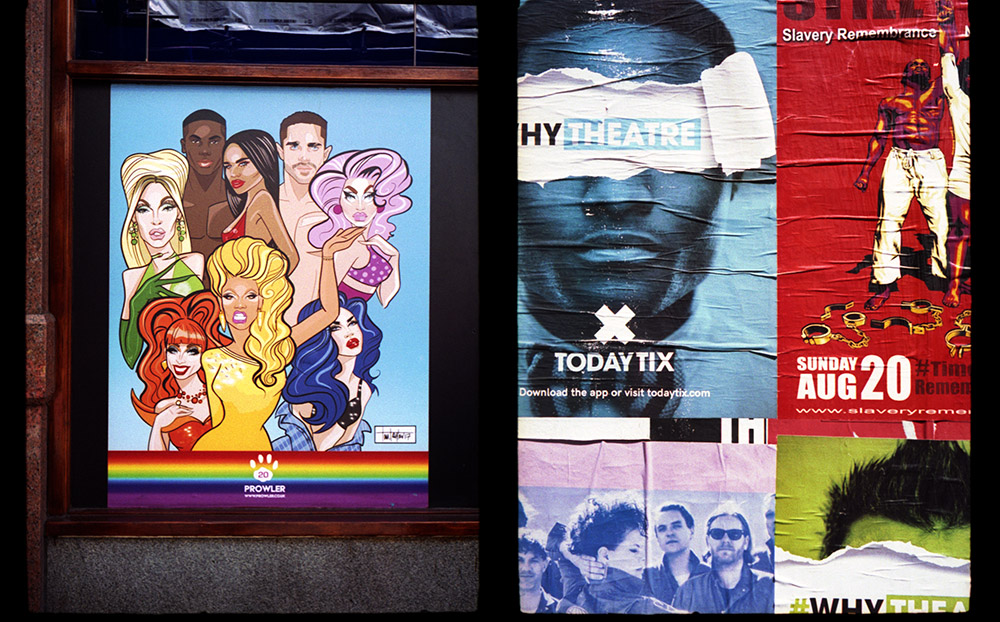
All of the photographs in this post were taken with autoexposure. The Half has a program system ranging from f/2.8 + 1/20th to f/22 + 1/250th. With ISO 200 Fuji Superia it generally selected f/11 + 125th or thereabouts. Oddly the viewfinder shows shutter speeds up to 1/250th, but the manual speed control has 1/300 instead. Perhaps the autoexposure system is stepless.


I've always assumed that selenium meters gradually lose their puff when exposed to light, but it seems that the real enemy of selenium cells is corrosion. Perhaps the original owner(s) kept the camera away from moisture. Hooray for that man or woman or person or thing or colour. I have no idea how much the Fujica Half cost when it was new, but it feels well-made and has a specification that was, at the time, at the higher end of the scale, so perhaps the first owner treasured it.
If the gods of Blogger's content management system are smiling down on me there should now be an interesting article / eBay shopping list from the July 1989 Popular Photography about second-wave half-frame cameras:
The Half has scale focus, with détentes at 2.9 feet (marked P, probably for Portrait) and 14.9 feet (marked G, probably for Garmonbozia / "pain and sorrow"). The aperture ranges from f/2.8 - f/22, with an A setting for autoexposure. The shutter speeds are B - 30 - 60 - 125 - 300, but you have to select an aperture before the shutter control will stick. It has a leaf shutter which makes a quiet click, and the frame counter is on the bottom of the camera. There's an off-centre tripod socket, a self-timer, and a PC socket. And a cold shoe, and some kind of flash automation that I will never use.


The lightmeter control only covers ISO 12 to ISO 200, so if you have a box of Fuji Velva 50 you're in luck; Ilford 3200 not so much. In my experience 400-speed negative film works just fine exposed at ISO 200, in fact some people overexpose by a stop to lift the shadows.
Film loading requires a bit of faith - it's one of those systems that doesn't advance film properly unless the back is closed - but it hasn't failed me yet. Is the lens any good? After poring over the scans it seems to be consistent across the frame when stopped down, although not as razor-sharp as the Ricoh Caddy I took for a spin back in 2016, and at f/2.8 the borders aren't all that great, but I can't be sure if that's the lens or mis-focusing on my part.
The shutter button feels a bit spongy, perhaps because it also has to operate the aperture/shutter needle in the viewfinder as well as tripping the shutter. Nonetheless I was impressed with the Fujica Half. Perhaps the only downside is that it doesn't have a filter thread. If you want to use a polariser you have to hold it against the lens. This isn't an issue in the United Kingdom, where the sun comes out but once a year, but perhaps when we have left the European Union we can export our clouds to extra-European nations that are short of clouds, such as e.g. Kenya or Egypt, and they can sell us sunshine in return. We could do with some sunshine.


In London only men or women are allowed to cross the road.
I scan the negatives with an Epson V500 and use the gap between frames to set the black level, which works a treat.
I've always assumed that selenium meters gradually lose their puff when exposed to light, but it seems that the real enemy of selenium cells is corrosion. Perhaps the original owner(s) kept the camera away from moisture. Hooray for that man or woman or person or thing or colour. I have no idea how much the Fujica Half cost when it was new, but it feels well-made and has a specification that was, at the time, at the higher end of the scale, so perhaps the first owner treasured it.
If the gods of Blogger's content management system are smiling down on me there should now be an interesting article / eBay shopping list from the July 1989 Popular Photography about second-wave half-frame cameras:
The Half has scale focus, with détentes at 2.9 feet (marked P, probably for Portrait) and 14.9 feet (marked G, probably for Garmonbozia / "pain and sorrow"). The aperture ranges from f/2.8 - f/22, with an A setting for autoexposure. The shutter speeds are B - 30 - 60 - 125 - 300, but you have to select an aperture before the shutter control will stick. It has a leaf shutter which makes a quiet click, and the frame counter is on the bottom of the camera. There's an off-centre tripod socket, a self-timer, and a PC socket. And a cold shoe, and some kind of flash automation that I will never use.
The lightmeter control only covers ISO 12 to ISO 200, so if you have a box of Fuji Velva 50 you're in luck; Ilford 3200 not so much. In my experience 400-speed negative film works just fine exposed at ISO 200, in fact some people overexpose by a stop to lift the shadows.
Film loading requires a bit of faith - it's one of those systems that doesn't advance film properly unless the back is closed - but it hasn't failed me yet. Is the lens any good? After poring over the scans it seems to be consistent across the frame when stopped down, although not as razor-sharp as the Ricoh Caddy I took for a spin back in 2016, and at f/2.8 the borders aren't all that great, but I can't be sure if that's the lens or mis-focusing on my part.
The shutter button feels a bit spongy, perhaps because it also has to operate the aperture/shutter needle in the viewfinder as well as tripping the shutter. Nonetheless I was impressed with the Fujica Half. Perhaps the only downside is that it doesn't have a filter thread. If you want to use a polariser you have to hold it against the lens. This isn't an issue in the United Kingdom, where the sun comes out but once a year, but perhaps when we have left the European Union we can export our clouds to extra-European nations that are short of clouds, such as e.g. Kenya or Egypt, and they can sell us sunshine in return. We could do with some sunshine.


