Showing posts with label pen f. Show all posts

Sunday, 19 June 2016

Nikon Lenses on a Pen F


The Olympus Pen F half-frame SLR had a small range of lenses. I've written about the 25mm f/2.8, the 40mm f/1.4, and the standard 38mm f/1.8 before. The system majored in normal primes and telephoto zooms, with a big gap at the wide end. The widest Pen F lens was a 20mm f/3.5, but with the 1.4x crop factor of half-frame it was only really a 28mm. And there were no fast telephotos, no fisheye, and no tilt-shift, no mirror lenses etc.


Fortunately Olympus sold a range of adapters that could fit other lenses onto the Pen F lens mount. Judging by eBay's listings the most popular was M42, but there were also T-Mount, Canon FD, Nikon F and Minolta models, even one for Olympus OM lenses. The adapters had some limitations - there was no aperture automation, so you had to use stop-down metering, and the intriguing M39 Leica screw mount adapter was macro only. Nonetheless it was nice to have the option. In a way the Pen F was a distant ancestor of modern mirrorless cameras, in that it was unusually compatible with other lens systems.


Phototec 100

The Nikon F adapter is particularly interesting because the Nikon F mount is still used today, and until relatively recently Nikon lenses had mechanical aperture rings. G-type Nikon lenses will mount on a Pen F adapter but the aperture will be perpetually stopped down to f/22 or something equally silly (unless you use blu-tak to hold the aperture pin open).

The lens looks massive; in reality the Pen F is small.

The adapter isn't particularly bulky.

Luckily I have some manual-everything Nikon lenses. For this post I used a Samyang 14mm f/2.8, which becomes a 20mm on a half-frame SLR. Optically it has a lot of barrel distortion and it's difficult to focus on an original Pen F because the camera doesn't have a split-image viewfinder, and with a wide angle lens everything looks far away.

On a physical level it looks silly, and on a practical level the great bulk defeats one of the Pen F system's raisons d'ĂȘtre; it was supposed to be compact. On the other hand if you want to go wider than 28mm with a Pen F (or faster than f/4 at the longer end) there aren't many other options, and the Samyang 14mm is not unusually large for a 14mm full-frame lens.


Also, off to the Tate Modern, which has grown since I was last there. The last exhibit, Abraham Cruzvillegas's Empty Lot, was a load of cobblers. It has now been replaced by a choir and a twisty building which has grown from one of the Tate's corners. If the intention was to pay homage to 1960s public architecture, they succeeded. There is a viewing platform on the top, a restaurant just beneath that, and exhibition spaces all the way down.


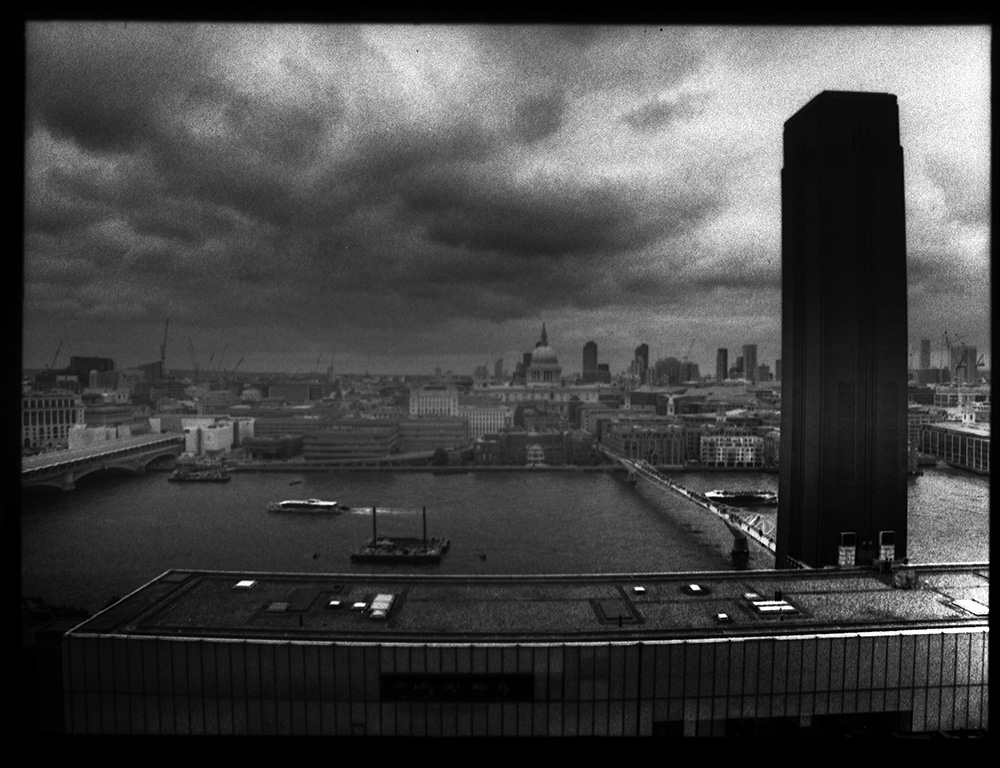

The top of the Tate affords a view into the living rooms of all the posh flats that surround the gallery. The living rooms looked unlived-in; when I was there they were empty and extraordinarily clean, with magazines and furniture dotted around as if they were show homes. I wondered how many of the flats were simply investment vehicles. The area around the Tate Modern is empty of all the things that support human life.

The exhibits included some people handing out ribbons, plus some thin intense-looking Europeans making music with air pumps, and if you think about it aren't we the exhibits in some strange way? As we peer at the art, security cameras peer at us; in a control room somewhere there are banks of monitors overseen by operators who ponder our meaning. At least it's nice to imagine that someone is pondering our meaning. The alternative - that no-one is observing us - is too horrible to contemplate.


EDIT: Four years later I repeated the experiment with a Vivitar 70-210mm f/3.5 Series 1, which became a kind of 100-300mm.


Saturday, 23 January 2016

Olympus Pen F 40mm f/1.4: Ruined Smiling


Let's have a look at the Olympus Zuiko 40mm f/1.4. It was one of the standard lenses for the Olympus Pen F half-frame SLR of the 1960s, faster than the standard 38mm f/1.8, less pancake-y than the 38mm f/2.8, and cheaper than the flagship 42mm f/1.2. Half-frame cameras had a 1.4x crop factor, so the 40mm is a slightly narrow 56mm in full-frame 35mm terms.


Physically the 40mm and 38mm are very similar. My 40mm lens is an early model with a conventional aperture ring. When Olympus launched the Pen FT they modified the lenses to work with the FT's lightmeter - the aperture ring could be rotated to show a set of numbers that corresponded with the lightmeter scale, although you could use conventional f-stops if you wanted.


As you can see the coatings appear to be different - the 40mm has a golden hue, the 38mm is much subtler. Compared to full-sized SLR lenses they are both tiny little jewels with cute end caps. The lens hood is a retro affair that clamps gently onto the front of the lens.

Performance-wise they're essentially the same; sharp in the middle at all apertures, no obvious optical deficits. Judging by this test the corners aren't so good at wider apertures, but for a fast standard lens that doesn't really matter because the corners will never be in focus. For the night-time shots in this article I used ISO 100 Agfa Precisa slide film, with the lens wide-open and the shutter at 1/30th or 1/15th, and it was sharp where it mattered.


Perhaps because the frame is vertical I find that lenses seem wider on the Pen F. The 40mm didn't feel limiting. If you already have the 38mm there isn't really a compelling reason to switch to the 40mm, but on the other hand you could sell the 38mm to fund your purchase of the 40mm, which is what I did.


The Pen F
Along with the lens I got hold of an original Pen F. Olympus sold three Pen SLRs. The Pen F (1963) was manual-everything, with no lightmeter. The Pen FT (1966) added a lightmeter and some tweaks, and the FV (1967) kept the tweaks but removed the lightmeter. The FT had a dimmer viewfinder window than the other two - some of the light was diverted into the meter - and having compared them them side-by-side with an F I can confirm that this is noticeable. The Pen F's ground glass focus screen seems to "pop" whereas the FT is a bit vague. Let's have a look at those tweaks, Pen F on the right, FT on the left:


Full-frontal nudity was taboo in Hollywood films for most of the first half of the 20th Century. There were scattered instances of full-frontal nudity in some of the edgier, artier films of the 1960s, but pubic hair didn't became hot box-office until Catch-22 in 1970. From that point onwards almost every Hollywood film had pubic hair, until of course Star Wars ushered in a new era of family-friendly blockbusters, but surely Chewbacca is naked, so perhaps Star Wars had masses of pubic hair after all.

Apropos of nothing, a Pen F shot with an infrared camera

I grew up in the 1980s, a time when pubic hair was no longer in vogue; it's not that nudity was unacceptable (NSFW), it's that pubic hair was seen as a throwback to the unwashed hippy era, and so women shaved it off. Nudity in the 1980s was clean-shaven, generally topless, and the women looked as if they had been to the gym at least once. The FT added a self-timer lever so you can take selfies, and the shutter speed dial became one of those lift-and-twist things so that you could set the lightmeter's ISO. Along the way the F's peculiar gothic logo was removed, although it remained on the lens caps. Why did Olympus decide on a gothic font for such a modernist camera? Dunno.

Let's look at the back and top:


The FT has a little rectangular window that shines light into the viewfinder, illuminating the lightmeter scale. It works surprisingly well provided you don't put your finger over it. The FT also has a single-stroke winder, whereas with the Pen F you have to pull the little winding lever twice when you advance the film.

Hollywood has had an odd relationship with bottom nudity. In films such as Splash and Cocoon it was a way of showing nudity in a PG context, but back then bottoms were not nearly as central to our collective sexuality as they are today. In the past bottoms were funny rather than sexy, but over the last twenty years or so Western culture has embraced bottoms. Celebrities such as Kim Kardashian and Jennifer Lopez and Elliot Offen have built business empires on their bottoms.

The F and FT have slightly different bottoms; the tripod mount is in a different place, and as a consequence you have to use different cases:


The FT also has a hole for the battery.

How about the sides? The F's more compact winding lever looks more elegant. NB there wasn't a motor drive or speed winder for the Pen F system; on the whole it had a limited range of accessories, mostly concentrated in the macro and medical imaging fields. Half-frame was apparently also popular for police mugshots, although the police generally used modified full-frame SLRs.


The Pen F range had cold accessory shoes that mounted on the viewfinder, which is why so many of them have chipped or broken viewfinder surrounds. The cameras had flash sync at all speeds with the PC socket above (the X marking is for electronic flashes, the M is for old-fashioned flash bulbs).


I like the Pen F. It's small and perfectly-formed, and it's a proper SLR. So far I've used the 38mm, 40mm, and 25mm f/2.8 lenses; the system was modest and concentrated in the normal-to-telephoto range, perhaps because the vertical format lent itself to portraits, or perhaps because the smaller format wasn't ideal for large landscape prints. There was only one lens wider than 25mm, a 20mm f/3.5.

Pen F lenses can be adapted for use on Micro Four-Thirds and NEX cameras with a simple metal ring; they're generally smaller than their modern autofocus equivalents, and a couple of them will fit into a jacket pocket. Alas there's no easy way to mount them on a full-frame SLR, so I can't objectively evaluate their performance. Nonetheless the 40mm f/1.4 pleases me, and that's what matters.


Tuesday, 16 June 2015

Olympus Pen F 25mm f/2.8: Tender Cruelty


A while back I had a look at the Olympus Pen FT, a half-frame SLR from the 1960s. At the time I only had one lens, the standard 38mm f/1.8. That bugged me, because what's the point of having an interchangeable-lens SLR if you only have one lens? All you can do is take the lens off, and put it back on again. Take it off, and put it back on again. It gets boring. It's pointless.


The problem is that Pen F lenses are hard to come by nowadays. The system sold decently at the time but was never a smashing success, and Olympus gave up on it in the early 1970s in favour of the full-frame OM. Half-frame Pen F lenses were basically useless without a Pen F, and for the next thirty years I imagine that a lot of them were thrown away or left to rot in cupboards and attics and sheds and trunks and suitcases and garages and water towers and hangars and basements and wine cellars and hidden compartments and buried safes and kitty litter trays and saucepans and coffins and dirigibles and trousers and sovereign nations and medicine bottles and oceans and clouds and the pouches of kangaroos and discarded wallets and haberdashers and ottomans.


What do you get if you make several men wobble back and forth? A mendulum. The system became collectable in the 1990s, if only because the Pen F's sleek good looks were an antidote to the naffness of an age of plastic. The advent of modern rangefinder-type digital cameras accelerated that process, because Pen F lenses can easily be adapted for Micro Four Thirds and the Sony NEX system. Furthermore the lenses look kawaii and perform really well; they're well-built and, because they were originally designed for a small frame format, they have a useful range of focal lengths.


Half-frame 35mm is essentially the same size as APS-H, and Pen F lenses were designed with a 1.4x focal length multiplier in mind. They will cover all of the popular sub-frame digital formats, including in theory the APS-H sensor in the Leica M8, although as far as I know there isn't a Pen F - M adapter. The standard 38mm acts as a 60mm on an APS-C camera, a 76mm on a Micro Four thirds camera, and a 53mm on a Pen F.


The Pen F system had a modest range of lenses, stretching from a 20mm f/3.5 wide to an 800mm f/8 mirror, with a pair of zooms, which were novel at the time. The subject of this post is a 25mm f/2.8 that seems to have been introduced slightly after the other lenses. It doesn't appear in the early brochures, which instead talk about the compact 25mm f/4.0 instead.


I have only ever heard good things about the Pen F's lenses. So the story goes, Olympus tried to mitigate the lower resolution of the format by making the lenses super-sharp; at least the standard 38mm f/1.8 I have is perfectly fine wide-open with slide film. Is this hype? Sales gumpfh dreamed up by a copywriter working for Olympus back in 1963, when the Pen F was launched? How do you spell gumpfh anyway?


Adox Silvermax.

For this article I used Adox Silvermax, a black and white film which apparently has a wider dynamic range than other films when developed with Adox's special developer, which I don't have. Instead I splashed on some Rodinal and left it to stand for an hour and a half. Straight from the scanner, the results look a bit flat and grey, reminiscent of Agfa APX, but that's a good thing because it's easier to add contrast than take it away.

It's bumph, isn't it? Sales bumph. Not gumph. Completely different word. Have I been wrong all these years? What did people think of me?


On a Pen F the 25mm acts as a wide-ish 35mm. It has a 43mm filter thread, and so I used a 43-49mm step-up ring for the polariser. How does it cope with flare? I have no idea, I live in England, there's no sun. Looking through these images I can see an extremely mild, almost imperceptible amount of barrel distortion.

I'm not in a position to evaluate the lens' resolution - I was shooting wide-open at 1/60th on an overcast day and the medication was only just keeping the tremors in check, and I developed and scanned the film myself, and focusing with the FT is something of a pain because there's no split-circle focus, just a very fine microprism and the viewfinder is quite dim. Looking at the scans I can't tell the difference between f/2.8 and f/5.6 or whatever I stopped down to.


I can find barely anything about the 25mm f/2.8 on the internet. eBay suggests that the system was far more popular in Japan than elsewhere. The serial number of my lens - 105566 - suggests that Olympus didn't sell very many. Presumably they started at 100000, and if there had been millions, what are the chances that my random example would be in the first six thousand?

Back in 1969 it sold for $99 in the US, which is about $600 today, and the Pen F was not a major mainstream success. The Pentax Spotmatic outsold it eight to one, and my understanding is that SLRs in general didn't really take off - or at least they didn't become must-have toys - until towards the end of the Pen F's run. In contrast Olympus went on to sell roughly two million OM-1s, at which point hopefully they gave Yoshihisa Maitani a big bottle of champagne and one heck of a nice watch. He went on to design the XA, which is genius. Even more genius.


As always the Pen F is wonderful. If only it had a split-image focus aid and autoexposure. The shutter thunks away with a neat clack and you never have to change film, and because everything is vertical the world seems new.


I often wonder to myself, is there a photographer in China, right now, documenting Chinese industrial buildings in the same way that Bernd and Hilla Becher documented water towers and mines in Germany? Is that man worried about the fate of China's heavy industry, given that rising wages will eventually drive it abroad? Where will heavy industry end up when everybody in the world is paid fairly? Antarctica? Also, if you assume that Joanna Newsom's The Milk-Eyed Mender was recorded at 45rpm, and you slow it down to 33.3rpm, it sounds terrible.