Showing posts with label nikon. Show all posts

Thursday, 22 December 2016

Nikon 20mm f/3.5: Pleasant Squiggles


"So come on out tonight", sang George Benson, "and we'll lead the others on a ride to paradise". There's a melancholic undercurrent to disco music. The people wanted to party forever, because the alternative was a grim day job with assholes. If your life is full of angst you don't want to listen to angsty music, you want to escape. "Don't you know we can fly", sang George Benson, to an audience of people who could not fly.


But I have good news for you, dear reader. Your life is about to change for the better, because I have chosen you - specifically you - to join me as we lead all the other readers of this blog on a ride to paradise. I have coated the words of this post with a special paste that renders them unintelligible to everyone except for you. The other readers see only pleasant squiggles.

I have chosen you because you are special; there is a starlight look in your eyes. I promise you that everything is going to be alright, and within a few paragraphs we will be flying to a place where there is nothing you do not love. The other people reading this blog are insanely jealous of you, INSERT NAME HERE. You are truly a fortunate INSERT GENDER.


But before that we're going to have a look at the Nikon 20mm f/3.5, or if we're splitting hairs the Nikkor 20mm f/3.5. It's a manual focus lens from late 1970s. It was born as an AI lens and ended its life some time in the 1980s as an AI-S lens, which is good because it will work with modern Nikon bodies without damaging them, although for this post I used it on a Canon 5D MkII with an adapter, and then later on a Nikon F-301 with some Ilford HP5, and then still later some Kodak Ektachrome slide film.


Let me test the bathtub. Laissez-moi tester la baignoire. As you can see the lens has moustache-style distortion, with a bulge in the middle and flaring at the edges. Cars go by very quickly. f/3.5 was nothing special even in the 1970s but it's less of an issue with modern high-ISO digital cameras.

It's a full-frame lens, compact, made of metal, well-built. It's important that you send me your address so that I can send you the special pills you must take. You must add me to your will as a show of faith. At the assigned time we will all take the special pills, and we will fly to paradise. There will be no more pain. On an APS-C camera the 20mm becomes a kind of slightly narrow 28mm lens. The small size is such that it's not completely unbalanced on a Micro Four Thirds or NEX camera, although the non-AI-and-then-briefly-AI 20mm f/4 it replaced was even smaller. Obviously you will never see your family or friends again. You needn't worry about them. They'll be alright. If you're not restricted to Nikon lenses, the old Olympus OM 21mm f/3.5 is smaller still:

My Olympus 21mm has seen better days. There are better days ahead. Optically the Nikon lens is slightly better in the corners, and slightly more practical - the Olympus lens needs a step-up ring if you want to avoid vignetting with filters.

What is AI and AI-S? It's a Nikon thing from the late 1970s. They changed the way that their lenses interfaced with the camera, and then they changed it again, but only slightly. The AI-S system was short-lived (only a handful of early-80s film cameras made use of it) but Nikon also took the opportunity to revamp their lens range, and AI-S-era prime lenses are highly prized today as the pinnacle of Nikon's manual focus metal-and-glass know-how. The Nikon 20mm f/3.5 is still relatively economical on the used market. Unlike other AI-S lenses such as the 28mm f/2.8 AI-S it doesn't have a floating element for close-range correction (this appeared in the later, larger, 20mm f/2.8).


Back in the late 1970s 20mm was still ultrawide. After decades of visual fatigue, particularly from playing computer games, I find that the 20mm focal length feels natural. It's not as eye-popping as it used to be. On a practical level there are plenty of full-frame zoom lenses that go wider than 20mm, but none of them are as compact as the 20mm f/3.5. Tiny wide-angle lenses are one of the killer apps of full-frame cameras; smaller formats don't have an obvious equivalent. The relatively new Laowa 12mm f/2.8, for example, approximates a 20mm field of view on an APS-C camera, but it is relatively massive.


What's it like? I was impressed. It vignettes all the way to f/11 and is slightly soft in the corners wide open, but the centre is always sharp and the edges sharpen up when stopped down. About the only problem is focusing. It has a very short focus throw. Snick...snick from infinity to close-up. It's surprisingly hard to focus on infinity, especially if you're using it with an adapter.


The full frame, a 21mp image shot with a Canon 5D MkII.

The centre, at f/3.5, with no post-processing at all. It's just fine and dandy. I'm not going to show f/8 - it's fractionally sharper but not mattersomely so.

The extreme bottom-right corner of a different image taken in the same spot, at f/11. There's a bit of CA, which is easily correctable, and it's not razor sharp in the last few hundred pixels, but this is being picky. In the rational world of sane people the lens is really good. At f/8 it's similar but with slightly more vignetting. I surmise that it peaks at f/8 on an APS-C camera, f/11 full-frame.

Does it make any sense nowadays? On a full-frame camera, yes; it's a cromulent way of getting wide-angle coverage in a small package. On an APS-C camera the focal length is a bit boring and you'll wish it was faster. On the other hand it holds its value on the used market so you could always sell it again if you get bored. It is now time for you to take the special pills. I have not written any more words after this because you will not be here to read them. The words will instead appear inside your mind, and then there will be peace. Isn't that what you want?


Sunday, 7 August 2016

Nikon Coolpix 900


There are spirits on the mountain, and every mountain has a soul that reaches beyond the spirit world. We sense it in our sleep. I have never visited Mount Erebus or Mount Vinson, but they haunt my dreams. The same is true of Mount Siple. It has been photographed from afar by passing ships, and geologists have taken samples from its flanks, but there is no record of anyone attempting to reach its summit. It's not that Siple is a technically difficult climb - the problem is getting there. It's located on an island off the coast of Antarctica and there's no practical way to reach it. I can only visit Mount Siple in my dreams; when I close my eyes I am there.

The soul of a mountain is fierce. They are born from fire and shaped by the wind, which has no mercy. Men and women are drawn to them; drawn to their deaths. Almost 350 people have reached the summit of K2, but 84 have died in the attempt. For every four or so people who came back there is a ghost who never returned, crushed or suffocated or frozen. A bleached-white corpse with ragged skin. Annapurna's ratio is even worse, and even in tame Europe in the twenty-first century, in an age of smartphones and social media, people still die on the Eiger and the Matterhorn.

The mountain I fear most is Cerro Torre, in the Andes. Not for its death toll, which is in the low single figures. Only a handful of elite mountaineers have attempted the climb. It's the sheer physical presence of the thing that frightens me. It's a spike:

The Cerro Torre, by Davide Brighenti, licensed under CC by 2.5.

The Cerro Torre has a controversial history. In 1959 a two-man team consisting of alpine veteran Cesare Maestri and Austrian guide Toni Egger attempted the summit, but in the process Egger died, and although Maestri claimed to have reached the top his account of the last few hundred metres was vague and very few people believed him. He tried again, in 1970, but this attempt was just as controversial because he brought along a petrol-driven bolt gun, which he used to hammer hundreds of pegs into the mountain's south-east ridge.

Even with this assistance he didn't quite reach the summit; upon reaching the rocky plateau at the top he declared that the final block of ice (visible in the image above) wasn't really part of the mountain at all, so he didn't climb it. Most of the bolts were removed by a 2012 party that disagreed with Maestri's methods, but I am sure that Cerro Torre will continue to drive men to madness until the end of human history.

When will the mountains die? No-one is quite sure. It's generally accepted that the Himalayas are only fifty million years old, created by the northern motion of India as it collided with Eurasia. Some studies suggest that a mountain range existed almost half a billion years before the current Himalayas, and it appears that the science of plate tectonics is still inexact as there are too many variables to model. A quarter of a billion years from now the Earth's continents will have smashed together into a new Pangea, but long before then the names of Everest and K2 will have been forgotten, as will the mountains. New mountains will surpass them, and the mountains that reach for the dying sun will not have names. Today we're going to have a look at the Nikon Coolpix 900, a digital camera from 1998. It was the first of Nikon's swivel-bodied digital compacts, and although it's not very good, great oaks from mighty acorns... mighty oaks from little acorns, oh what's the use

The 900 was followed within a few months by the 900s, which improved the metering and added a flash connector. Note that in the advert the lens has been swivelled all the way around to point backwards - the 900 was one of the first selfie cameras.

The internal calendar counts up to 2037, just like the Coolpix 990. The people of 1998 dreamed of a different future, not this.

Readers of a certain age might recall Nikon's swivel-bodied cameras. They didn't really come into their own until the 950 and 990 of 1999 and 2000. I've written about the Coolpix 990 before, at great and tedious length, but I was always curious about the 900, the first of the line.

The 900 looks and feels like a prototype. It has a unique body style that only lasted for this one generation. Metallic silver instead of chunky black plastic. The specification is much simpler than its successors and overall it feels like a false start. Whereas the 950, 990 etc were notable for their range of manual controls and overall system flexibility, the 900 is just a simple digital compact with a swivelling body. It has no cleverness beyond a macro mode and selectable metering, which was at least better than the all-automatic digital compacts of the day. It has always-on autofocus, a tiny poxy screen, no histogram, painfully slow image review, the body feels cheap and flimsy, gaunt places in face. If it was a human being it would be one of those people who declines to answer when you ask if they voted for Brexit. You know the kind.


Although it feels like a budget camera it actually sold for around $900, which was a lot of money in 1998. It was more expensive than a Nikon N90s film camera, then approaching the end of its life. The pace of change was such that Coolpix 900 owners probably felt buyer's remorse within a few months, although they might have got some money back by selling it.

Looking through price lists in old issues of Popular Photography is depressing; almost all photo gear of the late 1990s has now depreciated to nothing. The 900 and its ilk were status symbols, very briefly, but now they are junk. The Coolpix 900 is slightly less junk than the popular, floppy-disk-based Sony Mavica, but it still has no practical use in 2016 except as part of a collection.


There is a wealth of material on the internet about the 990. The 900, not so much. I learn that the 900s was sold as part of a tie-in deal with 3D Realms, who threw in a copy of Duke Nukem 3D and a prize of a one-year lease on a Hummer or $10,000 in cash for the lucky winner. In those days digital cameras were essentially PC accessories; as the advert above implies, grumbling sad old men were generally not keen on digital cameras as photographic tools in the late 1990s. These people are now dead, or very old, and no-one misses them! They created nothing of worth and left nothing behind. The rest of us were too busy singing to put anybody down. The winner of the competition opted for the cash. If he had bought shares in Apple - then busy with the brand-new iMac - he would have etc but etc probably etc.

Beyond that, the 900 was only on sale for a year or so, and was thoroughly overshadowed by the 950 / 990 etc. It predated most of the modern internet photography sites. As with the 990, no famous photos were taken with a 900. This chap went off to Rome and Venice; this man photographed a street in Seoul with one. To confuse matters Google keeps asking me about the Coolpix P900, a modern-day bridge camera with an extraordinarily zoomy 24-2000mm lens. In addition to the 900s there was also the Coolpix 910, a Japan-only edition of the 900s in a blue body.


The 900 has a resolution of 1.2mp, with a maximum file size of 1280x960. It has very simple tone controls but very little else; no sharpening and of course no movie mode. It's very fussy with Compact Flash cards, and after sifting through my box of things I found a mixture of 128mb and 64mb cards that worked. The camera was supplied with an 8mb card, which was pathetic even in 1998.

The image quality is hard to like. The 990 only had a three megapixel sensor, but I didn't have a problem with the image quality; it was grainy but generally sharp and detailed. The 900 on the other hand suffers from shadow noise and an oversharpened videotape-like image, not helped by the unexceptional lens, which is barrelly at the 38mm-equivalent wide end and soft at the 115mm-equivalent long end. Here's an example of the interface, which must predate the invention of thumbnails because it redraws the images from scratch every single time:


The Coolpix 900 has a fixed ISO of 64, although as you can see in the images above even daylight blue sky is noisy. The lens zooms internally and has a 28mm filter thread. Later 900-series cameras added a range of accessory lenses which I assume fit the 900; it has menu options for a wide and a telephoto lens.

The 900-series cameras were generally sold alongside a non-swivel equivalent, but the 900 seems to have been a standalone model. The earlier Coolpix 600 has an inferior specification and the later Coolpix 700 was sold alongside the 950. One positive thing is that it uses plain AA batteries, and with modern Eneloops it lasts forever - back in 1998 it would have gone through AA alkalines like an early digital camera through AA alkalines.


Beyond that, what is there it say about the 900? Unlike the 990 it does not have a psycho-social-techno-financio-etcetero dimension. It emerged at a time when people were still wary of digital photography, when the early adopters were well-off computer nerds who could afford to blow $900 on a camera that only made sense if you spent several hundred dollars on Compact Flash cards and thousands on a PC.

Also, using it in 2016 reinforced my hatred of compact digital cameras, of having to hold a camera in front of my face to see an LCD screen in glaring sunlight and then tilting it left and right to make the image level and then giving up and using Dutch angles all the time. If God had intended me to hold things in front of my face he would have given me a third arm projecting from the top of my head which he did not.

I generally held the camera at waist-height, looking down at the screen, as if it was a twin-lens reflex; the 900 is a slow camera, and overall the shooting experience had something of medium format film about it, except that the files aren't as good. This is the end of the post, and for some of you it is the end of your life, because there is a skeleton right behind you, goodnight.


There is a sexual subtext running throughout this blog. Occasionally it bursts onto the surface. My writing is driven by a furious sexual urge, and by its inverse, the furious worship of death, for death and orgasm are both sweet release from torment. How I envy the exploding whale, and the explosive obliteration of its body. It is their planet, not ours.

Sunday, 19 June 2016

Nikon Lenses on a Pen F


The Olympus Pen F half-frame SLR had a small range of lenses. I've written about the 25mm f/2.8, the 40mm f/1.4, and the standard 38mm f/1.8 before. The system majored in normal primes and telephoto zooms, with a big gap at the wide end. The widest Pen F lens was a 20mm f/3.5, but with the 1.4x crop factor of half-frame it was only really a 28mm. And there were no fast telephotos, no fisheye, and no tilt-shift, no mirror lenses etc.


Fortunately Olympus sold a range of adapters that could fit other lenses onto the Pen F lens mount. Judging by eBay's listings the most popular was M42, but there were also T-Mount, Canon FD, Nikon F and Minolta models, even one for Olympus OM lenses. The adapters had some limitations - there was no aperture automation, so you had to use stop-down metering, and the intriguing M39 Leica screw mount adapter was macro only. Nonetheless it was nice to have the option. In a way the Pen F was a distant ancestor of modern mirrorless cameras, in that it was unusually compatible with other lens systems.


Phototec 100

The Nikon F adapter is particularly interesting because the Nikon F mount is still used today, and until relatively recently Nikon lenses had mechanical aperture rings. G-type Nikon lenses will mount on a Pen F adapter but the aperture will be perpetually stopped down to f/22 or something equally silly (unless you use blu-tak to hold the aperture pin open).

The lens looks massive; in reality the Pen F is small.

The adapter isn't particularly bulky.

Luckily I have some manual-everything Nikon lenses. For this post I used a Samyang 14mm f/2.8, which becomes a 20mm on a half-frame SLR. Optically it has a lot of barrel distortion and it's difficult to focus on an original Pen F because the camera doesn't have a split-image viewfinder, and with a wide angle lens everything looks far away.

On a physical level it looks silly, and on a practical level the great bulk defeats one of the Pen F system's raisons d'être; it was supposed to be compact. On the other hand if you want to go wider than 28mm with a Pen F (or faster than f/4 at the longer end) there aren't many other options, and the Samyang 14mm is not unusually large for a 14mm full-frame lens.


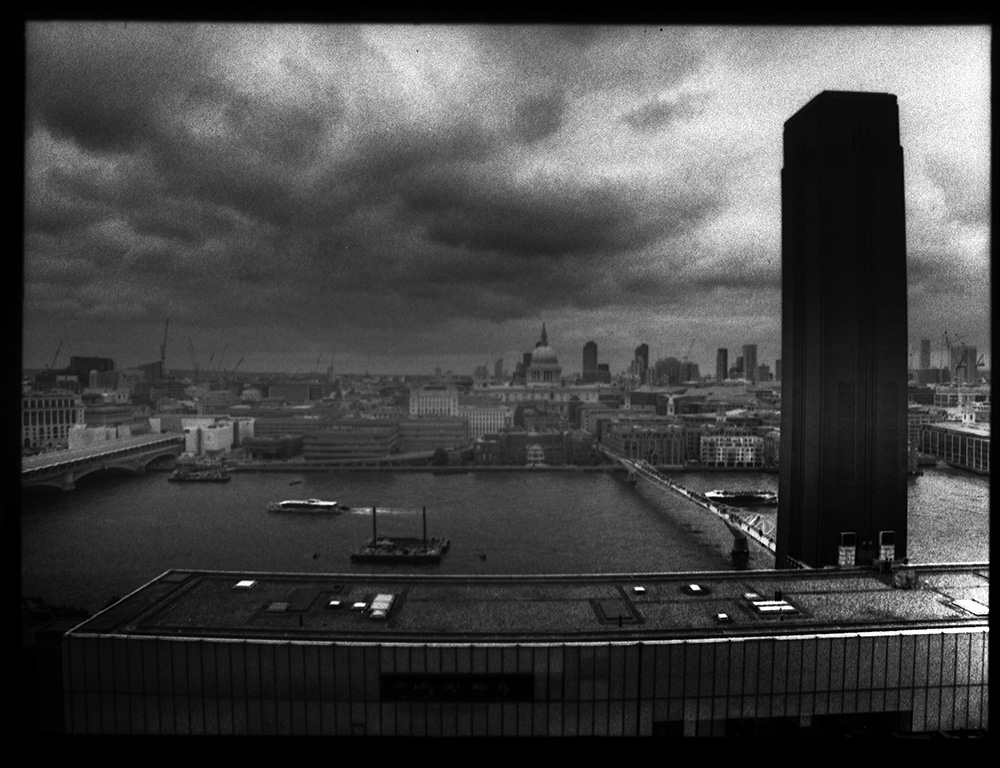
Also, off to the Tate Modern, which has grown since I was last there. The last exhibit, Abraham Cruzvillegas's Empty Lot, was a load of cobblers. It has now been replaced by a choir and a twisty building which has grown from one of the Tate's corners. If the intention was to pay homage to 1960s public architecture, they succeeded. There is a viewing platform on the top, a restaurant just beneath that, and exhibition spaces all the way down.


The top of the Tate affords a view into the living rooms of all the posh flats that surround the gallery. The living rooms looked unlived-in; when I was there they were empty and extraordinarily clean, with magazines and furniture dotted around as if they were show homes. I wondered how many of the flats were simply investment vehicles. The area around the Tate Modern is empty of all the things that support human life.

The exhibits included some people handing out ribbons, plus some thin intense-looking Europeans making music with air pumps, and if you think about it aren't we the exhibits in some strange way? As we peer at the art, security cameras peer at us; in a control room somewhere there are banks of monitors overseen by operators who ponder our meaning. At least it's nice to imagine that someone is pondering our meaning. The alternative - that no-one is observing us - is too horrible to contemplate.


EDIT: Four years later I repeated the experiment with a Vivitar 70-210mm f/3.5 Series 1, which became a kind of 100-300mm.