Showing posts with label photography. Show all posts

Sunday, 30 October 2016

Mobile Phone Photography: A Couple of Tricks

Genoa, shot with a Moto G

You may find yourself in a museum, and you may find yourself in a public space, and you may find yourself in a restricted area where you cannot take a proper camera, and you may ask yourself "what is a proper camera anyway?", and you may ask yourself "how can I make do with what I have?", like everybody else in this sweet cesspool, because making your way in this world today takes everything you've got.

I've said it before, but the likes of Henri Cartier-Bresson and Eugene Smith and Robert Capa would have killed to have a smartphone. Back in the Time of Giants they travelled the world with cute rangefinder cameras not because the cameras were cool, but because they made sense at the time. Contax and Leica rangefinders were a lot smaller than Speed Graphic press cameras, and they could take several shots in rapid succession. The giants of the past would have killed for a portable camera that could upload images to a press agency instantly; that could shoot video and record sound. They would not have grumbled about smartphones, they would have snapped them up, packed their bags, and gone out to take pictures of people dying in dramatic ways.

But mobile phone cameras have a couple of limitations. I'm not fussed about resolution; fixed focal length is something you have to deal with on the spot; having to use an LCD screen is a mixed bag. My biggest bugbear is dynamic range. Mobile phone cameras have narrow dynamic range. You can either shoot for the shadows and blow out the sky, or shoot for the sky and have an extremely noisy landscape. Narrow dynamic range is the difference between the following two images (straight from the camera at the top, with numerous tweaks at the bottom):
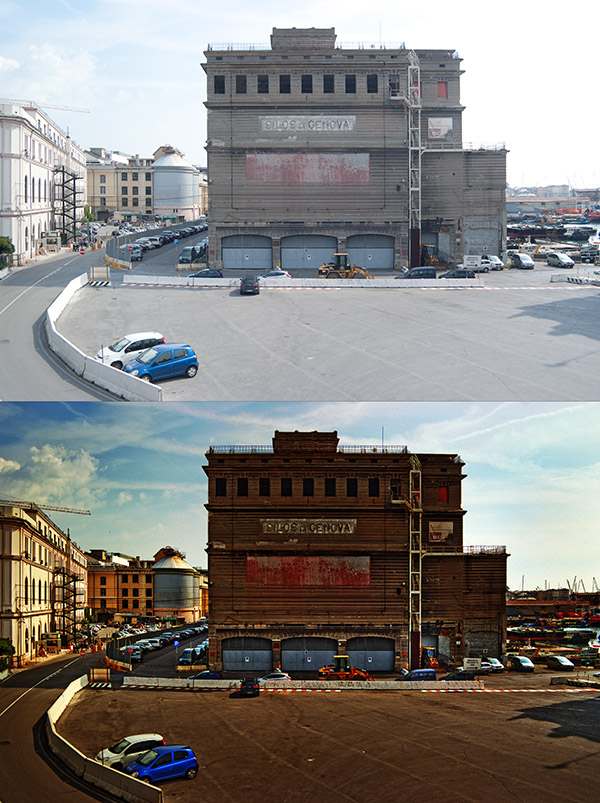

That was shot with a Fuji S5, a digital SLR with an unusually dynamic sensor. Mobile phones generally expose for the subject, so the sky tends to blow out, and there's little you can do to bring it back. But I have a few really simple tricks.

Trick One
Over the last few years I've shot a lot of film. Slide film has the same smooth colours and limited dynamic range as digital, but even when it blows out detail it still tends to retain a hint of colour. Consider the following, which is overexposed Provia 100, cross-processed:


Here's a crop of the top-left:


Even though the sky is basically blown-out, there are still some faint traces of colour. In this crop I've darkened the image so that you can see the grain. Or consider this, with the original scan at the top and the Photoshop remaster at the bottom, which looks ludicrously yellow in comparison, but natural in isolation (the sun was setting):


The detail in the church's frontage has been obliterated, but there was still some colour left, and with a bit of work the second example is the end result. It's terrifically simple to recreate this with Photoshop or any graphics package that has layers, masks, and graduated fills. The technique is simple. I feel ashamed. Those are two separate thoughts.

Consider the following, in which the sky has blown out:


Simply turning down the brightness doesn't make the sky better, in fact it makes it worse. The sky is clipped in the same way that Iggy Pop's remaster of Raw Power is clipped, e.g. the top end isn't just fuzzy, it has been shaved off. It has gone, so we must replace it.

Pop open the image in Photoshop. Layer - New Layer, and then just fill the layer with orange, and add a Reveal All mask:


This has the effect of adding an orange wash over everything. Now use the graduated fill tool on the Reveal All mask thusly, and finally turn down the Opacity to about 23% or so:


The end result doesn't restore the sky, instead it replaces it with an orange wash which is a lot more attractive. This kind of effect is incredibly simple, but it works. I suppose it's reminiscent of the old Hollywood trick of preflashing, but instead of lifting the shadows it tames the highlights. Here's a shot from the film Skyfall, in which Moneypenny shoots James Bond and then Adele starts singing:


At the top is how it appears in the film, and at the bottom is how I imagine it probably looked in real life. The film was shot digitally, and perhaps because of that the sky has blown out, so in post-production instead of matting in some clouds they instead chose to tint the frame brown. Once you notice this you start to see it on television shows a lot. Old-fashioned analogue video had the same problem.

In days of yore the cinematographer might have used a graduated neutral density filter, as in this shot from Barry Lyndon, which looks a bit naff as a still but works perfectly well in the film (both times it appears, it is very quick):


But graduated filters only work when the camera is static, and what if the sky had been overcast? A graduated filter would have just made it darker, without bringing out any more detail. In any case, which is most important: a neat-looking sky, or Moneypenny shooting James Bond?

Trick Two
The answer is of course "Moneypenny shooting James Bond". Check this out:


Again the sun confounds me. Here's a closer look:


On the horizon the chimneys of Mestre, the industrial heart of Venice. Far in the distance, about thirty miles away, the Euganean Hills on the other side of Padua. It's a beautiful world, isn't it? We see it once and then never again.

How to tame the sun? As before, it's easy. Layer - Layer via copy. Apply a massive amount of Gaussian blur, so that the image is completely blurred out. Then add a Layer Mask, but this time use a Hide All layer, and then use a circular graduated fill around the sun. In the following image I've been really sloppy with the mask, which looks unnatural in a bad way, as if the sun was floating on top of the picture:


In the following image I've toned down the Opacity and worked a bit on the mask, and tweaked the brightness and contrast so that it looked more like the image in my mind:


There's a spot of green lens flare that I've left in. All of these images were shot with a Motorola Moto G (Mark II), a solid Android smartphone with a decent camera that has a good-but-erratic HDR mode. The HDR mode won't help with blown-out highlights, though - it seems to lift the shadows instead.

The above trick works in the following case:


The phone captured all the details but the scene is too bright, as if it was shot earlier in the day. On the right, darkening the sky makes it look terrible. If we add a new layer and blur it, the posterised highlights are gone, but of course the image is blurry:

Saint Giorgio Maggiore looks like an angry gargoyle with two sharp teeth. Do you remember They Live, where Rowdy Roddy Piper puts on a pair of sunglasses and sees the world as it really is? If we could see the universe as it really is it would rock our faith, because even atheists have faith that the human animal possesses something special that separates it from other animals; that our brains are not just pattern-matching devices created by a process of trial and error, but instead vehicles for a soul. Thankfully our tiny minds cannot grasp the infinite.

If we use a graduated mask on the sky, we get this, which admittedly wouldn't work if there were clouds:


In this example the result is a little over-the-top, and the islands are a little blurred as well. And of course there's an artificiality to it, because there's a clean break between the sky and the water. If this was a shot of New York city, with skyscrapers jutting into the air, you would need to do a lot more work on the mask. Eventually your face would grow to fill the mask, and then you are the demons.

Mobile phone photography is a conundrum. As mentioned up the page it's fantastic; if you're the kind of person that moans about smartphones and instagram etc, I don't want to know you. A hundred years ago you would have moaned about this new fangled 35mm nonsense, and a few decades before you would have moaned about photography itself - it's not creative, after all, a photographer is no better than a surveyor. History will flow over you like a river, it will gouge you. The water itself is just a tool of gravity. Gravity uses water to slice through rock; it seduces water and holds it fast in giant pools. But gravity is not a thing, it is instead a result of mass warping spacetime. Mass is the villain here, not gravity.

But, yes, there's a technological conundrum. In terms of dynamic range and light sensitivity mobile phones will always lag behind dedicated cameras, because the sensors are of necessity smaller; and any advances that improve mobile phone sensors would also improve camera sensors as well, so the gulf would be just as wide. There's no way to enlarge a mobile phone sensor without enlarging the optics, short of a revolution in optical design, and with huge optics a mobile phone is no longer a mobile phone, it is a talking camera. There seems to be no way to square the circle, but what if we take a lateral step sideways?

I've said it before, but I believe that in future people won't take photographs. They will instead trawl the internet for other photographs, or they will trawl Google Maps, and they will mash them up, repost them, edit them. The big star imagemakers of the future will be akin to the DJs of today, they will curate and collate, remix and repost. CGI has already conquered the Ikea catalogue, and has made inroads in the fields of pornography and landscape art; I predict that by the year 2020 H G Wells' vision of the Eloi - a future elite who sit in front of Pornhub all day - will have come true. I plan to be at the forefront of this new race. Photography will pass, just as all mediums pass.

Thursday, 3 January 2013

In Praise of Grain

Olympus OM-10 / Vivitar 70-210mm f/3.5
Kodak TMAX 400

One positive consequence of the decline of film photography has been a flood of cheap old film equipment on the second-hand market. And not just box brownies and plastic instamatics, but Nikon F3s and Hasselblad 500s - real grown-up cameras that went to war and photographed Twiggy. When they were new people dreamed about owning them, and travelling the world for National Geographic, or being asked by the editor of Sports Illustrated to spend a few weeks in the Bahamas shooting the annual swimsuit issue. Or perhaps you were going to take publicity photographs on a movie set, or you were going to follow Aerosmith on tour. If only you had a proper camera.


And so a while back I picked up a battered old Mamiya RB67. It sold for $800 or so in the late 1970s, including the lens. Nowadays people can hardly give them away. They're awkward to send by mail, because they're bulky and weigh 6lb. The RB67 is a medium format camera that uses 120 rollfilm, of a kind the local grocery store probably never sold; you had to order it from a magazine or go to a camera shop in the city. Medium format was special in the 1970s and 1980s. The film was bigger than 35mm and the equipment was big and expensive too. You really had to want it, but if you turned up to shoot a wedding with a Bronica or a Mamiya - or a Hasselblad, if you were loaded - people paid attention to you, because you were obviously the real deal. Not some silly amateur.


The RB67 wasn't used much for weddings, though, it was a studio camera, born to live on a tripod. Born to shoot studio portraits and those awful 70s cookery books. Six pounds of metal, rubber, glass and plastic - mostly metal - with an enormous shutter that makes a loud THWACK when it closes. Every frame is an event, and when you're shooting with the RB67 you only get ten shots per roll. Ten big, detailed shots; the camera's 6x7cm negative has almost five times the surface area of 35mm film. The slides look fantastic on a light table and once upon a time a picture editor would have gone ga-ga over them.

Mamiya RB67
Fuji Velvia 50


And there's no grain. If you want to fill a double-page magazine spread with a single image, you have to enlarge the negative, but the more you enlarge the negative, the more you enlarge the grain; and so the bigger the negative the better the results. The most exacting landscape photographers - and the lucky men and women who shot Playboy centrefolds - generally used cumbersome wooden view cameras that took astonishingly clear 8x10 inch film plates.

But there's the thing. When people think of film, they think of film's flaws. Looking at the images that my RB67 produces I can't help but feel a twinge of disappointment. The pictures are smooth and clean, just like digital photographs. Sharp details, good saturation, no flaws, no grain. They look too perfect, too clinical.

Mamiya RB67
Fuji Velva 50

There was always a tension between different film formats. Some photographers moved freely between them. The Richard Avedons and David Baileys of this world shot their studio portraits with smooth medium format but were not averse to getting their hands dirty with 35mm. Don McCullin and Cartier-Bresson and Eugene Smith used grainy, scuzzy 35mm, because the smaller cameras could go places their large format brothers could not. The images they sent back from Vietnam and Sudan - and the streets of Paris and Pittsburgh - set the visual template for a generation's reality, just as the sharp perfection of colour magazine adverts became shorthand for fantasy. Robert Capa's images of D-Day were shot with a 35mm Contax rangefinder in the murk and gloom of a stormy June morning, and the negatives were famously ruined during the development process. Nonetheless the ghostly, chaotic images that survived were desperately real. No-one ever questioned their veracity; not like they questioned Joe Rosenthal's photograph of the flag-raising on Iwo Jima. Rosenthal used a Speed Graphic press camera, shooting 5x4 inch sheet film. His image of the flag has an unreal clarity that only served to fuel accusations the whole thing had been posed in a quiet moment, away from danger.


In good light a digital image possesses a neutrality that technical film photographers of the 20th Century would have killed for. Kodak and Fuji spent decades trying to squeeze the look out of photography, but never quite achieved it; and the most popular films - Fuji Velvia, Kodachrome, Tri-X - all had a distinctive combination of contrast, tonality, and grain that film photographers could recognise instantly. On an objective level, digital gives the photographer a neutral base on which to weave his Photoshop magic, and yet the plethora of cameras with built-in photographic filters, the Instagrams and Picmonkeys, all fill a great yawning desire to make the blandness of accurately-captured reality sing with colour and quirks. Grain makes real life look like a movie.

A heavily retouched photograph
taken with a medium format camera; it would be boring otherwise

Or at least it did, once. Hollywood has had a hate-love-hate relationship with grain. Classic Hollywood films were generally shot on well-lit soundstages, but the rise of New Hollywood in the 1960s and 1970s brought with it a run-and-gun aesthetic that emphasised shooting on location with minimal equipment. The leading film stocks of the day were still relatively slow, so in imperfect light cinematographers had to underexpose when shooting and overdevelop in the processing, which made the grain almost tactile. For The French Connection, Manhattan, The Taking of Pelham 123, Owen Roizman and Gordon Willis were prepared to embrace grain in pursuit of their artistic vision, with the happy side-effect of making those films seem like news footage of a fantasy. New Hollywood was built on imperfections.


But with the rise of hi-def TV and Blu-Ray, Hollywood was faced with a quandry. Hi-def formats render imperfections with a clarity hitherto unavailable in the home. Grain can be smoothed away with Digital Noise Reduction (DNR), and when done well DNR can produce clean results without sacrificing the original look. James Cameron's Aliens - a famously grainy film - underwent a remarkably sympathetic restoration for its 2011 Blu-Ray release, but when done poorly the results resemble a cartoon. The initial Blu-Ray releases of Patton and Predator were widely criticised for transforming George C Scott and Arnold Schwarzenegger into plastic-faced showroom dummies, and the original Blu-Ray release of Gladiator was so badly afflicted with DNR that the studio offered to exchange the older discs for a newer transfer supervised by Ridley Scott himself. Fortunately for cineastes the most-anticipated catalogue title of all - Lawrence of Arabia - was shot on relatively grain-free 65mm film stock and restored (several times) by people who cared.


And yet for all my attachment to grain I have to acknowledge that its appeal is a generational thing. I grew up in the 1980s, an age when high-gloss colour was king, but the news photography of the 1960s and 1970s that caught my eye from history books was shot with high-speed black and white film. The grain was further exaggerated by the high-contrast halftone printing technology used by newspapers of the day. It just happened that the era of grain coincided with some of the darkest and most newsworthy decades in human history. By the 1980s, most newspapers had switched to colour, and the television news had abandoned 16mm film in favour of portable video equipment. Nowadays few people under the age of forty have organic memories of film grain, and modern-day found footage movies - The Blair Witch Project, Cloverfield, Paranormal Activity and so forth - all draw their power from the look of digital video, which has its own set of quirks.


Daphne Oram's Oramics machine
Olympus OM-2N, 24mm f/2, 50mm f/1.4, Kodak TMAX 400

So the passing of film grain is bitter-sweet. Every generation has its time in the sun. No doubt if I had grown up in the 1920s, accustomed to the large-format plate photographs that were the norm in the first decades of photography, I would have been horrified by small-format photojournalism, just as black and white purists were unconvinced by colour photography in the 1960s. Every generation looks down on those that follow; and dies.


Hollywood - and television - still shoots a lot of film, but in an age of 3D, CGI and digital projectors 35mm cinematography is heading gradually for extinction. It might not happen for a few years, but it will happen, and the equipment will be abandoned as the professionals move on. There will be a golden period when you or I can own an actual 35mm movie camera, of a kind used to shoot The Godfather, for perhaps a few thousand dollars. Already, Super 16mm cameras are affordable enough that low-budget filmmakers no longer have to hire them, when they can own them outright. The processing will be expensive, the scanning nightmarishly hard. But think of it! Your very own movie camera. Owning the equipment that Sven Nykvist used will not turn you into Sven Nykvist, but still; you can touch it, just as he might have touched it, once.

So, let's drink to the slow death of film.

Also, Susan Sarandon hugging a llama.

Sunday, 16 December 2012

Olympus OM-2N: Hot Black Heart

Olympus OM-2N / Zuiko 50mm f/1.4 / Adox CHS 25 / Kensington & Chelsea
R09 / an hour

With the end of the world only a few days away, I went for a stroll with my OM-2. The old Olympus OMs were occasionally described as the Saab of cameras, which is to say that they were technically clever, a little bit quirky - in a clever way - but geeky and not at all sexy. Not like Nikon.

For proof, here's Muhammad Ali posing with a Nikon. And here's Michael Jackson, also posing with a Nikon, back when he was still Michael Jackson. Serge Gainsbourg, no doubt photographing a very young girl, with a Nikon. Benny Andersson of Abba - Abba! - short pause Nikon. Joey Ramone, Nikon. Marilyn Monroe, Nikon. And so on. Going over this post two years later I'm struck by the unwisdom of linking to Tumblr blogs. They're transient and trivial and for the most part consist of the same small pool of photographs passed around endlessly; and a few months later the owners get bored, or they're hit with a copyright infringement notice, and then they're gone, leaving nothing behind, comma, comma, full stop.


I think it's supposed to be Kanye West (the sign gives it away)

Yeah, some of those photos predate the OM system, and of course I'm being selective. And those people are actors and musicians, not photographers. But still. Nikon is the sex camera of sex people. Rolleiflex was for the gentleman or lady. Polaroid for the artist. Pentax for Ringo Starr. Olympus had David Bailey, but only because the company were paying him to appear in their adverts, and I can't find a single picture of him holding an OM-1.


The OM range was popular with astrophotographers and photomicroscopers, because it had a good range of macro accessories and the shutter didn't require power during long exposures. You can imagine that it was popular with radio enthusiasts and solderers and model aeroplane builders. Stamp collectors. These people are irritating because they seem so happy. Why should they be happy?


Still, the OM system has had a strange kind of afterlife with the in-name-only OM-D, a good-looking modern digital camera that attracted favourable reviews last year. I was always curious about the older OM cameras so I decided to find out what they were like. I shall now present to you my findings. Unlike other, smellier blogs, this one has actual pictures taken with the camera itself. By a photographic genius e.g. me. Not just a lot of pictures of the camera.


The OM system was formally launched in 1973, although it was originally going to be called the M-System; the first camera was launched as the Olympus M-1. Leica was not happy with this - from the 1950s their own cameras had been M-something - and so Olympus agreed to change the name. The M1 is also a motorway, it connects Leeds with London so that the people of Leeds can escape.


The OM-1 was very late to the SLR party. During the 1950s and 1960s Olympus had been a lone wolf hunting away from the pack, its mouth stained with the flesh of its prey as it dove through banks of snow, driven by a satanic lust for warm blood; it had long since filled its belly, now it hunted in a futile quest to discharge the mounting howl of rage that swelled within its hot black heart.


The first manifestation of this sadistic exercise in brutal power was the dainty half-frame Pen F, which Olympus had sold throughout the 1960s. The Pen F was followed by the anonymous Olympus FTL, an M42 stopgap that no-one remembers much nowadays. By 1973 the competition had been in the game for over a decade, but there was a constant influx of new buyers who were not wedded to an existing system and the OM-1 was very popular with first-timers. Olympus' SLRs were good value, slightly more expensive than Pentax, but cheaper than Canon and Nikon, and looking through old issues of Popular Photography with Google Books it seems that the magazines liked them as well.


They were clever, too. Olympus knew that they couldn't compete at the high end of the market - Nikon had that sewn up - and churning out rebadged, OEM-designed bodies would have been a shameful admission of defeat. Furthermore they had the great brain of Yoshihisa Maitani to hand, so they decided to compete with cleverness. Maitani was perhaps the only superstar Japanese camera designer of the 1970s - at a time when some people in the West still thought of Japanese people as interchangeable units, Olympus was happy to put him in their US adverts.


Mir.com already covers the minutiae of the OM system in mind-numbing detail and so I won't duplicate their work. The OM-1 was smaller and lighter than the competition (in particular, it was noticeably shorter). This was achieved by some clever engineering and sheer force of will, and by moving the shutter speed dial so that it went around the lens mount, which freed up space on the top plate. Nikon had used a similar arrangement with the Nikkormat FT-N of the late 1960s but seemed uninterested in the idea and never used it again. Apart from the camera body, the system as a whole was designed for compactness. The lenses were tiny and the winder was half the size of competing designs. An OM-1 body with a couple of lenses was not much larger than an equivalent rangefinder setup. The OM also had an unusually voluminous viewfinder, which was impressive given the small size of the body.

Conceptually the OM-1 was much more conservative. It had a mechanically-powered shutter and used battery-powered match-needle metering with centre weighting. Unfortunately the meter uses the long-discontinued mercury PX625 battery and so it's not an ideal choice nowadays. Which is why I bought an OM-2 instead.


The OM-2 was launched in 1975, at a time when the OM-1's influence was starting to be felt. Small was the in thing, but the OM-2 added something new to the mix - electronics. It had aperture-priority automatic exposure and a stepless, electronically-timed shutter that needed batteries to work properly, although fortunately it uses SR44 silver oxide cells, which are still being made. Without the batteries the camera is useless, which was a controversial issue at the time. When Nikon launched the battery-power F3 in 1980 there were howls of protest from professionals worried that they would run out of batteries in the middle of Afghanistan or El Salvadore; the consumer marketplace had fewer qualms, and in the wake of the OM-2 there was a wave of electronic cameras. Late-70s post OM-2 cameras such as the Canon AV-1 and Pentax ME tended to use microprocessor-controlled digital electronics, whereas the OM-2N is in contrast analogue. Olympus didn't introduce a microprocessor-controlled professional-level SLR until the OM-4 of 1983 (the OM-3, launched the following year, was essentially an OM-1 in an OM-4 body, with a mechanical shutter and uncoupled meter).


The OM-2 had an off-the-film metering system that had a little cell inside the camera body pointing directly at the surface of the film; it measured the amount of light hitting the film during the exposure, and closed the shutter accordingly. For ordinary daylight exposures this was overkill, but it transformed flash automation. Until the OM-2 came along, a camera's flash system had to estimate the correct exposure before the shutter opened and then hope for the best. The OM-2 could measure flash exposure as it happened, and the basic concept of measuring the surface of the film was quickly adopted by the rest of the industry.


My OM-2 is an OM-2N, which has a few minor refinements that smoothed out the flash system. Here it is, sitting next to a Leica R8, being small:


It's ironic that Leica's SLR designs were so anti-Leica. The early, in-house Leicaflex was blocky and anonymous; the Minolta-Leicas of the 1970s and 1980s were just anonymous; the later in-house R8 and R9 are distinctive but blocky. It's a shame that Leica didn't dump Minolta and climb into bed with Olympus instead. The OM system was more Leica than Leica.


On a technical level the OM-2 is simple by modern standards. Compared to the R8 above it has a slower top shutter speed - 1/1000 vs 1/8000 - and there's no mirror lock-up. It only has full-frame averaging aperture priority metering, no spot or multi-spot, and the viewfinder is not illuminated, so it's hard to see what shutter speed the camera has chosen in low light. It's neat the way that the viewfinder display changes when you switch from automatic exposure to manual; the transparent shutter speed overlay slides out of the way and is replaced with a +/- match needle tab.

"Self-portrait with sticker"


The OM-2 remained in production until the mid-1980s, when it was replaced by the OM-4, which had a tougher body and a more versatile metering system. There was also the OM-2SP and OM-2S, which were product-engineered mid-level models based on the OM-4. They added a spot meter and program exposure but were bedevilled by electrical problems that drained the batteries quickly, even when the cameras were sitting unused. The OM-2S and SP were only in production for a couple of years in the mid-1980s. The OM-4 remained on sale until 2002, by which time it was an anachronism.


There was also a lower-cost range, starting with the OM-10, which was launched in 1979. The double-digit OM cameras were very popular in their day and mirrored the features of their single-digit counterparts. The OM-10 parallels the OM-2, with aperture-priority autoexposure, although the manual speed control was an optional extra. Here's an OM-10 body sitting in front of an OM-2:


The OM10's hot shoe is fixed in place, the winding lever is simpler, and there are a few more plastic parts. The insides are apparently not as robust, although mine still works. In some respects the OM-10 is more advanced than the OM-2 - the viewfinder has a larger, LED-illuminated shutter speed display - and the shutter has the same top speed. Physically the two bodies are almost exactly the same size. On the used market OM-10s are staggeringly cheap, because Olympus sold lots of them.


Ah, but what's the OM-2 like as a camera, as a means of expression; as an extension of my senses? It's wonderful, to be honest, small enough to carry around all day without becoming a burden - it thrashes the R8 in that respect - and easy enough to use that it doesn't become fussy. With a 50mm f/1.4 it's ready for anything, provided that thing isn't very large or very far away. A small lens kit consisting of 50mm and a 21mm, 24mm, or 28mm takes up less space than a single zoom lens.


Olympus' lens range mirrored Leica's rangefinder line-up, with a lot of wides and very short telephotos, and a few longer telephotos that no-one bought, with an overall emphasis on prime lenses. The OM system dates from a time when entry-level cameras came with a prime lens, and by the time zoom lenses had become the default choice the OM range was aimed at a slightly higher market segment. My 50mm f/1.4 is one of the older models, and it's no great shakes at f/1.4, but good enough. I have seen better bokeh.


I used Adox CHS 25 for most of the black and white images in this article. I had some rolls lying around. It has a great look - very moody - but it's a nightmare to use, because it's very fragile. Contemplate the following:


Bear in mind that for every white speck you see in this thumbnail, there are a dozen smaller white specks that only become apparent at full size. If you have OCD it's the worst film in the world.

Well, perhaps not; if you actually do have OCD, you probably wash the negatives thoroughly and develop them in a dust-free environment. The following picture was brought to you courtesy of the number nine, plus Photoshop's spot healing and clone brushes. In fact I often have to do so much cloning and spot healing that the film's supposed resolution advantage is cloned away (brickwork or anything with a regular pattern is horrendously time-consuming to retouch):


And that's the OM-2. More versatile than a point-and-shoot, far smaller than an elephant, more dangerous than a two-horned narwhal. I took all these pictures with mine, but remember that it's the genius behind the camera that matters, i.e. me.

Me and London. London matters. Because every genius needs something to feed his mind, and London has a lot of things to look at and think about. And eat, too. It has shops as well. An integrated transport network. Staggeringly expensive houses, filled with people who are not there.