

Let's have a look at the Vivitar 70-210mm f/3.5 Series 1. The original mark one version. I've written about the mark two version of the lens before, but I've never used the original. It's a telephoto zoom lens from the 1970s, with a pully-pushy twisty-turny zoom-focus design and a separate macro mode. It was launched in 1974 and remained on sale until 1981 or so.
Most of the 70-210s I have seen on eBay have fungus in them, perhaps because push-pull lenses tend to suck in a lot of aerial detritus. However I recently found one in good condition, so I decided to give it a whirl. Mine has a serial number that begins 2200, which suggests it was made towards the end of the run, but even so it must be around forty years old.


The original 70-210mm f/3.5 Series 1 is a physically imposing lens with a distinctive pair of wings near the lens mount - you press a button and twist the wings to enable the macro range.

It's fiddly and only works at the 210mm end. When the macro mode is turned on you push and pull the zoom to focus. The magnification ratio is around 1:2, which is still very good nowadays. The macro mode compensates for the relatively long minimum focus distance, just under two metres.

The button. Later versions of the lens did away with the separate macro mode and just focused more closely.


A 100% crop from a six megapixel original - as mentioned in the text the K-mount aperture prong interferes with full-frame Canon SLR mirrors, so I could only use the lens on my ancient 300D. This was taken at f/16, at which point diffraction has started to soften the image.


At f/8 the macro mode range is nice and sharp, although it's difficult to use - the lens is heavy, but it doesn't have a tripod mount, so you either need a lot of light or a sturdy base.

For comparison this is the Mark Two version of the lens, which was made by Tokina. The Mark Two had a smaller - larger? smaller? - magnification ratio of around 1:4, essentially the same as a typical modern telephoto zoom.
Vivitar is, or was, an American camera company that markets Far Eastern OEM optical and electrical equipment on the international market. I'm not sure if the company still exists - it seems to be one of those phantom brands, like Motorola and Atari, that's owned by a hedge fund, but Amazon lists Vivitar dashboard cameras and selfie sticks and so forth so perhaps it hasn't completely vanished.


Both shot at 210mm. There's a fair amount of vignetting at f/3.5 (top), much less at f/8 (bottom).
The Series 1 range was an attempt to go upmarket, with a bunch of lenses commissioned from some of the better Japanese OEM firms. The first batch of Series 1 lenses had custom optical designs, but by the 1980s the range was composed of rebadged imports albeit that they were of a generally high standard. They all tended to have excellent build quality, and the classic lenses had a black satin finish that still looks awesome.
The 70-210mm f/3.5 was the most famous of the Series 1 lenses and appears to have sold like hot cakes, judging by the number on the used market. As mentioned a lot of used examples have fungus, and opening them up to clean it out is nightmarishly difficult - the front element unscrews, but beyond that you're on your own.

The macro shots were all taken with an APS-C camera, so they're slightly unrepresentative of the full-frame image. This is the minimum focus distance, and even at f/11 the depth of field is tiny.
Price-wise the 70-210mm was more expensive than third-party zooms from Sigma and Tokina, but a lot cheaper than first-party lenses from Nikon and Canon. The timing was good, as well; 35mm SLR zoom lenses had been around since the 1950s, but the market didn't really embrace them until the mid-1970s. At that point Vivitar and Sigma etc cleaned up, because first-party manufacturers generally weren't keen on zooms (Olympus and Pentax, for example, didn't release a comparable telephoto zoom until the 1980s; Nikon's 80-200mm f/4 was very expensive).


Why all the bicycles? Partially because they're there, partially because they're flat. NB I wrote this post in March 2020 - I write everything way before it gets published - but a year later the world is much as it was back then. Bucherer is a by-appointment watch dealer, so I imagine they were better-positioned to ride out the pandemic than e.g. a new pizza restaurant.
In the past I've used the Series 1 200mm f/3, the 28-90mm f/2.8-3.5, and the Mark Two version of the 70-210mm f/3.5. They're all physically well-made, still surprisingly sharp by modern standards, although the colours tend to be muted, perhaps a consequence of old-fashioned coatings.
Back in the 1970s the 70-210mm f/3.5 was appealing because it was "ten wider" at both ends than typical first-party 80-200mm f/4.5 zooms, plus it was a stop faster and could focus very closely. It was available for a wide range of different lens mounts. Pentax PK and Nikon AI lenses don't have to be adapted for use with modern Pentax and Nikon digital SLRs; M42 and Olympus OM can easily be adapted for the Canon EF mount; Minolta, Canon FD, and Konica AR can only be adapted for mirrorless cameras. On a Micro Four-Thirds camera the 70-210mm f/3.5 would be an awkward 140-220mm.
Mine is a PK lens, which I used for most of the images on this page with the cheapest Pentax film body I could find, an SF7:

The SF7 is one of those plastic autofocus cameras from the 1990s that's objectively excellent, the peak of film camera design, but no-one cares about it nowadays because it has no charm. It has a full range of exposure controls and optional electronic focus confirmation with manual lenses - it beeps when the 70-210mm f/3.5 is in focus - but it's physically unlovely and uses a 2CR5 battery, which is increasingly hard to come by. The camera's aperture priority exposure tends to aim for highlight retention, so perhaps it's optimised for slide film.


As mentioned earlier the Series 1 lenses I have used tended to have muted colours, which isn't a huge problem because Photoshop can fix that. The original 70-210mm is no exception, although it wasn't helped by the overcast weather. An evolving viral plague also clouded my mood, although on the positive side it thinned out London's crowds.


No-one likes crowds but it's unnerving when they're suddenly gone. The 70-210mm f/3.5's Macro mode is difficult to use on the street, but it can be done:


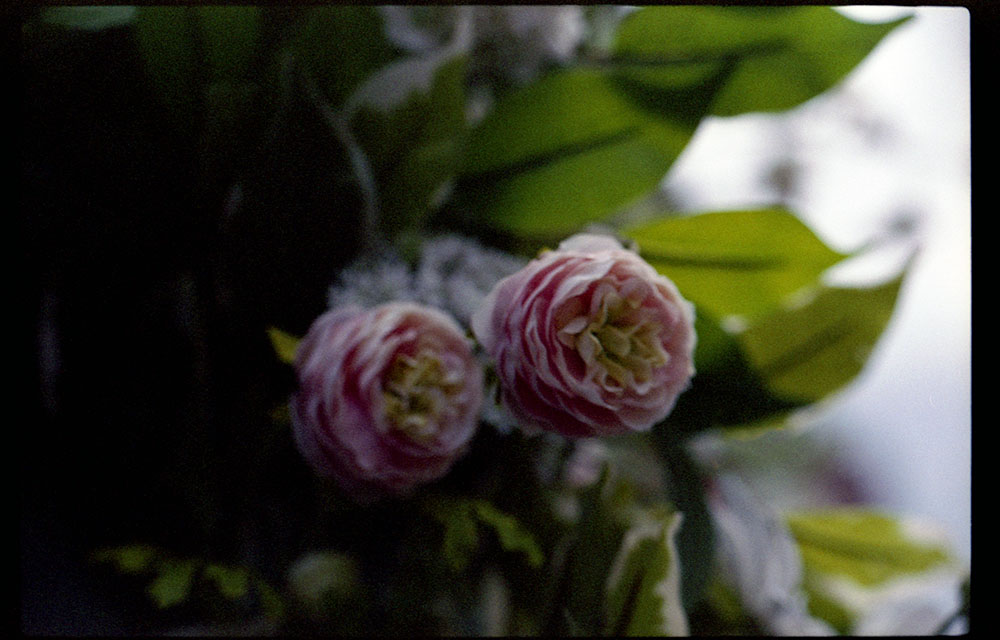
I can't formally test the lens' sharpness, because the Pentax aperture lever catches against my Canon 5D's mirror, and I used grainy 400-speed film. Compared to the Mark Two lens it appears to have less purple fringing wide open, and it's sharper at 210mm - the Mark Two drops off at the long end. You have to train yourself to push forward to zoom out, pull back to zoom in. Focus is in the normal way, e.g. twist left for infinity. Not the odd, non-standard Nikon way.


Does the 70-210mm f/3.5 make any sense nowadays? It's very big and heavy, so you really have to want to carry it around. Precisely focusing and zooming with a pushy-pully telephoto zoom isn't much fun. The ability to take macro photos of things is mitigated by the difficulty of focusing accurately (you essentially have to set the lens to a certain distance and then rock back and forth on your heels).
I can't judge the bokeh. The macro shots don't count, because the background is completely out of focus, and the outdoors images were mostly taken at f/8 or at long focus distances. The colours are relatively flat, but that can be fixed with Photoshop, and also by going on holiday to Italy*, where the weather is a lot nicer. Sadly that's not an option at the moment.
On the other hand, if I was going on a trip with a film camera I would have no qualms about packing the lens, if I had space in my bag. It was state of the art in the 1970s and has aged well, with good overall sharpness at all focal lengths at f/8. It's very much a outdoors / indoors-with-studio-strobes lens and purely as a value proposition my hunch is that you'd have to pay a lot more to get a better modern autofocus lens, albeit that the modern lens would probably have image stabilisation.

Bergamo
* Around this time of year I often pop abroad to the town of Bergamo in north Italy. The airport is advertised by low-cost airlines as Milan Bergamo, because it's only a forty-minute train ride to Milan Centrale (for €7.70, off the top of my head).


Milan
However Bergamo is attractive by itself. The new town becomes progressively more charming as you venture away from the train station, and at the end of a long wide boulevard there's an old town on a hill, with castle walls around it.

Bergamo
And now sadly it's the epicentre of a plague that has swept Europe. Hundreds have died in Bergamo alone and the town is now associated with military convoys bearing coffins.

Bergamo, again - this spot here
I'm not Italian, and if you totted up all the time I have spent in Bergamo over the course of my life it would amount to less than six months, but I feel sorry for the place and hope it gets better. For a few years back there the world opened up, and then it closed again.


