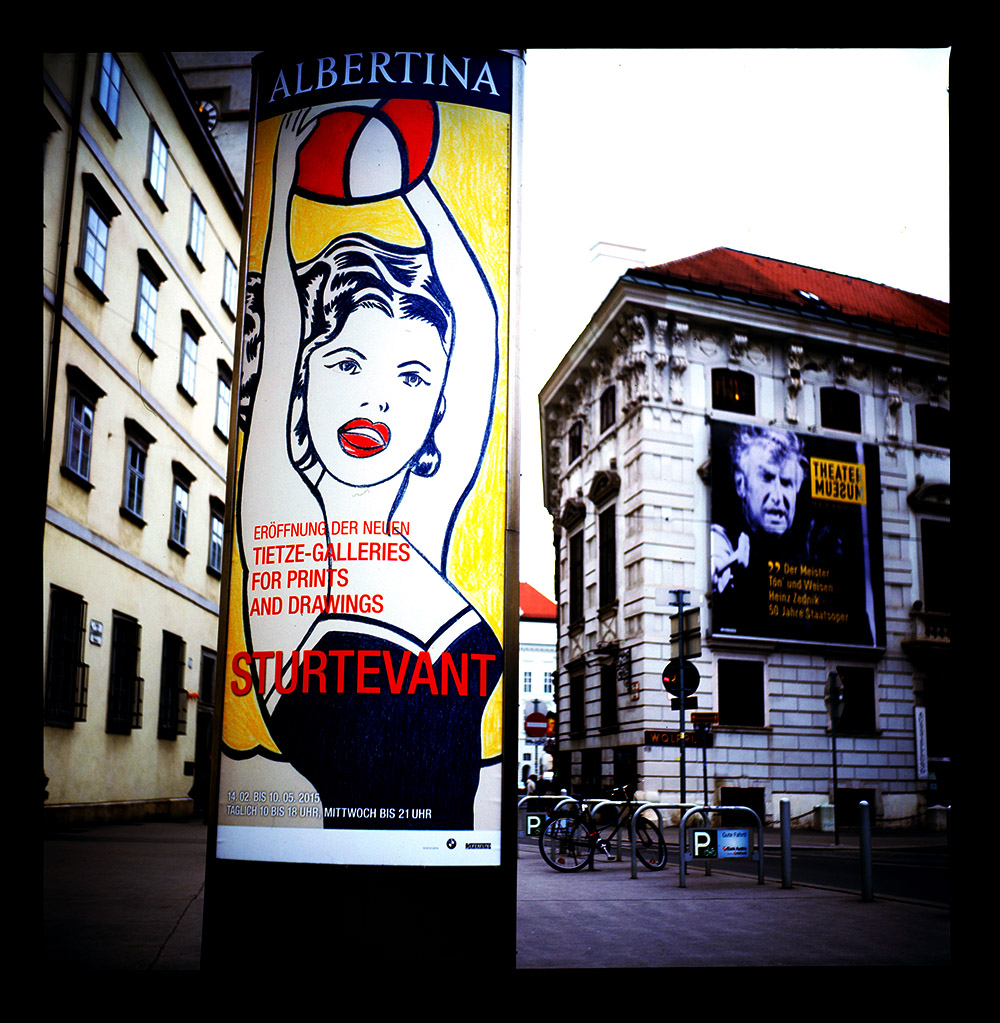
Off to Vienna, with a Yashica Mat and a bag of Fuji Superia (above) and Fuji Velvia (Duran Sandwiches, below). Vienna is a popular day trip on the train from Budapest or Bratislava. They all lie on the Danube, and a river cruise is a cost-effective way of ticking several countries off your list. I'm going to visit Wales and Scotland last, because they're easiest.
After spending five hours in Vienna I now feel that I can look Central Europe in the eye, as an equal; me a human being, Central Europe a mass of countries where young men debate politics in coffee houses and women dress in big skirts and they have horse-drawn carriages etc. I learn this from Project Gutenberg's
With the World's Great Travellers, a compendium of travel writing from the 19th Century.
On the day I visited Vienna the horse-drawn carriages and early photographers and men with large moustaches and anarchists had been packed away; in their place there was a large shopping mall attached to a smaller museum area that was also a shopping mall, with a low-key style. We are all heading in the same direction, driven by the same fears and desires.
With the World's Etc has a lengthy excerpt from John Russell's
A Tour in Germany, published in the mid-1820s. Of Vienna I learn that:
"The proper city is of nearly a circular form, and cannot be more than three miles in circumference, for I have often walked quite around the ramparts in less than an hour. The style of building does not pretend to much ornament, but is massive and imposing; the streets are generally narrow, and the houses lofty, rising to four or five floors, which are all entered by a common stair. ... Some individual masses of building, in the very heart of the city, are as populous as large villages."
Which suggests that Vienna circa 1820 must have seemed like Judge Dredd's Mega-City One to John Russell. Little did he know what the future had in store. New York of the 1820s was a modest port, and Europe was still the centre, the future, the pinnacle of the world.
Elsewhere in the book American traveller Bayard Taylor, writing in the mid-century, is "...lost in astonishment at the perfection of art attained by the Greeks and Romans. ... I should almost despair of such another blaze of glory on the world were it not for my devout belief that what has been done may be done again, and had I not faith that the dawn in which we live will bring another day equally glorious."
After all, "why should not America with the experience and added wisdom which three thousand years have slowly yielded to the old world, joined to the giant energy of her youth and freedom, re-bestow on the world the divine creations of art?" And only one hundred short years later Jeff Koons was born.
I find it hard to think about Vienna without thinking about Hitler. Perhaps that's because I'm British, or perhaps it's because I'm a closet Nazi. Not thinking about Hitler is like not thinking about an elephant, it's difficult to do it consciously. (tries) And now I'm thinking about a Nazi elephant, wearing a
stahlhelm, and did you know the Germans had a tank called the
Elefant? It was actually a tank destroyer, basically an anti-tank gun in an armoured chassis. They were awesome! But German industry could only make a few dozen of them and so sadly the Nazis... and so the Nazis lost the war. Which is a good thing.
Hitler was of course born in Austria. There was nothing particularly unusual about Hitler's early life. His dad was an authoritarian bureaucrat who was a big fish in a small pond; Hitler seems to have consciously rebelled against his father whilst simultaneously and unconsciously becoming a copy of him, incapable of admitting error and prone to outbursts of anger whenever people failed to heed his instructions. As with Adventure Time's
Earl of Lemongrab he found himself continually butting against a world that was
unacceptable! but also bigger than him, but rather than learn to fit his environment he decided to change the world instead. Some people try to change the world constructively, by inventing a more efficient vacuum cleaner or curing Hepatitis; Hitler had no time for that.
After finishing school Hitler essentially became a pretentious hipster, and it's fascinating to draw parallels between him and the modern world. Hitler's dad died when he was young, and so he spent his teenage years lazing about whilst his mother did the housework. At the risk of offending single parents worldwide, I maintain that it's easier for two
people to raise children than a single person by themselves, if only on a purely practical level, and that the socialist alternative - for the state to raise children so that everybody has seven billion parents - is unworkable and open to abuse, beside which it's just mean.
Like all teenagers, Hitler was an arrogant sod who learned about the human world from books first and from first-hand experience second, so that he began with a vastly over-inflated sense of his own importance and knowledge. His modern heirs spend their days on Reddit; my generation grew up with Wired magazine and
No Logo, and my ancestors presumably grew up with
The Downwave and Omni, pre-packaged facts with all the little details and boring working-out removed. As an autodidact Hitler was free to ignore anything he didn't agree with or have the time to think about, and throughout his life he seems to have surrounded himself with a mixture of fawning sycophants and strong people who saw in him a useful shield.
He set himself the task of becoming a great artist, and failed, and from that point onwards he blamed his failure on those around him. Meanwhile his mother died and he found himself essentially a piece of human flotsam in Vienna, where he was an insignificant dot, a tiny particle of radioactive fallout. Like fallout he continued to burn. The Great War fashioned his generation into a bomb, and during the 1920s and 1930s he finally achieved critical mass, touching off a runaway chain reaction that engulfed the world in another one of its periodic orgies of bloodletting.
It's just "Duran Sandwiches". Named after Vladimir Duran, who founded the place.
The New Romantics had a thing for Europe, in homage to David Bowie's Berlin period, and the retro-futurism of mid-70s Kraftwerk. They had a thing for a kind of fantasy mitteleuropa that linked the Weimar republic with the modern day, skipping over the Nazi regime. There was Bauhaus, Spandau Ballet, "Vienna". Future historians of culture will wonder why a bunch of London clubgoers decided to draw inspiration from half a century ago and far away.
And yet the human race keeps going. The two World Wars demonstrated that individual human life was insignificant; but in terms of mass death the wars were just a blip, because the Earth's population more than tripled during the twentieth century. A few months ago it was theorised that a new world war would have
almost no effect on global population. Over the coming century the human population will increase
even if a catastrophic event kills two billion people, assuming that this event does not make the planet uninhabitable.
The average human being weighs 62kg. Two billion corpses would weigh one hundred and twenty four million metric tonnes of flesh bone and blood. If my calculations are correct that would equal
the world's tonnage of chicken meat production for one year in the mid-2030s. For human beings the deaths of two billion people would be a horrendous event that would hopefully cause us to turn away from violence forever, although in practice we would get used to it and carry on as before; for chickens, the deaths of two billion chickens is the United States' chicken consumption for four months.
It would take the elimination of over four billion of us to cut the human population down, so the next time you complain that the roads are too crowded, or that you have to sit next to fat people on the plane, bear in mind that the alternative is far worse.
"And it was the buildings themselves that were always the principal attraction for me."