Showing posts with label berlin. Show all posts

Saturday, 1 February 2025

Of Late I Think of Schonefeld

It's not often I write about the airports of Berlin, but something about Schonefeld moves me. Everybody hated Schonefeld, and now it's an empty shell, but I miss it.

"Faster, Schonefeld", said Thom Yorke. He said it three times. But Schonefeld was not there.

Schonefeld's buildings are still in good shape, but they're all boarded up. The car park is empty. The only departures are buses that connect the terminal building to Rudow and points north. There's an airport hotel just across the road, but why? The curved walkway that links the terminal building to Schoneberg's S-Bahn station is still there, and so is the station, but the circus has left town.

For the record, the full title of this blog post is Of Late I Think of Schonefeld: Aria on Gaze ([REDACTED] Your Head). Following legal action from NBC and the estate of George Peppard I had to rewrite the title. Some reference works erroneously give this post a ZTT catalogue number, but they are wrong. It has no formal connection with ZTT Records. Beware counterfeits of this post that miscapitalise the word "of".

What is Schonefeld? It's a defunct international airport south of Berlin, just outside the city limits. Berlin has an unusual amount of defunct international airports. Three, as far as I can tell. Tempelhof was photogenic and historic, but it was just too small, so it closed in 2008. The enormous terminal building is still intact. The runways are now a huge urban park.


Of all Berlin's airports, Tempelhof is the only one that has a romantic aspect. It's the rock star of the bunch. It opened in the 1920s, but it was vastly expanded by the Nazis during the 1930s. They built an enormous terminal building that spread across several city blocks.

Adolf Hitler was not fond of Berlin. It was too cosmopolitan for his tastes. He wanted to knock it all down and replace it with a new city, Germania, and Tempelhof was to be its gateway to the world. Hitler had a vision of gentle aeroplanes softly landing on Tempelhof's grass airstrips, bringing and spreading love, from Germany to everywhere. Liebesstation Tempelhof. That was his vision.

This is the Schwerbelastungskörper, a lump of concrete that was built in order to see whether Berlin's marshy ground could support Hitler's vision of Germania. It could not.

I don't want to give the wrong impression, dear reader, but if I had not known that Tempelhof was the dream of a bunch of strutting warmongers I would not have guessed. It's expansive, but not especially imposing. The overall design is rigid and geometric, but in a pleasingly minimalist way. Even in the rain the warmly-coloured limestone walls are attractive. Templehof looks more modern than the Brutalist buildings of a decade later. It does not look ninety years old.


Tempelhof was a vital lifeline during the Berlin Blockage, and then for a couple of decades it was a popular commercial airport, until in 1975 most flights moved to Tegel. From 1975 until 1981 it was exclusively used by the US military, after which commercial flights were reinstated. For the rest of its life it was a small-scale commuter airport akin to London City, too small for international operations but with a killer location right in the middle of Berlin.

After the end of the Cold War its days were numbered, but it took until 2008 for Berlin's government to actually close the place, and even then there was widespread public opposition. Now it is a park, and despite attempts to redevelop the area it still has something of the "poor but sexy" Berlin of the 1990s. I checked it out in Microsoft Flight Simulator 2020, which gets the general outline right but has an odd-looking control tower:


Tempelhof is also a refugee centre. When I visited in 2015 the refugees were housed inside the terminal building, but now they're in a fenced-off area just outside. They are happy there.

Moving swiftly on, there's also Tegel. I don't know a thing about Tegel. I've never been there. According to the internet it was constructed by the French in the post-war years. During the Cold War it was Berlin's main international airport. Nothing of note happened at Tegel and it closed in 2021. Tegel. Insert brief history of Tegel here. No-one seems to have had any feelings for Tegel, either pro or con. RIP in peace, Tegel.

Berlin also had Gatow, in West Berlin, which was technically an international airport but was only used by the Royal Air Force, and Stakken Humanoid, which was used during the Weimar years as a base for Zeppelin flights to London, and Johannisthal, which was Berlin's very first airport, but doesn't seem to have ever had scheduled international flights. But what of Schonefeld?

I visited Berlin for the first time in 2015. I wanted to tick it off the list of European cities I hadn't visited yet. I was pleasantly surprised by Berlin. You can take bottles and cans back to the supermarket and you get some money back. You don't even have to speak to anybody. You put the bottles and cans into a machine, and it gives you 25 euro cents. It's called the pfand system, after the German word for deposit, which is pfand. Berlin has other things, but that thing stood out.

In 2015 Schonefeld was Berlin's main low-cost airport. It was a Cold War relic that had been built up in the post-war years by East Germany, and then absorbed into post-Cold War Berlin's infrastructure as a low-cost alternative to Tegel. Schonefeld was supposed to close in 2011 to make way for a new airport, Berlin Brandenburg, built on the same site but slightly further south. But Brandenburg was delayed, so Schonefeld had to stay open.


Schonefeld had two problems. I experienced them both first-hand. On the way into Berlin it wasn't so bad, but the airport was never properly integrated into Berlin's public transport system, so the major route into Berlin was an S-Bahn station just outside the terminal. A forbidding, strangely oppressive S-Bahn station with a long underground corridor. For historical reasons Schoenfeld's S-Bahn line had to take a circuitous, counter-clockwise route into Berlin, because the direct path would have crossed the Berlin Wall. And so it took ages to get into the city, even though Schonefeld is only ten miles from the city centre.

Schonefeld showed its true colours on the way back. The airport just didn't have enough space. The airside section was a long, twisty corridor, with fast food restaurants scattered around but only a handful of chairs. My enduring memory is of clumps of people sitting on the benches surrounded by their bags. Once past that area the final section was a walkway that was a good illustration of the adage that there are few things more permanent than a temporary solution. A couple of brave souls on the internet seem to have photographed the very same corridor:

I remember overhearing a young man saying "this is shit", and I wanted to give him a high-five, but I am British so I kept quiet. But I did agree with him.

For a long time Schonefeld was a perfectly ordinary airport. The original field was built in the 1930s to support the nearby Henschel aviation plant. In the post-war years it became part of East Germany. As part of the post-war settlement only the four major Allied powers were allowed to operate commercial flights to Berlin, which meant that East German airlines weren't allowed to fly into the city. But Schonefeld was just outside the city limits, so the East German authorities expanded the airfield and turned it into the hub for East German airline Interflug.

It became the gateway to Berlin for the entire Eastern Bloc, including airlines as far afield as Cubana of Cuba. In addition a few Western Bloc and non-aligned airlines used it as well, and even a few West German airlines that were not allowed to fly to Tempelhof. I learn from the internet that passengers from West Berlin had to take a special bus that went through a checkpoint just next to Schwartzkopffstrasse S-Bahn station.

In theory the airport was doomed the moment the Berlin Wall fell, but it took until the twenty-first century for Berlin's government to start work on a replacement. Construction began on Berlin Brandenburg in 2006, and it was supposed to open in 2011. The terminal was mostly completed by that date, but a variety of issues delayed opening for almost a decade, during which Brandenburg was a ghost airport, with cleaners and security guards but no passengers.

Among other issues it turned out the fire safety system had been designed by an apprentice draftsman who was not a qualified engineer, so the wiring had to be ripped out and replaced. The lengthy modification process coincided with a boom in air travel, which meant that passenger demand overtook the airport's original planned capacity. What would have been suitable for 2011 was inadequate just a few years later, which necessitated the last-minute addition of an entire second terminal.

Overall Brandenburg was a poor advertisement for Berlin. Technically the airport's full name is Berlin Brandenburg Willy Brandt Airport, but the Willy Brandt Foundation cooled on the association, and I have the impression that the state of Brandenburg cooled on it as well, so nowadays it seems to be informally called BER, or "the airport", or "the flughaven", or "der flughaven". The Apple II produced colour graphics by sending patterns of dots to the television in such a way that the dots interfered with the NTSC colour signal. It was fascinating.

Brandenburg finally opened in October 2020, but in a final twist of fate this was during the height of the COVID pandemic. In its first year of operations passenger numbers were around 85% lower than they had been at Tegel and Schonefeld pre-pandemic. In hindsight the pandemic might have been a good thing for Brandenburg. It gave the airport's operators a chance to fine-tune operations with a reduced passenger load. But COVID had one major negative side-effect - it killed off Schonefeld.


As mentioned previously Brandenburg occupies the same site as Schonefeld. It even uses one of Schoenfeld's old runways, with the terminal buildings on the south side of the airstrip instead of the north. There were plans to keep Schonefeld open, as Berlin Brandenburg Terminal 5, with Ryanair as its major client. The walkway that leads from the terminal to the S-Bahn station still has some faded posters that present this as the final evolution of Schonefeld. They gave it a number and took away its name.

But COVID meant that there was insufficient demand. The airport was used as a vaccination station and refugee processing area, and then it was closed. As of 2024 Brandenburg's passenger numbers are still down by around two-thirds compared to Tegel and Schonefeld pre-COVID, so the chances of Schonefeld ever reopening are slim.


The building still exists. Perhaps there will be a huge economic boom, and Germans will stop caring about the environment, and it will open again. The terminal car park has plenty of free space. As mentioned earlier the only scheduled services are buses that go off to Rudow, which has some shops, and if you stay on the bus a little bit longer there's a drive-through McDonalds on the left, which comes in handy on a Sunday when everything is closed. Everything closes in Berlin on a Sunday, remember that.


There's also Schonefeld S-Bahn station. It has around eight lines, but only two of them go anywhere. To the left, Berlin Brandenburg, and to the right Berlin, in a long counter-clockwise motion. The area around Schonefeld has a number of airport hotels and an industrial park, which presumably exist because of the airport, and there's a small village, which again presumably houses people who work at Berlin Brandenburg. I suppose technically the village is the real Schonefeld and the airport is an offshoot of the village.

The former terminal building is an interesting hello-place. It's not a magnetic go-there, but it's peaceful. For a few minutes I made it a yes-happen. As I wandered around I didn't see any security guards. No-one waved me on. Whatever evil once lurked in the heart of Schonefeld had dissipated, and I was at peace with the world.

Monday, 8 February 2016

David Bowie: Zeit! 77-79: Anthems of the Mind


Seeds, angles, ghostchests. It's been a long time since I bought some physical records. Zeit stood out because it's a cheap way of getting digital copies of some albums I have on vinyl. It has roughly 3.5gb of data spread across five CDs for £14 or so. It's cheaper than buying the individual albums on iTunes and you can use the discs as physical backups, or you can sell them on eBay for $800 MINT L##K BOWIE RARE to cash in on Bowie's untimely death. The Berlin Trilogy has been compiled once before, back in the 1980s, as an LP boxed set called Portrait of a Star, but it was only available in France as a limited edition, so this is the first time that these albums have been widely available as a set outside of France not as a limited edition on compact disc with Stage as well stop newline newline.

You already know about David Bowie's Berlin Trilogy. A thousand years from now history will record that the emaciated, cocaine-addled walking corpse of David Bowie fled Los Angeles for Berlin, where he teamed up with heroin-addled bipolar rock beast Iggy Pop and cerebral balding jacket-wearing boffin Brian Eno, and together they went to lots of decadent parties leaving Eno behind in the studio with his synthesisers - he was happiest there - and then they recorded two classic albums and Lodger in Berlin's Hansa Studio while East German guards peered at them through the windows. David Bowie wore a black leather jacket and it was always snowing and everything was black and white. He shopped in normal shops like a normal person, for peas and coffee and it was awesome, like a spy movie.

The details aren't correct but you get the gist. That's what history will record. It will be forgotten that the albums were actually produced by sonic wizard Tony Visconti, and only "Heroes" with quotes was recorded in its entirety in Berlin. Visconti's name is in the album liner notes, but people in the future will assume that Tony Visconti was a pseudonym or a misprint, or they will simply refuse to believe the written record. There were other musicians besides Bowie and Eno, and they recorded more than three albums together. The trilogy began with Iggy Pop's The Idiot, which was recorded in France and Munich and then touched up in Berlin, and in between Low and "Heroes" the gang put out Pop's Lust for Life. On the way home Eno stopped in Cologne to record Cluster and Eno. They were very busy.


David Bowie was a more attractive woman than many women

The trilogy wasn't a complete musical break from Bowie's previous work. Bowie's music gradually evolved, even when his personal life was marked by abrupt shifts. Low feels like a development of Station to Station, and Lodger feels like a set of demo recordings for Scary Monsters. To my ears Bowie's run of Station to Station-Low-"Heroes"-Stage feels of a piece, followed by Lodger-Scary Monsters and then a break before Let's Dance and then the dread 1980s.

As a thing unto itself Zeit is perfunctory. The only thing going for it is the price. You get four albums in a cardboard slipcase. The studio records were remastered in 1999. No bonus tracks. Low's cover image has been tampered with. On the original vinyl it's obviously a normal photograph of Bowie cut-and-pasted onto what looks like a fiery hellscape; for the CD they've treated Bowie's face so that it looks orange, and they've used the clone brush to extend the background a bit. It's very poor. For the sake of completeness the CDs appear to be 2014 repressings made specially for Zeit; the packaging is very subtly different from the standalone pressings. Stage is a two-CD set that was remastered and expanded in 2005. It has liner notes from Tony Visconti, who reveals that he tried so hard to make the album sound like a studio recording that reviewers assumed it was a fake, like Kiss Alive or Thin Lizzy's Alive and Dangerous, coincidentally also produced by Tony Visconti.

Stage is the stand-out for me because I've never heard it before. It's a recreation of Bowie's 1978 world tour, cobbled together from three dates in the United States. There are tracks from Low and "Heroes", plus a short set of songs from The Rise and Fall of Ziggy Stardust and the Spiders from Etc for the old folks in the audience. And "Fame" because it got to number one in the States.

Bowie only released two live albums, David Live (1974) and Stage (1978). There was also a video album of the late-80s Glass Spider tour. Nobody liked any of them. Stage gets a bum rap for being too slick, for sounding like thinner recreations of the studio tracks with faint audience noise. The original release had the tracks presented in chronological order, which meant that the double-vinyl went Ziggy - Station to Station - Low - "Heroes". Unfortunately the Ziggy tracks are only okay, and the Low tracks are mostly instrumentals, which meant that sides two and four were much better than sides one and three. Also, the original studio version of Low was a sonic masterpiece; the songs were excellent but the overall sound and atmosphere was just as important, and in a live setting that doesn't come across as well, so what's the point?

The 2005 remaster fixes the sequencing, which means that the instrumentals are spread out. The band is incredibly tight viz "Stay". Bowie deploys an early version of his big 1980s voice, but here it's subtler, and of course the material is a lot stronger. "Heroes" doesn't quite have the same squalling force as the original and I'm not convinced by the extended version of "Breaking Glass" - the band just drags out the ending - but on the other hand "Station to Station" is easily as good as the album version and the likes of "What in the World", "Blackout", "Beauty and the Beast" and "Hang on to Yourself" are great fun. "Stay" culminates in a fantastic jam that could have gone for half an hour easy I wouldn't have minded no guvnor. Rumour has it that the band slowed down the tempo for the recorded shows so that they wouldn't make any mistakes, which - if true - means that the rest of the tour must have been fantastic. In my opinion music can't be too fast, the faster the better.


The Ziggy suite doesn't move me but then again neither does the original album. It's an alien relic from the days of blues-based guitar rock. There's a funny thing about the Ziggy songs. On "Heroes" and Scary Monsters Bowie worked with asshole guitar wizard Robert Fripp, but for the 1978 tour he had Adrian Belew, who was like a nicer junior version of Fripp and less of an asshole. Belew was one of those late-70s-early-80s stunt guitarists who was on lots of godawful albums by assholes such as Frank Zappa and David Byrne and Paul Simon etc.

Belew's thing was elephant noises. He made elephant noises with his guitar. This wowed people in the early 1980s. He makes elephant noises on Stage, but not during the Ziggy suite, where he seems surprisingly restrained on what were originally guitar-heavy tracks. The original version of Ziggy's title track is built on a distinctive guitar riff, but on Stage the riff is done with synth horns, and overall the Ziggy songs feel like an afterthought. As a straightforward rhythm guitarist Belew doesn't really stand out. No, tell a lie, there was a third Bowie live album, Ziggy Stardust: The Motion Picture, which was recorded a year and a lifetime before David Live. I haven't heard it.

Elsewhere on the record Belew's solos are generally a mess, neither as rock-flashy as Eddie Van Halen or as technical-flashy as Robert Fripp; he plays a lot of notes but my impression of Belew on Stage is of a wibbly trebly forgettable mess. He also performed on the studio version of Lodger, where again he managed to be flashily extroverted and anonymously forgettable at the same time. The only guitary thing I remember from Lodger is Carlos Alomar's choppy two-note rhythm solo from "Look Back in Anger", which in contrast was a model of restraint.

Some bands benefit from having a technically gifted guitar wizard, but Bowie operated best with musically inventive people rather than manic soloists. That was the fundamental problem with Bowie's career in the 1980s and during the Tin Machine period. He worked with producers who could engineer a mean gated snare sound, and musicians who could play perfectly to a click track, but the result was a run of bland records because there were no worthwhile musical ideas.

Lodger. I used to have Lodger on vinyl. The first half of side two is pretty good. "DJ", "Look Back in Anger", "Boys Keep Swinging", that's a good run. Add "Alabama Song" and "Fantastic Voyage" and you would have a decent LP side. Not a great one but decent. I don't think Lodger can be saved. In an ideal world Bowie might have released "Anger" and "DJ" as a double-A, holding back "Boys Keep Swinging" for Scary Monsters, where it would fit right in. Lodger was reviewed poorly when it was new and inevitably there has been a concerted attempt to rehabilitate it since then, but it's nowhere near as good as Low or "Heroes", in fact it's not good at all. "Red Sails" sounds like a 12" b-side, the rest of side one is rotten in different ways.

The irony is that during the height of the New Wave, Bowie suddenly found himself being outsold by electronic T Rex riff-rock throwback Gary Numan, and out-smarted by twitchy nerdy proto-world-music man-drummer woman-bassist Talking Heads, whose Fear of Music would have been a better Lodger than Lodger. Brian Eno is in theory on Lodger, but his soul had already defected to the Talking Heads camp so only his body was present, his unimpressive weedy balding nerdy body. With Talking Heads he went on to make Remain in Light, which was awesome but could never have been a David Bowie record, so perhaps this is Brian Eno's story after all.

In a neat touch the albums were the right order in the slipcase. See what I mean about Low's cover art. It's not a bootleg, there's even a page about it on Bowie's official website

I haven't heard Lust for Life all the way through. I do however own Pop's The Idiot. It's terrifying that Bowie had all these great songs and just gave them away! Imagine if "Heroes" and "Lodger" had been bulked out with the best of The Idiot and Lust for Life. They would have been two-fifths and nine-tenths better respectively. And at the same time it's great that The Idiot exists. It's sludgy, decadent, bitchy, robotic, mean, scary, hilarious, menacing, toasted sesame seed oil, "multiple independently-targeted re-entry vehicles"; it sounds more Berlin-y than Bowie's own Berlin records, although the bulk of it was recorded in France, before they left for Berlin. "Tiny Girls" is a bit weak, especially coming so soon after "China Girl", and "Baby" is only okay. "Mass Production" is a super idea that would have benefited from better production. The rest of the album is golden. If Bowie's Berlin Trilogy was a massive influence on the likes of Japan and Ultravox etc then Pop's voice-of-doom on The Idiot was the template for Joy Division, Bauhaus, Echo and the Bunnymen and so forth.

"The first time I met the Dum Dum Boys I was fascinated. They just stood in front of the old drug store. I was most impressed. No-one else was impressed, not at all."

Low is my favourite of the lot. At the time the critics were unsure if it was a one-off novelty or a serious career change; forty years later it's still a breath of fresh air. Side one has seven concise little songs, each of which has at least one and sometimes several clever ideas. There's the flu-flump at the beginning of "Breaking Glass", the beautiful little electronic melody at the beginning and middle of "A New Career in a New Town", the Pac-Man noises in "What in the World", the way that "Sound and Vision" feels like one very long extended verse, the clanky piano in "Be My Wife". Taken individually the songs are fascinating, but they flow well as an album; unlike "Heroes", none of them overshadow the others.

The record is often stereotyped as a downbeat bummer, but "What in the World" has a giddy hysteria to it and "New Career" is quietly hopeful. It sounds exactly like the title, which is clever given that it's an instrumental. It starts off tentatively and then becomes a harmonica-laden road song, as if the subject of the song was embracing life on the road; it becomes tentative again, as if he or she was wistfully recalling their past life, and then the harmonica returns. We are driven into the future whether we like it or not. "Be My Wife" is sad and desperate but at least the singer is honest. Low spans the gamut of human emotions from deranged hysteria to paranoid madness via deep melancholy, but it never becomes a Goth cliché. "Warszawa" begins with a doom-laden piano but eventually soars to the heavens. It is the anthem of a country that only exists in the mind.

The electronic instrumentals are reminiscent of Brian Eno's Music for Films, but with a thicker production and stronger albeit simpler melodies. I got into Bowie via side two of Low; I grew up with ambient electronic music and was curious to hear this apparently excellent album from the past that I had read about. Compared to the likes of Future Sound of London and The Orb, Bowie's ambient experiments sound old-fashioned, analogue, slightly cheesy, but I have grown to love them. "Warszawa" and "Art Decade" have one-finger melodies rendered with a distinctive mixture of Mellotron and simple analogue synthesisers. Many years later Philip Glass fleshed out the orchestration with a symphony orchestra, but the extra complexity didn't really improve them. I wonder how "Warszawa" would sound as a solo piece for viola, performed in an underground tunnel at night.

I have the impression that critics in the 1970s disrespected David Bowie for the same reason that critics in the 1980s disrespected Madonna, the same reason that critics occasionally bash Quentin Tarantino and David Lynch; there was a feeling that Bowie wasn't a real musician with ideas of his own, he was just a copycat using a session band to assemble parodies of other people's music. Low is both a good counterargument and a bad one. The instrumentals sound like Brian Eno solo compositions with Bowie singing on top - Eno worked on several of them while Bowie was in Paris dealing with a lawsuit - and for the rest of the record Bowie would turn up to the studio and ask his band to jam while he improvised lyrics. Furthermore there was a huge infrastructure of musical and studio equipment plus Tony Visconti working the machines, but ultimately the only thing that matters is the end result, and in the case of Low the end result is a fantastic record, and as Bowie demonstrated during the 1980s there is an art to picking the right influences, the right collaborators.

"castrated"

I've left "Heroes" until last. It's a synthesis of Low and Lodger and Stage, good but not great. It has the slick performances of Stage, the experimentation of Low, and some of the... well it has almost nothing of Lodger but quite a bit of the 1980s, because the rock songs would have fit perfectly in that decade. The production sounds more modern than 1977. Visconti pioneered the big drum sound of the 1980s with a different technology; he used slapback echo and a pitch-shifter instead of gated reverb. The result is very similar, a big thwacking drum sound with a sharp, very short reverberation. It's all over Low, more restrained on "Heroes" (it comes to the forefront on "Joe the Lion"), very subdued on Lodger. As a result the likes of "Beauty and the Beast" and "Blackout" have an odd mix of early-mid-80s drums, late-70s disco bass, and the kind of inspired guitar experimentation that doesn't belong to a particular era.

The problem with "Heroes" is that it feels a bit phoned-in. Every track on Low earned its place and had something interesting about it. "Joe the Lion" is fine, an excellent second track, but it feels anonymous. "Sons of the Silent Age" feels like an out-take from one of Bowie's early-70s records, and the instrumental tracks skirt the boundary between inspired minimalism and just plain unfinished. "Crystal Japan", which was recorded for a Japanese TV commercial as a kind of last-gasp of the Berlin period, would have improved the record slightly. "The Secret Life of Arabia" is stuck on the end like an advert for Lodger, and I'm not just cribbing that from Pushing Ahead of the Dame, I came up with that idea independently, by myself. The ambient pieces are a bit too successful, in that they blend into the background.

"Heroes" is also thrown off-balance by the title track, which I have to be in the right frame of mind to enjoy. It's huge and domineering. The tracks on Low work as individual pieces but they also flow coherently into an album, whereas "Heroes" feels like the title track plus a set of excellent singles. Imagine if Bowie had given up on albums and just released "Heroes" and Lodger as a set of singles, with perhaps a double-album compilation in 1979, a la New Order's Substance. That would have been awesome.

As a kid I was disappointed with the Berlin records, because I expected them to sound just like Kraftwerk, totally synthesised with electronic drums etc. I have always loved the sound of records, the precise clockwork sound of electronic music, the lush beautiful sound of electronic music, and to my ears Low was just boogie-rock with old-fashioned-sounding synthesisers. In reality I just had a very limited exposure to boogie-rock. It's impossible for one man to appreciate all the different flavours of music that the human animal has devised. I would have to be a master of Chinese and Indian classical music and the oddest electronic experiments of Stockhausen in addition to all forms of Western music past and present. I have to specialise in a narrow field, and it just happens that boogie-rock is tangential to that field. There comes a point in a man's personal development when he realises that his culture is not the sole, dominant, objective world culture, it is just one tiny petal on a vast flower, no more important than the others.

The future of media - it will change the way our brains work

To what extent was Harold Shand doomed? Could he have cut a deal and saved his life, if not his empire? After demonstrating that they could accurately hit a target the size of a missile solo, wouldn't it have been a better idea for the superpowers to simply ban solid-fuel missiles, in favour of liquid-fuelled designs - which would then be stored unfuelled, question mark? It would have greatly reduced the chance of an accidental nuclear attack whilst retaining a live nuclear deterrent. Ballistic missile submarines would have complicated matters, but both sides had nuclear submarines, and they only had a limited strike capability; there would have been a separate deal limiting the numbers of missile submarines. Yes, the Russian submarines were technologically inferior, but the Russians would never have admitted this.


The Berlin Trilogy will slowly fade away. Most people are unaware of it. Whenever a pop culture thing from my youth appears on Imgur or Reddit - very rarely, because I'm British - the comments reinforce the fact that my culture is not as widespread as I instinctively believe. Nobody's culture is as widespread as they believe. Periodically Imgur revives Bob Ross and Mr Rogers, who I know only from the internet; the predominantly teenage white male American commentators recognise them, but not from television, instead they recognise them from the last time they appeared on Imgur. Even American culture has been turned into a set of reposts. When Bowie died he briefly lit up the internet, but he was overshadowed a few days later by Alan Rickman, who had been in the Harry Potter films. Rickman meant more to the kids of Imgur than Bowie. The young Americans that Bowie wooed in the 1970s still remember him, although probably not his Berlin records; the audience he gained in the 1980s had moved on by the middle of the decade, and although he tried hard to woo their kids in the 1990s and early 2000s, by and large he failed.

It's not my past, but over a long enough timescale nothing is anybody's past. The present overwhelms it and the future is agile. Surviving after death is like playing a game of chess where you have to write all your moves down in advance. That might work if you are navigating the oceans or the depths of space, provided that there are no storms, and it might work in a game of noughts and crosses, but chess is too complex, there are too many imponderables. You have to react, and in a game of pre-programmed chess you are at the mercy of the other player. Still, if there's one thing I've learned from David Bowie, it's that once you have a name and identity, it is stuck for life and you can't change it. Unless you decide to.

Friday, 8 January 2016

Berlin: Bees Burst with Fierce Hungry Love


The minds of bees erupt with light as they fuck the flower; they thrust their bodies into the pollen like bullets penetrating the heart of ecstasy. O! to experience the fierce hungry love of bees. To dive into the world's vagina and fuck the sun. Off to Berlin!


I actually went in early November. It took me a while to recover. It's hard to write about Berlin. It has a lot of history but most of it has been wiped away. Geographically it's built on a swamp, and although it has rivers none of them are as charismatic as the Thames or the Tiber or the Danube. It's inland, which is boring. Nowadays Berlin is turning into a generic Euro-pudding of ultra-expensive flats and houses with basement extensions, just like London. But without the basements because Berlin is built on a swamp. I've said that.

What a perverse world we live in, that the richest of us should build homes underground. If I was very rich I would live atop a mountain. I would not spend a single penny of my fortune on an underground snooker room or swimming pool.

In a few years Berlin will be an investment haven for billionaires and their kids. For a while I could tolerate this wireless keyboard but over time it has become increasingly intermittent. The bonds of trust between us have been broken, innocence has been destroyed and I will never trust it again.


A lot has changed since 1961. Back then, men in military uniform jumped over barbed-wire barriers - now giant women in lingerie encourage other women to share pictures of themselves also in lingerie.

I can't help but think that I missed Berlin. It all happened before I got there. In the distant past it was a place where Harry Palmer cautiously snuck around bombed-out ruins while tanks went toe-to-toe at Checkpoint Charlie and brave dreamers met by the wall. By the time I was a kid, in the 1980s, that kind of thing was passé and Berlin no longer seemed like a nuclear flashpoint. When I was young the war was going to start in the Middle East, or perhaps it would start with the misidentification of a flock of geese somewhere in the bowels of NORAD or the headquarters of the Soviet Strategic Rocket Forces. Within half an hour we would be scavenging through radioactive ash for the last ever can of Spam.

During the 1980s Berlin popped up in the news every now and again, but overall it felt unimportant. Besides, people could apply for Visas, couldn't they? There was a train line that went from West to East, couldn't the East Berliners just escape through the tunnels? What was so great about mid-80s Berlin? Imagine an East Berliner cautiously raising a manhole cover and pulling himself up into West Berlin circa 1987. The West Berliners would have just sneered at him and his East German money and told him to go home.


Why would the West Berliners want to share their space with the people of East Berlin? I grew up reading Judge Dredd, which is set in a ruined future world where cramped cities of the future are surrounded by walls that keep out dangerous mutants and poor people - this was presented as a harsh but necessary measure - and as a kid I imagined what would happen if Berlin's guards met one night and swapped places. The East Berliners would wake up and rush the wall, only to be machine-gunned by guards firing from within West Berlin, trying to keep them out. "You can't have our BMWs", they would say, "or our Leicas and Porsches, besides which you can't afford to live here, naff off". As a kid, whenever I thought of German people I thought of fat businessmen in suits.


The wall fell when I was thirteen. My indelible memory is of Nicholas Witchell talking over fuzzy videotape of men in jeans and puffy jackets hammering away at concrete. The wall was demolished and obliterated within a few years. I never had a chance to stand beside it while guards shot above my head, kissing as though nothing could fall. The shame was on the other side; we can beat them, forever and ever.

In the event the people of East Berlin were given a wad of cash when they entered West Berlin, in the hope they would spend it all before they went home. They were not machine-gunned at all. Today Potsdamer Platz is a large modern shopping mall with one of those touchscreen McDonald's where you don't have to interact with the staff.

I like using the touchscreen, I can spend time exploring the menu instead of having to blurt something out when I get to the front of the queue. I hate it when they ask what drink I want, doubly so in Europe because I don't speak German and I feel guilty forcing the staff to speak English but then again it's an American restaurant chain not bloody McBergmann's.

I have to remember that McDonald's sells Coca-Cola, whereas Burger King... but according to Google, Burger King also sells Coca-Cola. They both sell Coca-Cola. Neither of them sell Pepsi. I hadn't noticed that until now. Google, McDonald's, Burger King, Pepsi, Coca-Cola, that is the world we live in today. Facebook and Twitter.

I must have looked a fool asking for Pepsi in Burger King. Oh sweet Jesus no. My apartment was just inside what had been East Berlin. There were traces of the former East - the paving slabs were wonky, there were lots of those plastic pipes that Berlin has - but on the whole East Berlin is now indistinguishable from any run-down city in the United Kingdom.

East Berlin. I didn't notice the numberplate until reviewing the photo much later. It's really real, and a complete coincidence.

The GDR's former hub was Alexanderplatz. A plan to obliterate it and turn it into a mirror of Potsdamer Platz was recently defeated, but the Palace of the Republic - the former seat of government - was torn down in 2006. I missed it by nine years. I never had a chance to stand beside it while guards shot above my head etc. Latterly it became a fascinating and probably very expensive art installation. Think of all the laws, the debates, the careers that happened in that building, and how irrelevant they suddenly became, almost overnight.


There was a time when you could be shot for approaching this line. I walked back and forth over it a couple of times; there are still lines of death in the world, fewer in Europe than there were, but perhaps they will return.

As a British person it's hard for me to appreciate the nightmare horror of East Berlin. The grim reality of having a free flat and free healthcare and free education etc. Imagine how awful it must have been.

Most histories of the Cold War are written by Americans, who contrast the grim tower blocks and empty supermarkets and crap cars of the USSR with the neat ticky-tacky houses and shiny chrome Cadillacs of boomtown USA, where everybody had a chrome walk-in fridge and a television set for every room in the house. But here in the UK life was grim after the Second World War and remained grim for years afterwards. We had crap tower blocks and crap cars too, just like the Russians.

Britain's post-war economy coasted for a while and then died. In the 1970s, life in the USSR didn't seem so much worse than life in the UK. When the Sex Pistols sang about tunnelling under the Berlin Wall in "Holidays in the Sun" they weren't just being provocative. Britain in the pre-Thatcher era really was a horrible place of mass unemployment and economic malaise, with no light or colour and no opportunities for young people. Naked people were grey. I think of pre-Thatcher Britain as a mirror of Enver Hoxha's Albania, a paranoid, isolationist place convinced that the rest of the world talked about it constantly, when in fact the rest of the world didn't care. Thankfully that Britain is gone. Margaret Thatcher and her Tory Party introduced a free market economy and now we all have DVD players and so forth.

There's something quite melancholic about East Germany from a British perspective. They had comics and cartoons and pop music and books etc, just like us, and now they're totally obsolete and forgotten. But the same is true of us, of Dan Dare and Meccano, and the ZX Spectrum and Knightmare, and even Kylie Minogue. The future belongs to the internet and particularly Wikipedia, which is American and always has been, and when kids today talk about Kylie they're not talking about Kylie Minogue, they're talking about a different Kylie, an inferior Kylie.

British children of the future will never know Tony Hart; instead they will grow up with repeats of Bob Ross, and they will be inspired by Mr Rogers. And yet it turns out that much of British culture was just a front for child abuse, and most of it was rubbish, and if it was so good why is it dead? The French try to keep their culture alive, but it's futile. People are the ultimate judge.

Yes but what about your holiday in Berlin, what about bloody Berlin, what was Berlin like? Well madam I was not spat on, nobody robbed me, none of the women flashed their breasts at me, and unlike in Barcelona none of the women grabbed me in the street and offered to make love to me. As a British person I've always been accustomed to sitting at the top table of global culture, but even so it was a shock when I first got onto the internet, in the mid-1990s, and discovered that most of the things I had grown up with were meaningless on this new frontier.

Most of the things; a few things had captured the hearts and minds of Americans, but what must it be like for people from lesser nations such as Slovakia or Bulgaria? I don't know if they have the internet yet, but how will they feel when they realise that their entire national history - everything that happened, and every one of their countrymen and countrywomen and countrypeople - is of no consequence whatsoever? Each generation of mankind is cast into oblivion by its children, and so it is that nations, religions, cultures, shared mythologies are pushed aside by the new nation of the internet.

I sometimes wonder what it must have been like for the last inhabitant of Easter Island. I picture him standing on the beach, watching as ships approached; he has tales to tell of Easter Island's history, but when the visitors landed they marched past him, and he died unnoticed. And with him died the final record of Easter Island's history and culture. So it will be with East Germany, so it will be with Britain.


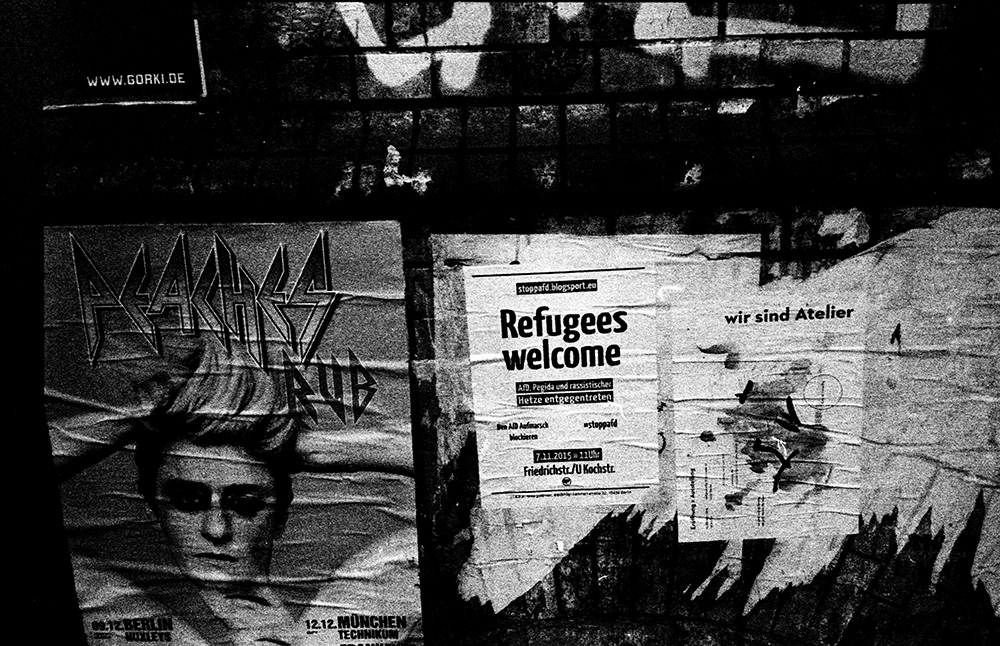
I visited Dresden on Friday 13 November 2015. The train was delayed on the way back. When I finally sat down and checked the news I learned that there had been a mass shooting in Paris. The next day this memorial appeared outside the Bundestag.

I can't tell what Berliners are like because apparently they don't exist. Everybody in Berlin comes from somewhere else and is just there temporarily, as in London. I drew up an itinerary of places to visit that inevitably degenerated into a scramble to see everything in the last couple of days. Two days from the end I stumbled on this set of blog posts and fell into a deep depression as I contemplated the gulf between us.

We're writing about the same subject, some of the same places, similar photographs even, but her writing has charm whereas mine is pretentious, stodgy, incredibly pompous and just fundamentally unlikeable, essentially a weak imitation of Auberon Waugh. Our writing is different because we had completely different upbringings and exist in a totally different environment and target a different market; and of course she was probably writing with her professional voice whereas all of the words on this blog are blood-raw scrapings from the skin of my soul.

We were shaped by different things, we continue to be shaped by different things, we will never achieve meaningful communication. Locked in these bodies we are born alone, live alone, and die alone, like deep-sea divers trapped in a diving suit at the bottom of the ocean. Like that man who tried to retrieve the body of the dead diver, but he misjudged the task and just added to the death toll. There is no help at the bottom of the sea.


Berlin, Berlin. Tempelhof is a large disused airport and one of the few remnants of the pre-Cold War era. The post-Weimar era. That era. You know. Them.

I say large - the building is vast but the runway is too small for modern jets, so it all had to go. Aeroplanes no longer land there. Tempelhof is eerie because it was abandoned only a few years ago, in 2008, and all the signs still look modern. The terminal building is well-maintained and on the whole it looks as if it has been closed just temporarily.

When I went it was filled with worried-looking men in puffy jackets because it was being used as a camp for refugees. The former runways were full of kite-flyers, leg-joggers, and barbecue-stokers. Tempelhof is occasionally used as a film location; you might recognise it even if you have never been there. It's a bit like love in that respect. You can recognise it because you saw it on telly, even if you have never actually seen it in real life.


Everything in this post was shot with either an Olympus Stylus Epic using Fuji Superia, Ilford HP5, or Agfa Precisa; or my Moto G mobile phone

Berlin's geography is odd. The bright-lights-big-city centre of town is off to the west because it's the centre of the former West Berlin; the geographical centre is just inside the former East Berlin; the bright-lights-etc centre of East Berlin was to the west of East Berlin and so it's in the geographical centre, around Museum Island and Alexanderplatz, which has a large shopping mall but feels a bit low-rent in comparison to the area around Potsdamer Platz. East Berlin was popular a few years ago because it was literally low-rent - unusual for a modern European capital - but that's all over now.


BOXOUT: The Memorial to the Murdered Jews of Europe is now over ten years old. It's a disaster. I understand the idea - it's supposed to be offputting, a wound in the heart of Berlin - but it doesn't work.

The design lends itself to photographs of people leaping across the top of the blocks, and when I was there I saw at least two couples doing this, tarting up their Facebook profiles. It's low to the ground in the middle of a traffic intersection, surrounded by ordinary shops, and my enduring memory of the place is of Hertz Rent-a-Car, kebab shops, anonymous office blocks, generic European peoplecarriers waiting at traffic lights.

The floor, with its little lights and non-slip pavement, looks cheap. Besides which, it's too late. The time for a memorial was 1946. If I had been in charge of Germany, I would have gathered every German over the age of fifty and forced them to build this memorial, and then I would have forced them to move away the rubble - just pile it up into hills - and rebuild the surrounding area until they were all dead. The unstated purpose would be to work them to death.

It's not Germans that ruined the world, it's old people, and they have long since escaped justice. Old people are the mortal enemy of humankind, not immigrants. They send their children out to die for a bit of money. The current generation of old people destroyed the world's economy and sold us all out; they will die in nursing homes in a pool of their own piss, with poorly-paid non-English-speaking nurses ignoring them. And then one day I will be one of them, and a new generation will do the same to me, and it will dawn on me that perhaps old people were not the problem after all, but people in general.


Museum Island didn't thrill me much, in part because the large exhibits at the Pergamon are currently closed for renovation. The island is perfectly okay, but the museums are a bit fusty. Did I mention bottle recycling? When I go on holiday I self-cater because the thought of a package tour horrifies me. Having to pretend to be nice to a bunch of fat old English assholes, yuck. If you buy a bottle of fizzy pop from a German supermarket, you can take it back and put it into a special machine that reads the barcode, eats the bottle, and gives you 25 euro cents. That's about seventeen English pence. Not much, but imagine taking back ten bottles. Now you're talking. That's two and a half euros. Enough to buy another bottle. I remember wondering if I could make a profit. No.

The feeling of joy I had when I worked this machine for the first time is indescribable. I carefully observed the people of Berlin as they put their bottles into this machine, and at an opportune moment I stood forward and used the machine myself. No-one looked at me as if I was strange. No alarms sounded and nothing broke. Berlin did not reject me. There was no shouting, no feeling of failure and inadequacy. I had triumphed over my biggest enemies; myself, and others.


South-west of the Reichstag is a second museum complex, the Kulturforum, which was created in the 1960s because Museum Island was just inside East Berlin and thus hard to visit. The Kulturforum's Gemäldegalerie had an exhibition of works derived from Botticelli's Birth of Venus. There's a thing in galleries where you have to pretend not to be checking out photographs of naked women. You're supposed to glance at them as if you are bored with naked women. And yet, as a man, I am never bored of naked women.

Along with many millions of other people I have seen the original Birth of Venus, which is indeed striking; the exhibition was surprisingly good, given the very narrow focus; I have never been to Venus, the planet, which is just as well because I would die and that would be bad. The atmosphere of Venus is completely inhospitable to life.


Berlin's atmosphere on the other hand is not inhospitable. Some cities evoke within me a sensation, and so did Berlin, although I can't define or express it. Which of the artworks moved me most? That's easy, Antonio Donghi's Donna al Caffè. The colours and composition spoke to me. I don't know who Donna was, but she has the expression of someone who regrets agreeing to pose for a portrait but will go through with it anyway. I have seen that expression before, quite often, in the faces of the women I have met. Disappointment and loathing. Eventually you start to crave it. The other paintings that grabbed me were Canaletto's La Vigilia di Santa Marta and La Vigilia di San Pietro, two images of Venice that are extraordinary because they present the night-time as genuinely dark and hard to see. The internet's scans don't capture their subtlety.

Moving on to the next thing in Berlin (looks in bag) the DDR Museum was a small hole in the wall albeit that the space was utilised well. It presented life in the DDR as a fairly pleasant place where people had houses and led pretty comfortable lives, unlike for example modern Britain, where people have to pay £600 per month to live in a shed - literally, in a converted shed - and share a bathroom with eight other people. The text mocked the DDR but the exhibits made it look surprisingly attractive. Life had purpose and meaning, and by the 1970s people had somewhere to live, and if people had to join a queue before they could have a video recorder or a mobile phone what was so wrong with that?

As for the Stasi, in Britain today you can be sent to prison for sending pro-ISIS tweets, possessing terrorist propaganda, or being a lunatic fantasist with legions of social media followers. You don't have to actually do anything to be sent to prison. You don't even have to encourage other people to do things. In Britain today, if you're a Muslim and you have Air Force One on DVD, you're in deep trouble, doubly so if you lend it to someone.


An example of East Berlin's supposedly awful housing; but in London today this would house twelve people, who would pay £400 each for the privilege of hot-bunking. Or alternatively two people paying £1,700 a month between them.


We had bog-standard cameras too. Sold by Argos. In fact Argos sold almost the exact same model of Praktica.

But that's enough politics. The Computer Game Museum is small but emotional, because it was full of kids playing video games, just like when I was a kid playing video games. Little do they know the horror in store for them. My generation had a bad deal. When I was a kid, video games were frowned upon. Parents hated them and trendy people pooh-poohed them.

Nowadays trendy people pretend to have always loved video games. The irony is that video game arcades were massive in the 1980s but were generally ignored even by the adventurous parts of the mainstream. There was no Lester Bangs or Hunter S Thompson of the video arcade, no Boswell, and as the saying goes, no Boswell, no Buck Rogers. You and I went there to watch other people beat Double Dragon while the speakers played something by Iron Maiden, Powerslave in the 8-bit era, Somewhere in Time during the early Neo Geo period, from what I recall you could finish the whole game with the backwards elbow attack.

Iron Maiden's albums charted highly but, just like video arcades, the mainstream press hated heavy metal and wasn't even aware of chiptune music. My entire childhood culture was ignored or outright mocked by the mainstream media, which is probably why I have always been wary of it. The mainstream mocked my culture when I was young; what essential aspect of modern youth culture is the mainstream mocking today?

Other people beating Double Dragon

Adults in those days had pub darts and pub snooker and stupid boring crap like cribbage. Kids, listen to me when I say that adults are a dead end. They have nothing to teach you. Their pastimes are out-of-date. They are the enemy, trust me. Dot dot dot but now that video games are fashionable, video arcades are still dead and will probably never come back.


Is there a place for a modern video arcade? The arcade has risen from the grave once before. When I was very young arcades were all over the place; they had Space Invaders, Defender, Pac-Man and latterly Outrun and oodles of games with fancy motorised cabinets. Michael Jackson had a video arcade of his own, and I remember wishing I could hang out with him. One of many dreams that did not come true.

By the end of the 1980s the novelty had worn off, and a lot of places had closed, but the release of a string of beat-em-ups - notably Street Fighter II - reinvigorated the arcade, and even in the late 1990s the likes of Virtua Fighter, Sega Rally, Star Wars Trilogy and Dance Dance Revolution still packed them in. But the technological gap between dedicated arcade hardware and the Playstation and Dreamcast home consoles was really narrow, and despite dominating the arcades Sega developed financial difficulties, and rents increased, and I don't know. Perhaps crime kept people at home, and conversely the Game Boy meant that you could play games anywhere.

Gambling slot machines still exist, airports have those grabber machines that pick up mobile phone cases. Gaming is still huge. The Game Boy has given way to the mobile phone, and although the PC is becoming a niche, the Playstation is still around. But arcades are still dead. I blame rent. If rent was cheap, it wouldn't matter if the machines only brought in a pittance. There are people who would be perfectly happy to run a video arcade on a salary hovering around minimum wage, if the machines covered the rent, just so that they could run a video arcade. And you could make extra cash by using the machines to launder money, and you could sell drugs round the back and allow prostitutes to use the toilets. That's how I would run the place anyway.

Does anybody still make arcade games? Perhaps the arcade could have modern PCs and games consoles hooked up to screens, in some kind of robust unbreakable case. The problem is, what's the point? Why travel into town to play games that are no better than the games you can play at home? Because it would be an event, and also the drugs and prostitution would bring people in. I went to the arcade to be wowed by Gauntlet and Virtua Racing, but also because it was the only place to find other people with whom I could play those games, especially four-player Gauntlet. Throw in fellatio and drugs and I would spend most of my time and money in a modern arcade. I can't see arcades having the same widespread appeal as before, but it saddens me that London's Trocadero Centre (for example) died such a horrible death. It was stripped from the inside, left to die for a decade, and eventually turned into a hotel, except that it's still not dead yet. Professional video games tournaments fulfil a similar role but the atmosphere is very different and a lot smellier.

I don't know. Professional arcade owners knew more about running arcades than I do, and they couldn't make the maths work. I also went to Ostpacket, a store that specialises in consumer goods from the former DDR. Ostpacket was originally part of a mall, but it's now a separate store. Unfortunately it meant nothing to me. There is nothing inherently amusing about recreations of goods from the former DDR, and without any cultural context it's just chocolate and ersatz Angel Delight. And some of the chocolate is still available brand new in Lidl and Aldi here in the UK.


The Reichstag is the seat of government. The interior resembles the lair of a Bond villain, although in reality it is the lair of Angela Merkel. It looks as if there is a giant laser hovering over parliament poised to turn the politicians into dust if they displease her. As a tourist attraction it's essentially an elevator followed by a winding staircase, although the views are nice. I found it hard not to grin during the security screening, which is carried out by stereotypically brusque German security guards. It's not my fault that jacket and ticket sound similar in German-accented English. The man must have thought I was mad when I handed him my jacket.

I dedicated an entire post to Konnopke's Imbiss, where I ate some currywurst. Checkpoint Charlie and the Berlin Wall Memorial are two sides of the same tourist coin; Checkpoint Charlie is naff, the Berlin Wall Memorial is sombre. A TV screen showed footage of the protests leading up to the wall and its eventual destruction, and I couldn't help but feel a little moved by the sight of a mass of moustachioed men wearing Adidas tracksuits rushing past the camera. Back in 1989 I remember wondering why the people of Liverpool wanted to visit West Germany so much - it was only later on that I discovered they were in fact East Germans.

The same TV also showed footage of the 40th anniversary celebrations of the GDR, which took place just four weeks before the Wall was torn down.


The East Germans were basically economic migrants, weren't they? They weren't motivated by a love of freedom, they wanted to own a BMW. If East Germany had been a nightmare hellscape on a par with North Korea I could sympathise with them more, although the wall would not have fallen; as it stands the people of East Germany exchanged dull, ordered lives of sufficiency for a rollercoaster ride of high rents, consumer debt, and periodic economic collapse. If you ever want to irritate a left-wing person, talk to them about Berlin. They'll start to waffle on about the six months they spent living in the former East Berlin in the late 1990s when the rents were cheap and how horrible it is that the area is being gentrified but isn't that what the former East Germans wanted I mean I'm not saying that the DDR was great but, you know, but how come so many people were shot trying to get out etc.

Some people think that mankind is descended from monkeys, but why not bears? They're just like human beings but with lots of fur. I telephoned the National History Museum earlier today and asked them, "why not bears?" I said this seven times down the phone as loudly as I could and then hung up.


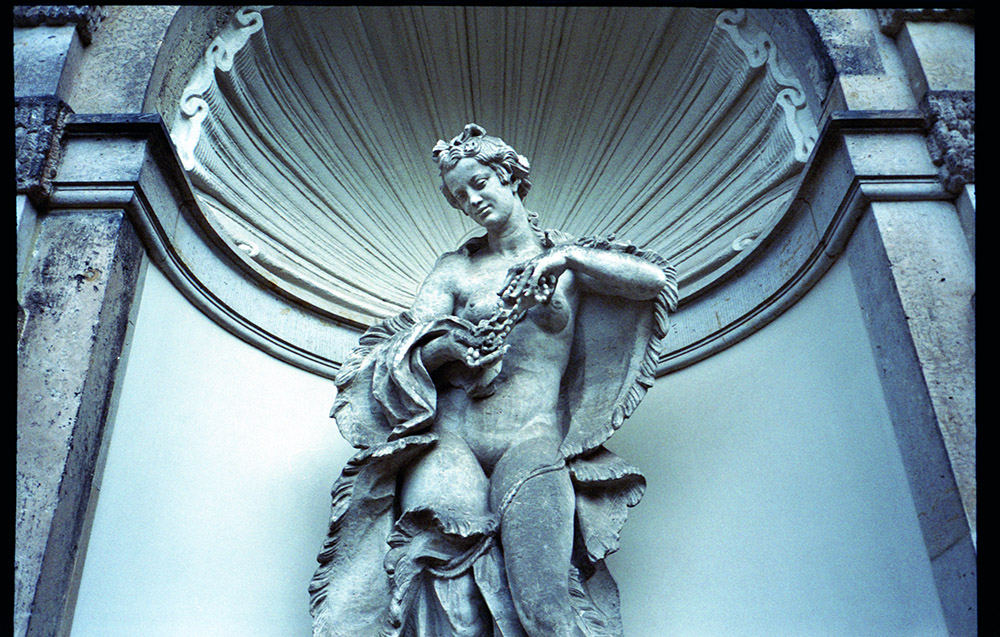
I also went to Dresden, although I spent so much time looking at Dresden that I didn't have time to see any of it. I walked from the station to the mostly-closed Zwinger Palace, which has a nympheum, essentially a real-life Pornhub where presumably the local rich people could go and masturbate to statues of naked women.

Dresden was in the former DDR and is a curious mixture of empty spaces, modest tower blocks, more empty spaces, and run-down-but-not-unattractive streets. The station is in the midst of a large shopping mall. I walked to the military museum, which took longer than I expected. The museum resembles something from Half-Life 2. It's an old building with a jagged metal shard rammed through it, as if it was being absorbed by the Combine.


Aiee, it's Peter Elson!

The museum's curators must have had a difficult job. Military museums in Britain are stuffed with reminders of our glorious triumphs over the villainous Europeans, and at the same time they tend to fetishise Nazi-era military technology. In contrast museums in Europe have to deal with the fact that they were the bad guys and that they lost. Furthermore Germany's military history in the last sixty years has been very modest and I imagine that the curators didn't want their museum to become a haven for the wrong kind of people, doubly so given that the museum is in Dresden.


And coverage of the Cold War is awkward because Dresden is in the former East Germany, which means that the people of Dresden were the baddies even after the war. Twenty-seven years ago the people of Dresden were itching for a chance to thrust their Russian-supplied T-72s into the radioactive wastes of what had been West Germany. It would have been interesting to see the museum try to cover that, but ultimately it handwaves the Cold War away. The exhibits tend to portray the Bundeswehr as if it had always been a pan-German force. The museum has a faint anti-war air, and on the whole it comes across as the kind of military museum a group of art students might make.

Berlin has an odd position in the history of Nazi-era Germany. It was the capital, and Hitler died there, but he spent most of his time elsewhere. We expected him to flee south to Austria; we were genuinely surprised when he stayed in Berlin. The city appears to have had no special enthusiasm for Hitler and his Nazi Party, and Hitler did not think much of Berlin. He wanted to tear it down, destroy it, rebuild it in his image, give it a new name, call it Germania. If the Nazis had won the war Berlin would not exist today, either in name or in spirit.


Do I have any tips for people journeying to Berlin? It's not Kandahar. The people of Berlin share my alphabet and culture. Berlin is easily walkable, with an extensive and cheap public transport system. The only time anybody checked my public transport ticket was on the express train to the airport. I navigated with GPS, and despite not speaking a word of German I got along. The Berliners don't speak much English so I suppose we are equal. Ich bin der musikant, mit taschenrechner in der hand. That's German. It's not enough to build a conversation around.

Berlin has electricity - you'll need a Europlug - and wi-fi. Despite being Britain's foremost David Bowie expert I did not even try to follow his steps, because Berlin 2015 is not Berlin 1977, it's all gone. As with Italy you have to open train doors yourself. Otherwise you'll stand in front of the closed doors and the other passengers will think that there's something wrong with you and they'll get worried that you're not going to open the doors and then they'll hurriedly reach in front of you and press the button / pull the handle and you will have committed a social faux-pas.

What will I remember most about my trip to Berlin? The train ride to Dresden. Listening to this. The birds that followed the train.