Showing posts with label blade runner. Show all posts

Monday, 13 March 2023

Blade Runner: A Beautiful Mess


Let's have a look at Blade Runner (1982), but to make things real spicy-like I saw it on the IMAX screen at London's Science Museum. I've always been disappointed with Blade Runner, but I decided that if I was going to eat the cheeseburger I might as well eat the hell out of it.
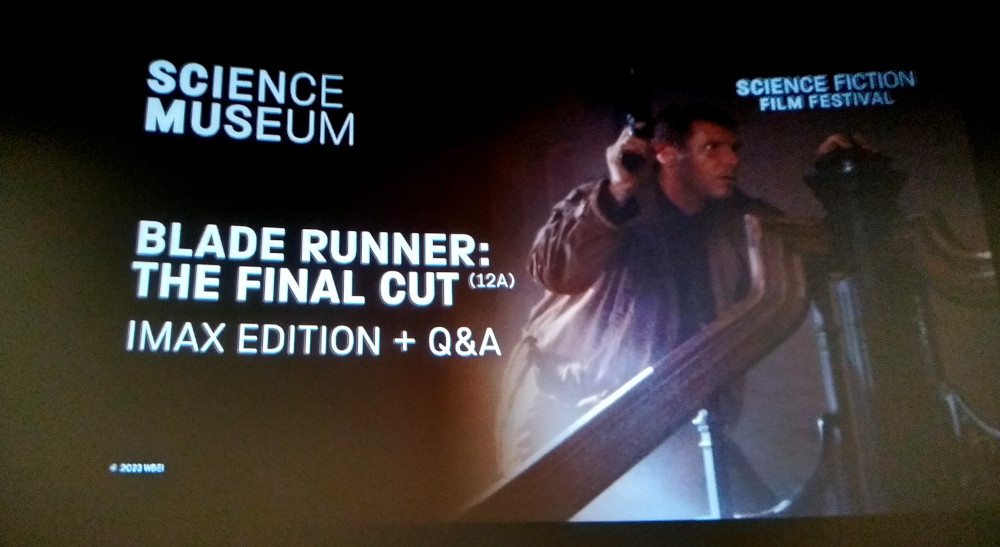

For the record the IMAX screening was a digital presentation of The Final Cut of 2007, which tightens up the editing and fixes some special effects gaffes that were still present in the Director's Cut of 1992. The screening I saw began with the Ladd Company logo. There was lots of film grain, which is not a bad thing at all - it reminded me of Chungking Express at times - and on a visual level I am pleased to say the film has held up.

Director Ridley Scott wanted the futuristic Los Angeles of 2019 to look as if the twentieth century had coalesced into a big pile of beautiful detritus, and Blade Runner's clutter is still beautiful.

It was accompanied by a talk from a roboticist from UCL and a short interview with associate producer Ivor Powell. I learned from the former that it is possible to remotely control a cockroach. Imagine if we could remotely control something useful, like an aeroplane or a car. Or a helicopter. Is Blade Runner any good? No.

Look, I get Blade Runner. I grew up in the 1980s. I am not a fuddy-duddy. Blade Runner is one of the most influential science fiction films of that decade, alongside Alien, The Terminator, Aliens, and RoboCop, and yes I know that Alien came out in 1979. You don't have to point that out.

You're also going to point out that Blade Runner is a lot more sophisticated than those films, but that's not true. Blade Runner has the surface appearance of sophistication. It has lovely cinematography and a measured pace, but there's an emptiness to it. Especially compared to RoboCop, which had a lot to say about greed, vanity, and delusion. In comparison Blade Runner feels like a summary of substance, an index of substantial topics with no text.


On the positive side the film still looks awesome. The careful use of colour and intelligent use of sound effects as a storytelling device are recognisably modern. Even in its original, pre-Director's Cut, pre-Final Cut form, Blade Runner recognisably belonged to the modern age. The fashions are timeless. The use of old-fashioned television displays and mechanical computer relays feel like a deliberate stylistic choice. Even Vangelis' electronic score - heavy with atmospheric washes and bassy sound effects - has aged gracefully. The surprising thing is that the synthesisers haven't dated; it's the saxophone and electric piano that sound of their time, not the Yamaha CS-80 and the Lexicon reverb.

But as a story it's a mess. You have to understand that I get Blade Runner. I get it. The film was released on the very same day as John Carpenter's The Thing, which had a similarly rough ride from contemporary film critics. They hated The Thing. Vincent Canby of the New York Times described it as "instant junk", comma, "a foolish, depressing, overproduced movie that mixes horror with science fiction to make something that is fun as neither one thing or the other".

But he was dead wrong. The Thing is a masterpiece. It deftly mixes visceral shocks with a creeping, underlying sense of doom. The gore effects establish that the film is not messing around, but for the most part the film's impact comes from its restrained, ratcheted tension and sense of hopeless dread. The critics were wrong about The Thing because they didn't get it.


The critics weren't quite so dismissive of Blade Runner. They praised its looks but were unmoved by the rest of it. Janet Maslin, also of the Times, loved the visuals but described its story as a mess. And so did I, a few paragraphs ago, but that's because it's true. It's a mess. Janet Maslin wasn't an old fuddy-duddy who didn't understand Blade Runner's brilliance. She got the film. She got the film. She was right.

The standard narrative is that the film was killed at the box office by ET, but that's not true. The two films had completely difference audiences. Blade Runner failed to turn a profit because it was a poorly-reviewed, slow-paced detective story with bursts of nasty ultraviolence aimed at an adult audience that still pooh-poohed sci-fi.

It was released within a few weeks of Conan the Barbarian, Mad Max 2, Star Trek 2: The Wrath of Khan, Tron, and Firefox - May-June-July 1982 sounds fantastic - all of which at least made back their budgets, so I imagine the typical moviegoer of 1982 was perfectly capable of seeing more than one film at the cinema. Blade Runner didn't fail because the people of 1982 were sentimental morons, it failed because it was an expensive, slow-paced detective film aimed at an audience that didn't exist.


Over time Blade Runner found a new audience of starry-eyed kids such as myself who were mesmerised by its visuals, so it became something of a mainstream cult, an underdog. In the age of Akira and Syndicate it wasn't fashionable to say bad things about Blade Runner, because if you did, you were square. You didn't get it. You were an old fuddy-duddy like Vincent Canby. And so people my age learned to pretend to like Blade Runner even though we had doubts. We bought it when it came out on the latest high-def optical format but didn't watch it. We kept the Blu-Ray in the wrapper.

Let's talk about the good stuff. On a visual level Blade Runner codified the look of the future throughout the rest of the 1980s. The light through blue smoke; the spotlights; the Japanese-language adverts. The cinematography makes extensive use of narrow depth of field and chiaroscuro, in contrast to the flat, television-style lighting of so many contemporary films. The editing is punchy. Even the use of bass drops on the soundtrack feels contemporary. It doesn't look like a science fiction film from 1982. It looks like a proper film, a real film, a grown-up film.


And Rutger Hauer gives a fantastic performance as a charismatic, violent man-child who burns with righteous indignation at his crummy lot in life. He only appears for a few minutes, and only has a few lines, but the film lights up when he is on the screen.

Ditto Brion James, who spent the rest of his career playing belligerent heavies on account of this film. And Daryl Hannah, who plays a variation of Hauer's role, as a child-like killer who wears an emotional mask she can remove at will, while simultaneously giving the impression that under it all she might have some genuine emotions. They are all tragic characters, driven to kill by impulses they cannot understand, created as disposable tools by a heartless world, but the film largely ignores them. They dominate my memories of the film, but they're barely in it.


At heart Blade Runner is a variation of The Deer Hunter or First Blood. It's a film in which soldiers return from the war to find themselves alienated from a world that doesn't want them. But instead of focusing on the former soldiers, Blade Runner follows a detective who hunts them, because the producers needed a big star name, and he couldn't be a villain, so they hired Harrison Ford, but gave him nothing to do. And because he needed a love interest they hired Sean Young, and gave her nothing to do either. Young makes the most of what she has but Ford was apparently not enthused with the material, and it shows.

Beyond that the film (a) is too prosaic to work as a detective mystery (b) is badly-paced, with a busy opening and a dull middle section (c) raises a number of interesting sci-fi ideas but then does nothing with them (d) is surprisingly simple and linear for its length (e) is just generally overstuffed. The sequel, Blade Runner 2049, had almost exactly the same problems, but was more engaging as a story because it had an underlying mystery. And at least it tried to explore its sci-fi ideas, although it was still muddled.

Reviewers in 1982 pointed out that our hero's detective work is perfunctory, as did Harrison Ford himself, and they were right. Ford's character does a little bit of detective work involving some photographs and a snake scale, but everything after that relies on coincidences of timing and geography. The baddies essentially run into him. You might argue that Blade Runner is about more important things than detective work, but why couldn't the writers at least make the detective aspect interesting? Or added at least one plot twist, or something unexpected? It wouldn't have done any harm.


I haven't explained the plot. Blade Runner is a detective film set in Los Angeles in the year 2019, which in 1982 was almost forty years in the future. The city is blanketed in pollution. Humanity has developed robot slaves to do all the heavy work, but they're only authorised for use in the off-world colonies. The robot slaves - replicants - are almost indistinguishable from human beings, but smarter, stronger, more durable. Our superiors in every way.

Three things distinguish them from us. They are brought into the world as adults, with implanted memories, so they lack the emotional development of human beings who have spent a lifetime learning to deal with disappointment and rejection and having to take the bus to a post office on the estate because the local Argos has closed and the nearest Click and Collect depot is miles away. Secondly they're a lot stronger, although the film implies that they aren't superhuman, just massively more efficient (otherwise presumably the authorities could detect them by sticking pins into their arms, or something).


And thirdly they have a lifespan of just four years. The film implies that the replicants are unaware of this, although the villains find out somehow. They flee to Earth in the hope that they might extend their lives, in the process leaving a trail of death behind them, because they have nothing to lose, no reason to hold back. Blade Runner is essentially two parallel detective stories, one in which the escaped replicants try to arrange a meeting with the boss of the company who made them, another in which a detective tracks them down. The replicants achieve their goal first, only to find out that they are doomed, and at that point the detective's story just peters out.


There's a second plot. Early in the film the boss of the company that makes the replicants introduces a new model to the detective. She is more human-like than the other replicants. The fact that this character is a replicant is played as a mystery, but only briefly. No sooner is the character introduced than we learn she is not real. She learns the truth shortly afterwards, in a scene that might have had more impact if we knew her, or if it had been a surprise. Sean Young is asked to express what must be intense emotions at the realisation her entire life is a lie, and although she does a good job the script doesn't help her at all.

A better film might have gone on to ask why human beings are real, and perfect duplicates of humans are not, but Blade Runner doesn't seem to care. Sean Young is fine in the role but ultimately the character is given little more screentime than the villains, and the romance between her and Harrison Ford's detective isn't engaging.


There's a persistent theory that the detective himself is an advanced replicant, in which case the romantic angle would actually make sense. The film would be about two emotionally-stunted robots learning to become human. Another film might have treated that as a hopeful outcome, because if robots can learn to love there is hope for the future, but again Blade Runner tentatively raises this theme but does nothing with it, as if the screenwriters had been told to make a tough action thriller and not trouble the audience with too many ideas.

It's so frumple. Blade Runner could have been great, but the story is just too prosaic to work by itself, and underneath it the film has a peculiar lack of curiosity. Does the average person in the street know that megacorporations are breeding slaves? Wouldn't that be a major political issue in the United States of 2019? Wouldn't the reveal that the villains are replicants have been more impactful if it had been kept hidden until later in the film?

As it stands, the nature of replicants is explained in a clumsy "as you know" dialogue scene right at the beginning, during which the stereotypical chief of police explains replicants to a man who has spent his career hunting them down.

The film's production design was strip-mined by oodles of films and video games. This kitchen immediately put me in mind of the latter-day Deus Ex games.

Wouldn't it have been interesting if the film had shown humanity on the verge of extinction, with the emotionally-stunted robot duplicates as our only chance of preserving something of humanity? The book explores that theme, and the film's portrait of a world where animal life has suffered mass extinctions alludes to it, but as with so much of the film this wisp of an idea is raised but never explored.

And that's Blade Runner in a nutshell. It's a frustrating missed opportunity. If the film had picked a single sci-fi idea, or built an interesting mystery, I would love it. It reminds me of Deus Ex: Human Revolution, in the sense that both works allude to a mass of interesting ideas but never commit to exploring any one of them in depth.


It could have been a film in which a set of tragic anti-heroes realise that they are doomed to be left behind by a future that doesn't need them, as in The Wild Bunch, or a mystery in which humanity attempts to cheat mass extinction by building a replacement that can survive in a harsh new world, as in The Talos Principle, or even just a solid action-adventure thriller along the lines of Manhunter, or a philosophical work that examines what it is to be real, as in Toy Story, but ultimately it's a mystery-less detective film, an unromantic romance, an unexciting action film, a philosophical meditation with the depth of an Ultravox video.

But it looks fantastic, I'll give it that.

EDIT: After writing this a couple of things struck me. This shot is puzzling:


Puzzling because it looks as if it was filmed by pointing a camera at a screen playing back the footage. As if it was mobile phone footage of a television screen. It stands out because it's wobbly and fuzzy and lasts for several seconds. I don't have a copy of the original version of the film to hand but I wonder if it was rehearsal footage spliced in for pacing issues.

A few months before Blade Runner was released Ridley Scott directed a commercial for Chanel. It was part of a series that began in 1979. One of the film's most iconic shots originally came from the Chanel commercial:


In the 1980s Ridley Scott was often dismissed as a lightweight visual stylist, a brash analogue of the nascent New Romantic movement. In my opinion he was just ahead of the curve.

Saturday, 7 October 2017

Blade Runner 2049


Off to the cinema to see Blade Runner 2049, a new science fiction adventure starring Harrison Ford as an old man and Ryan Gosling as Jesus. Ford prepared for the role by growing old - he is 75 years old - and Ryan Gosling prepared for the role by not crying even though the cattle woke him up. Blade Runner 2049 is a sequel that nobody wanted but it's actually very good, so that's okay.

The original film came out long before you were born, and although very few people liked it at the time it's generally regarded as a minor classic nowadays. A minor classic if you are a film school student, a major classic if you love the way things look. The extraordinary production design was very influential. I have always felt that it had a core of fascinating ideas buried underneath a mediocre detective thriller, but more of that further down the page.


Blade Runner was released in June 1982, the exact very same month as ET, Star Trek 2: The Wrath of Khan, and John Carpenter's The Thing. Time has been kind to all of those films, but contemporary critics had a very different opinion. ET and Trek were well-received and went on to make big piles of money, ET in particular. The Thing and Blade Runner were however dismissed as hollow exercises in revolving gore effects and futuristic set design respectively. They eventually became popular on the home video market, then in its infancy, but in 1982 they seemed like self-indulgent wastes of money.

The two films have a surprising amount in common. They were released on the same day, June 25, the height of the summer blockbuster season. The villains are perfect duplicates of human beings, so perfect that they don't know they're fakes. Our hero has a devil of a time catching them, and at the end you're left wondering if he is a duplicate as well, or indeed whether it matters at all. Both films were intended to catapult their directors firmly into the A-list of Hollywood directing talent, but it didn't work out. John Carpenter's career never really recovered from The Thing and he spent the rest of his life directing intermittently brilliant B-movies.

In 1982 Ridley Scott was a brash limey wunderkind, the wave of the future, natural heir of Stanley Kubrick, hard-working advertising director made good, but this reputation took a hammering from the back-to-back failures of Blade Runner and Legend (1985), which lost even more money. Unlike John Carpenter he recovered, but although he subsequently masterminded a string of huge popular hits his output has been incredibly erratic. It's as if he picks scripts at random and then does the most incredible ultra-professional job of turning them into a film, but even Ridley Scott's special sauce isn't enough to compensate for the weak material. I wonder if it's a legacy of his days as a commercial director, when he had to take whatever work was available.


For every Gladiator or Black Hawk Down he has directed at least one huge flop (Kingdom of Heaven, Robin Hood) and half-a-dozen forgettable fillers such as White Squall or American Gangster or GI Jane that no-one remembers. On a visual level he seemed to hang up his laurels after Legend; his post-Legend films were good-looking but never class-leading. As a director of muscular sci-fi action horror films he was quickly overshadowed by James Cameron, and on an artistic level he never really had a distinctive voice. In the great ranking scheme of Hollywood directors people will always respect him more than the likes of Joel Schumacher or Tony Scott, who also filmed the 1980s with smoked-glass-filters and backlit steam, but imagine his career without Alien or Blade Runner; no-one would care very much about him. He would be David Puttnam or Howard Hughes.

~

I've always been ambivalent about Blade Runner. It's an interesting set of ideas buried underneath a boring film. On the surface it's a futuristic detective drama about a secret policeman, played by Harrison Ford, who has to track down organic robots who are almost indistinguishable from human beings. They are born with adult bodies and are given false memories of a past that they didn't have, and then shipped off into space to do jobs that human beings refuse to do. They are allowed to work alongside human beings but they aren't allowed to visit Earth, on pain of death. As the film opens, a team of these replicants has landed in Los Angeles. It seems that they want to have a word with the head of the corporation that created them and it's up to detective Deckard to find them and kill them.

Which he does, with some perfunctory detective work that mostly involves looking at a computer. As a thriller Blade Runner just doesn't work. Deckard does less sleuthing than the villains, and he's always a few steps behind them. Ultimately he fails to stop the chief baddie from achieving his goal and only escapes with his life because the villain has a crisis of conscience. This isn't necessarily the recipe for a bad film - Chinatown had a similarly hapless main character - but Blade Runner's detective plot is simplistic and uninteresting.

There's also a creepy romantic subplot in which Deckard romances a robot prostitute, played by Sean Young. The romance aspect was presumably mandated by the studio; it hasn't aged well. It's bad enough that Deckard forces himself on Rachel, but what makes it worse is that Deckard is aware she's essentially a brain-damaged child bred to be a rich man's plaything. Early in the film he humiliates her during an interrogation and reveals that he knows every detail of her fake past. If we accept that Deckard is a robot duplicate himself then the romance makes a bit more sense - he is emotionally simple and hasn't had his end off - but if that's the case the film becomes a big so-what, because the film doesn't follow through and, on a fundamental level, neither Deckard or Rachel come across as interesting people. All the other characters are essentially distinctive faces rather than people, and none of them do very much...

...with the exception of Rutger Hauer as lead villain Roy Batty. Hauer has limited screen time but is the most interesting actor in the film, playing the only interesting character. Although he is the bad guy Roy Batty is more sinned against than sinning. He was an unwanted child shipped off to fight in somebody else's war, and he now faces a lonely death because the robot duplicates are given a four-year lifespan. Whether this is a technical consequence of their construction or a deliberate attempt at planned obsolescence is left ambiguous, but either way it's horrible because the replicants are shown to be conscious and self-aware. They are aware of their own mortality, but unaware that death will strike them down in just a few years rather than in old age. They are presumably expected to die in battle, fed propaganda that they are fighting a desperate struggle against an implacable enemy, and the few that reach the end of the tours of duty are, I imagine, shipped back to Earth where they are euthanised, or perhaps they are simply dumped into space.

On a deeper level Blade Runner is essentially a soldiers-coming-home film along the likes of The Best Years of Our Lives or The Deer Hunter, in which soldiers are unable to reintegrate with a society that doesn't care what they have been through. The replicants are thrown on the trash heap by an ungrateful population that's not prepared to cut them some slack when the fighting is over.

As a soldiers-returning-home allegory and an early warning of the perils of genetic engineering Blade Runner could have been a stone-cold classic. If the film had concentrated on that, I would love it, but instead we have Deckard examining photographs and chasing leads like a futuristic Joe Friday. The film only really attempts to deal with its philosophical underpinnings right at the end, with a poignant final monologue apparently written by Rutger Hauer on the day of shooting. Batty accepts that despite living an extraordinary life he is doomed to die alone and unmourned, as are we all; he spares Deckard from certain death so that there is at least one person left to remember him. Batty raged against the dying of the light, but like Dylan Thomas' dad he died nonetheless.

Blade Runner raises far more questions than it answers. What does the common man in Blade Runner's universe think about the replicants? Is their existence widely-known? Can they reproduce by themselves? If they have superhuman strength, how come they don't realise that they're not human beings? Are they made to think that they are genuine human beings who have been genetically augmented? Why bother spending a fortune on replica human beings when the real thing is so cheap? Why make the replicants look like human beings at all? Why not make them ten feet tall and full of muscles? And so forth.

Sadly the film doesn't have time to answer any of those questions, and I imagine that Ridley Scott probably wasn't interested. He was a technically rigorous director whose goal was to get the script onto the screen as efficiently as possible without necessarily making a work of great art. Blade Runner suffers in comparison with idea-led sci-fi films such as Children of Men or Eternal Sunshine of the Spotless Mind or even Total Recall because it doesn't work on the surface and the ideas aren't explored. It feels like sacrilege to compare Total Recall with Blade Runner, but in my opinion Recall was more successful at combining sci-fi ideas with a genre film.


Despite critical indifference two elements of Blade Runner attracted almost universal praise. Firstly there was its extraordinary look, which combined Scott's commercial-honed knack for arresting compositions with hyperdetailed street sets and state-of-the-art modelwork. The film took place in the rain-drenched darkness of Los Angeles circa 2019, in a future where the population is continually bombarded with animated billboards and advertising signs. It implies that Japan or perhaps China has achieved economic dominance over the United States - a scenario widely anticipated in the 1980s - and that although the human race has no shortage of bodies, the cramped and polluted conditions have made Los Angeles and by extension the entire world an oppressive hellhole. The film treads a fine line between accumulating subtle details in order to build an impressionistic portrait of a future world, and just introducing things arbitrarily so that we can marvel at them, but its world feels more coherent than that of the clones that followed.

Blade Runner's look and feel - and its dark, grim atmosphere, and occasional bouts of bloody violence - were lifted wholesale by films and computer games over the next thirty years. Eventually backlit steam and rain-flecked darkness became a cliché - the likes of 28 Days Later and Children of Men suggested a new visual language for science fiction - but Blade Runner is still an exceptionally handsome film.

The other thing that everybody except the Academy of Motion Picture Arts and Sciences liked was the score, which was composed by old-school synthesiser wizard Vangelis. Vangelis had a knack for catchy tunes, but beyond the beginning and end titles his music for Blade Runner was mostly atmosphere, performed with a mixture of acoustic piano, a big reverb unit, and a massive Yamaha CS-80 strings patch. He refused to release a proper soundtrack album until 1994, by happy coincidence in the middle of a boom in ambient electronic music ("Rachel's Song" was widely sampled, notably by Future Sound of London for "My Kingdom"). It overshadows the rest of his discography and has aged incredibly well.

~

On to Blade Runner 2049. This time the music is by Hans Zimmer and some other guy. It briefly quotes Vangelis' theme but is otherwise standard Hans Zimmer, heavy on effects and texture rather than melodies. Zimmer shares with Vangelis a workflow whereby he sculpts the entire soundtrack in his home studio rather than writing music on paper for an orchestra, with the result that many of the musical cues in 2049 are sound effects rather than tunes. Alas his work on Blade Runner 2049 doesn't stand out, not because it's an insult to Vangelis' music but simply because Zimmer doesn't appear to have been particularly inspired. He was apparently given the job at short notice. It works in the context of the film but I can't imagine listening to it independently, unlike the original.

Visually the film goes for the gritty magical realism of something like The Revenant rather than the maximal gloss of the original. It's frequently gorgeous, but every film is gorgeous nowadays. Hollywood has for the most part finally got the hang of CGI. From the posters I was expecting a neon mass of teal and orange, but it has a subtle, almost monochromatic colour palette that would probably have lost nothing in black and white. The set design makes use of CRT monitors and old-fashioned computer terminals which are obsolete today and would be long-gone in 2049. As with the original there are prominent corporate logos, this time for Sony and Peugeot. Our hero's police car is made by Peugeot. I find it hard to believe that Peugeot will be around in 2049.

But is the film any good? In my opinion it's a well-made, tense thriller that largely fails as a sequel. The best sequels either present the further exciting adventures of a bunch of familiar characters, or they expand upon the original or take it in a new direction. Blade Runner 2049 simply repeats the first film with a single new twist, which feels less significant than the characters in the film imply. Harrison Ford, Sean Young '82, and Edward James Olmos make cameo appearances, but they exist largely outside the plot.

I say Sean Young '82 because they've used CGI to recreate Sean Young as she was in 1982. It's reminiscent of Rogue One's recreation of Peter Cushing, but Sean Young is still alive. I wonder why they didn't recreate Harrison Ford '82 and set the film in 2024? Sadly Rutger Hauer does not make an appearance, which is a shame because the film could do with a good central villain.

The plot this time is that the world went to pot after 2019 but recovered to a point where it is still shitty but people don't have to eat other people so that's nice. Ryan Gosling is a Blade Runner who must hunt down replicants and take them out of circulation, with the twist that he is a replicant himself. This becomes apparent in an early fight scene where he takes inhuman punishment from a much larger opponent but keeps fighting back. Everybody knows he's a replicant. It's not a secret. People hate him because he's not human, and also because he's good at his job. It transpires that the surviving replicants may be evolving, which may or may not be a problem, and it's possible that Ryan Gosling - his character doesn't have a name, only a serial number - might be the replicants' messiah, or perhaps he isn't even a replicant after all, who knows?

I don't want to give away the plot, but it doesn't make sense, at least at first glance. The chief villain - played by Jared Leto in a two-scene cameo - has a plan to fill the universe with people, but the replicants aren't good enough because they can't breed and he can't manufacture them in sufficient quantities, so he needs to create new replicants that can reproduce. But why not use people instead? Judging by what we see of Los Angeles in 2049 there is no shortage of them.

But here the film bamboozles me, because for every question I raise it has a potential answer. The script is either very lucky or very smart, and that intrigues me. Leto's character is childless; there's an implication that he doesn't care whether the replicants are economically viable or not, he just wants to fill the universe with creations of his own making. On the other hand he has no respect whatsoever for the lives of his supposed children, but on the other, other hand perhaps he is simply a very bad father. The film pulls this trick a few times. A lengthy plot point in which one character plants a tracking device on another - followed by a sequence in which a wounded character is apparently just left behind to be discovered by others - is less baffling than it seems once you re-evaluate the motives of one of the chief baddies.

Ditto the ending, which in theory doesn't work. The messiah that the replicants are prepared to rally behind is a faulty model that can only survive in an artificial environment. In fact I was amazed that the character wasn't brutally interrogated and killed. It would be so easy to do it without raising suspicion. The chief villain is still alive at the end of the film and there's no indication he has had a change of heart, and he seems the vengeful sort.


But again, the film suggests that perhaps the seemingly upbeat ending is just a brief pause before our heroes are scooped up and retired, and that the only escape from the nightmare future of 2049 is a peaceful death. They are visiting someone who is known to the baddies and the sky is full of surveillance drones; perhaps they have all gone there to die together.

Or perhaps it is a happy ending after all. On reflection it seems to me that the hero and villain actually wanted the same thing, in which case it's odd that the villain is such a bastard. In my opinion the characterisation of Jared Leto's villain doesn't fit the film. He's one of those quiet psychopaths who likes to spring into bursts of unexpected violence, which is a huge cliché. His analogue in the first film was more effective. Genetic expert Eldon Tyrell wasn't so much a violent psychopath as an uncaring bureaucrat; he hid behind a cloak of deniability in a world where there was no good or bad, just competing strategies, and that's more scary than yet another copy of Robert De Niro in The Untouchables.

Blade Runner 2049 is on surer footing as a thriller. It's prone to digressions and has a slow pace but it's hypnotic rather than tedious. Gosling's detective work isn't much better than Deckard's, but it looks more difficult and there's more of it and it's never boring. There are some brief action sequences of the Christopher Nolan variety, with wham noises and bloodless headshots, but they're surprisingly perfunctory. A sequence in which Harrison Ford gets to deploy the famous SMACK! punch sound effect from Raiders of the Lost Ark is silly, but Harrison Ford isn't going to be in many more action films, so why not? Some actors will be remembered for their most famous lines, or their hairstyle; Harrison Ford will be remembered for the sound of a baseball bat thwacking against a pile of leather jackets.

But why is Deckard nostalgic for the 1950s? Harrison Ford was alive in the 1950s but Deckard hadn't even been born then. Even if his memories are false - the film leaves that ambiguous - they wouldn't be of the 1950s. This will haunt me.

Earlier on I pointed out that the original Blade Runner had some interesting ideas buried under a boring detective plot. The sequel mostly fixes that. The detective plot is interesting and the philosophical ideas underpinning it are given sufficient coverage to make the detective plot feel meaningful, although Leto's speeches owe too much to the cod-philosophy of The Matrix. There is however one large idea that is glossed over; we learn that the replicants have amassed a secret army poised to attack the city and take over. That would have been an interesting film. Blade Runner 2049's big flaw is that it's essentially a remake of the original, but expanded, and with a greater emphasis on the main character's ambiguous humanity. It's a shame it didn't push in a new direction. It's still a very good film though.

I haven't talked about the performances. Ryan Gosling has a dumb grin on his face for most of the film, but his characterisation makes sense because he's an emotionally retarded robot. A sequence in which his mask of reserve slips is effective, but if the film wanted to show him progressing from numbness to human passion it doesn't work, because he reverts back to the dumb grin for the rest of the film. Jared Leto's performance is hammy. Harrison Ford growls a lot. The female characters are stereotypes. No-one else stands out. It's not going to win acting awards.


This being 2017 I have to cover diversity issues. Sadly the film gets poor marks. The only female characters are a live-in prostitute - introduced to us while cooking a meal, no less - and another prostitute, and a stereotypical high-kicking ice lady who is probably also a prostitute. The one female character who isn't a prostitute is a police chief, who at least has an air of competence although in the end she doesn't achieve very much. Her sloppy grasp of computer security helps the baddies track down Ryan Gosling. In a lazy piece of writing the villain simply asks the police chief's computer to locate him, which it does immediately. That's not detective work. It's Google.

The two main black speaking characters are a low-rent criminal fence and a Fagin-eque slave driver who abuses children but is a snivelling coward when confronted with the wrath of the white man. As with Minority Report the purest, most innocent character is a thin white Scandinavian woman, a kind of stoner pixie dream girl. The replicants are presumably supposed to represent the trans community, but although they're physically strong they are portrayed as mentally stunted. Sadly therefore I can only give Blade Runner 2049 zero marks out of five. And I thought it was pretty good.

A note about the screening. I saw it at the BFI IMAX in London. If you're going to see a film, see the hell out of it. It wasn't shot in the IMAX format or on 70mm film, but it still looked wonderful on the big screen, although the deep dark blacks were a kind of muddy brown. Blade Runner 2049 was shot on good old-fashioned digital at a resolution just less than 4K. It's a 2D film that has been computer-converted into 3D. I wanted to see the 2D screening; I clicked the wrong button; I saw it in 3D. There is one really good 3D shot (of rain trickling down a window in the foreground while the characters interact in the background) but beyond that the 3D effect quickly wore off, at which point it felt like watching a film in 2D but with glasses on my face.

The screening was introduced by a peppy lady called Sebda or Sedna. We entered the cinema separately and left separately. We did not connect in any meaningful way, and yet barely a moment has gone by in which this woman has not haunted my dreams. How can something so pure, so beautiful, survive in a world like this? She is too good for me, and that makes me sad. I have not yet begun to drink.