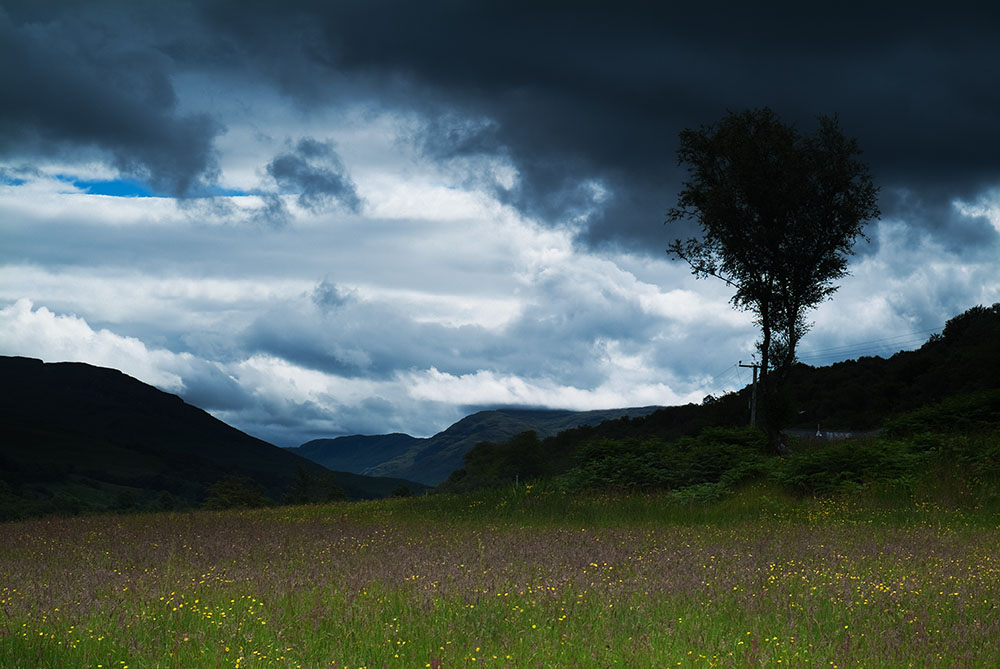
Off to Scotland, to do some cycling and camping and also have my arms
bitten off by midges. Have you ever seen
Monty Python and the Holy Grail?
It was mostly shot in and around Doune Castle in Central Scotland, but a couple
of scenes were filmed at Castle Stalker in the west of the country.

Castle Stalker is privately owned and you can only see it from the
outside. The Monty Python team were restricted to shooting exteriors.
Graham Chapman's King Arthur goes up the steps and knocks on the door, but
he doesn't go inside. Nonetheless I've always wanted to see it, but how?
I don't drive. The nearest train station is Oban, ten miles as the crow
flies to the south, but more like twenty miles once you account for the
twists and turns of the coastline. That's too far to walk. I could take a
taxi, but that seems wrong. Besides, do I want to spend five hours on the
train to Glasgow, then another three on a train to Oban, just to take a
taxi to look at a castle for a few minutes? No, I do not.
So I filed Castle Stalker away in my filing cabinet of "places in
Britain that are harder and more expensive to visit than Rome, so why
not go to Rome". However last year I bought a
Brompton folding bicycle, and that planted an idea in my mind.
Long-term readers of this blog might wonder why I started writing about
military food a couple of years ago:
Partially it was curiosity, but mostly it was because 2020 was going to be
the year I did some hiking and camping. Proper multi-day hiking. Real
man-vs-nature stuff. I wanted to see if military MREs were any good as
hiking food (they are not; too bulky). So I bought a bunch of
different MREs and tried them out, and I got hold of some camping
equipment, including a
Trangia alcohol stove. I stocked up on compressed toilet paper, dried food, and alcoholic hand
gel, which ironically came in handy a few months later...
... because nature also had plans for 2020. It decided to give us all a
playful kicking, in the process shutting down international air travel.
Before 2020 a complete shutdown of international air travel would have
been the plot of a thriller, but it actually happened in real life. An
extraordinary period that is not yet over.
After the airline refunded my tickets I made a profit of four pounds, on
account of currency fluctuations.
Four pounds! Flush with this cash
I bought a Brompton folding bicycle,
which I took off to Italy
during the brief period at the end of 2020 when it looked as though the
world was getting back to normal. A year later I still have that bicycle,
plus my camping gear, so why not put it to some use? It's too late to fly
on a 747 - they're all gone - and Mongolia is still closed, and Monica
Bellucci will have to look after herself for a while longer, but
Castle Stalker is still there.
As mentioned earlier a main road leads from Oban to the Castle and then
north to Inverness, but it's not ideal for cycling, especially not cycle
touring with lots of luggage. Here's what part of the A828 looks like:
It's not hyper-busy, but it's the only road north of Oban, so there's a
steady stream of cars and trucks, usually in little groups, once every
couple of minutes. Bicycles are explicitly forbidden from some parts of
the road. Could I have risked it, and pulled over when traffic came
along? No, I could not.
But there is hope.
National Cycle Route 78
runs alongside the A828. A few parts run on the road, albeit only on
sections with a 30mph speed restriction, but mostly you can cycle up the
left coast of Scotland without having to share space with lorries. So I
refined my plans. I broke the route into three sections:
Section one runs for about four miles from Oban to a bridge at Connel.
Section two is about eight miles from Connel to another bridge at
Dallachulish / Creagan. Section three is another four miles to Castle
Stalker. My original idea was to continue north to the village of Duror
and then camp out near a bothy in the hills above it, but I decided to
drop that part of the route. Too ambitious, and the section from
Dalnatrat to Duror is one of the few parts that runs along a main road.
Perhaps I will visit Duror another time.
Instead of visiting Duror I devised a plan to cycle up to Dallachulish /
Creagan, find somewhere to camp overnight, then continue to Castle
Stalker the next day, then visit Port Appin to kill time, then return to
my camp and rest overnight, then cycle back to Oban on day three. I
could in theory have done it all in two days, but a train strike forced
me to spend three days on the road. If I had a proper touring bike or I
was very fit (or both) I could in theory have cycled from Connel to
Castle Stalker and back in a single day, but I didn't just want to see
the castle, I wanted to do some camping as well, and if I'm going to
camp for one day, why not two?
One of the many great things about Scotland is that you can, in theory,
camp on non-privately-owned land without a permit. It's one of the few
places - along with Mongolia, Greenland, off the top of my head Norway
and Sweden - that permits wild camping. Obviously there are limits, and
even if I was legally in the right it would be a terrible idea to camp
near a road, because there are hooligans all over the world. I am
familiar with the Country Code, the gist of which is that you should
leave no trace.

All gone. I used an ever-handy Ikea Dimpa bag as a small groundsheet.
After setting it up I noticed a red plastic stick stuck in the ground,
just visible in the bottom-left - had someone else used this spot
beforehand?
I'll write about the camping side of things separately. I took along my
Trangia stove, which burns alcohol. You're supposed to use meths, but I used
alcoholic hand gel, which worked just as well. I want to stress that in the
following picture it isn't lit (it's too close to the tent flap):
That red stick again.
The tent is a Six Moons Lunar Solo. I chose a tent over a bivvy bag so that I
had space to store my Brompton if necessary. The Lunar Solo requires six tent
pegs, with fittings for another two if you have them, and in theory it
requires a 49" hiking pole, but I bought a carbon fibre tent pole from eBay
which worked just as well. I suppose I could have used the Brompton's seatpost
as a makeshift pole if there were exceptionally high winds.
Here's a shot of the equipment I took, all packed up:
That's a Brompton B75, a generic backpack, a Brompton Large Metro Bag, and the
Dimpa bag, which went inside the backpack. It was handy in case my Brompton
was covered in mud and I had to bag it up for the train.
Two things worried me. Firstly that the combined weight of the backpack and my
chunky body would cause the seatpost to collapse. In the end this wasn't a
problem - after cycling for an hour the seatpost dropped about an inch, and no
more - but just in case I put all the fluffy, lightweight stuff in the
backpack. That included the tent, the sleeping bag, the sleeping bag liner,
and an inflatable bed.
Do you remember the fad for rubber horse masks from a few years ago? I could
have brought along one of them. It would have been nostalgic, and perhaps it
might have sparked up some conversations, but in the end I left mine at home.
The second thing that worried me was this:
It's the standard Brompton front luggage block. Rated for 10kg, and apparently
very sturdy. Brompton bags have a frame with a plastic slot that slides over
the luggage block. It's a clever design that works well, but how would the
block hold up to sudden knocks, or hours of being pushed over cattle grids and
rutted tracks? Would the block snap? Would the block hold, but gradually come
loose from the bike? Would I have to tie the bag to the frame with some tent
ropes? In the end I left behind a couple of things, including a tripod, to
make sure that the luggage bag weighed as little as possible (about 6kg in the
end).
Thankfully however nothing went wrong. The luggage block feels as solid now as
it did before the trip. Furthermore the rest of the B75 held up. The hinges
are still intact, nothing has rusted, the gears still work, as do the brakes
etc. I have Schwalbe Marathon tyres - not the Plus variety, just ordinary
Marathons - and they're still intact as well, despite pushing the bike up
several gravel tracks.
Google tells me that some people have cycled through China and Tibet on their
Bromptons, so perhaps I'm worrying too much, but let's talk about the trip.
Stage zero involved transporting myself and the Brompton from the south of
England to Glasgow via train, but that was just a load-carrying exercise.
Stage zero point one involved getting the train from Glasgow to Oban. I
arrived at just gone 11:20. Oban is a popular outdoorsy location and lots of
the other passengers had luggage and bikes:
I'm not sure what happens if you try to get on with a bicycle but there's no
space. Luckily my Brompton fits into the standard end-of-carriage luggage
racks and would at a pinch fit in front of a seat.
Stage One
This runs from Oban to the bridge at Connel. I picked up National Cycle Route
78 on Glencruitten Road, which leads east-north-east from Oban:
It winds uphill before splitting into two roads; the eastern road leads to a
C-road that runs north to Connel, through scenic farmland:
This part of the journey isn't much fun. It's a single-track road with
periodic passing places. The section above is relatively flat, but the first
part is very hilly. There's just enough space for a bicycle and off-roader to
pass on the road. I mention off-roaders because although the volume of traffic
was objectively low there was nonetheless a steady trickle of cars, almost
entirely off-roaders, often in little convoys of two or three vehicles in a
clump. Furthermore with all this luggage my Brompton didn't do inclines
at all, so I found myself awkwardly pushing a bike uphill, hoping that
nobody would come over the crest too quickly to dodge.
The irony is that this part of the journey was entirely superfluous. After
reaching the bridge I realised that I could have skipped Oban entirely and got
off the train at Connel Ferry station, which is about a quarter of a mile from
the bridge. I have to say that if you're planning to do this trip yourself,
you don't lose anything by cutting out Oban.
The bridge at Connel
Before going on I took the opportunity to stop off at a village shop in Connel
to get something to drink. This part of the trip was, judging by Google's
distance measuring ruler, five and a bit miles long. It took me around an hour
and three-quarters to reach the bridge, although I could have done it faster
if I hadn't kept stopping to take photographs. Minus luggage, on a proper
touring bike, with stronger leg muscles, I would have been quicker still.
Stage Two
The rest of the trip was a lot easier because it was almost entirely on a flat
cycle path. Once past the bridge I came to a new part of the cycle route that
goes by Oban Airport (EGEO):
Oban Airport is also in Microsoft Flight Simulator 2020. The arrangement is
roughly correct. Just up the coast is a caravan park - there are several
camping stops in the area, but they're all aimed at motor caravaners, not
tent-ers:
Cycle Route 78 then goes through some nice wooded paths that lead to
Benderloch, a mile and a half up the road, which has a shop and a camping
store. At that point you can turn off to visit Tralee Beach, which is mostly
covered in shingles. The biggest problem I found was insects. Scotland is
plagued with midges in the summer months. If spiders ever discover Scotland
they would have a field day, but perhaps the cure would be worse than the
disease. There were benches along the route, but they were swarmed with flies
and midges, so I kept going.
The route eventually turns into a pavement that runs beside the road. I
remember cycling past a man selling oysters, and a small truck stop area that
had a restaurant and a pottery shop. Was it a pottery shop? Yes, according to
Google Maps, it was.
Just past the half-way point you have to cross the road from west to east and
detour around another caravan park:
It took me around two hours to reach this point, although I took time to have
a look at the beach. At that point I had to find somewhere in the vicinity of
Gleann Dubh reservoir to make camp, so I stopped taking photographs because
the reservoir was half-way up a hill:
In the following photo I'm standing roughly at the bottom-right, the
southern edge of the reservoir, looking at the spit of land that sticks
into the water on the right of the picture.
Looking back south-west
I went counter-clockwise around the reservoir. A couple of lads, possibly from
the caravan site at the foot of the hill, were fishing, so in order not to
attract attention I didn't explore the clockwise part of the water's edge. I
have no idea if it's legal to fish in reservoirs in Scotland. I have to say
that the water didn't look particularly appealing. As per the image from
Microsoft Flight Simulator the clockwise part was much less wooded. I will
probably never know if it would have been a better camping spot.
Incidentally my biggest worry throughout the trip was other people.
I know that wild camping is allowed in Scotland, but do the locals
know that? Are they keen on it? I imagined a busybody asking me where I
was going, then threatening to call the police if I didn't buzz off, then
smashing my bike if I refused.
A track led down to the water's edge, but there were already a pair of tents.
A second group of lads were kayaking. I have no idea if they were connected to
the first group. On the positive side I was at least in the right ballpark,
although as it began to rain it dawned on me that I had travelled four hundred
miles across the UK on the off chance that one of the green patches on Google
Maps was the right place to pitch a tent, and that I was now half-way up a
hill with a bunch of neds for company.
However the nearby forests had a couple of patches that looked less boggy than
the others, so as mentioned above I pitched my tent and got settled in. It was
by now seven o'clock in the evening. As mentioned earlier there was a red
plastic stick at the exact spot I pitched my tent. It was obviously
artificial. There were a couple of other signs of human passage:
Satanic signal? Hobo code? Something to do with the Forestry Commission?
Random crap? Who knows.
After spending the night in nature's sweet embrace I decided to risk leaving
the tent standing throughout day two, so after waking at around 06:00 I left
my backpack in the tent and cycled on to Castle Stalker with a few things in
my Brompton bag.
Gleann Dubh at half-seven in the morning.
The kayak people were still about. I encountered a couple of dog-walkers on
the trail early in the morning. It took a surprisingly long time to cover the
three-quarters of a mile from the reservoir back to the road, because it was a
bunch of steep, winding, gravel tracks.
The kayakers left on the third morning - they had built a fire.
Stage Three
Day two. The last stage was easy. The cycle route crosses a bridge at Creagan
/ Dallachulish:
And then becomes a wooded path:
Eventually it crosses the A828. You can in theory turn off west and cycle up
to check out Port Appin at this point, although you would have to cycle up a
steep hill to get there. I decided to go off to Castle Stalker first:
Castle Stalker is also in Microsoft Flight Simulator 2020.
Incidentally I navigated with
OSMAnd on my mobile phone.
OSMAnd is the only open source project I have ever donated money to, because
it's the only one that has been genuinely useful. It showed me that there was
a bridge leading from the vicinity of the castle to Port Appin. The Jubilee
Bridge.
The road to Port Appin was similar to the road in stage one of my journey, but
easier, because there were fewer trucks:
I arrived at around 10:00, which was handy because the local Co-Op opened at
that time. I chowed down on some chocolate and fizzy pop. Port Appin itself is
a jetty with a couple of restaurants and a nice view of a distant lighthouse.
I was tempted to stop for breakfast, but my trousers were covered in mud, I
had nowhere to put my bike, and I probably smelled strongly of deodorant. I've
seen lots of films in which the locals spurn the out-of-town drifter so I
decided not to risk it. Port Appin struck me was a nice place to stay if you
wanted to get some writing done.
And that was essentially that. I retraced my path back over the bridge and
cycled back to my tent. Almost immediately I realised that I hadn't taken an
Instagram-friendly shot of my Brompton with Castle Stalker in the background,
but I was in no mood to backtrack. I had a mean sore throat, probably a
combination of cycling with my mouth open and drinking chemically-purified
water. After getting back to the tent I had a meal, read a bit more of my book
- Richard Rhodes' Dark Sun - and got some rest. I can confirm that the
Six Moons Lunar Solo has an effective anti-midge screen.
I was aware that the train left Oban at 12:21, and would arrive at Connel
Ferry a few minutes later. I woke up early enough so that I could in theory
have walked the distance in time - perhaps my Brompton would finally develop a
puncture - but in the end nothing went wrong, so my trip ended with a mixture
of freewheeling and pushing my Brompton back to Connel Ferry in the early
hours of Monday morning while it drizzled.
Suppose you want to do something like this but without the camping? The
obvious answer would be to book a room in Port Appin or the surrounding area
and use that as a base. I would suggest cycling from Connel Ferry to Port
Appin, and if you want to see Oban perhaps you could cycle back to Connel
Ferry and take the train to Oban on your last day there, then take the train
from Oban to Glasgow Queen Street. Connel Ferry doesn't have a ticket
dispenser so you'd either have to book in advance online or ask the ticket
inspector.
From Port Appin you could then pop across the water to Lismore and also
perhaps go north and visit Duror and the hills above it. Your attempts to have
a nice picnic will be frustrated by flies and midges, unless you go in the
colder months, but that's part of the charm of being in the outdoors.
Of course if you don't want to camp or cycle there are, as mentioned, several
motor-caravan camping sites in the local area. I'm not a lawyer, but I
understand you can't just park at the side of the road and sleep in your
motorhome overnight, although this raises the question of whether you could
park the motorhome and then sleep in a tent outside it.
And of course if you're really fit you could do the journey in one day. The
earliest train is 05:20-08:35 Glasgow-Oban, the last train Oban-Glasgow
20:37-23:33, more than enough time to cycle there and back with a long pause
for lunch and some exploration on top of that.
Will I ever go back? Who knows.