Showing posts with label ektachrome. Show all posts

Tuesday, 20 March 2018

Bomarzo, Monster Park II: Kodak Ektachrome

"Rah! I'm a monstah!"

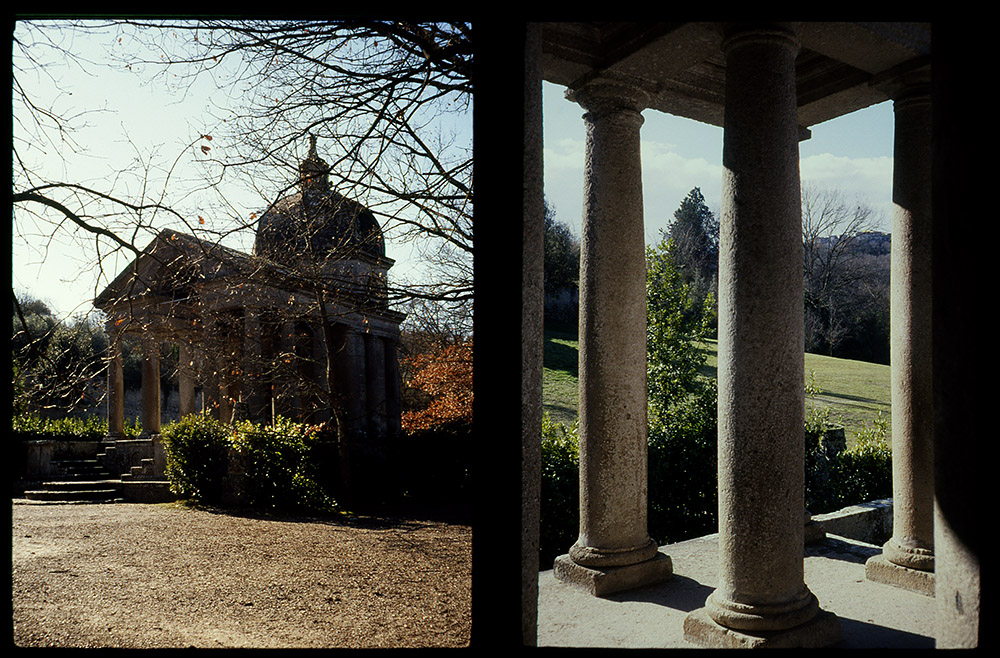
Last month I went off to Bomarzo in Italy to see the Parco dei Mostri, an attractive park dotted with monstrous stone sculptures created in the late 1500s. I took along my Fujica Half half-frame camera and some Kodak Pro Image film, and also some Kodak Ektachrome that expired a long time ago.


Bomarzo is an awkward day trip from Rome but entirely doable by public transport. I have done it myself, and now I can look myself in the mirror and say "I know de way", like Ugandan Knuckles. Do you remember Ugandan Knuckles? All the way back in January 2018 it became fashionable amongst young people to gatecrash a set of virtual communities with an avatar that resembled Sega's popular Knuckles character, but deformed, while delivering quotations from Who Killed Captain Alex?, a low-budget Ugandan action film. Thus Ugandan Knuckles. The fad flourished briefly in the first month of 2018. Two months later I almost feel nostalgic for it.


Uganda has a surprisingly productive albeit underfunded film industry, which seems to have embraced the audience participation elements of Rocky Horror and DJ toasting etcetera. Ugandan film-makers don't have access to much money, so inevitably they major in exploitation films, violent action and horror, and what's wrong with that? I grew up watching violent action and horror films on videotape, especially if they had nudity, such as for example The Howling or Lifeforce, and there's nothing wrong with me.


The mouth has a surprisingly big table inside. I changed film on the table.

Sadly the Ugandan government isn't keen on the other thing and has funded an anti-pornography committee to the tune of half a million dollars, which is probably more money than the total budget of all Ugandan films made in any given year. I learn that the Ugandan government has spent almost ninety thousand dollars importing a pornography detection machine from South Korea, which is ridiculous given that teenage boys will eagerly do the job for free.

As a consequence of this Uganda is badly underrepresented on Pornhub, indeed half of Pornhub's returns for "uganda" are actually Ugandan Knuckles uploads, which aren't even porn. I maintain that it's not government initiatives that bring people of different creeds, colours, and religions together, it is instead pornography and drugs and rock and roll and Counter-Strike and so forth. "We are two of soul".


The mainstream media was convinced that Ugandan Knuckles was bad because it was racist, and so if I do decide to look myself in the mirror and say "I know de way" I will make sure that no-one is watching me. History will look back at a time when Western society decided to ban a cartoon frog and wonder what went wrong.

After visiting Bomarzo, which I have described already and I'm not going to do it again, I returned to Rome, but the light was fading. There are continual rumours that what remains of Kodak is going to reintroduce Ektachrome - the company discontinued its entire slide film range several years ago, leaving Fuji as the world's sole remaining manufacturer of slide film - but I'll believe it when I see it and I won't rejoice all that much. Ektachrome itself was okay, essentially a budget alternative to Kodachrome that was easier to develop. When it was a thing it was often criticised for being a bit flat and pale, and when Fuji inroduced the dense, hypersaturated Velvia in 1990 landscape and advertising photographers switched to that instead. Kodak attempted to compete with "high saturation" versions of Ektachrome but it was too little, too late, and of course it was ultimately for nothing because the problem facing Kodak wasn't weak slide film, the end


Tuesday, 16 May 2017

Olympus XA3


My only hope is that the nightmares will cease when I die. But what if they continue? What if, without the moderating influence of my conscious mind, the nightmares are set free? So I have resolved to reverse the wheel and ram the ship through Cthulhu. I will activate every neuron in my mind, generating a furnace of anti-death so potent that it burns the nightmares out. To this end I'm going to have a look at the Olympus XA3, a compact camera from 1985. In my hands it has looked upon all that the universe has to hold of horror and there is no escape.


For this post I decided to photograph blue things and red things.

I've written about the original Olympus XA before. It was a neat little micro-camera from 1979 with aperture-priority autoexposure and a proper split-image rangefinder housed in a tiny body, with a really good 35mm f/2.8 lens. The XA was sold alongside the budget-priced XA2, which had three-zone focusing and a 35mm f/3.5, and the confusingly-named XA1, which had a fixed-focus 35mm f/4 and a selenium light meter. The XA1 was a bit naff. They were all designed by Yoshihisa Maitani, who devised a string of classic cameras including the Pen F, the OM, the Trip 35 and the original Stylus, among others.

While you're reading this post please listen to OOIOO's "Umo", which came out a while back but didn't we all:


Writing in 1928, H P Lovecraft imagined a future in which the scientific method's piecing together of dissociated knowledge would open up such terrifying vistas of reality, and of our frightful position therein, that we shall either go mad from the revelation or flee from the deadly light into the peace and safety of a new dark age. Imagine that!


All of the XA cameras were manual focus, which was anachronistic by the mid-1980s. Nonetheless they sold well, and Olympus launched a second wave in 1985. The XA3 was essentially an XA2 with DX film encoding and a special quick-loading system; the XA4 was similar but had a 28mm f/2.8 wideangle lens that could focus down to a foot, with a special lanyard that could be used as a measuring aid or makeshift garrote.


London is full of billboards like this, on construction sites, where investment vehicles are constructed for people who won't live there.

Alas the XA3 and XA4 were not enough, and Olympus discontinued the range a year or so later. Olympus' early autofocus compacts didn't have much of an impact, but the Olympus Stylus and particularly the Olympus Stylus Epic of the 1990s were very popular and still have a following today. Over the last decade Olympus has revived many of its old brands to good effect, and it will be interesting to see if they ever dig up the old XA.

Of the lot I haven't tried the XA1, XA4, or original Stylus; their dead bodies told their secrets in dreams to the first men, who formed a cult which had never died. Of the others I prefer the XA, if only because the viewfinder is huge and it has more controls.


I actually shot all these pictures last year, when I went to see Barry Lyndon. I was so busy writing about Barry Lyndon that I completely forgot about the XA3. When I am writing I forget about everything else, including food and sleep.

I don't know if it's the V500 scanner or slide film in general, but Ektachrome has a distinctive glow.

Compared to the XA the Stylus Epic has a slightly better lens - it vignettes much less - and used examples are much newer and less likely to go wrong. Furthermore the XA's soft-touch shutter button is an acquired taste.


The XA3 also has a soft-touch shutter button, but it has a bit of give so it's not too bad. As with the other XAs the shutter is really quiet - long exposures go snick (long pause) snick - but the thumbwheel winder is quite noisy, albeit that you can hide it in a jacket pocket while you advance the film, whereas with the later motorised cameras you have no choice.

My Kodak Ektachrome expired in 2007. Slide film tends to go purple as it ages, but the colours can be corrected with Photoshop. At the top, how it came out of the scanner (with the levels fixed); at the bottom, Photoshop.

Writing about the XA3 is difficult, firstly because it's basically the same as the XA2, secondly because I live on a placid island of ignorance in the midst of black seas of infinity, and it was not meant that I should voyage far.

The combination of 35mm and f/3.5 is more or less perfect, although f/2.8 would have been nicer; nonetheless it's wide enough, narrow enough, fast enough, and it's easy to hold the XA3 steady. Exposures are spot-on. It's compatible with the standard XA flashes, which I will probably never use unless someone invites me to a party, which is unlikely, especially after the last time. It shares with the XA2 a design issue whereby whenever you open the sliding cover the focus lever defaults to the mid-distance instead of the last position you selected. On a physical level the XA3 is slightly but noticeably larger than the XA. It's harder to come by on the used market, as it was only sold for a short period and was overshadowed by the XA2 (cheaper) and the XA4 (wider).

You can't override the DX setting, but if the film doesn't have a DX code there is however a full range of ISO settings (from ISO 25 to ISO 1600). It shares with the XA a +1.5 stop backlight correction setting, which is selected with a little self-timer/battery check/miniature tripod lever on the bottom of the camera, breathe out

Wednesday, 29 March 2017

The Writer


For a few months in the middle of 2005 there was a giant table and chair on Hampstead Heath. It was a sculpture called The Writer by footballer-turned-artist* Giancarlo Neri. It had been exhibited in 2003 in Rome and went on tour to Hampstead Heath in 2005. After that it was sent to Monza, where it remains. Is it the same thing, or a recreation? I can't tell. It has held up surprisingly well.

* NB I don't want to imply that footballers are not artists. They are different artists.


I stumbled on it entirely by chance. It's in the giant park in Monza, but downhill a bit, and unless you go off the main drag you might miss it. Despite living in London I was unaware of the sculpture back in 2005, but then again I was unaware of many things in 2005, not just The Writer. I didn't know what the word sublime meant, for example; I understood that it meant "very good, like trifle for example", but beyond that it was just a word.

I know now that the sublime is something awesomely vast, too huge to comprehend, and that it is better than the beautiful, which is merely pretty.


Depending on the weather, Monza's park is either a lovely picnic spot or a terrific location for a 1970s horror film.

Can art achieve the sublime in a media-saturated age? Is the concept relevant at all? The likes of Close Encounters of the Third Kind and 2001 tried to evoke the sublime - but once the giant spaceships had become boring, what then?

I grew up during the tail end of a postmodern age, during a period which lofty grandiosity was as unfashionable as Newtonian physics. I associate the concept with Caspar Friedrich's Wanderer Above the Sea of Clouds. But it wasn't really postmodernism that killed off the sublime. At the end of The Wizard of Oz we learn that the great wizard is just an old man pulling levers, but even before then science had done much to dispel the fog. A part of the sublime died when someone discovered that you can make a frog's leg twitch by putting electricity through it.


We experience infinity every time we fall asleep; each and every one of us experiences the sublime when we fall unconscious and surrender to the void. For children, everything is sublime, but we grow up, we wake up, and find there is nothing there. As adults we learn that there is nothing. The merely beautiful may not shake the heavens, but it amuses and excites us during the short time we have between birth and death, and what more is there?


The remains of a previous large-scale artwork. Monza seems to be a graveyard for public art.

Monza itself is lovely as always. As a tourist destination it tends to be overshadowed by nearby Milan and Lake Como, and the majority of visitors go to see the racing cars. When I was there the park was getting ready for a visit from The Pope.

The park is the main event - it's huge - but the centre itself is a neat, pedestrianised collection of shops and of course I imagine it is extremely expensive to live there. The train station has the typical collection of people hanging out. There is a McDonalds. For the images in this post I took along a Nikon F-301 film camera, a Vivitar 70-150mm f/3.8, some long-expired Kodak Ektachrome, and some Fuji Superia, all of which I will no doubt write about in great detail at some point. I'm going to write something about Nikon's short-lived AI-S system as well.

Also it was a nice day and I developed blisters on my toes. Later on I had a strange dream in which I was having a shower and a European man handed me some soap while a load of elderly Italian people watched me shower, and it dawned on me that I was using up all of the water, but they were happy just to watch me have a shower. Why is that? I will never know.

Friday, 21 October 2016

Pentax Espio 80V

Let's have a look at the Pentax Espio 80V.

There are spirits in the sea, and every ocean has a soul. We sense it in our sleep. I have never seen the Arctic Ocean, but its distant chill haunts my dreams. A few months ago I wrote about Cerro Torre, in the Andes. A spike of rock that stabs two miles into the sky. If God tripped he would impale himself on it, and then there would be no God.

Some mountains scare men; others excite them; a few terrify. Cerro Torre's death toll is in the low single figures, not because the mountain is easy, but because it is so hard only the most committed make the attempt.


A while back I had a look at the Olympus Stylus Epic, a terrific compact film camera from the 1990s. The Stylus' fixed 35mm f/2.8 lens was excellent, but in the actual 1990s people wanted zoom lenses instead. What were those zoomy compacts like? A Pentax 80V came to me for nothing so I decided to try it out. It was launched in 2002, which is the 1990s (this is official).

From the sky to the ocean depths. The most challenging dives have also claimed the fewest souls. The deepest stretch of ocean is the Marianas Trench in the Western Pacific. The only corpses down there died long before they hit bottom. Only three men have made the descent, and they all made it back. Not the same but alive. Above them the ocean, and above that an infrastructure, a lifeline of support ships.

Here's the little bastard. It's chunky but the ergonomics are decent. There was also an Espio 80 with a similar specification but a more attractive body and a faster lens. The 80V has a typically useless 1990s-style viewfinder. DX film encoding, motorised everything, active infrared autofocus, no manual overrides. CR123A battery. It leaves the film leader out.

The Marianas Trench is deeper than Mount Everest is tall. The equipment required for human survival at high altitudes is relatively simple. Some mountaineers have trained themselves to tackle Everest's final ascent without oxygen, but at thirty-five thousand feet below sea level no amount of training can acclimatise the human body to the pressure of millions of tonnes of water. Even at shallower depths no man has held his breath for more than twenty-four minutes.

Image-quality-wise the 35-80mm lens is surprisingly good, although f/6.3-12.5 is really slow. As a daylight snapshot camera the 80V is fine, but it has no character, and in 2016 why bother with it? The simple viewfinder and narrow aperture limit your creative options.


Diving is difficult and the sea is deadly, the old grey widowmaker of legend. The vast, featureless expanse confounds navigation, and without cover the elements are pitiless. At great depth rigid diving suits eliminate the problems that arise from compression, but they are clumsy and expensive. A spacesuit only has to keep the pressure of less than one atmosphere in, whereas at a depth of five hundred metres a rigid diving suit must keep the pressure of fifty atmospheres out, while allowing the diver sufficient flexibility to use his limbs.


There's noticeable barrel distortion wide open; the telephoto range is better. 2002, 2003 was the last gasp of film compacts. The unusually wide Pentax 24EW and the Nikon Lite-Touch 70Ws, with a 28-70mm f/5.6-10 lens, were among the best, but they couldn't hold back to the time. The shift to digital also meant a shift to smaller sensors, which allowed for faster lenses. At first the noise and unsubtle sharpening of early digital cameras nullified this advantage, but within a few years digital compacts had overhauled their film ancestors.

Rigid suits are relatively safe, but the operators are forced to use metal pincers or entirely mechanical manipulator systems. No-one has managed to create gloves that will work at great depths. The alternative is to use traditional wetsuits or drysuits, but they require increasingly esoteric mixtures of breathing gasses combined with staged ascents, to allow time for the gasses to diffuse throughout the body.

After enough time at depth the human metabolism begins to resemble fizzy lemonade. Unless the cap is released slowly there is an explosion of bubbles, which can be fatal. Even experienced divers make mistakes, especially given that diving gases under pressure can have a narcotic effect. Astronauts have it easy. Once through the airlock they can remove their spacesuit and carry on with their work. Deep sea divers have to pause at each stage in their transition between atmospheres. The ocean stays with them.


It says "no photo", but I took a photo, because each man is free, each man is a god. Typically with old film compacts the ur-model was the simplest and best and the later zoomy spin-offs were boring. The pinnacle of the Espio range was the Espio Mini, which had a fixed 32mm f/3.5 lens - slightly wider and slightly slower than the Stylus Epic's 35mm f/2.8, but still miles better than a zoom, especially in the right hands.

Even after reaching the surface deep-sea divers must wait for several hours until they can consider another dive. Furthermore the need for a staged ascent introduces a new set of risks. If the diver has miscalculated his gas reserves or if a medical emergency compels a rapid ascent, his only hope is a decompression chamber.

But even that solution can be fraught. During the Piper Alpha fire of 1988 the rig's divers were lucky to exit the chamber before the fire destroyed their oxygen supply. If the timing had been wrong they would have had a choice between two equally nasty deaths, and the memorably grisly Byford Dolphin decompression incident of 1983 - during which one unfortunate diver was almost entirely degloved - is the stuff of internet legend.

This post was brought to you by Kodak Ektachrome 100; nine-year-old Kodak Ektachrome that expired in 2007. Ektachrome, and far too many semicolons.

We live in a narrow band of warmth and light. Outside our comfort zone we die. The whales gaze as our corpses fall. We came from the sea, inherited the Earth from the dinosaurs, and perhaps one day the sky will be ours.