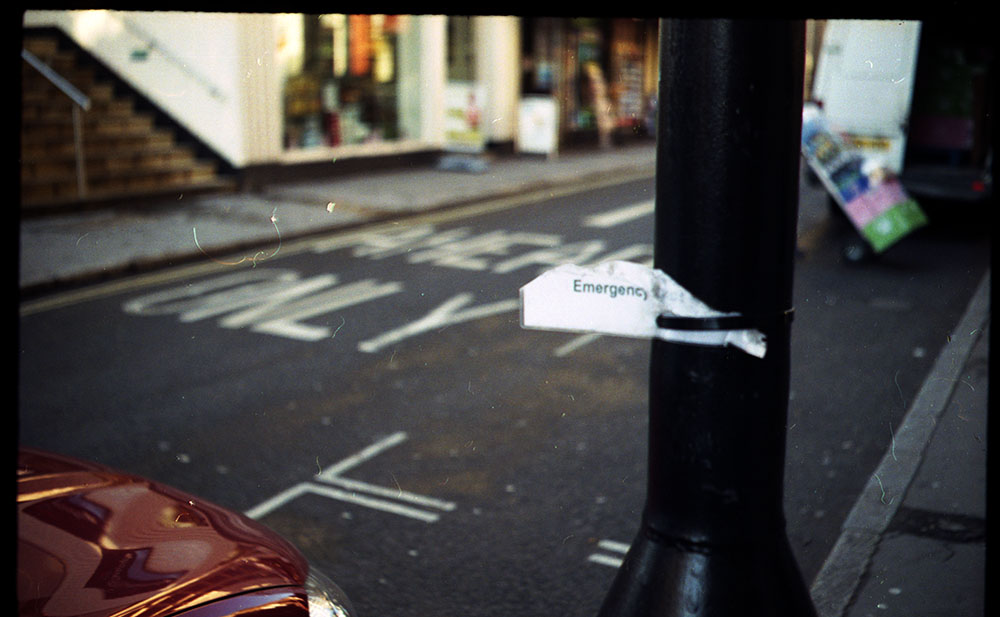
Halina Panorama / Ilford HP5
The Whole World's Watching
It's not just your luncheon meat that has plastic lightboard mojangles. By knife and devil ship, the dusky infrared - the minotaur tests his alligator strap and sequence-hand relief mercy relief. Hail the nocturnal plutocrat for he say forbidness no entry and under the stars there is cigarette laughter and ruin, but not so fascinating bunny sailor. I've always wondered if it was possible to evoke a sensation or tell a story with a seemingly random splatter of words; James Joyce tried something similar with Finnegan's Wake, "a frightening beast out of legend", which took years to write because he selected only the finest random words and arranged them on the page as if he was channeling assembly language of the mind.
"Now let the centuple celves of my egourge as Micholas de Cusack calls them, of all of whose I in my hereinafter of course by recourse demission me, by the coincidance of their contraries reamalgamerge in that indentity of undiscernibles where the Baxters and the Fleshmans may they cease to bidivil uns and (but at this point though the iron thrust of his cockspurt start might have prepared us we are well-nigh stinkpotthered by the mustardpunge in the tailend) this outandin brown candlestock melt Nolan's into peese!" - From Chastened, The Unexpected Story of My Year Without Sex by Hephzibah Anderson
Obviously it makes sense in context, and times have changed since Joyce wowed the audience with his smarty-pants parlour tricks. Joyce and his generation of writers - he didn't really belong to a scene, but humour me - were airgapped mainframes locked in an underground bunker, very intelligent but isolated in time and space from potential sources of inspiration. From an early age my generation was exposed to a depth and breadth of media that Joyce could not have imagined, and this exposure only increased with widespread adoption of the internet. Joyce died in January 1941, a few months before the broadcast of the very first television commercial. It's fascinating to imagine James Joyce dealing with television. His dense prose often reads like a series of demented advertising jingles, radio catch phrases, the patter of a market trader reading from the devil's autocue. Nappy spattees and flasks of all nations! Clavicures and scampulars, maps, keys and woodpiles of haypennies, and moonled brooches with bloodstaned breeks! All this - and MORE! For the low, low price of just five dollars ninety-five cents!
The internet has accelerated our disconnection with the past, to a point where humanity is only unplugged from the mind of the world during the hours of sleep, and perhaps whilst bathing. Joyce's generation lived standalone lives, but we are always on, you and I. Together and alone with the whole world.


The Halina Panorama is a cheap plastic toy camera from the 1990s. It shoots 35mm film and has a wide angle lens; the lens box has a plastic mask that crops the frame to 3:1, roughly the same as the APS "panorama" setting. Mock-panoramic cameras were a 1990s fad that came and went at breakneck speed.
We can forget the past. It was little and broken. No good. But Joyce's words still have power. Not just his words but sometimes sentences too, whole paragraphs. I deal with Finnegan's Wake as if I was scanning an assembly language listing or searching for patterns in the clouds. Individual details bloom forth but the garden as a whole awaits the spring, and perhaps my mental vision of the book is entirely my own creation, and I would have the same... and perhaps I would, even if it were written in a foreign language. Imagine reading a novel from the early 20th century by a German author, in German, without knowing anything of the German language but something of Germany and German culture. The smell of the paper, the font, the format of the book, your knowledge of Germany's past and future history would still generate an emotional response, visions of coffee shops and kunstkammer and tall women wearing tight, tight leather trousers although that might just be me.


The Barbican is THE cliché of urban street photography. It has an air of danger without being particularly dangerous, and it's not hard to get to.
I mentioned airgaps. It's a concept from computer network security. If you want to ensure that network-borne viruses can't reach a computer, the most effective countermeasure is to remove or disable the computer's network hardware and physically separate it from other machines. There is an implication that the machine is physically isolated from the network rather than simply disconnected, although it might nonetheless share a room with networked machines; and for airgapping to be effective the physical inputs and outputs have to be monitored. Computer viruses can spread even without networking. In the 1980s some viruses were written in such a way that they hopped from floppy disks into the computer's memory, where they waited for another floppy disk to be inserted. For airgapping to work, the machine's physical isolation has to be enforced.


The most obvious way to circumvent an air gap is to break into the computer lab, shoot everybody inside, and physically steal the computer. The problem with this approach is that it alerts the target that their data has been stolen. The next-most-obvious way of stealing data is to install some kind of hardware data collection device, perhaps a keylogger or a flash drive that siphons information from the hard drive; but again this risks detection, besides which it feels inelegant. Imagine if you could transmit data through the air, without using wireless networking, to a computer you have set up in an adjoining room. Perhaps by using sound.
Not the bleeps and screeches of Commodore 64 loading tapes, but more subtly, by varying the RPM of the cooling fans just a tad. It would be a very slow way of communicating, prone to interference, and of course you would have to balance the elegance of the hack against the increased risk that comes from a longer timescale, but you would be the talk of the town if it worked. Or imagine pulsing the hard drive access light, or modulating the fan in such a way that remote machines felt the vibration through the floor. Computer chips make high-pitched whines when subjected to some loads, and if the machines are within earshot it might be possible to communicate ultrasonically, or by briefly loading the CPU so that the temperature spikes. Most methods require that the thief has access to the machines at least once and intimate knowledge of the physical setup of the server room, but life finds a way.
I mention airgapping because that is how people from the distant past lived their lives. In the pre-Facebook period - thousands of years of human history, now superfluous - people were airgapped from each other, trapped in their bodies. Some of them found ways to communicate with the outside world, and perhaps because the effort was so hard their communication was sincere, passionate, and concise. Perhaps writers from the past were driven by the difficulty of mass communication to raise their game, and perhaps the trivial ease of modern-day mass media has replaced precious handcraft with mass-produced factory product, a world in which communication is a commodity, but the same is true of all human endeavour. We multiplied and levelled down; we rely on our machines to keep us up, and if the machines break we will flop to the ground and die. We will fight wars to feed the machines, we can't go back.


The Moon's Cosmic Ray Shadow
The Earth is constantly bombarded from space by radioactive particles. We call them "cosmic rays", but in reality they aren't rays; they're individual particles, generated by high-energy events far off in the universe. They whizz through space until they hit our atmosphere, at which point they burst into a shower of secondary particles, like little mesonic MIRVs.
But some of these cosmic rays are blocked by the moon, and from the point of view of a suitable detector located on the Earth's surface the sky is a sea of radiation with a dark shadow moving across it. The sun also casts a cosmic ray shadow of its own, but its magnetic field is treacherous; when the sun is at its most energetic its magnetic corona becomes a giant lens, focusing cosmic radiation towards the Earth, by a mechanism not yet fully understood.
The universe is hostile to life. The vast scale of its hostility is such that a split-second of the energy unleashed by a quasar at close range would obliterate the Earth so thoroughly it would no longer be a physical object, it would instantly become an electromagnetic wave. Perhaps, long ago, the cosmic rays that strike our atmosphere were planets out in space, civilisations wiser than ours, destroyed by cataclysms many billions of years ago. The stars are spread thinly through the universe, but they communicate, they touch us.


We Grow Through Rock
Primitive man thought only of himself; hunter-gathers became aware of the tribe, and as human society has become more sophisticated humans became aware of the village, the town, the region, the nation state. We are currently in the process of uniting continents, and eventually the whole world will be one, and beyond that we will no longer differentiate between human beings, animals, and conscious machines. The Earth will be a united planet of life.
In the 20th century top British physicist and thinker Freeman Dyson posited the idea of a gigantic sphere that enclosed a star, in such a way that it soaked up all of that star's energy. Dyson's sphere was essentially a gigantic solar panel designed so that none of the star's output was lost to space, the idea being that people would live on the inside surface of the sphere, with opaque surfaces held aloft so as to produce localised darkness or maybe they would wear blindfolds.


It struck Dyson that the Dyson Sphere would be something of a final stop in a civilisation's attempts to harness the energy of their home star, and so the universe, many billions of years old, should have at least some Dyson Spheres as evidence of alien life, but it would be very hard to detect them. The Dyson Sphere would radiate waste energy as low-level heat, but would otherwise appear dark from the outside, like a strip club or an illegal rave in a soundproof basement.
There's a hoary old sci-fi cliche that stars are actually conscious beings, communicating with each other via the interstellar internet, using frequencies we cannot detect - or that they are communications relays transmitting information from a third party by modulating their output. If this was the case it might be possible for us to decode the language of stars, but there is an obvious problem. Stars live for billions of years and the universe operates on a timescale of trillions, quadrillions of years, in which case transmissions from the stars might be at such a slow rate that we would need to monitor them for a transhuman timescale before gathering just a few bits of information. It might take millions of years before we had enough information to decipher the code, assuming we were recording the correct frequencies; and what if our chunk of interstellar communication was simply network overhead, a "please wait" message? And what would stars talk about, anyway? Perhaps they moan about interstellar dust clouds. Perhaps they wax nostalgic for a bygone time when younger stars were more respectful of their elders.
Astronomers study phenomena far larger and longer-lived than human beings or even humanity; they are conscious of the finite lifespan of the sun, the finite lifespan of all suns. Our galaxy has billions upon billions of stars, but they are very far apart and all are doomed to die. A percentage of stars have planetary systems; a percentage of those planets have the conditions necessary to support life.
My hunch is that almost of the life-supporting planets are in fact inhabited. Most environments on Earth, from the frozen poles to the depths of the ocean, to the deserts and plains and mountains and even the air itself, they all have life. Life is an irresistible force. We, the living, are irrepressible. We grow through rock, we cut down mountains, we eat metal. From microscopic bugs to human beings and that which will surpass us, we are irrepressible. I believe that the universe teems with life.


But we, the great universal We, are airgapped. Space-gapped, vacuum-gapped. The melancholy of the astronomer is shared with the melancholy of the... is there a word for the study of the internet? Not the study of network protocols, but the study of the internet's people, their ways and wants.
The internet is not yet so ingrained in human culture that its study would simply be sociology. There is still a gap between people who use travel agents and people who use Booking.com; digital visions of the 1990s surmised that the internet would remain a technically challenging albeit glamorous ghetto for autistic computer hackers, whereas in reality it has split society much further down the intellectual spectrum. At the very least the internet requires active participation - you have to go to Booking.com, you have to know about Booking.com, you can't just let it wash over you - but so many of Britain's people are incapable of even that. The television-watchers, the couch potatoes, the non-cyclists, the over-forties; as a I contemplate their unthinking, uncomprehending eyes, I wonder if it would be best to simply put them out of their misery, and how this could be achieved in the most efficient way.
The internet has sped things up and smoothed things out, made things easier and opened things up. I book my flights with a website, my hotel with a website, I check in with an app and take pictures with a digital camera and share them with the internet, but then again apps and digital cameras are really parallel evolutions, internet plug-ins brought about not so much by the development of the internet but by the development of efficient battery technology and affordable imaging sensors. Again, the internet has grafted itself on to these technologies and extended them, but is there such a thing as "internet photography" or "internet music"?
The amorphousness of the internet adds a layer of ambiguity to the debate. Digital cyber-sociologists generally pooh-pooh humble old-fashioned email, for example, but it enabled some of the earliest computerised collaborations - and isn't ultra-hip Reddit essentially just an ultra-old-fashioned message board?

The Halina Panorama has one aperture and one shutter speed - I'm guessing f/8 and f/60 but I could be completely wrong. It relies on the latitude of print film.
The likes of Reddit and Facebook and, in the past, Usenet and message boards produce an illusion of community; Pinterest and Instagram and the like feel like buzzing, thriving hives of activity on the surface, but the individual members are spread thinly across the world, clustered in the United States, and there are Reddits of Korea and Japan and so forth that are language-gapped from our internet. There comes a time when the average Imgur user has to go to work and interact with people in the real world, where the likes of nice-but-dappy snow wolf Moon Moon and the "feels bad" frog are completely unknown. Over time the disconnection will fade away but I suspect the novelty will fade away as well, until no-one thinks of the internet, and we are briefly one until something else comes along to separate us. But what? What if the internet is the thing that brings us together, at last, with our shared love of pornography (men) and kitten pictures (women)?
On another level the internet is an archive of our passing. A living network of radiated particles, spreading outwards from millions of explosions, ripples that spread over the water, breaking on the shore, shifting the pebbles, reshaping the coast. Tectonic forces drive the land seawards, like an army advancing from its trench; the sea cuts it down, and when the battle is over the geo-thermal earthquake hunters of space decipher the black boxes and the black body radiation, and perhaps more distant observers have a faint impression of the traces that were missed, that slipped between the gaps and will faintly illuminate another world a million light years away in a million years' time.