Showing posts with label moto g. Show all posts

Sunday, 30 October 2016

Mobile Phone Photography: A Couple of Tricks

Genoa, shot with a Moto G

You may find yourself in a museum, and you may find yourself in a public space, and you may find yourself in a restricted area where you cannot take a proper camera, and you may ask yourself "what is a proper camera anyway?", and you may ask yourself "how can I make do with what I have?", like everybody else in this sweet cesspool, because making your way in this world today takes everything you've got.

I've said it before, but the likes of Henri Cartier-Bresson and Eugene Smith and Robert Capa would have killed to have a smartphone. Back in the Time of Giants they travelled the world with cute rangefinder cameras not because the cameras were cool, but because they made sense at the time. Contax and Leica rangefinders were a lot smaller than Speed Graphic press cameras, and they could take several shots in rapid succession. The giants of the past would have killed for a portable camera that could upload images to a press agency instantly; that could shoot video and record sound. They would not have grumbled about smartphones, they would have snapped them up, packed their bags, and gone out to take pictures of people dying in dramatic ways.

But mobile phone cameras have a couple of limitations. I'm not fussed about resolution; fixed focal length is something you have to deal with on the spot; having to use an LCD screen is a mixed bag. My biggest bugbear is dynamic range. Mobile phone cameras have narrow dynamic range. You can either shoot for the shadows and blow out the sky, or shoot for the sky and have an extremely noisy landscape. Narrow dynamic range is the difference between the following two images (straight from the camera at the top, with numerous tweaks at the bottom):
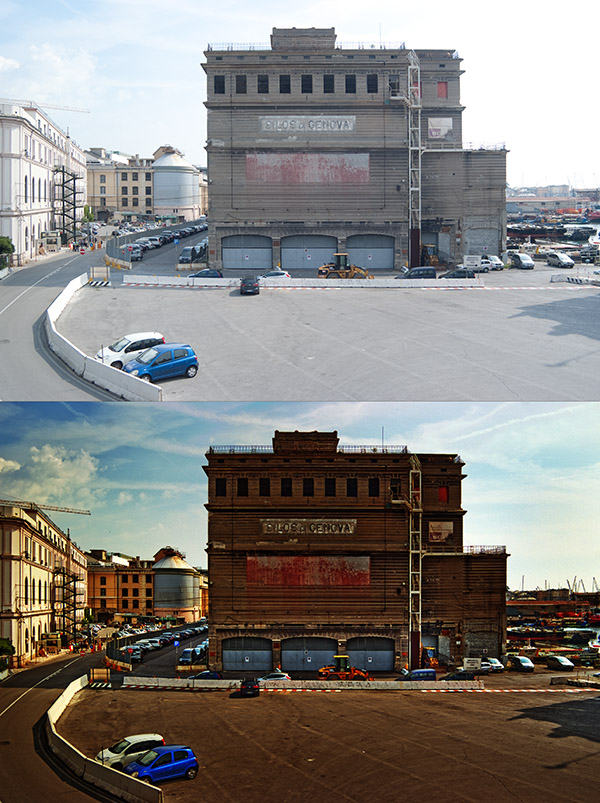

That was shot with a Fuji S5, a digital SLR with an unusually dynamic sensor. Mobile phones generally expose for the subject, so the sky tends to blow out, and there's little you can do to bring it back. But I have a few really simple tricks.

Trick One
Over the last few years I've shot a lot of film. Slide film has the same smooth colours and limited dynamic range as digital, but even when it blows out detail it still tends to retain a hint of colour. Consider the following, which is overexposed Provia 100, cross-processed:


Here's a crop of the top-left:


Even though the sky is basically blown-out, there are still some faint traces of colour. In this crop I've darkened the image so that you can see the grain. Or consider this, with the original scan at the top and the Photoshop remaster at the bottom, which looks ludicrously yellow in comparison, but natural in isolation (the sun was setting):


The detail in the church's frontage has been obliterated, but there was still some colour left, and with a bit of work the second example is the end result. It's terrifically simple to recreate this with Photoshop or any graphics package that has layers, masks, and graduated fills. The technique is simple. I feel ashamed. Those are two separate thoughts.

Consider the following, in which the sky has blown out:


Simply turning down the brightness doesn't make the sky better, in fact it makes it worse. The sky is clipped in the same way that Iggy Pop's remaster of Raw Power is clipped, e.g. the top end isn't just fuzzy, it has been shaved off. It has gone, so we must replace it.

Pop open the image in Photoshop. Layer - New Layer, and then just fill the layer with orange, and add a Reveal All mask:


This has the effect of adding an orange wash over everything. Now use the graduated fill tool on the Reveal All mask thusly, and finally turn down the Opacity to about 23% or so:


The end result doesn't restore the sky, instead it replaces it with an orange wash which is a lot more attractive. This kind of effect is incredibly simple, but it works. I suppose it's reminiscent of the old Hollywood trick of preflashing, but instead of lifting the shadows it tames the highlights. Here's a shot from the film Skyfall, in which Moneypenny shoots James Bond and then Adele starts singing:


At the top is how it appears in the film, and at the bottom is how I imagine it probably looked in real life. The film was shot digitally, and perhaps because of that the sky has blown out, so in post-production instead of matting in some clouds they instead chose to tint the frame brown. Once you notice this you start to see it on television shows a lot. Old-fashioned analogue video had the same problem.

In days of yore the cinematographer might have used a graduated neutral density filter, as in this shot from Barry Lyndon, which looks a bit naff as a still but works perfectly well in the film (both times it appears, it is very quick):


But graduated filters only work when the camera is static, and what if the sky had been overcast? A graduated filter would have just made it darker, without bringing out any more detail. In any case, which is most important: a neat-looking sky, or Moneypenny shooting James Bond?

Trick Two
The answer is of course "Moneypenny shooting James Bond". Check this out:


Again the sun confounds me. Here's a closer look:


On the horizon the chimneys of Mestre, the industrial heart of Venice. Far in the distance, about thirty miles away, the Euganean Hills on the other side of Padua. It's a beautiful world, isn't it? We see it once and then never again.

How to tame the sun? As before, it's easy. Layer - Layer via copy. Apply a massive amount of Gaussian blur, so that the image is completely blurred out. Then add a Layer Mask, but this time use a Hide All layer, and then use a circular graduated fill around the sun. In the following image I've been really sloppy with the mask, which looks unnatural in a bad way, as if the sun was floating on top of the picture:


In the following image I've toned down the Opacity and worked a bit on the mask, and tweaked the brightness and contrast so that it looked more like the image in my mind:


There's a spot of green lens flare that I've left in. All of these images were shot with a Motorola Moto G (Mark II), a solid Android smartphone with a decent camera that has a good-but-erratic HDR mode. The HDR mode won't help with blown-out highlights, though - it seems to lift the shadows instead.

The above trick works in the following case:


The phone captured all the details but the scene is too bright, as if it was shot earlier in the day. On the right, darkening the sky makes it look terrible. If we add a new layer and blur it, the posterised highlights are gone, but of course the image is blurry:
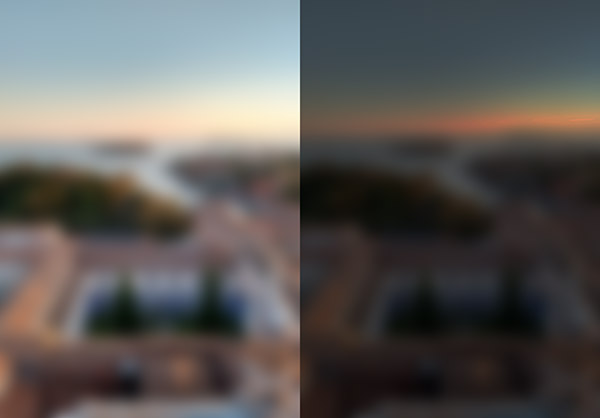

Saint Giorgio Maggiore looks like an angry gargoyle with two sharp teeth. Do you remember They Live, where Rowdy Roddy Piper puts on a pair of sunglasses and sees the world as it really is? If we could see the universe as it really is it would rock our faith, because even atheists have faith that the human animal possesses something special that separates it from other animals; that our brains are not just pattern-matching devices created by a process of trial and error, but instead vehicles for a soul. Thankfully our tiny minds cannot grasp the infinite.

If we use a graduated mask on the sky, we get this, which admittedly wouldn't work if there were clouds:


In this example the result is a little over-the-top, and the islands are a little blurred as well. And of course there's an artificiality to it, because there's a clean break between the sky and the water. If this was a shot of New York city, with skyscrapers jutting into the air, you would need to do a lot more work on the mask. Eventually your face would grow to fill the mask, and then you are the demons.

Mobile phone photography is a conundrum. As mentioned up the page it's fantastic; if you're the kind of person that moans about smartphones and instagram etc, I don't want to know you. A hundred years ago you would have moaned about this new fangled 35mm nonsense, and a few decades before you would have moaned about photography itself - it's not creative, after all, a photographer is no better than a surveyor. History will flow over you like a river, it will gouge you. The water itself is just a tool of gravity. Gravity uses water to slice through rock; it seduces water and holds it fast in giant pools. But gravity is not a thing, it is instead a result of mass warping spacetime. Mass is the villain here, not gravity.

But, yes, there's a technological conundrum. In terms of dynamic range and light sensitivity mobile phones will always lag behind dedicated cameras, because the sensors are of necessity smaller; and any advances that improve mobile phone sensors would also improve camera sensors as well, so the gulf would be just as wide. There's no way to enlarge a mobile phone sensor without enlarging the optics, short of a revolution in optical design, and with huge optics a mobile phone is no longer a mobile phone, it is a talking camera. There seems to be no way to square the circle, but what if we take a lateral step sideways?

I've said it before, but I believe that in future people won't take photographs. They will instead trawl the internet for other photographs, or they will trawl Google Maps, and they will mash them up, repost them, edit them. The big star imagemakers of the future will be akin to the DJs of today, they will curate and collate, remix and repost. CGI has already conquered the Ikea catalogue, and has made inroads in the fields of pornography and landscape art; I predict that by the year 2020 H G Wells' vision of the Eloi - a future elite who sit in front of Pornhub all day - will have come true. I plan to be at the forefront of this new race. Photography will pass, just as all mediums pass.

Saturday, 24 October 2015

Motorola Moto G, 2nd Generation: Refrigerator Mother

Hola, Moto

Let's have a look at the Motorola Moto G. Some time ago I owned an Asus Transformer TF101, an Android tablet from 2011. Despite being absolutely ancient it was still very useful in 2014, and I warmed to Android. The Moto G is essentially a miniaturised Android tablet with built-in voice communications functionality; a kind of "smart telephone".

I'm not interested in making phone calls - if human beings were supposed to talk, God would have given us mouths - but as a small Android tablet it impressed me. My review will concentrate on a few practical aspects of the Moto G; for the most part modern smartphones are like cars, they are much the same.

That reminds me of a joke. Why are cars like rainbows? Because they only come out at night.

OpenStreetMap / OsmAnd is one of the few naively idealistic trendy young person open source "free" projects that I have donated money to. It has saved my bacon a couple of times.

The actual place, as above, the Basilica di San Giorgio Maggiore.

I haven't made any phone calls with my Moto G. I dislike phone calls. They remind me too much of a dark period in my life that I would rather forget. Suffice it to say that people's bins are public property, and if Helena Bonham-Carter doesn't want to speak to me that's fine, there's no need to involve the police. Why did I pick a Moto G? I'd like to say that the Moto G picked me, but that's not true. It didn't pick me. It's a mobile phone, not a bloody cat.

I wanted a handheld device that could store airline boarding passes, which rules out anything with Windows Phone, because Windows Phone has a dismal app store with no airline apps, or decent apps of any kind. A small tablet would be fine, and I briefly looked at a iPod Touch, but the screen resolution is too low. I suspect this is deliberate on Apple's part to boost sales of the smaller iPads. There doesn't seem to be an Android equivalent of the iPod Touch - the Samsung Galaxy Player was discontinued a long time ago - and it struck me that telephony might come in handy if I fall into a ravine and need to summon help. A telephone then.

It's a lot cheaper if you book in advance. The Italian train network makes me wonder what is wrong with Britain that it should cost half a day's wages to travel for ninety minutes on the train.

I didn't want to spend a fortune because telephones are a terrible investment. Preferably it should have a full-sized SIM slot because my SIM card is ancient, although in the end I abandoned this idea and ordered a new tiny SIM.

Of the iPhones, the 3GS is now very cheap but technically obsolete; the 4S is also cheap but on the verge of obsolescence; the 5 was still (just) current when I made my decision, so Android it is. My impression is that in the future people will look back on the iPhone 4/4S as the high point of the iPhone range, but alas in 2015 it is behind the curve. The iPhone 5C is relatively cheap, but I would rather carry a generic Android phone than an iPhone 5C. A generic Android phone says nothing about me - I could be an airline pilot, a student, a nobody, a top surgeon, a European politician - whereas the 5C broadcasts to the world that I want an iPhone but don't have enough money for one of the good models.

On to Android. It should have the most generic, unfucky implementation of Android allied to the best spec at a good price, resolution-memory-card slot-processor speed-no quirks in that order. I came very close to buying a Google Nexus 4. The Nexus 4 is ancient, but it was top-of-the-range when it was new and the spec is basically the same as a modern good-quality landfill Android cheapy. But they are old, and mobile phones live a hard life. Like Welsh people, they are subject to lots of abuse and even though they may look good on the outside, you can't tell what is broken inside them.

The Moto G then leaped out at me because it's cheap, I've heard of it, Motorola's Android is almost stock, it has a bigger screen with a higher resolution than the Moto E and it is cheaper than the Moto X, which adds very little. There are other phones, but that way madness lies.

In this very narrow context, in PC terms the Moto G has the computer power of a 1.83ghz mid-2000s Pentium M. But with a much better graphics card, in a handheld case that runs for a day or more on battery power without needing a fan.

Although it does have a fan. Me! It's jarring when I jump from the captions into the text. I won't do that again.

The Moto G is very popular because it does nothing wrong and it's very cheap. It has been Motorola's salvation, the phone that made Motorola popular again. Mine is a second-generation model which I bought as part of a clearance sale; there is a plethora of subvariants, and mine is the standard UK model, the XT1072.

The third generation Moto G adds water resistance and some incremental updates at a higher price, the first generation has a half-inch-smaller screen and is only available used. The Gs all have a similar spec, with a 1280x768 screen, 1gb of memory, a Micro SD card slot, GPS wth GLONASS compatibility, sufficient processing and graphics muscle for most things. Everything else is par for the course with a modern Android smart telephone e.g. dual cameras, a headphone socket, software-defined buttons, torch. Some variants have two SIM slots. The top of the range, 16gb mark three model has 2gb of memory.

The view from Sirmione

A similar scene, shot with an Olympus Pen FT using Fuji Velvia, illustrating why you should never leave a graduated neutral density filter at home.

The Moto G has had lots of positive reviews and has widespread grassroots support. Forum dwellers enjoy the low price and the stock Android, but generally have two complaints - the battery is fixed in place and the 2gb model sold out quickly. Android runs fine on 1gb machines, but more memory is always a good thing.

Before I continue, I want to point out that I have no commercial relationship with Motorola. I already roll the nickels, I have no need of Motorola's dimes. I bought my Moto G with my own money. Money I scraped from the hard soil with the bloodied, bandaged fingers of my own two frozen hands. The opinions expressed in this blog post are entirely my own. My last wish is that German unity should remain, and that an understanding between the East and West will come about and bring peace for the world. If God has seen the things I have done, he didn't seem to mind. The world is growing dark.

And cold. I mention GLONASS support because I wanted to see whether I could use a mobile phone as a portable navigator instead of my old Garmin eTrex Legend HCx. Here's my eTrex:


It has seen better days, but haven't we all. I said better days, not good days. It's all relative. As you grow older every day is worse than the last. The HCx was launched in 2008. It runs from a pair of AA batteries - lithiums last ages and weigh almost nothing, so I generally use them - and connects to a computer via USB. It has a MicroSD socket, and it can read OpenStreetMap map files.

The Legend is generally good and would make a lot of sense in adverse environments - in the cockpit of a boat, or in a microlight or something - but the screen is small, the map redraws slowly, and the sticky-out joystick/button tends to catch on things when I put the unit into a pocket, adding spurious waypoints every time it does so. The GPS receiver takes a while to get going but is tenacious when it finally gets a fix.

I took it with me on holiday, but after the first day I ignored it because the Moto G's GPS was just as good, and its screen was much better. Using the same basic OpenStreetMap data I could easily swish the map around Venice and Milan trying to find my way. With the eTrex I would have very slowly chugged along with the joystick. The Moto G uses wifi to increase precision, which feels like cheating but works in an urban environment, and it locked on to the satellites within a few seconds, even indoors.

In Venice it navigated me efficiently from the train station to the cemetery to the Peggy Guggenheim Museum to the ferries and back again with the minimum of fuss. Not once was I confronted with something unexpected; I did not have to interact with the locals or use my wits to survive. My enduring memory of Venice is of looking at OsmAnd+ on my Moto G. The Moto G was more useful to me than parents or the government. It kept me safe, and I developed an emotional attachment to it. I feel scared and alone when I do not have it. In future I will not remember Venice, or being alive, I will instead remember that time I used a Motorola Moto G for the first time.


This is why Apple has such a hold over its fans. Apple Fans develop an emotional attachment to their phone, and emotion overwhelms all other human impulses. It feels strange to have an emotional attachment to an Android phone. Android is generic and meaningless. Falling in love with Android is like falling in love with a metal framework covered in cloth, as in the famous experiment with the monkeys.

But the monkeys did fall in love, and so did I. At night I like to touch it. And plug it in to my laptop, because it recharges with USB. It doesn't come with a mains adapter, you have to plug it into a computer to charge it up. If only there was a way to plug it into my heart. Then it would always be charged, because the power of my heart would give it wings. Mine came with a cable that transferred power but not data; I had to buy a data cable in order to transfer music to the Moto G.

The panoramas look okay small, but up close they're very low-res.

The camera's images benefit from a contrast boost. It generally tries to expose to the right - it doesn't hurt much to dial down the exposure a little bit.

Battery-wise I didn't do any formal tests. In Venice, from roughly eleven in the morning until midnight, it ran OsmAnd+ with GPS plus phone reception and some music, no wifi, and was at forty percent charge by the end of the day. The headphone socket is on the top of the phone, so you can stuff it into your jacket pocket and listen to music. There's an FM radio which uses the headphone lead as an antenna.

Out in the wilderness or during the rain I would take my eTrex. The eTrex is waterproof and could easily survive being dropped on the ground. But can I phone for help with an eTrex? Will it store timetables and other things? What if I fall into a ravine that has no mobile reception but there's a wifi hotspot at the bottom? What if I am kidnapped by a tribe of warrior women who threaten to kill me unless I can make their crops grow, so I use the Moto G to browse Google for crop-growing tips, and then the queen of the warrior women decides to keep me as her personal sex slave? It's unlikely, and I imagine that a tribe of warrior women would have their pick of men, but what if they're underground and they only have access to two men, and the other guy doesn't have a Moto G? I'm sorry pal, but there can be only one.

The camera has an eight megapixel sensor allied to a 28mm-equivalent f/2.0 lens. There's a clever HDR mode that's genuinely effective. I'm not sure whether it boosts the shadows or layers several bracketed shots. Annoyingly you can either control exposure compensation and focus point or have HDR but not both. There is a panorama feature which takes a while to develop its images. They look nice on the phone but are only a megapixel or so, I have no idea why.

Crap photo, but the HDR effect is really good and stands up to close inspection.

Peter Boardman's The Shining Mountain. "bong peg". As an ebook the screen is really too small, but it doesn't pretend to be an ebook so that's okay.

What else? OsmAnd+ is rubbish for car navigation, I just use it as a moving map. It tries, but I can't rely on it. The camera is decent. The 1280x768 screen is bright and clear with the brightness pumped up in daylight, and the blacks are deep enough to merge with the black of the bezel if you look at it straight on. There's a white Moto G, but it looks rubbish because the front camera and light sensor are still black. The screen is too small to read books comfortably. I've always wondered what impact screen size has on the enjoyment of porn. Obviously your brain understands that the images of women on a large monitor are much smaller than an actual life-size woman at the same distance, but does the brain assume that pictures of women are real women at a distance? In which case the brain must assume that a naked woman on a mobile phone screen is very far away and thus unattainable, which might be why porn doesn't work on a mobile phone. The Moto G's vibrator is nowhere near powerful enough to work as an aid to masturbation, besides which the case isn't moisture-resistant.

My Asus Transformer began with Android three point something, was upgraded by Asus to Android four point something, and then I used the popular KatKiss ROMs to it take it to Android four point four something or something. In my experience newer versions of Android were actually faster than the older versions. My Moto G came with Android 5.0.2, which looks a little bit slicker than late-4 Android but otherwise doesn't seem to add very much. Over the last few days it has updated to Android 5.1, although curiously despite going through the motions of this the phone's setup screen still thinks that it's running 5.02. It works, and that's what counts.

Ports-wise, there's a headphone socket on the top, plus a MicroSD socket underneath the back cover, and my standard UK Moto G has one (1) one single individual SIM card slot. There's no easy way to connect the phone to a monitor, and of course no USB ports, which is something the TF101 tablet has over the Moto G. I say this because the Moto G is powerful enough to double as a simple computer. The Moto G will apparently cast to a television via Google's Chromecast dongle.


The touchscreen surprised me. Even in portrait mode with the keyboard squashed into the bottom of the display I could type, at a pinch. As the saying goes, it's impressive enough that a dog can talk, it doesn't matter what it says. Did you know that there was a film called Shootfighter? It was a straight-to-video martial arts film. I used to think the name was stupid, because it was a martial arts film; they didn't fight with guns. There wasn't any shooting. But it turns out that shootfighting is the actual term for a certain type of mixed martial arts fighting, so I have to concede that the producers of Shootfighter were smarter than me. Or at least they knew more about their onions than I did.

And that's the Moto G, it does nothing wrong and I haven't mentioned the body yet. Physically it feels well-made although at this price point it's on the verge of being cheap enough to just chuck away if it breaks. It has a Gorilla Glass screen which attracts smudges but wipes clean easily. Officially none of the internal components are replaceable, but judging by iFixIt a teardown is fiddly but conceptually easy, essentially lots of screws plus carefully separating things. The components, particularly battery and LCD/touchscreen combos, are widely available on eBay. Unless you are given one for twenty pounds or so, it's not economical to buy a broken Moto G and repair it at home. Everythin' in the modern age is disposable, includin' th' phones, the end.