Birds do it, bees do it - even educated fleas do it. Let's do it! Let's have a look at the Olympus 9mm f/8.0 Fisheye Body Cap Lens. It's a novelty lens sold by Olympus for the Micro Four Thirds system. It doubles as a fisheye lens and as a
As a body cap it's so-so, but as a fisheye lens it's surprisingly good, especially given that it costs less than a hundred English pounds. It looks like this:


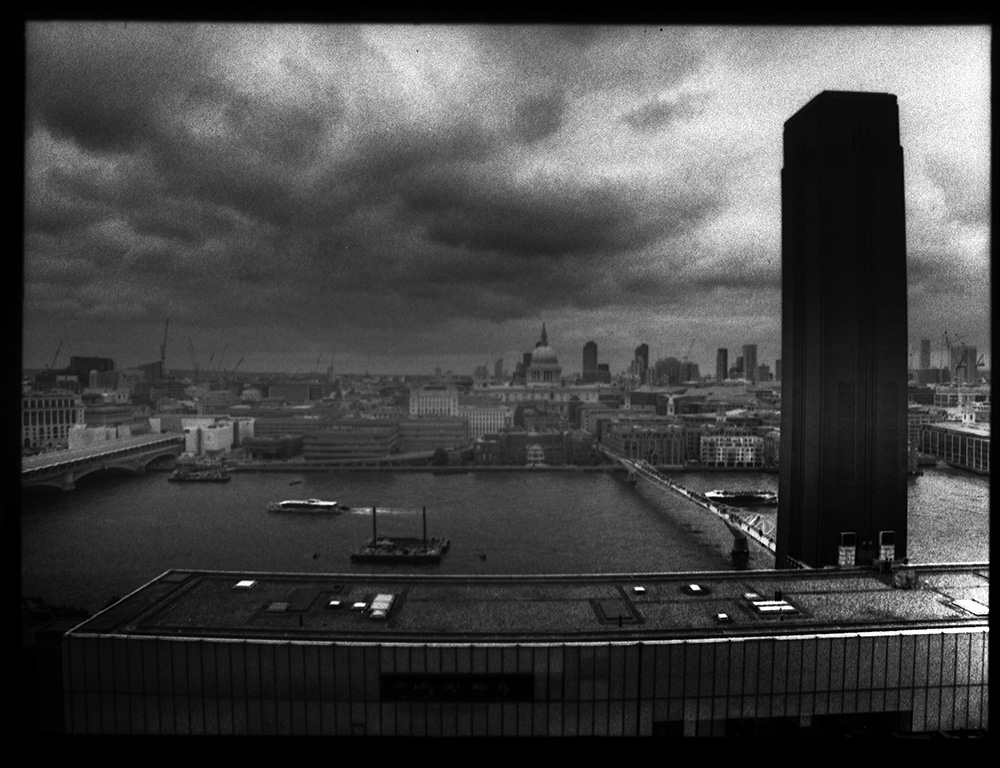
Now, I get no kick from champagne - mere alcohol doesn't thrill me at all - but what I do enjoy is stretching out fisheye images with software. The end result is a very wide field of view albeit with blurry edges. Here are some images taken with a fisheye lens that have been stretched out with software:


Ultrawide images do something to me, something that simply mystifies me. I think it's because I grew up with 3D video games, and I'm used to vanishing point perspective and blocky shapes.
The images above were all shot with a Canon 5D, a heavy full-frame SLR using a full-frame fisheye lens, but what if there was a lighter, smaller option? Such as for example the Olympus 9mm fisheye body cap? What if it existed, which it does?


Some of the ceilings of the Doge's Palace, taken with this lens, using the E-PL1's right-angle viewfinder.
Furthermore I've long been curious about the Micro Four Thirds system, and used examples of the early twelve megapixel bodies have come down in price, so here we are. The Micro Four Thirds system has a limited number of ultrawide lenses, and so the 9mm fisheye body cap can be used as a left-field choice if you want pocket-sized ultrawide coverage in that format.
It has to be said that if you crop off off the outer 20% of the image the fisheye effect is greatly diminished. You end up with something that's still very wide and more than large enough for Instagram. If you use the camera's JPG engine to crop the images square, eliminating the left and right sides entirely, landscapes barely look fisheye at all:


The 9mm fisheye is sold as a novelty. It's not listed in the "lens" section of the company's website, instead it's buried away in the "accessories" section. The optical elements are made out of glass rather than plastic, and the image quality is legitimately, genuinely good - not fuzzy like a Holga. for example. In fact the lens is surprisingly delightful, delicious, delectable, skip a few, de-lovely.


Mechanically it's really simple. The aperture is fixed at f/8 and it only has three focusing positions, of which infinity and the middle position are essentially the same. If you push the focus lever past infinity a sliding cap covers the tiny front element. The overall arrangement reminds me a bit of the old Olympus XA, with its sliding cover and pushy-pully rangefinder lever.
EXIF? No, but given that it's always 9mm and always f/8 that's not a big loss. In-body image stabilisation? Only if you enable it manually, and I didn't bother.


The Teatro Olimpico in Vincenza, which has an early example of forced perspective.
In olden days the idea of composing at f/8 was looked on as something shocking, but with a gain-boosted electronic viewfinder it's relatively simple. With electronic viewfinders you could say that anything goes, although sadly the E-PL1 doesn't have an electronic spirit level.


Cole Porter didn't write any songs about computerised perspective correction, but if he had done so this paragraph would have some lyrics from one of those songs. The pictures below illustrate three options open to the fisheye photographer. The first image hasn't been corrected at all. As you can see it has the bulged look of fisheye images.

In the following image the distortion has been corrected, which cuts off some of the left and right sides but still leaves a very wide field of view.

The final image has been corrected for perspective as well, so that it looks a bit like Doom, but without hellslime or imps etc:

The results aren't pretty up-close, but very few things are pretty up-close.
Shot from a train coming home from Feltre, north-east Italy. The 9mm fisheye would probably be very good for action sports videos - BASE jumping, paragliding and stuff like that.
The four images below demonstrate central sharpness, which is very good. They've been stretched, but not sharpened, and there's no noise reduction. The original files are 12mp. The E-PL1 has a 12mp sensor that was ubiquitous during the early years of Micro Four Thirds.
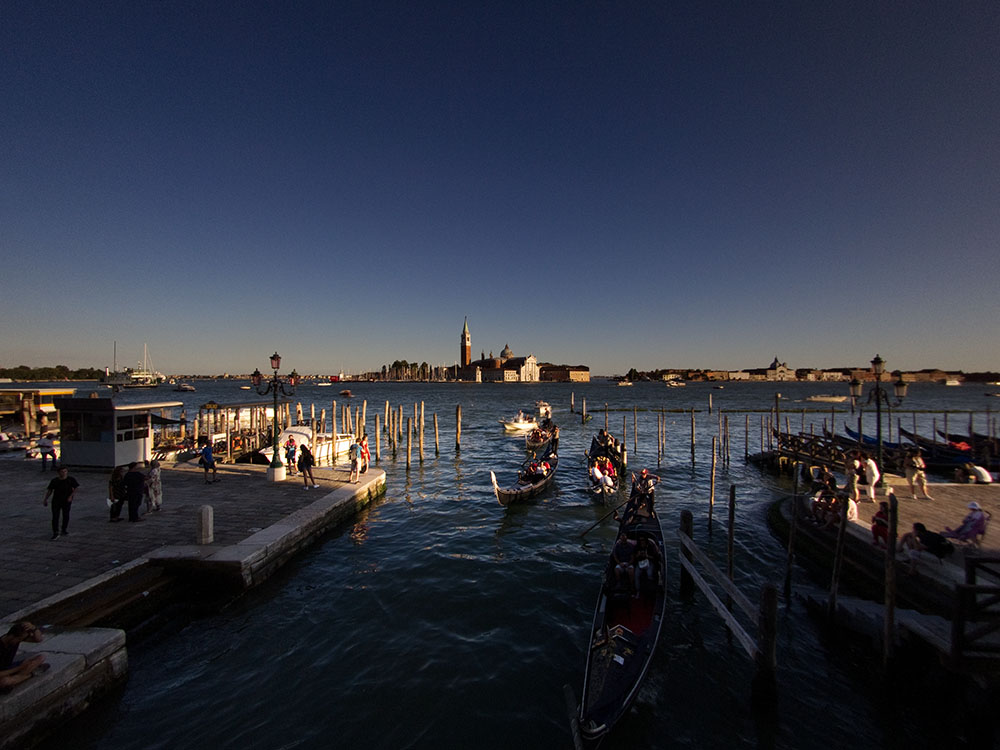


With a bit of sharpening they would really take off. In the middle of the last picture is the MS Sirena, which first set sail in 1999 and allows 800 people to tick Dubrovnik and Venice off their bucket list. In the photograph above it's just about to sail past San Giorgio Maggiore to parts east.
On a complete tangent, if you're at the top of San Giorgio Maggiore's bell tower and a cruise liner sails by, and you're carrying a Canon 300mm f/4 IS, it looks like this:


You and I babe / we'll be riding high, babe / every care is gone / from this moment on
Isn't it great that the liner has a huge television screen? That way the passengers will always have something to look at. But I digress.


How does the Olympus 9mm compare with full-frame fisheye lenses? In terms of wideness it's on a par with a full-frame 15-16mm fisheye, such as the popular Zenitar. As with all the fisheye lenses I have used the big issue is colour fringing at the edges of the image, both purple and multi-coloured. This can be fixed with software, preferably before you stretch out the image (otherwise you stretch out the colour fringing as well and it becomes massive), although purple fringing is harder and involves fiddling with the hue and saturation controls. Beyond that, the only thing full-frame lenses really gain is speed - most of them open up to f/2.8 or so. It's easy to handhold fisheye images and if you're a perfectionist you'll be using a tripod with a spirit level, so speed isn't a huge advantage.
The other big issue with fisheye images is dynamic range. If you're outdoors the image will have a lot of sky, and you can't use graduated filters because fisheye lenses bulge out. You could in theory use filters with the Olympus 9mm, but it doesn't have a filter thread. I imagine it wouldn't be hard to Jerry-build one, although given the tiny front element I surmise that a graduated filter would need a very sharp dividing line. I could be wrong.

This raises the question of whether I could use this lens plus a Micro Four Thirds body as a dedicated fisheye camera, to which the answer is probably yes, although the E-PL1 is behind the curve. It's almost a decade old. ISO 1600 is grainy albeit that colour noise is low, and frustratingly the E-PL1 doesn't have any kind of remote shutter release and only brackets by a stop each way. I'll write more about the E-PL1 at some point.

In summary the 9mm fisheye body cap is surprisingly good. It's a lot better than the conceptually similar 3.2mm fisheye for the Pentax Q system, optically not quite as good as the Samyang 7.5mm f/3.5, but a lot cheaper. And it's a body cap as well! The mind boggles.