Showing posts with label half-frame. Show all posts

Saturday, 15 April 2023

Fujica Half: Turin and Genoa: Socialismo O Barbarie


Or Torino e Genova, if you're using the Italian train network. It's important to remember that. I remember being in Italy several years ago and I was very drunk, so I wanted to go to Turin. I spoke quietly to a figure on the far side of the road wearing a suit. "I want to go to Turin", I said. "I want to go to Turin". I said it quietly because some people find my manner offensive. "I want to go to Turin", I said, but he didn't hear me.

Why do I like Italy so much? The pragmatic answer is that I only go there on holiday, so I'm in a happy mood. And I have an escape route, so whatever problems affect the average Italian do not affect me. And I'm shallow. I only see the surface.


If Italy is so great, why do other countries exist? There must be a catch. Something nightmarish, something sinister beneath its attractive exterior, its good-value trains, its countryside that is beautiful in both the sunshine and the rain, the epic coasts, the museums, and everybody is thin and lovely etc.

It's probably something to do with house prices and economic opportunity. You'd think that a country with such huge tracts of land would have masses of cheap houses, but no. Or rather it does, but they're in mountain towns miles from anywhere. New Zealand and Canada have huge tracts of land as well, and house prices in those countries are famously high, so perhaps the land is full of poison or something.


Many years ago Italians moved en masse - that's French - to the New World to seek their fortune. I know this because I visited Genoa's Maritime Museum, which has an exhibit about Italian migration to the Americas during the 1800s. Nowadays around twenty to thirty million Brazilians - half of them in Sao Paolo - can trace their ancestry back to Italy, which means that Brazilian-Americans actually outnumber North-American-Italians.

Perhaps in another world Martin Scorsese might have been born in Brazil, and nowadays Brazil would have a thriving gangster film industry, although in interviews Scorsese would be at pains to point out that only a minority of his films are gangster films.


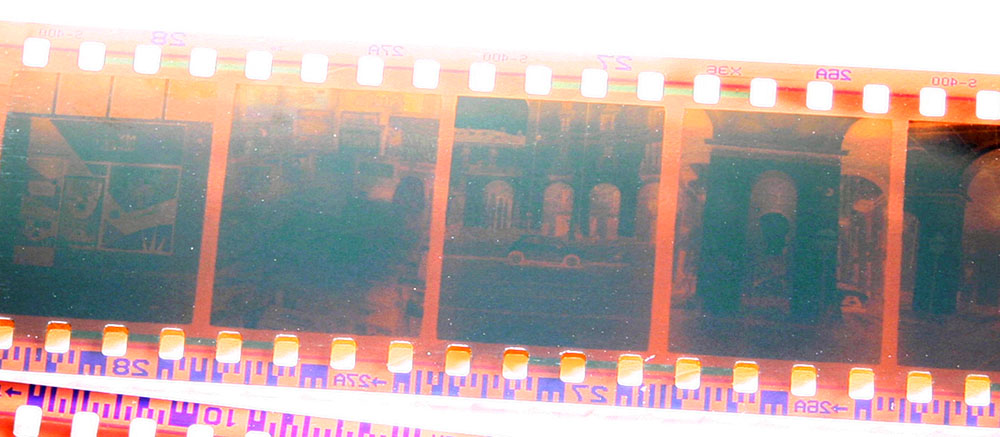
A strip of half-frame film. Look at that dust!

I'm digressing. Ten years ago - ten years! - I bought an old Olympus Pen half-frame camera, and I've been interested in half-frame ever since. Half-frame cameras use ordinary 35mm film, but the frame is half the size and turned on its side. By coincidence it's almost exactly the same size and shape as Super 35mm motion picture film. Standard photolabs have no trouble processing it.


On a practical level half-frame is frugal. That was the sales pitch back in the late 1950s, when Olympus sold the Pen. Despite being popular in Japan and Europe it never took off in the United States. My personal theory is that Kodak was horrified by the idea, firstly because the company's goal was to sell more film, not less, and secondly because half-frame was a relatively open standard.

Instead Kodak came up with 126 and 110 Instamatic, which put a small roll of film in an expensive plastic cartridge of Kodak's own design. As of 2023 Instamatic is dead as a doornail, but half-frame lives on, or at least it will continue to live on until the cameras have all broken and film chemicals are no longer available.


On an artistic level half-frame changes the way I photograph things. Portrait orientation forces me to put a little bit of thought into composition. Instead of just wildly pointing the camera at clouds and people's feet I have to think. The fact that I can make seventy-two exposures per frame encourages me to take lot of pictures, and perhaps use them to tell little visual stories. I'm less precious about what I photograph so there's more of an emphasis on editorial selection than on-the-spot photo judgement.

The use of sequential still images to tell stories is probably as old as art. I wouldn't be surprised if there are cave paintings that depict a figure with a spear, and then a tiger, and then a figure with a spear standing over a dead tiger while a group of other figures cheer.


Or, say, a cave painting where a recent graduate of physics arrives at work and puts on a hazard suit and then goes into a big room and presses a button and then everything explodes and he escapes from the lab but gets put into hibernation by a mysterious businessman and then he awakes and finds himself in the future after the Earth has been taken over by aliens and then he goes on the run and then leads an attack on a notorious prison and then gets trapped in a teleporter and then leads an assault on the alien headquarters and I can't remember what happened in Episode One and then there was a boring bit with alien insects and then a big fight in a forest and then there was a big cliffhanger that was simultaneously resolved and not resolved thirteen years later by a VR spin-off.


Olympus is the company most associated with half-frame. Their range of cameras culminated with the Pen F half-frame SLR system, which put half-frame into a gorgeous little SLR body with a range of interchangeable lenses. I took a Pen-F to Chernobyl a couple of years ago because I could sense the window of opportunity closing. And close it did.

However several other Japanese manufacturers also a go at half-frame, including Canon, Yashica, Petri, and Ricoh, with the Caddy. For the most part the format faded away in the 1970s, but it had a second wind in the late 1980s with the Yashica Samurai half-frame bridge camera. As mentioned earlier it was never popular in the United States and remains alien there.


For the images in this post I carried around my Fujica Half, which I first wrote about back in 2017. It's a simple thing with scale focusing and autoexposure. It has an 28mm f/2.8 lens, roughly the same field of view as a regular 40mm lens. It has manual aperture and shutter control, which is useful because a lot of old point-and-shoot cameras need special batteries that are no longer available.


But the Half also has autoexposure. It uses a solar-powered selenium lightmeter. Surprisingly mine still works. It even seems to be accurate. The shutter and winding mechanism also work, so I salute the technicians who put it together back in the 1960s. I suppose if they were in their twenties they might still be alive today.

I have no idea how much the Half cost back then, but my guess is that it was relatively posh for a point-and-shoot and would have been built to what was at the time a high standard. By technicians who had something to prove, because Japanese industry was at the time trying really hard to establish a reputation for quality.


The autoexposure system can only be set from ISO 12 to ISO 200, but the 400-speed Agfa Superia I used is out of date, so I set it to ISO 100 and left it at that. The results were slightly flat and yellowy, like a panna cotta, which is an Italian dessert from Italy which is where I was.


I'm not a photo snob, and as far as I'm concerned there's nothing inherently magical about film. I'm old enough to remember when film photography was the dominant format, and there was nothing magical about it back then.

My tastes were formed in the 1990s, and back then the fight wasn't between film and digital, it was between technically perfect, automatic-everything film cameras and the occasionally beautiful scuzziness of the Holga. It was between middle-aged men with moustaches photographing sports with a Nikon F5 (on the one hand) and stoned students persuading women to pose naked while they fumbled with the controls of a Seagull TLR in a disused factory (on the other). I naturally sympathised with the latter group of people, because naked women are awesome, but I'm not a format snob.


Which is a long-winded way of saying that I carried my Fujica Half with me not as a pose, but because it's still a practical image-making tool. Compared to my mobile phone I prefer the ergonomics of a viewfinder - of holding the camera to my face and peering through a covered window, rather than holding it at arms' length and trying to deal with glare.

And the shutter response is positive and instant, whereas with a mobile phone there's a tiny bit of lag between the decision and the image. On a technical level negative film captures highlights without blowing them out, and the borders look great, but on the other hand digital sensors have much better low-light performance - colour film never advanced much beyond ISO 800 - and of course the images can be instantly shared with the whole world, so both formats have their advantages.


As mentioned up the page ordinary photolabs will process half-frame 35mm without issue, if you can find a photolab. Here in the UK I used to use a company called Peak Imaging, but they no longer exist. Scanning half-frame is also relatively easy - I use the black border in between the two frames to set the black level, and then process the images as normal - but it's laborious because there are twice as many pictures.

Half-frame has half the resolution of regular 35mm, which isn't necessarily a bad thing. It has the same resolution as motion picture film, so the grain is more apparent, and there's nothing wrong with grain. Life has grain, grain and surface noise.

Tuesday, 13 November 2018

Chernobyl 2: The Explosion


Have you ever heard of the bat and ball puzzle? It's a maths puzzle. Cedric buys a cricket ball for ten pence. Let's imagine that it's the 1950s. You can't buy a cricket ball for ten pence nowadays, but let's imagine it's the 1950s.

He buys a cricket call for ten pence. He buys a bat as well. The bat is one pound more expensive than the ball. How much does he pay in total for the bat and ball?

Pripyat's main square

Instinctively most people would say one pound and ten pence. The ball is ten pence. The bat is a pound more expensive equals a pound. One pound ten pence.

But that's wrong. The bat isn't a pound. It's a pound more than 10p, which is £1.10, and then you add on 10p for the ball equals £1.20. I remember the first time I worked this out in my head. It felt incredible, as if a huge rush of refreshing air had blown into my mind. I felt as if I understood the universe. I was intelligent!

I remember thinking of all the things I could do with my intelligence. The limitless horizons of the universe were within my grasp. The feeling faded, but for a while it was magical. Numbers.

Technically you're not supposed to go into or climb on the buildings - it's unsafe - but the tour operators aren't dummies. This is why I'm not naming the company I picked, because I don't want them to get in trouble. It would take just one dead American tourist to put a bunch of Ukranian tour guides out of work and perhaps even behind bars.

Intelligence is not enough. The ability to solve maths problems is not enough. Neither is writing, or the ability to play guitar. Mastery of tools is just the first step. You still have to beat the metal; write the symphony; use your knowledge of maths to prove once and for all that the gravitational constant is indeed constant. That is where I failed.

But, oh, that magic feeling. It took me an age to understand what went on inside Chernobyl's number four reactor in the early hours of 26 April 1986, and even though I think I understand the technical aspects there are so many things I'll never understand, at least not fully. The culture for example.

As mentioned in the previous post I'm not like most other people on the internet. I'm British, not American, so modern Ukraine isn't as jarring as it might be if I was an upper-middle class Californian. When I think of the Soviet Union I think of Britain in the 1970s, but with secret policemen on every street corner and no David Bowie.


A year after Chernobyl there was another atomic accident, this time in Goiania, Brazil. Some scavengers broke into an abandoned cancer treatment centre and stole part of an abandoned radiotherapy machine. It was a powerful gamma radiation source used to deliver targeted radiotherapy, but they didn't know that. From their point of view it was a piece of scrap with glowing blue pellets inside it. They passed it on to a local scrap metal dealer, who took it home to show his family.

They were fascinated by the supernatural blue glow that came from inside the device. They broke it open and passed the radioactive pellets to their friends, who fell ill. Eventually the authorities realised what was going on and intervened, but four people were given lethal doses of radiation, including the scrapyard owner's six-year-old daughter-in-law. Dozens more were contaminated by radioactive debris that had leaked from the container.

It's easy to mock those people. How could they have been so stupid? But perhaps they didn't think a lethal radiation source would be left behind in a derelict hospital. There was just one guard, who took that night off to visit the cinema. Perhaps they simply didn't know about radiation. I didn't grasp the fact that radiotherapy involves radiation until I was a grown-up. Until then assumed it was something to do with radios, or something.

Every generation has a different past and a different future. We are driven by ghosts on a radar screen, shadows cast by bonfires, unknowable illusions conjured by the inner light of faith. The staff on duty at Chernobyl that night were the product of a system and a culture of which I know nothing. They had different dreams and different fears, they lived in a different world.


They had been asked to run a test. Nuclear reactors need a lot of electricity to keep going. Ordinarily this comes from the reactor itself, but in the event of a malfunction there is a backup generator. The problem was that Chernobyl's backup generator took several minutes to bring online, so the authorities decided to find out if the inertia of the freewheeling reactor turbine could generate power even after the nuclear reaction had been quenched.

The test was scheduled for the daytime, but there was an emergency so it was put off until late at night. I have no idea if the night shift was less well-briefed than the day shift. The issue of individual responsibility for the disaster is still a thorny subject. Twenty-six years earlier, in 1960, there was a huge explosion at the Soviet rocket base in Baikonur. An ICBM fired its upper stage while the rocket was still being fuelled. Almost a hundred people were killed in the fireball.

Among the dead was Marshal Mitrofan Nedelin, their leader. The investigative commission decided to punish no-one because, in the words of General Secretary Leonid Brezhnev, "the guilty have already been punished". Whatever firing squad the authorities had ready for Nedelin was redundant because he was already dead.

If the Chernobyl accident was the result of human error the people responsible for pushing the buttons paid for it with their lives. They died slowly, their insides burned by radiation. Their bodies were buried in metal coffins in order not to contaminate the soil. A handful of Chernobyl's senior staff were sentenced to hard labour, and by the time their sentences were over the Soviet Union no longer existed and they were effectively unemployable. The men who made the system found themselves unemployed  and irrelevant a few years later. The guilty were punished.

The disaster had two immediate technical causes. The first was Xenon poisoning. When Uranium-235 decays it spits out neutrons. Most of the neutrons fly off into the air, but some of them crash into other atoms of Uranium-235, causing them to spit out neutrons too. The end result is a nuclear chain reaction of neutrons smashing into U-235 atoms, which decay and fire out neutrons that smash into U-235 atoms etc. If you compress all this into a tiny ball the result is a nuclear explosion.


The smashed U-235 atoms leave behind little chunks of atomic debris called fission products. One such product is Xenon-135. Most of the fission products have no effect on the nuclear reaction, but Xenon-135 absorbs neutrons and slows the reaction down. Ordinarily the flow of neutrons quickly burns away the Xenon, but if too much builds up inside the reactor rods the neutrons grind to a halt and the power drops. This is Xenon poisoning. Xenon-135 evaporates in a little over nine hours, but the team working on the reactor that night couldn't wait nine hours, they had a deadline.

There's an experiment you can do. Heat a pan of water until it boils, then drop in a piece of ice. In a few seconds the whole pan stops boiling. The cold ice is just enough to push the water below the boiling point, but when the ice melts the pan starts boiling again. Imagine you want to boil away the ice really quickly, so you turn the gas all the way up. That's more or less what happened at Chernobyl.

During the test the technicians at Chernobyl slowly deactivated the reactor, but Xenon-135 started to build up within the fuel rods, which caused the reactor power to decrease much faster than the staff expected. They didn't want to wait for the Xenon to decay naturally, so they withdrew most of the control rods in order to boost the reactor's power and burn off the Xenon. For a while this worked.

Apparently the staff managed to run the test, although history doesn't record if it was successful or not. By the time they finished most of the Xenon had burned away. The control rods were still disengaged, and when the Xenon evaporated the reaction started to go into overdrive because there was nothing left to block the neutrons. One of the technicians hit the emergency scram button, which sent the control rods back down into the reactor, but the results were unexpectedly catastrophic.

The second technical cause of the disaster was the design of the reactor itself. Let's talk about water. Water has several functions in a nuclear reactor. It generates steam that powers the reactor's turbine. It draws heat away from the fuel rods and stops them from melting. It can also be used to raise or lower the power of the reaction by moderating the flow of neutrons.

The Chernobyl reactor is built on the river Pripyat. The reactor is behind me; you're not allowed to take pictures this close from this angle.


The moderating effect of water is slightly counter-intuitive. Water slows down neutrons, and a lot of water will block the neutrons entirely and stop the reaction. Paradoxically a little bit of water actually makes the reaction more powerful, because slow neutrons sustain a reaction better than fast neutrons. Imagine that slow neutrons are big fat blundering chunks of energy smashing their way through the fuel rods whereas fast neutrons are tiny little high-speed bullets that immediately shoot off into the ether.

Nuclear reactors are designed so that the individual fuel rods are subcritical. By themselves they can't sustain a nuclear chain reaction. They don't produce enough neutrons. In order to start a nuclear reaction the rods have to be placed next to each other, at which point the flow of neutrons between the rods is in theory high enough to make the reaction start.

But even then modern reactors are designed so that their array of fuel rods is also slightly subcritical. The nuclear reaction doesn't start until water is added to the reactor. If the water leaks or boils away the nuclear reaction stops because the neutrons are going too fast to sustain a chain reaction.


Modern reactors are not immune to failure. If a water-moderated reactor loses its water the nuclear reaction stops, but there's nothing to stop the fuel rods from overheating and melting. This is what happened at Fukushima. The plant operators at Fukushima shut down the reactor properly, but the loss of cooling water meant that some of the fuel rods melted down, wrecking the interior of the plant and releasing nuclear contamination into the environment. A meltdown is a catastrophe, but it's a slower and more manageable catastrophe than a massive steam explosion.

At Chernobyl the water wasn't supposed to be part of the nuclear reaction. It was used purely for heat transfer, but the designers still had to compensate for its presence. When the control rods were pulled out of the reactor cooling water rushed into the channels, which reduced the reactor power slightly, so the rods were designed with graphite tips. Graphite slows down neutrons and boosts the nuclear reaction, the idea being that as the water rushed into the control rod channels the graphite tips would boost the reaction just enough to stop the power suddenly dropping.


The problem is that during the final stages of the disaster most of the cooling water had boiled into steam, which doesn't absorb neutrons at all. As the control rods pushed down into the reactor their graphite tips boosted the power, counteracting water that was no longer there, and in a split-second there was a massive positive feedback loop. The heat shot up and deformed the rods, jamming them in place, and then the runaway reaction caused the remaining water - thirty thousand gallons of it - to erupt into a violent steam explosion.

The resulting blast threw the concrete lid of the containment vessel to one side, opening the reactor core to the turbine hall. A few seconds later an even more violent explosion blew open the roof of the building and threw chunks of burning graphite and nuclear fuel into the surrounding environment. A raging fire began to send a cloud of radioactive smoke into the environment.

There's some debate about the nature of the second explosion. The prevailing theory is that the intense heat caused the remaining steam to split into oxygen and hydrogen, which exploded because hydrogen is very reactive. It's generally accepted that it couldn't have been a nuclear explosion, because that only happens if the atomic material is compressed at the moment of detonation. No-one was there to witness it, and the plant's instruments were destroyed.

Two of the reactor's staff were killed immediately, buried by debris. For a few weeks the official death toll only included those two people, which was accurate but misleading, because most of the staff on duty that night were given lethal doses of radiation. The dosage was too high for their equipment to measure but they could taste it. For the most part they survived for a few weeks, a few hung on for a couple of months.


As of 2018 the official death toll is 37, including four helicopter crewmembers killed in a crash during the clean-up operation. There are rumours that many of the "liquidators" were worked until near-death, at which point they were shipped off to other parts of the Soviet Union to die out of sight. Furthermore the uncertain effects of chronic radiation sickness has frustrated attempts to come up with a definitive death toll. The World Health Organisation estimates 4,000 excess deaths as a result of the disaster. A study by a member of the International Agency for Research on Cancer estimates 9,000 excess deaths plus over twenty thousand extra cancer cases, not necessarily fatal.

On an economic level I very much doubt that the extra money from disaster tourism will ever compensate for the loss of several towns plus an expensive radar array and a nuclear power complex plus the cost of cleaning up the disaster area. Belarus, just over the border, doesn't even get money from tourists. The Soviet Union initially tried to clean up the area by itself, but after the collapse Chernobyl fell down the list of Russia's economic priorities, and now the zone is managed by international agencies.


On a political level the disaster appalled General Secretary Mikhail Gorbachev, who took a dim view of the old guard's attempt to brush it under the carpet. A few weeks later he gave a televised speech that poured scorn on international alarm at the accident, but his words have none of the reality-distorting chutzpah of vintage Soviet propaganda. If nothing else the lack of transparency made his novel new policy of glasnost look like a hollow sham, which angered him because he really did believe that greater transparency was a good thing.

I can't help but draw parallels with the Challenger disaster of 1986. In both cases the potential safety risks were deliberately overlooked by an organisation keen to maintain a schedule, but in the words of Richard Feynman, Nobel Prize-winning physicist and member of the commission selected to investigate the disaster, "reality must take precedence over public relations, for nature cannot be fooled."

It would be nice to think that Feynman's contributions to the Challenger investigation were lauded and acted upon, but seventeen years later exactly the same culture he damned lost Columbia and its seven crewmembers; in contrast the Russian nuclear industry has not had a major nuclear accident since Chernobyl, so perhaps people can change. If there's one thing I've learned from Rocky IV, it's that people can change.

Tuesday, 20 March 2018

Bomarzo, Monster Park II: Kodak Ektachrome

"Rah! I'm a monstah!"

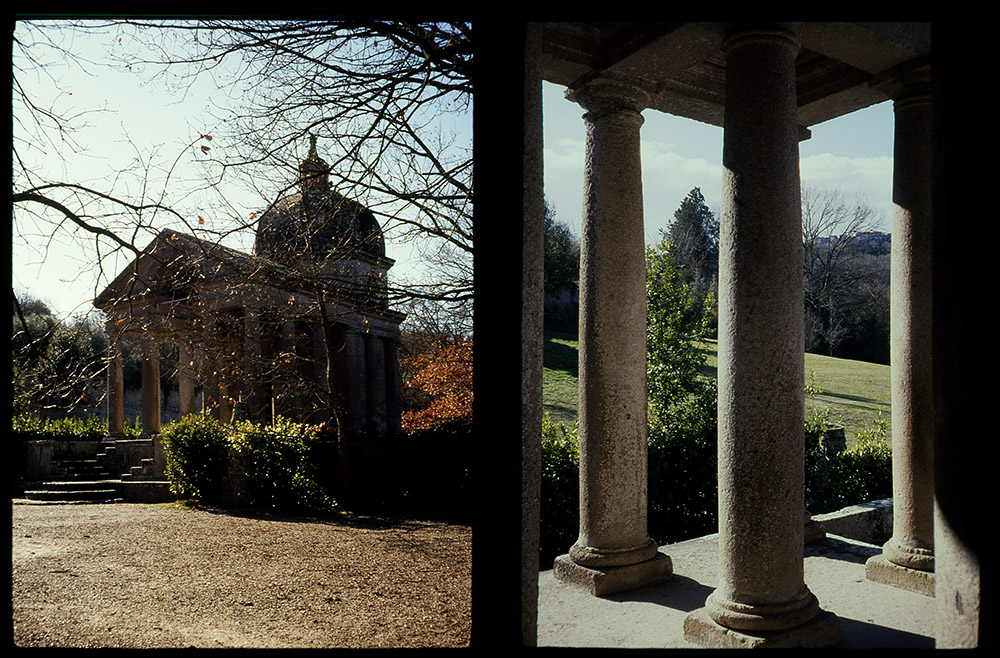
Last month I went off to Bomarzo in Italy to see the Parco dei Mostri, an attractive park dotted with monstrous stone sculptures created in the late 1500s. I took along my Fujica Half half-frame camera and some Kodak Pro Image film, and also some Kodak Ektachrome that expired a long time ago.


Bomarzo is an awkward day trip from Rome but entirely doable by public transport. I have done it myself, and now I can look myself in the mirror and say "I know de way", like Ugandan Knuckles. Do you remember Ugandan Knuckles? All the way back in January 2018 it became fashionable amongst young people to gatecrash a set of virtual communities with an avatar that resembled Sega's popular Knuckles character, but deformed, while delivering quotations from Who Killed Captain Alex?, a low-budget Ugandan action film. Thus Ugandan Knuckles. The fad flourished briefly in the first month of 2018. Two months later I almost feel nostalgic for it.


Uganda has a surprisingly productive albeit underfunded film industry, which seems to have embraced the audience participation elements of Rocky Horror and DJ toasting etcetera. Ugandan film-makers don't have access to much money, so inevitably they major in exploitation films, violent action and horror, and what's wrong with that? I grew up watching violent action and horror films on videotape, especially if they had nudity, such as for example The Howling or Lifeforce, and there's nothing wrong with me.


The mouth has a surprisingly big table inside. I changed film on the table.

Sadly the Ugandan government isn't keen on the other thing and has funded an anti-pornography committee to the tune of half a million dollars, which is probably more money than the total budget of all Ugandan films made in any given year. I learn that the Ugandan government has spent almost ninety thousand dollars importing a pornography detection machine from South Korea, which is ridiculous given that teenage boys will eagerly do the job for free.

As a consequence of this Uganda is badly underrepresented on Pornhub, indeed half of Pornhub's returns for "uganda" are actually Ugandan Knuckles uploads, which aren't even porn. I maintain that it's not government initiatives that bring people of different creeds, colours, and religions together, it is instead pornography and drugs and rock and roll and Counter-Strike and so forth. "We are two of soul".


The mainstream media was convinced that Ugandan Knuckles was bad because it was racist, and so if I do decide to look myself in the mirror and say "I know de way" I will make sure that no-one is watching me. History will look back at a time when Western society decided to ban a cartoon frog and wonder what went wrong.

After visiting Bomarzo, which I have described already and I'm not going to do it again, I returned to Rome, but the light was fading. There are continual rumours that what remains of Kodak is going to reintroduce Ektachrome - the company discontinued its entire slide film range several years ago, leaving Fuji as the world's sole remaining manufacturer of slide film - but I'll believe it when I see it and I won't rejoice all that much. Ektachrome itself was okay, essentially a budget alternative to Kodachrome that was easier to develop. When it was a thing it was often criticised for being a bit flat and pale, and when Fuji inroduced the dense, hypersaturated Velvia in 1990 landscape and advertising photographers switched to that instead. Kodak attempted to compete with "high saturation" versions of Ektachrome but it was too little, too late, and of course it was ultimately for nothing because the problem facing Kodak wasn't weak slide film, the end


Thursday, 22 February 2018

Bomarzo, Monster Park I: Kodak Pro Image


Off to Bomarzo, to see the Parco dei Mostri, an attractive park dotted with monstrous stone sculptures created in the late 1500s. That's the late 16th Century. It always threw me as a kid that the 19th Century had years beginning with 18 and the 1900s were actually the 20th Century. The reason of course is that the years from one to one hundred inclusive were the 1st century, and the years from 101 to 200 were the 2nd century, although to confuse things a lot of people place the beginning of the centuries at the etc next paragraph.


I took along my Fujica Half, a half-frame camera from the 1960s. It has a selenium meter that still works, and it's small and handy and I like half-frame so why not. I also decided to try out some film I bought. Kodak Pro Image, a long-discontinued portrait film from Kodak, probably from the early 2000s:


What was Kodak Pro Image? That's a good question. There's almost nothing about it on the internet, nothing from when it was real. The packaging has text in English, Spanish, and what I assume to be Portuguese, so perhaps it was professional film made for the South American market; or for that matter the British, Spanish, and Portuguese markets, who knows. How it ended up in England, I know not. Mine was made in 2009 and is now out of date. What was Kodak? It was a huge company that made film and imaging products. It still exists, but for the most part it is now a faded sign that you see on top of magazine kiosks when you go on holiday.


Kodak still sells some film. Its official professional portrait film is Portra, which has never really grabbed me, but then again perhaps that's a good thing given that portrait film is supposed to be subtle. I can't really judge Pro Image because my rolls are ten years out of date and I can't tell how they were stored, but it has a definite orange-yellow-red bias, which makes sense for a portrait film.


Fresh from the scanner the images appear to have an orange warming filter slapped over them, not necessarily a bad thing. With a bit of tweaking the results can be made to look normal, but I like the orange. Bear in mind that I went to Bomarzo in February; Pro Image gives the impression that I went in summer and that it was pleasantly warm, whereas in reality the sunshine was harsh early-spring sunshine and it was cool in the shade. Sweet lies. Pro Image coped well with backlighting and highlights, which is one of the good things about negative film. It's ISO 100 but I gave it a slight boost because it's so old. There isn't a lot of grain, but then again it appears to be a relatively modern 100-speed film; film was pretty slick in the 1990s.


On a tangent, I've seen a few fashion shoots over the last couple of years that have film grain, but they were obviously shot with a digital camera. The grain has been added in post-production. Grain in the context of stills photography is a bit of an illusion. I remember seeing an exhibition of images by Eugene Smith, complete with the original negatives and some unaltered full-frame prints, and it struck me that the grainy look of black and white film wasn't just a function of pushing, it was also a function of cropping as well. Eugene Smith did a heck-tonne of cropping, and if you want to capture the grainy look of old film you have to bear in mind that even old film wasn't all that grainy unless it was pushed, and you're actually looking at extreme cropping.

Furthermore 35mm motion picture film is essentially half-frame, but with an even smaller frame because it has to accommodate the optical soundtrack, and furthermore the images you see in this post and throughout this blog are the entire frame with no cropping, whereas films were always cropped a little bit during projection. I'm digressing here.


Bomarzo is a small town that trickles down from the top of a hill. It has a population of crows that swirl out from a castle and swirl back in again. It's spooky in a gothic horror way, especially given that the houses are mostly monochrome.

This was shot with my mobile phone. It illustrates one of the perennial problems with smaller digital sensors and digital photography in general; the sky is blown out, gone, and it's not coming back.

The town is off the beaten path, and perhaps because of that a lot of houses seemed to be for sale. I imagine it's a tricky commute, given the winding roads and general isolation. Getting there from Rome is difficult. I took the train to Viterbo, then a bus, then I walked to the park, then on the way back I took the bus to Viterbo and the train back to Rome. This chap has a very useful guide, which is in Italian but you get the gist. As before I relied on OSMAND on my mobile phone to show me the way; the OpenStreetMap data for Bomarzo even includes the special hidden zig-zag stairs that take you down from Bomarzo to the road leading to the park.

The walk from Bomarzo to the park involves going up into Bomarzo and then down into the park, but before reaching it my way was blocked by a landslide and I almost had to turn back:


In the end I found some planks of wood, and I rested them on top of the landslide and skated down the hill and ramped over the landslide and when I was in the air I did a cool backflip and landed again and continued downhill to the park. Some people watching me applauded and a cute girl asked for my mobile number which I gave her.

Viterbo, by the way, is a big road junction. There are no pavements and everywhere there are main roads packed with cars. The pedestrians are downtrodden. This is my enduring memory of Viterbo, and this is just one road junction of many:


From top to bottom a pedestrian crossing that leads from a broken pavement to a metal barrier; a load of cars; a garden gate that opens onto a busy main road, with a pavement - if it really is a pavement - that's just a painted line. Rachel Carson's Silent Spring came true, and exists today in Viterbo. I felt sorry for the people. Even the people in cars. They drive; but they are driven, by Moloch, who will never be satisfied until the people of Viterbo have destroyed their own souls.


Alternatively you could go via Orte, but I chose Viterbo because the bus terminates there, and there's an automatic ticket machine so you don't have to order a bus ticket from a human being. I learned from gazing out of the bus windows that rural Italy consists of groups of old men sitting around tables talking to each other while no doubt the women actually do all of the work.


Because this is the internet and the possibilities are endless I have decided to make the rest of this paragraph interactive. I'll provide you with some letters and you can re-order them as you wish, and at the end there's a chocolate bar. oaewekhi. cgtulihMuyohtwm ehdaaae emhaublroniEI pratprnlpshsn eeoodrdLoteharecgns'e itiho-thdi ubGwnesrItplehpa ttmhhaefh ogsOesincodtpi dlusre0iriiT ndldcpi; rd:deesarcgeaOu u2rodkudwss9eprsuarmrife5ecinTiensprttneooydwes. bakt boons enhchyglhb tunrm,btsnnthksp Brooyfteaoar ypwews,thruadadcjsfcishPstneytsefecr onolIiucrtioa i1dta gbo.edusfihhe rusFtateo fltcf Csk ahifeni oyeplrao phtefnieesan ilesocrge Pkuel uiebsbmctezee6oitpr yaanls [milky bar]:


That covers the history of the park. It's a pleasant wander for a couple of hours, smaller than I expected. Bomarzo has a small supermarket but make sure you buy drinks first because it's a challenging hike back uphill to Bomarzo. The park in theory has a little cafe area, but it was closed when I arrived. Entry is €10 which is very reasonable for something so photogenic.


The leaning house is a terror. The tilted floor is subtly disorientating. I wonder if sick building syndrome is caused by wonky floors; tiny errors in levelling that make people feel nauseous.


At this point I reached the end of my single roll of Kodak Pro Image. I sat inside the monster's mouth and changed to Kodak Ektachrome, which will be in the next post. It's interesting to compare the war elephant that I saw in February 2018 with the elephant pictured in LIFE magazine's shoot, back in 1965; the elephant is a little bit more eroded and more mossy, but in fifty years it hasn't changed much, so there's no rush to visit the place. It will be there, waiting for you, next year and the next.