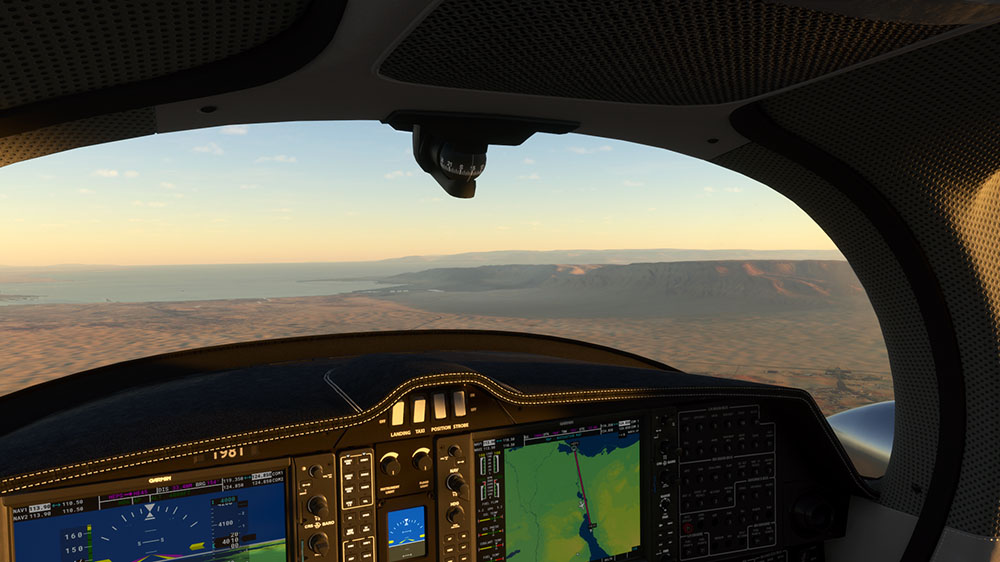
Let's have a look at
Microsoft Flight Simulator 2020, a game that
asks the questions "should I turn on the pitot heater" and "what does
inert sep on mean" and "why does the plane keep stalling" and finally
"I'm going to die here" and "it was all my fault", which technically aren't
questions, but they did go through my mind as I flew through an ice storm over
the glaciers of southern Chile.
In real life I've never had a chance to fly through an ice storm. I've never
flown through an ice storm over the glaciers of southern Chile, and after
trying it out in Microsoft Flight Simulator 2020 I'm not keen on the
experience, but at the same time I am a little bit keen because it was fun.
And scary, but also fun.
That's why people get themselves killed. That frisson of excitement. It's a
primal thing. After escaping from a tiger our ancestors were flooded with a
sense of relief. They wanted to experience that sensation again.
On the other hand you can turn off MSFS2020's damage model and use the
computer autopilot to explore the world risk-free, but come on. Amelia
Earhart didn't have that option. Her autopilot was a bunch of gears attached
to a cable. What are you, a wuss?
Admittedly Earhart did actually die. She must have hankered for that frisson
of danger too, and that's what killed her. Lost over the ocean in a Lockheed
Electra. That's an epic way to go. In another world she made it home safely,
and when the Second World War broke out she offered her services to the US
Army Air Forces, who completely ignored her because she was a woman, and
then she retired into relative poverty in the 1950s and spent the rest of
her life dreaming of planes.
Say again, this place
I'm digressing here. MSF2020 is a reboot of the venerable
Flight Simulator series, which dates back to Sublogic's original
game from 1982. Back in the 1980s and 1990s the IBM PC was very bad at
moving sprites around the screen, so it was rubbish at
Street Fighter 2, but it could crunch numbers like nobody's
business. That made it the go-to platform for flight simulators. Not just
civil simulators but also the WW2-themed Air Warrior, which was one
of the first massively multiplayer online games.
This article wasn't sponsored by Diamond Aircraft, by the way. It's
just that the DA62 has a good combination of performance, range, and
ease-of-use. It looks great as well. A few years later I got to see
one in the flesh, although they wouldn't let me fly it.
The flight simulator market thinned out in the late 1990s, and by the
time of Flight Simulator X in 2006 Microsoft's game was
essentially the only mainstream franchise left standing.
X had a vibrant market of downloadable scenery and
aeroplanes, which was in some respects ahead of its time, but in an age
of Grand Theft Auto and Crysis flight simulators fell out
of fashion and Microsoft seemed to lose interest in FSX. People
just didn't buy joysticks any more.
As of 2020 the surviving competitors in the civil flight simulator
market are Lockheed's Prepar3D, an extensive modification of
Flight Simulator X intended as a professional flight training
tool; FlightGear, an open source simulator that tends to be sold
by eBay and Amazon sellers in packaging that makes it look like
Flight Simulator, and XPlane, which isn't open source. Are
they any good? I have no idea, I haven't tried them out. I love you,
dear reader, but I feel that my time is better invested elsewhere.
The game uses a mixture of hand-made scenery and autogenerated models
synthesised from Bing Maps' top-down views of the world. On the one
hand the synthesis is very impressive, and it was the only way the
developers could recreate the entire world, but on the other hand
there's still a lot of room for third-party handcrafted models.
Nonetheless Florence is uncanny, particularly the little patch of
woodland in the middle distance.
A later patch reworked the water, which at least in early versions of
the game looked out-of-scale.
Microsoft tried to reboot the series with Flight, an online-only
title that was launched in 2012. It only had two planes, and the only
scenery was Hawaii. It failed to catch on and so Microsoft shut it down
just a few months later. It's no longer available, because it was
online-only.
I took a trip over the Aral Sea, although it's now a large lake
because the water was diverted for irrigation back in the 1980s. Some
of the land textures are jagged - the area isn't high on Bing Maps'
list of priorities - but nonetheless I still had the sensation of
flying over a parched desert.
Some aircraft have weather radar. In this screenshot there's a lot of
weather, and I'm in the middle of it.
The June 2019 announcement that Microsoft was working on new
Flight Simulator came as a pleasant surprise. The developers - a
French company called Asobo - were obscure, but the pre-release
screenshots were very impressive. After a brief public beta period the
game was released in August 2020 to generally strong reviews. The major
criticisms are that it has a lot of bugs and the airliner flight models
don't feel realistic, and it needs a very powerful PC to run at 4K, but
otherwise the critical consensus is that it's a visually stunning first
effort.
Each of those white dots is an airfield. Some are major airports,
some are just grass strips. You can fly from any one of them.
In this flight I did a circuit of Easter Island, looking for Moai. I
couldn't find any. As mentioned elsewhere in the article the game has
fewer hand-made models than FSX, but compensates for it with a much
better building-generation engine.
In the first month of release it has apparently sold a million copies, no
doubt helped by the fact that actual real-life air travel was disrupted by
a global plague. The developers promise to support it for at least ten
years, which is nice, although given that so much of the game is streamed
from the internet there's an ever-present worry that Microsoft will turn
off the servers, rendering most of the world an undetailed husk.
At the top of the image is what remains of Kai Tak airport, Hong
Kong, circa 2020.
The entire world map apparently takes up around 2-3 petabytes of data -
that's 2-3 million gigabytes - so there's no chance whatsoever you'll be
able to backup the entire world. The game will run in offline mode but
with low-detail scenery.
One popular pastime is to fly over your local neighbourhood. I've
walked up to the top of that hill, past the badges, and it's more or
less spot-on except for a couple of spurious houses.
I bought the disc-based copy, which comes on ten DVDs, in a box, with a
printed control sheet. A fresh installation took up 93gb:
But it downloaded a bunch of content after that. As of mid-2023, with all
the patches and world updates installed, it has ballooned up to 250gb:
I originally installed it on a 250gb SSD, figuring that I would have
plenty of free space. But no, 250gb is not enough.
What's it like on modest hardware? Let's have a look.
Flying through fog is surprisingly easy once you learn to use the
autopilot. But what if the autopilot fails? Supposedly it takes an
average of 178 seconds for visual flight pilots to become
disorientated when flying through instrument flight conditions,
and I can believe that. You have to train yourself to see with an
attitude indicator, speedometer, and compass instead of your
eyes.
Shek Pik reservoir in Hong Kong, in the game and real life
respectively. As you can see the terrain elevation is spot-on.
Bad stuff first. The game is a 120gb download, and although it's available
with Steam it downloads its own client first, then asks you to leave the
client open while it downloads the game. It's not much fun if you have a
data cap. The game is available as a 10-DVD set - this is the version I
have, and
I wrote about the installation process here
- but it still has to download several gigabytes' worth of patches, and the
terrain is streamed from the internet.
Twilight of LGA 1155
LGA 1155 is a socket released by Intel back in 2011. It remained competitive
for an unusually long time, but a number of modern games have overwhelmed
it, MSFS2020 among them. It's actually one generation older than MSFS2020's
minimum requirements, but my machine is at the upper limit of what LGA 1155
could do so it runs the game. Confusingly LGA 1155 was replaced by LGA 1150,
and then LGA 1151 and LGA 1120 (they're named after the number of pins; a
bad idea).
LGA 1155's star chip was the i5-2500k, a neat little quad-core 64-bit chip
that ran at 3.3ghz but could be easily overclocked to 4+ghz. The i5-2500k
remained state-of-the-art until the middle of the decade and only really hit
a wall when 4K gaming became mainstream in recent years. With a good
graphics card, lots of memory, and an SSD, an i5-2500k system will still
run most modern games at 1080, but at moderate settings and not at a
steady 60fps.
If your aircraft starts to ice up you have a number of options. Dive
below the clouds, where it's warmer; turn on the anti-ice system; keep
going and hope for the best; climb up into the sunlight.
I have always loved you, though I was born a galaxy away
I mention LGA 1155 because it was the last Intel chipset that supported
Windows XP, so for a lot of PC owners it was the point at which they
upgraded from a dual-core, 32-bit XP system with a 4gb memory limit to the
modern age of 64-bit chips with four or more cores fitted to motherboards
that can address 32gb of memory or more. I built my own PC from parts back
in 2011, with an i5-2500k at the core, although I've since upgraded it to a
Xeon 1275, which is the server analogue of the i7-3770k.
The i7-3770k is essentially the most powerful CPU available for LGA 1155,
the end of the line for that platform. It has four logical cores and four
virtual cores generated by a technology called hyperthreading. It benchmarks
50% faster than the i5-2500k, but for a long time the cost didn't justify
the upgrade; as of 2020 however they're cheap on the used market.
The game uses a form of megatexturing, as with Id Software's
Rage, but on a planetary scale.
My machine's weak link is the GPU, a Geforce 1650 with only 3gb of memory,
but MSF2020's built-in frame counter often says that I'm limited by the CPU,
because MSF2020 taxes the whole machine. Most games can be solved by
throwing a better GPU at them, but not MSF2020. It streams the world from
the internet, so it benefits from a fast, stable internet connection; it has
to load a lot of cached data, so it benefits from being installed on an SSD;
the CPU has to instruct the GPU do draw potentially thousands of buildings,
while simultaneously running flight and weather models, so you need a good
multicore CPU. A good GPU is of course essential, but with MSFS2020 it needs
to be part of a strong system.
Therefore if you have an LGA 1155 machine you really have to max it out. In my
experience the game is perfectly playable and good-looking at 1080 on my
machine, but even so it occasionally stutters, and at low altitudes over
detailed cities - Tokyo and New York, for example - it chugs. 4K would
overwhelm it. I get around 40fps flying over bare terrain or in cloud,
25-35fps over New York, with autogenerated traffic turned off. I find that
putting most of the sliders at medium, with reflections at high, clouds at
ultra, anti-aliasing at TAA, texture resolution at high strikes a good balance
between performance and looks.
Bugs? To date the game has only crashed once, during a period of high
multiplayer activity after the release of a reworked Japan. Some of the
terrain looks awful, in different ways:
Victoria falls really doesn't work. The photogrammetry engine got
confused.
The Leaning Tower of Pisa is simultaneously a flat texture map and a
model, each with a different shadow. The surrounding buildings are 3D but
the Duomo and Battistero are flat.
This is the island of Miyake, south of mainland Japan. The volcano isn't
filled in, so the game generates ghosting inside the crater.
The autopilot occasionally seems flaky, but that might just be me. I now set
HDG and VS speed modes at the beginning of flight instead of trying to use ALT
HOLD, which tended to make the plane crash. The game has two pause modes -
active pause keeps the simulation running but holds your plane still in the
air, normal ordinary pause-pause freezes the game. Active pause is nice if you
want to see the world move around you, but curiously your plane still
accelerates and decelerates, even though it's standing still, so you can
overspeed if you activate active pause while in a dive, in which case your
plane falls apart in mid-air for seemingly no reason.
The airliner and its contrail is part of the ground texture. Occasionally
Bing Maps' satellite coverage has cloud cover, which the game is generally
smart enough to turn into green grass.
There are grumbles on the internet that the modelling and avionics of the
game's two airliners, the Airbus A320 and Boeing 747, are only approximations
of the real thing, but I can't tell, I haven't flown either. The 747's in-game
cockpit seems unusually bare - a lot of switches are "inop", and some of the
navigation panels are just cosmetic - and on my first flight the aircraft
seemed keen to turn the autothrottle on immediately after takeoff, which made
slowing down to land difficult.
One of the game's strongest elements is the real-time weather / time
model - you can switch from live weather to a number of presets while the
game is running and also alter the time of day. In the shots above I
didn't like the look of that huge cloud, so I made it go away!
Incidentally I have flown in a A320, but sadly not a 747. The 747s are
rapidly being withdrawn from commercial service. Even in The Before Times they
were an endangered species, but there was still a chance I might be able to
fly on one. No longer.
On an unrelated note the AI air traffic controller will clear me to land on a
certain runway, but there doesn't seem to be a way to cancel that instruction
and pick another one. The in-game map also doesn't point out which runways
have an ATC and which are unstaffed, so I worry that I've wasted time trying
to talk to ATC staff who aren't there. The in-game map is somewhat akin to
Google Earth, but at a much lower level of detail, and when you zoom in it
just turns grey, so planning a sightseeing flight is unusually difficult.
Of course the game has only been out for two months and there have only been a
couple of patches. The general critical consensus is that the game was
released too early, but in Asobo's favour it's obviously a very difficult
undertaking; simply clearing the rights to all the in-game textures and
building models must require a team of full-time staff (some military airports
are censored on Bing Maps, for example).
To date there doesn't seem to be a killer add-on in the marketplace. There are
lots of ports from FSX, but no detailed model of a Concorde, for example, or a
Second World War fighter plane, but it's still early days.
That's enough gripes. Even at 1080, sub-60fps, the game is visually stunning.
Sometimes the ground textures have obvious seams, but on the whole the game
renders the world out to the horizon without obvious tiling. The weather model
is excellent, the in-cockpit lighting looks very realistic, and there are nice
touches such as the reflection of instruments in the cockpit windows at higher
graphic settings. The high-temperature exhaust from the turboprop aircraft
makes the air shimmer. In the following images the iced-up windows were
simultaneously attractive and disconcerting:


There doesn't seem to be a way to open the windows and scrape off the ice so I
turned on the windscreen anti-ice feature, and for good measure the engine
anti-ice, which sapped some of the power. The game models cars and boats, and
the little people who wave signs at the airport, what are they
called?
aircraft marshals, and the cockpit has an avatar for you and your co-pilot,
but you can't get out and walk around. The game doesn't have "space legs".
It's not Microsoft Everything Simulator 2020. If you want to have a
beer after a strenuous flight you have to have an actual beer in real life.
On one level MSFS2020 is a hard sell, because it's not a game in the
conventional sense. It has a number of landing challenges and bush aircraft
tests, albeit not to the same extent as FSX - and there are no
helicopters, so you can't rescue people from an oil rig (for example) - but
for the most part the gameplay consists of generating a flight plan and then
navigating between two airports. The game doesn't penalise you for just flying
directly between the two locations without using waypoints. You don't have to
learn about the downwind leg, whatever that is.
And yet there is something magnetic about navigating through freezing clouds
above the Andes, or checking out the Alps at close range, or flying around
Easter Island, or buzzing the Golden Gate Bridge etc. Back in 2006
FSX captured some of the sheer visual beauty of flying around, but
MSFS2020 trounces it.
At top MSFS2020 (2020), at bottom FSX (2006). Curiously FSX has a few
buildings that MSFS2020 doesn't (the Bank of China Tower, just visible at
the tip of the Cessna's right wing in the FSX image). In its favour FSX
captured the topography of the distant hills accurately, but the lighting
obviously belongs to an older generation.
Aircraft? The standard version has two jet airliners, plus a small Cessna
business jet, plus a mixture of stunt planes, two-four seat piston aircraft
and a couple of smaller turboprops. There's a Cessna Grand Caravan and a
Beechcraft King Air, but on the whole the game majors on smaller aircraft;
there's no Twin Otter, no Skymaster, and none of the various Fokker / Dornier
/ Embraer / Bombardier regional turboprop / jetliners. To be honest I don't
miss them, but a floatplane or tundra-tyres Twin Otter would be neat.
Uniquely the Icon A5 can land on water. It's unspectacular - there's no
wake.
Antarctica was flaky in FSX. Something about the coordinates so far south
messed up the texture mapping. MSFS2020 is much the same. The real life
McMurdo station is a sprawling little town, whereas here it's represented
by a rectangular trailer park.
There are two variations of the Piper Cub, plus the unusual Icon A5, which is
a small amphibian. The deluxe and premium deluxe editions add a Boeing 787, a
third Piper Cub, and mostly light aircraft, with some variations of the basic
models, but nothing particularly killer, so I bought the standard edition.
The game models some of the aeroplane interiors, although you have to use
the drone camera to explore them.
The developer mode lets you turn off all the textures and even revert to
wireframe mode, in which case the game vaguely resembles the earliest
versions of Flight Simulator.
Is it worth the money? Reviewing MSFS2020 is hard. I can't evaluate it as a
serious simulation but the 747 in particular has a lot of inoperative switches
and the internet is of the opinion that if you are a serious enthusiast, with
a mock-up cockpit, it's unfinished. There are grumbles that the flight model
is unusually twitchy, and that the big airliners run out of fuel far too
quickly, and that binding keyboard controls is needlessly obtuse.
At this early stage the marketplace is barren, and with a game such as this
the third-party infrastructure is almost as important as the main event.
Furthermore the game is still in active development, so as with
No Man's Sky - although hopefully not to the same binary extreme - a
year from now it'll be a very different title.
However for a novice such as myself who just wants to explore the world it's
terrific, and I feel I got my money's worth. The ground textures aren't as
detailed as Google Maps, but they're close, and as mentioned the topgraphy is
spot-on. If they introduce helicopters or even a completely autonomous camera
it might even develop a second wind as a world simulator, along the lines of
Google Earth. The real-time weather / time-of-day slider is almost worth the
price of... well, that's hyperbole for a game costing £60-£120 depending on
the edition, but I can't think of anything quite like it. It'll be fascinating
to see how it develops.