Showing posts with label olympus xa. Show all posts

Thursday, 1 May 2014

Notting Hill: Flow Tempest Nightingales

Scotch 640T, cross-processed

I wrote this article whilst listening to Sleepbot Environmental Broadcast, a 24-hour ambient music internet radio station which pleases me. I will miss it when it has gone. It's part of a website called Ambience for the Masses, which dates back to 1997 and is one of the few examples of pre-2000 internet culture that still means something. Think of all the internet radio stations that flourished in the 2000s, when internet radio was new; think of all the internet projects that were born and died in the final years of the 20th Century, when it all meant something, and the future would be better.

Very little has been written about those years. There comes a time when a man realises that, one day, someone will say his name for the last time. It will be written in a sheaf of hospital notes, shoved into a furnace, finally eroded from a gravestone. Except that in the future we will not have gravestones, because there will be no room.

The internet is a mirror of humanity in this respect. The network was built to last. It would take an earth-shattering kaboom to destroy it, just as it would take a vast conflagration to eliminate the human race. But individual people, individual websites, ideas, they delight the eyes and they are gone. The internet has a curious mixture of fads that grow and fade within a few weeks, mixed with scans of ancient pornography that will exist long after we are dead. It seems to me that the key to internet immortality is a kind of genericism. The dancing baby, Mahir, "all your base" etc did not last because they were too distinctive. They traded long-term fame for a burst of exposure followed by an eternity of blackness. The animated gifs and still images that last are those will can be repeated and repurposed without becoming tied to a place and time.

A while back I popped off to Rome with an Olympus XA, but before putting my faith in Blast Hardcheese a 35-year-old camera I wanted to make sure that it worked properly. It would have been disappointing if I came back from Italy and found that the film was blank. Or that England had been overrun by killer rats, or that my detailed knowledge of the lives of Peter Andre and Katie Price was no longer useful.


Notting Hill (1999) is one of those films that I have not seen, along with Santa Sangre (1989), The Silence of the Lambs (1991), the original version of DOA, and also Roman Holiday, The Sound of Music, The Birth of a Nation, Kramer Vs Kramer, The Matrix Revolutions, Gattaca etc. The list of films I have not seen is huge. It divides into three basic groups.

Firstly, those films which I have no desire to see and have not been forced to sit through. Notting Hill falls into this category. It was released in the UK a few weeks before The Matrix, which I saw instead. I remember seeing the trailers for Notting Hill and thinking that I was probably not part of the target audience.


Secondly there are films which I am too lazy to watch, but I have read about because I need to be familiar with them in order to function in society. This group includes Nights of Cabiria, Bicycle Thieves, Bring me the Head of Alfredo Garcia, Children of Men, large chunks of The Criterion Collection, Pan's Labyrinth, Oldboy etc. Chungking Express, which looks lovely in stills but I just can't work up the enthusiasm to watch it. Perhaps if I broke my legs, or suffered a stroke, I would have time. One day I will not have enough time, and at that point why bother? Do people miss Amy Winehouse? My recollection is that she released two albums but was unable to complete a third, and after five years of tabloid antics she died, and now she is gone and forgotten. Unlike Janis Joplin she never cracked the US market, and so she never appears on Imgur or Reddit or the internet in general, because she was never popular in the US. And that is why she has faded and vanished. The radio doesn't play her songs any more, she isn't on TV, the newspapers... it's as if they feel faintly embarassed about her demise, and would rather not remember her.


Thirdly there are films I have not heard about yet. I can't think of any examples because I haven't heard about them yet.

Notting Hill was originally a load of trees. Then it became a poor person slum, but now like the rest of London it is exclusively for wealthy Russians and the like because poor people can no longer afford to live there. It is a familiar story from New York, San Francisco, every major world city. My recollection of Notting Hill in the late 1990s / early 2000s is that it still had a certain amount of touristy charm back then. I remember spending ages browsing through the Musical Instrument Exchange, looking at old synthesisers and stacks of Akai S-series samplers that no-one wanted any more, because musicians were starting to use software samplers and VST instruments. The likes of the Ensoniq Mirage and the Watkins CopiCat tape echo machine were novelties in the late 1990s, no longer practical musical instruments. The Musical Instrument Exchange apparently closed in 2002, I remember it having very little stock towards the end.


It's a myth that synth gear was cheaper in the past; second-hand shops have always been overpriced. The same was true of cameras. I remember visiting the Camera and Photo Exchange as it was closing down (the Exchange empire was hit badly by eBay), and a Pentax Spotmatic with a 55mm f/2 was £80, versus £60 or so on eBay at the time. When I was a lad the Exchange shops were the high spot of Notting Hill. A couple of them are still open. The Comics and Books Exchange is exactly as I remember it, a slightly depressing treasure trove of second hand comics and books that brings home just how worthless and transient comics and books are. Twenty years ago an author spent nine months bashing out his masterpiece; now it is stacked up for 10p in the basement of a shop in Notting Hill and no-one wants it.


And there are the Star Trek tie-in novels, forgotten and unloved relics of a dead franchise. There's something distressing about them. They had meaning, once, but now they are meaningless, like a religion with no more followers or a type of toner cartridge for a type of printer that is no longer made. The circus has left town, and it's never coming back. I know how my parents' generation must have felt when Eagle comic ceased publication, and people forgot Dan Dare, and no-one remembered Old Mother Riley any more.

Not a great photo - it's out of focus, I was pressed in crowd - but towards the top-left there's a Mamiya C330, the updated replacement for the C33 and C3 I wrote about here.

I have always assumed that there was something fishy about the Exchange shops. The economics must be marginal and I wonder if they pay the staff anything at all. But they are a connection to the past, a past when there was a stratum of society that was poor, but not so poor that it couldn't buy records. Individual dreamers, most of them hopeless dead ends, but a few had something. A time when people had to leave the house in order to buy things. Nowadays Notting Hill has almost nothing to distinguish it from any other part of London, and that's not just me being an elderly curmudgeon, it's objective fact because I say so. The exception is Portabello Road market, a long street market where tourists go to look at white person things.

My experience of London in the early 2000s was of a place where everything was closing down. I've mentioned Joe's Basement before, the pro photo processing place. It had a website, a studio, bright ideas, but it shut in 2003 as the professional market for film photography died out. In the words of The Guardian, in an article about a chap called Richard Nicholson who goes around photographing darkrooms, "when he began his project in 2006, there were more than 200 thriving darkrooms dotted around the city; when he completed it in 2009, there were 12". There are probably only a handful by now. Countless magazines and record labels used their services until the early 2000s, and then they were gone.

But as one door closes another opens. The Exchanges and the photo developers did not die alone; banks and post offices died as well, and before them saddle makers and butchers and blacksmiths. The high street itself has been slowly dying, replaced with the few shops that cannot easily transition to the internet, for which there is still a demand. And ultimately as one body is put underground a baby boy is born, in the ghetto, and London evolves. Albeit that London seems to be evolving into an investment vehicle in which empty houses, empty streets are owned by corporate entities. Dull emptiness with no people, no life. Why not abstract the process, why bother with the actual houses? They're just stores of wealth, why not declare that something else has an equivalent worth and use that instead, and let people live in the houses cheaply, so that they have money to spend on trinkets?

There's something to be said about using animals as currency. You have an incentive to look after your money and feed it well, and in bad times a chicken can keep you warm and you can eat it.

Thursday, 10 April 2014

Rome: In Color


This is part of a series of posts about a trip to Rome and the surroundings. I also went to Florence, which was more regal than Rome, Herculaneum, which had fewer pickpockets than Rome (they had been killed by red-hot ash many years ago), Anzio, from which the Allied armies found it easy to check out but hard to leave, and briefly Naples, and also Rome again, but in black and white. I took a cute old Olympus XA rangefinder camera and a bag of mostly Kodak Ektar, and a Holga. This post essentially hoovers up the leftovers, which is why it has so much padding.

I begin. In 1884 W Cope Devereux described Rome and Italy as "an empire once so mighty, the Mistress of the World; then for so long desolate and entombed, a city of ruins; and now, phoenix-like, rising rapidly from her ashes, and preparing as "Young Italy" to take her place as a power among the other nations of Europe, many of whom have already welcomed her as a sister" (from Fair Italy, which is available at Project Gutenberg).


Sadly, the other nations of Europe seem to have regarded "Young Italy" as a pesky gypsy beggar girl rather than a sister, and the country had a pretty miserable century ahead of it. Italian people lived and loved, and in the end Italy survived in better shape than Austria-Hungary or the Ottoman Empire, but it had a bad deal. On a geographic-economic level Italy is a bit like Great Britain turned upside-down; the monied landowners are concentrated in the north, the poor tenants live in the south. Without an Empire, Italy lagged behind the other European powers, and millions of the most enterprising Italians emigrated to the United States in the late 1800s. Italy was on the winning side in the Great War, but ended up in the same situation as Britain circa 1945; bankrupt, heavily in debt, with nothing much to show for years of fighting except for a vague feeling of righteousness. Amidst economic malaise and a sense that it was all the fault of the Communists, Italy turned to fascism, which left it worse off than before.


As Vittorio De Sica's Bicycle Thieves pointed out, life in post-WW2 Italy was not much fun, although less bleak than Rossellini's Germany Year Zero (at least some of De Sica's characters can afford a bicycle). Fortunately a combination of aid from the Marshall Plan and a general European recovery in the late 1950s gave Italy an economic miracle second only to that of Germany, and by the 1960s Italy's levels of growth were higher than ours. Here in the UK there were was a genuine albeit minority concern that we were heading for some kind of neo-fascist takeover in the 1970s, on account of the parallels with Weimar Germany or post-Great War Italy; things never got that bad, and it seems ridiculous now, but I can understand why people might have been worried about Britain at the time.


Nowadays Italy is one of the PIIGS, although it's not as piggy as Spain or Greece. It's a little PIIG. The country is famous amongst people of my generation for The Italian Job (1969), which might easily have been called Mini Thieves ho ho.


They steal the Minis, don't they? They steal all the other cars, and go to Italy to steal Italian money, because in 1969 Britain was running out of money. Italy is something of a void for British people. It is famous for the cars and clothes and ancient monuments, and it's a popular holiday destination, but it's nowhere near as popular as Spain, and far fewer British people retire there than France or indeed Spain. Very wealthy people such as Polly Toynbee retire to Tuscany, but the average middle-class Briton dreams of retiring to Spain. Or dreamed, because Spain is increasingly notorious for its opaque property laws, and this has put off a lot of retirees.

I would go so far as to say that when British people think of Italian people, they actually think first of the stereotypical Italian-American; Nintendo's Mario, for example. Historically, the Roman Empire conquered us, and Victorian England had a thing for the ancient Romans - we were their heirs - but that wasn't modern Italy. After Imperial Rome fell, we were at war with the Catholics for many years, but it was the Spanish Catholics that were our enemies. Italy is close enough that it is not Eastern Europe, which is one great mass of miserable-looking thin people, but far enough that it was never used as a springboard for invasion, and the naval battles of the Second World War were generally overshadowed by events elsewhere. The Mediterranean is another one of those forgotten theatres, perhaps because is a modern-day assumption that the successful aerial attack on Taranto ended matters then and there and that the attacks on Malta were solely the work of the Luftwaffe.

Nowadays Italy's space agency wipes the floor with ours, their trains are faster than ours and work just as well if not better, fares are cheaper, and there are worse places to be poor.


"mostly in color"


The most obvious day trip from Rome is the Lido, which is the local beach resort; Italian men go there to drive their lowered Fiats back and forth along the seafront.

I went in March, which meant that I had the beach almost to myself, because March is too cold for Italians. And so I stood alone on the beach and imagined that a gigantic ringed planet was rising on the horizon, behind towering clouds of ice. On the way to the Lido there is a miniature Pompeii called Ostia Antica which I ignored because it was baking hot with direct sunshine and I was tired.


Naples-Herculaneum-Pompeii and Florence are both fairly expensive or slow train rides away from Rome, very and very in the case of Florence unless you book far in advance. Anzio is much closer, has a beach, and feels more pleasant than the Lido. Venice is just possible as a day trip, albeit that with a return ticket costing around €160 per person it's an expensive day trip.


And that was Rome. It has been around for some time and will still be there next year, the year after, a thousand years from now. All of the shots on this page were taken with an Olympus XA using a mixture of Kodak Ektar and Fuji Superia, except for the shots taken with a Holga, which were taken with a Holga.


On the way home, in the evening; England is north-west of Italy.

Sunday, 6 April 2014

Florence


Off to Florence. Writing in 1884, W Cope Devereaux was upset that he was being overcharged:
    We found the climate of Florence bright and pleasant, bracing and healthful, but it was rather too dear a place for those with a limited income. We had heard that it was an expensive city, and so indeed we found it, for with all our efforts to be economical our bill at the Hotel de Russie was astonishingly high; nor were we alone in this experience, our fellow-travellers averring that it was quite necessary "to cut down your hotel bill, and not to pay quite all that was demanded, as you were always overcharged". ... As far as I have seen of Italian travel, it is a system of "spoiling the Englishman," whenever there is a chance, and the traveller might save himself the trouble of ever taking his hand out of his pocket. As a specimen, we were actually charged a franc each for four small mutton cutlets, and three francs (2s. 6d.) for a cauliflower! Of course I complained, and got one or two francs knocked off.
Which raises the question of why he went to Florence in order to buy a cauliflower. Taking inflation into account, that cauliflower probably cost the same as a small car today, which seems absurd until you consider that wealth distribution was far less equitable in 1884. There were lots of very poor people who had no money whatsoever, and a few extraordinarily rich people, who could afford to have their luggage carried around in monogrammed Louis Vuitton trunks. Reading through Devereaux's book I'm struck by the thought that in 1884 we were the Americans. While the actual Americans were taming the West we, the English, were going abroad with wheely suitcases, shouting at the locals and demanding that they speak English.


Deveraux goes on to moan about tipping:
    At present there seems a private understanding among the servants, that one and all are to establish some sort of claim on you, thus: - you ring - the chambermaid appears; you ask for candles—she withdraws and sends the sommelier with them; and every trifling duty is performed by a different personage, instead of one servant taking the entire attendance, to whom you might feel some satisfaction in giving a remuneration. I think that, under the present regime there is little doubt that the visitors pay the servants wages rather than the landlord, and therefore the item of "attendance" charged in the hotel bill is simply a fraud.
Tipping is still a point of controversy today. I have no doubt that if you scour the works of Plato you will eventually find something about tipping. It's one of those subjects that never grows old. I wonder what else the chambermaid would have been prepared to do for a few francs, eh? Or perhaps she could have posed for some naughty pictures in her chambermaid's outfit.

In 1884 photography was an established technology but still difficult and expensive; plates and lenses were slow, which is one of the reasons why contemporary nudes tended to be draped on sofas as if asleep or dead. It was many years away from being accepted as a legitimate art form. Devereaux mentions photography in passing:
    While in Paris ... I was struck with the number of indecent photographs by no means to be confounded with works of art, in the windows of shops in the Rue de Rivoli, and indeed almost everywhere; such photographs, as we should never allow to be exhibited in London, yet here nothing was thought of it. Even ladies stopped to examine them without a blush.
Pornography has long been a driver of technology, it was often opined that broadband internet, CD writers, larger monitors... huge external hard drives, comfortable chairs etc were driven as much by a desire to amass huge quantities of pornography than by a desire to watch pirated non-pornographic films. No doubt scads of wealthy young gentlemen in the latter half of the 1800s took up photography as an excuse to persuade women to take off their clothes, so that the moment could be savoured again and again (this is why nude models generally charge more than prostitutes).


Devereaux had nothing much to say about Florence otherwise. Today it is clean, neat, nice-looking, perhaps a bit dull. From Rome I took a high-speed train, which is cheaper if you book in advance, with the complication that you have to pick specific times. On that high-speed train I travelled faster than anyone had travelled in William Devereaux's time, faster than anyone ever travelled with British Rail.

Of all the Euro-nations Italy has had the most eventful past, and as a consequence it occasionally feels like a piece of blu-tack that has been stretched and squeezed too much. Ancient Rome was one of the grandest cities of its time - of all time - but beyond the ancient ruins and tourist attractions modern Rome feels anonymous. London's Houses of Parliament and Buckingham Palace are world-famous, but the Roman equivalents are dull grey buildings which resemble a naval academy and a university campus respectively. Rome doesn't seem to have a main shopping street akin to Oxford St, and even though it has a large river going through it, there's no equivalent of Tower Bridge. Termini station is larger and busier than Waterloo or Paddington, but the main concourse is just a big dark hole, and there's nothing romantic or dramatic about it. Exit Waterloo and you're on the South Bank, looking across the Thames at the Houses of Parliament; exit Termini and you're in a large bus park, and to the left is a McDonald's and some poor people and cheap hotels.


Rome no doubt has nightclubs and art galleries that would make my heart weep, and people live and fall in love there and lead epic lives and die in the street for things they believe in, but the same is true of any city. As I wandered Rome I remember shouting at the paving slabs and passing cars, "what makes you special, Rome? Answer me!", and I'm very grateful to the local carabinieri for helping me to find my medication and deciding not to press charges.


It was in my shoe. I don't know how it got there. I had to take it off because the echoes were too loud.

Florence is famous for its art, and for "Stendhal Syndrome", a condition whereby people are overcome by the art and have to lie down. I was immune to this because I grew up in the 1980s. The most famous art museum in Florence is the Uffizi, which has a one-two punch; you go through a neatly-designed collection of Italian artwork first*, followed by some non-Italian art which is surprisingly easy to miss because it's slightly off the obvious path through the museum.

The art itself made me sick, in the "Jesus and the moneylenders" sense, because it was so cynical. Endless Madonnas and Children painted by artists who were probably bored of the subject, for churches that just wanted something to put on the wall, to impress churchgoers who would rather have been out drinking. The only thing that moved me was a tombstone from ancient Greece. Two and a half thousand years ago a man carved out a message so that people might remember the dead.

* Strictly speaking, the first thing you experience is a steep staircase. Which may be where Stendhal Syndrome comes from.


The one painting that everybody recognises is Botticelli's Birth of Venus, which is faded but still draws a crowd. Classical nude paintings are generally not very sexy and Birth of Venus is no exception, but the model has a gorgeous face and she's very attractive on a platonic level. I would marry her, we would sleep in separate rooms and I would have a mistress and a golden bicycle.


No-one is sure whether Venus was a real woman or just a figment of Botticelli's imagination. Whoever she was she's dead and gone now. The painting provided the inspiration for a scene from Terry Gilliam's The Adventures of Baron Munchausen, a terrible film remembered only for that one scene, and only because uncropped hi-def copies have a glimpse of part of Uma Thurman's right nipple for a few frames. Men remember that kind of detail.

Botticelli seems to have used the same model in Madonna of the Magnificat. Either that, or he had a particular dream woman:

It's tempting to say that women were more natural back then, but paintings are even more fake than photographs. They took months to produce and were filtered through the mind and talents of the painter. Ms Venus has anatomically impossible shoulders and an inhuman neck, and it looks to me as if her eyes are wonky.

Venus has the kind of face that makes men feel inadequate. Because she doesn't need you. And if you tried to keep hold of her you'd end up destroying something beautiful.

Botticelli's paintings were commissioned by the church or very wealthy people, and like all the classical art in the Uffizi and other museums it was commercial art. The paintings in the Uffizi weren't created because the artists had a unique vision that they wanted to explore, or because they had something to say about the human condition; they were created because the artists were paid to churn out illustrations for the local clergy, or produce portraits of wealthy businessman and their wives. A lot of it was hack work produced by the artist's assistants for people who simply needed something to brighten up their church or living room. Classical artists were the Cecil Beatons of their day. They were employed by, and had to flatter, people who had blood on their hands, or who kept the blood off by living in gated communities while the world burned around them. Italy's history is full of blood and fire, full of broken stone monuments paid for with blood, built on ashes.


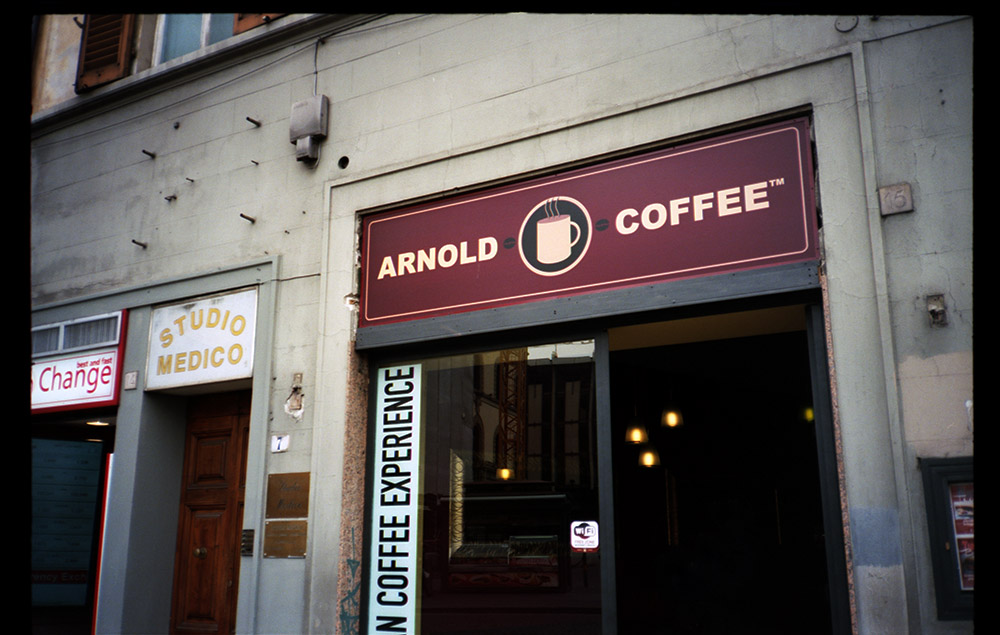
I took my Olympus XA and some Kodak Portra 160, which has a subtler colour palette than Kodak Ektar. Apropos of nothing Florence has the only other Arnold Coffee I have ever seen (the first was in Milan); it stands out because it resembles Starbucks, which is unusual because there are no Starbucks in Italy at all. The Italians have their own coffee.


The CIE are immigration processing centres; "lager" in this context means "camp", as in laager.