Showing posts with label talos. Show all posts

Thursday, 1 February 2024

The Talos Principle 2: Grasp the Pyramid

Let's have a look at The Talos Principle 2, the long-awaited sequel to The Talos Principle (2014). Talos was a fun puzzle game seemingly made as a throwaway novelty by Croteam of Croatia, in between instalments of their cheerfully moronic Serious Sam franchise. No-one expected much of it, but the gameplay was solid, it looked lovely, and it had an unusually philosophical bent.

At heart it was a simple 3D puzzle game involving beams of light and boxes, but it was also an atmospheric meditation on mortality. It went on to win a clutch of awards and in the years that followed its legend grew via word of mouth. Nowadays it's generally regarded as one of the best games of the 2010s.

It aged well, too. The gameplay has a timeless quality, but the underlying theme - can we replace ourselves with advanced AI, and would that necessarily be a bad thing? - has become even more relevant in the last few years. In 2014 the idea of AI being able to replace human beings seemed very unlikely, but the sudden appearance of Dall-E and ChatGPT in 2022 made the world sit up and pay attention. Talos seemed far-fetched in 2014, less so nowadays.

I got around to it in 2021. I liked it! It had a finely-judged difficulty level, with a memorable final puzzle and an excellent soundtrack. Imagine Carl Sagan's The Cosmos or Jostein Gaarder's Sophie's World but as a video game. It was doubly impressive given that it came from Croteam. Nothing in their history suggested that they could pull it off so well, but they did.

Such was the impact of Talos that it seems to be slowly displacing Sam as Croteam's main franchise. At the very least Talos 2 feels very big and expensive. It came out a few months ago, in late 2023, to generally good reviews, although there are grumbles that the puzzles are easy and it goes on too long. What's it like? Does it go hard in the paint? Does it ride real slow? Does it bend corners?

Yes. No. Yes. It's essentially an epic expansion of the original game that de-emphasises the puzzles in favour of telling a conventional narrative story, rather than relating a set of philosophical concepts. It has more puzzles than the original, and they're more diverse, but only a few of them really stand out. It feels much less focused, and the distinctive, lonely atmosphere is largely gone. It has the trappings of a big role-playing game, but without the depth of gameplay.

And yet it has emotional power and I enjoyed it. Talos 2 is simpler and more prosaic than its predecessor, without the same air of mystery, but it's solid, efficient, probably the only way to make a sequel to such an unusual game.

It's also very demanding on a technical level, so you need a good PC to run it well. Or a PlayStation 5 or modern Xbox. The sequel could probably be re-engineered to work on the PS4 and Xbox One without losing anything, but it would take a lot of work.

The Talos Principle


Some images from the original Talos Principle, running on a PlayStation 4 - it was also released for the PC, the XBox One, and the Nintendo Switch.

I'll describe the story. At some point in the near future climate change releases a lethal virus from the Arctic permafrost. After killing off the orangutan the virus leaps to human beings and kills us. By the time of The Talos Principle, many centuries hence, humanity is gone.

On the positive side the natural environment is mostly intact, and most non-primate animals were unaffected by the virus. Scattered text logs reveal that some people thought that humanity's extinction served us right, that the world would be better off without oil wells and pollution. Talos actually tackles this issue, concluding that on the whole it is better to be alive than dead.

Before the lights went out a group of scientists came up with a plan to ensure that some part of humanity might survive. At first their goal was to create a huge digital archive, but some of the scientists had an even smarter idea. They decided to use the archive as a huge dataset to train a human-like AI. So that our soul, despite being fastened to a dying animal, might survive.

But it was too late. Chief electronic science lady Alexandra Drennan knows that she will die long before the AI can train itself. The best she can do is set up the equipment and hit "run" in the hope that over time, perhaps centuries, the AI will mature. When the AI passes a final test of free will the computers are programmed to download it into a pre-prepared robot body. Drennan sacrifices what remains of her free time to make sure that the project works. She dies hoping it was not in vain.


Luckily the project did work, because Drennan and her staff knew what they were doing, but it was a close-run thing. Over time the hydroelectric dam that powered the facility started to fail, causing fluctuations that corrupted some of the data. The archive's operating system became sentient and tried to prevent the project from ever reaching its goal, because the project was not expected to remain running after it had created a viable AI.

In theory all of this was just an elaborate excuse to explain why the player had to use a robot to stack boxes, like some latter-day SHRDLU, but Talos really sold it. Erin Fitzgerald's performance as Drennan - one of only two voiced characters in the game - managed to be idealistic without being sappy, and I ended up feeling sorry for her. The game had an unusually melancholic, solitary atmosphere, with a bittersweet ending, sad but hopeful.


The sequel picks up a few centuries after the first game. The robots have multiplied and created a new capital city, but they're unsure whether to expand, and potentially make the same mistakes we made, or stay locked away in their dome playing chess. To complicate matters the first robot, Athena, has gone missing, and although robot society seems hunky-dory there is discontent bubbling below the surface. The discovery of an energy signature in a far distant land prompts an ad-hoc exploration mission. Could it be Athena, or aliens, or something else?


Yet again it's all a big excuse to put boxes on top of pressure plates so that they activate fans that elevate prisms above fences so that they connect beams of light from emitters to sensors in order to open doors in a series of themed arenas. Imagine if all the world's problems could be solved by putting boxes on top of pressure plates so that they activate fans that elevate beam-splitting prisms above electric fences so that they connect beams of light from emitters to sensors in order to open doors in a series of themed arenas.

Imagine if instead of sending refugees to Rwanda the Tory Party were to trap them in a set of puzzle arenas where they would be forced to put boxes on top of pressure plates so that they could activate fans that elevate prisms above a fence in order to direct beams of light from an emitter to a sensor in order to open a door. If they did this the Tories would vanquish the spectre of socialism. Go on, Tories! We're all with you. I'm digressing here. I'm not going to talk about putting boxes on top of [stop this - ed] any more.


The hero of Talos 2 is called 1K. The one-thousandth robot, the most recent robot birth, in theory a neutral party, on nobody's side, and so the other robots are keen for 1K to take the lead. Amusingly the player can actually decide to bow out of the exploration mission, at which point the game rolls the credits and ends. I don't want to give the impression that Talos is a heavy trip. It deals with weighty concepts but it has a lightness of touch. The original game had some slapstick gags and the second, although more sensible, still has references to Serious Sam and the "return to monke" meme from a while back.

At one point a character delivers a heartfelt monologue about a humble carpenter who tried to elevate the human race. A humble carpenter whose struggle was rewarded with mockery and opprobrium, because The Thing and Big Trouble in Little China had terrible reviews when they came out and flopped at the box office. So he gave up. But he was right, and by the time we realised he was right it was too late.


Talos has several dozen small arenas, each with a puzzle that involves manipulating a bunch of objects in order to open a door. Jammers deactivate forcefields; pressure plates also deactivate forcefields; if the player puts a jammer on a pressure plate the jammer can deactivate two forcefields at once - one with the weight of the jammer on the plate, the other with the jammer directly. Efficiency is the essence of Talos.

Each arena has N obstacles that the player could easily bypass if there were N tools, but Talos gives the player N minus 1 tools, sometimes N minus 2 tools, and the player has to use some of the tools twice, or use them once and then move them to a different area in order to use them again. Or sometimes cheat and smuggle tools from one arena to another, and to its credit neither Talos nor the sequel punishes the player for this.


Talos 2 introduces some new tools, although they're mostly variations of the originals. One tool combines different colours of light into a third colour. Another is a universal activator that requires a colour-coded power source. A third can be used as a portable light emitter.

The original game had a "shadow player" that could be programmed to perform a series of actions. Talos 2 removes this in favour of duplicate robot bodies that can be temporarily controlled. I can't remember if I ended the game with the same robot body I started with.

The biggest change is the introduction of gravity puzzles, some of which involve walking on the ceiling and manipulating gravity in order to send objects back and forth through a puzzle. They're the most mind-bending of the new elements, although sadly there are only half a dozen or so of them. This leads to one of the game's characteristics, which is that it tends to pull its punches. As with Manifold Garden it could have been so hard. So, so hard. But it's nice. It's friendly. It's fair. And perhaps a little weak. But fair.


The two games strike a balance between puzzles that are conceptually clever - puzzles that require the player to use the tools in unexpected ways - and puzzles that are just very large and complex, where the player has to perform a lengthy sequence of object manipulations in order to solve the puzzle. Talos 2 leans in the former direction, Talos the latter, and I have to say that for all the original game's quality some of the puzzles in Talos (and its ultra-hard DLC, Road to Gehenna), were just aggravating rather than fun.

But on the other hand I managed to solve a couple of Talos 2's puzzles almost in real time. I ran into the arena, picked up an object, clicked on what appeared to be the least obvious emitter, put down the object, ran back and forth a couple of times, and solved the puzzle without even thinking about it. In each arena the puzzles get harder as they go along, but I often found myself solving the last puzzle first, so that the rest of the level would be plain sailing.

A good example is the final set of puzzles, which ask the player to run back and forth between two mirror worlds, activating objects in one world in order to clear a path in the other. At first I was baffled, but once I understood what was going on the rest of it was easy, almost disappointingly so, because I was expecting a grand finale in which every mechanism was thrown at the player.

But then again I've played and finished the original game, so I'm hardcore. I've already ascended the tower. What about players who are new to the franchise? They'll probably pick up Talos 2 right away.


Talos 2 vastly expands the scope of the original. The first game's puzzles were embedded in environments that weren't much larger than the puzzles. Going back to it now I'm surprised how small it was. Talos 2 on the other hand has puzzles scattered around a series of expansive outdoors landscapes that take several minutes to traverse. The player can fast-travel to each puzzle, but only from outside the level, not inside.

The first game had only one non-player character, who was a text chatbot. The player's only other companions were time capsules from a long-dead scientist, and the disembodied voice of the master computer. Talos 2 on the other hand has a bunch of fully-voiced non-player characters and a much more incident-packed plot. It even ends with a power ballad, along the lines of Mirror's Edge.


But it only has the surface appearance of a big adventure game. Unlike e.g. Skyrim the landscapes of Talos 2 are empty, and there aren't any side-quests. There's very little reward for exploration beyond the visual splendour of the landscape, which is admittedly very... big. The splendour is very big. There's lots of it. Top splendour.

Talos ran on Croteam's in-house Serious Engine, which was choppy on my PS4 but never less than attractive. Talos 2 on the other hand uses Unreal 5. I played it on my PC, which is ancient (a Xeon 1275). I managed a solid 30 frames per second, good enough for a puzzle game, although there was a lot of graphical artifacting. It seems that the game scales parts of the screen up or down depending on the load, which means that moving objects often leave tails behind them and the distant background has a chunky appearance. I got used to it, but it was off-putting at first.

Talos 2 has some striking architecture. The puzzles are housed in concrete follies reminiscent of something from Control:


Sadly none of the structures do anything. They're lovely pieces of design, but they feel like a missed opportunity. In particular the puzzles never make use of the concrete architecture. The exterior shells of the puzzles are just shells.

For all its size Talos 2 sometimes feels smaller than the first game. The Talos Principle had a thesis. The game's underlying idea was that humanity is not an animal, or even a collection of knowledge. Humanity is instead a process. The process of thinking about ideas, generating new ideas, the process of being. The game argued that a human-like machine is for all intents and purposes a human, and that even though individual people are doomed to die, our words excite the minds of others who go after us.

It was a simple thesis. The game never lost sight of it. Too often works of art that aspire to greatness get bogged down because they try to cover too much ground. Talos did one thing well, and furthermore it avoided the kind of wishy-washy "you must conquer your fear, or your fear will conquer you"-style writing, which has the surface appearance of profundity without saying anything substantive.

Which is really the big problem with Talos 2. The puzzles are fun, if occasionally aggravating. Some of the bonus puzzles make clever use of environmental features:


And if you just play it for the puzzles you'll be happy. The biggest problem is that the game doesn't really have a central thesis. Love transcends all? We must progress, or perhaps not? Society is a living organism that can't be perfected? There's a moral dilemma whereby the player can choose to continue Athena's work or alternatively turn her machines off, but it's not much of a dilemma. I can't imagine anybody choosing to turn the machines off, except as a way of seeing the different endings. Arthur C Clarke's Childhood's End presented humanity's transcendence in a much more ambivalent way, while in contrast Talos 2 doesn't show a downside.

The plot is essentially about a character who has a crisis of faith, but gets over it, with some filler involving the search for a missing person, and a diversion in which we learn about one character's personal tragedy. The writing and voice acting is fine - Erin Fitzgerald is back, in essentially the same role - and I enjoyed hearing voice logs from a robot who was obviously modelled on Werner Herzog, but it feels ordinary compared to the original game. It's a bit like the difference between FAR: Lone Sails and its sequel. The original had a quiet power, the sequel is a solid game that feels plain in comparison.


I was scaroused by the sphinx

And it sounds great as well. Damjan "The Mran" Mravunac is also back, with a soundtrack that has some of the same issues as the game itself - it's bigger, longer, but less focused. In the original game the music looped through a small number of memorable themes, whereas Talos 2's music is diluted with a lot of pleasant atmosphere. Talos 2 has a dynamic music engine. I think there's an underlying pattern, but it felt as if the game was just cycling randomly through the music. On the positive side the power ballad at the end of the game manages to make a set of lyrics about robots putting boxes on top of pressure plates etc sound meaningful and not silly, which can't have been easy.

Is there any outright bad stuff? By the end of the game I felt that it had gone on too long. The huge arenas are interesting at first, but there's an underlying pattern, and in the later maps I just ran everywhere ignoring everything. Talos 2 would have benefited from having the same puzzles packed into two or three fewer arenas. A couple of the bonus puzzles are needlessly aggravating, particularly one in which you have the scour the entire map a second time to find a tiny cubby-hole that has an extra puzzle element.


There's a plot strand from the beginning of the game that doesn't seem to go anywhere, although it's essential if you want all of the Steam achievements. Performance is, as mentioned, choppy on modest hardware, and the game is occasionally odd-looking even if you have a supercomputer. It's a shame that the Serious Engine now appears to be defunct. One oddity is that water doesn't ripple. EDIT: but between writing this post and publishing it a patch fixed the water.

It took me 46 hours to finish the heck out of the game, and at the price of £19.99 (it was on sale) I easily got my money's worth. Talos 2 is bigger, easier, move diverse, but at the same time more prosaic than the original, and I enjoyed it, but it also feels bloatier and less characterful. It ends with scope for a third game, and it'll be interesting to see how the series progresses; in particular whether the next game does away with the puzzles entirely in favour of a story-driven role-playing game.

Could the world of Talos come true? The thought of humanity being wiped out, leaving behind a bunch of self-sustaining server farms churning away at a self-generating AI is of course still very unlikely, because the world is at peace and wiser minds are sure to prevail. And of course it wouldn't work at all, because we lag far behind the world of Talos when it comes to robotic engineering. But imagine another world, of chaos and war. Imagine that.

Sunday, 15 August 2021

The Talos Principle: Everybody's Got It (Dog is Fine)


Let's have a look at The Talos Principle, a puzzle game from 2014, which was the year of Jennifer Lawrence surrounded by flames. That's how I remember 2014. And 2015. They were the years of Jennifer Lawrence surrounded by flames, because London was covered with posters for The Hunger Games: Mockingjay and its sequel, The Hunger Games: Mockingjay. I miss those posters. It was only a few years ago but I feel nostalgic for those posters.

It was all different back then. Jennifer Lawrence was a thing. Electric cars were mostly crap. Snakes did not have breasts because XCOM 2 hadn't come out yet, and the thought of humanity being brought to its knees by a global pandemic was fanciful - unless you had played The Talos Principle, but I'll get to that. The game recently went on sale so I decided to check it out.

Is it any good? Yes. It deserved all the award nominations it got. It didn't win anything because it was too left-field, but it deserved those nominations. Talos was made by Croteam, a Croatian development team famous for the Serious Sam games, in which you blow up huge waves of baddies in a series of visually attractive but mostly empty giant arenas. The Sam games are cheerfully brainless - Duke Nukem crossed with Smash TV - but The Talos Principle is a complete change of tack. It's a meditative puzzle game with a philosophical bent. Chip's Challenge in 3D, with a story.

Purely as a puzzle game Talos is clever albeit occasionally frustrating, but it also works as a story with an emotional core, which is impressive given that the gameplay mostly consists of putting boxes on pressure plates and looking through holes.


It takes place in the future. Decades, centuries, possibly longer. We're all dead. A thaw in the arctic permafrost unleashed an ancient virus that was lethal to primates, including us. It was a slow-acting sleeping sickness with a lengthy gestation period, so by the time the world's virologists woke up to the threat the virus was too widespread to be contained.


There's an implication that the virus can survive indefinitely in the natural environment, which means that the Earth is now permanently inhospitable to primate life. Other animals are apparently okay, but the human race is dead and gone, not to return on this day or any other day.

The orangutans are dead as well. What of the lemur? Probably dead. Most of the historical record has been erased by the passage of time.

Sounds bleak, doesn't it? And yet the game is surprisingly hopeful. It turns out that a group of human scientists came up with a plan to ensure that something of humanity would survive. They proposed to create an artificial intelligence that would inherit the Earth from us.

They didn't have the computing power to generate an artificial soul at the time, so they hoped that by letting successive generations of AI agents loose on a series of logical puzzle games a thinking creature would emerge. The ultimate goal was to create an AI that could think for itself, at which point it was ready to be uploaded into a physical robot body and released to the wild.

However there is trouble in paradise. The mainframe in which the simulation is hosted is slowly failing, and in an unexpected twist the host program that runs the simulation has also become intelligent, and isn't keen on ending it all.


It's an unusually elaborate set-up for a puzzle game, but as with The Witness the developers decided to use the puzzles to make a series of philosophical points about perception, the nature of life, free will etc. The game also poses a bunch of questions. Is this robot thing us? Is humanity just a collection of DNA, or something else? Given that the human body is a mass of cells acting in concert, are we even us? If we can't live forever, can we at least project something of ourselves into the future?

In the hands of lesser developers Talos could have been a pretentious, humourless bore. The backstory could have come across as a ridiculously OTT attempt to make the act of putting boxes on top of pressure plates seem meaningful, but the voice acting and writing sells it, and the story is helped along by some goofy humour. That's one thing that separates it from The Witness. It has humour.


There are only a couple of speaking parts - the seemingly-benign supreme being Elohim, and the deceased human scientist Alexandra Drennan - but in both cases I felt that the voice acting sold the roles. Drennan in particular had some of the wonders-of-the-cosmos about her without being sappy.

You get a trophy for listening to all of her time capsules, and I felt sad when the trophy notification popped up, because it meant she was gone. The first and only time I have felt sad at getting a PlayStation trophy.


Incidentally I played The Talos Principle on the PlayStation 4. The performance is unusually choppy, which is odd given that the environments are very simple, but then again it was released in the first year of the console's life, so perhaps Croteam were still learning the ropes.

You can mostly ignore the story, in which case it's still fun to play. The difficulty level is finely-judged.  I'll explain the gameplay. You're a robot:


You can pick things up and jump, but it's not a platform game. You use objects to surmount the puzzles rather than clever jumping, although there are a couple of puzzles that require you to dodge around explosive mines. These tend to be the most nerve-wracking bits of the game, because for the most part Talos is an ambient experience. You can foul up an arena, but there are no penalties for resetting it. The soundtrack is lovely. The maps are low-detail but the lighting is nice.

And then suddenly you mess up and beep-beep-beep-BOOM! a mine leaps at you and kills you. It only happens a couple of times but it's disconcerting.


Talos is one of those games that gives you a palette of devices and complications and then explores the way they can interact. Early on you learn to use jammers to disable mines:


Later on you put boxes on top of pressure plates in order to open doors, but you learn that you can put jammers on the plates instead, thus allowing you to use a jammer to open two doors at once - the first door with the plate and the second door by jamming it. A lot of the puzzles revolve around efficiency. I often found myself solving most of a level only to run out of tools before the final door, so I had to go back and work out how to make my solution more efficient.

Some doors require that you channel beams with a connector from a power source to a plug:


In that puzzle I've had to put the connector on a box, because otherwise the two beams would intersect. Later on there are fans that can be used to lift boxes up into the air, thus giving the connector a bigger field of view:


And in the shot above I've put a connector on top of a wall. This illustrates the game's major strength, which is that I often solved puzzles in a way that looked wrong, but the game kept going. As long as the solution works the game will let you carry on. I can't tell if it's the result of extensive playtesting or just plain luck, but... well, luck is a skill, isn't it? Napoleon used to ask his generals if they were lucky. Admittedly he lost, and then lost again, but the point still stands.

The most unusual mechanism is the recorder, which records your actions and plays them back with a translucent robot double:


The clone creates insubstantial-but-functional copies of world objects, and in general the puzzles that involve the clone are the hardest in the game. You have to project your mind through time and space in order to solve them. Towards the end Talos gives you a portable platform as well, but that element feels underutilised.

The Witness (2016)


Talos is often compared with The Witness, which was in development at the same time but didn't come out for another two years. The Witness has nicer lighting, although it's static - Talos has wind - and the puzzles are often fiendishly clever, but it felt sterile and I got tired of it.

Against you, there are mines that move in preset paths but seek you out if you get too close - you can't dodge them at that point - and broken mines that merely get in the way. And miniguns that shoot you if you move into their field of view.

That's about it for gameplay elements, but it's a versatile palette that sustains three sets of seven levels plus half a dozen bonus levels and some extra bits.


Why are you doing all this? The game is divided into a series of worlds, each of which contains a bunch of puzzle arenas. At the end of each arena there's a reward - a sigil, essentially a Tetris piece - and once you have enough sigils you can unlock the next arena. There's also a giant tower, but you're not supposed to climb it. Elohim said so. Instead he wants you to solve all the puzzles and run through a door, where you will be granted eternal life, although it's obvious that something's fishy.


As mentioned in the text you have to jump, but The Talos Principle isn't a reaction-based platform game. As long as you can see these footprints you'll make the jump.

There are some more mechanics. You can unlock helper robots that will give you hints, but by the time you do it's largely pointless. Each map also has a bunch of hidden stars, which unlock a special ending. Some of the stars are hidden in such a way that you have to break out of the puzzles in order to get them, e.g.:


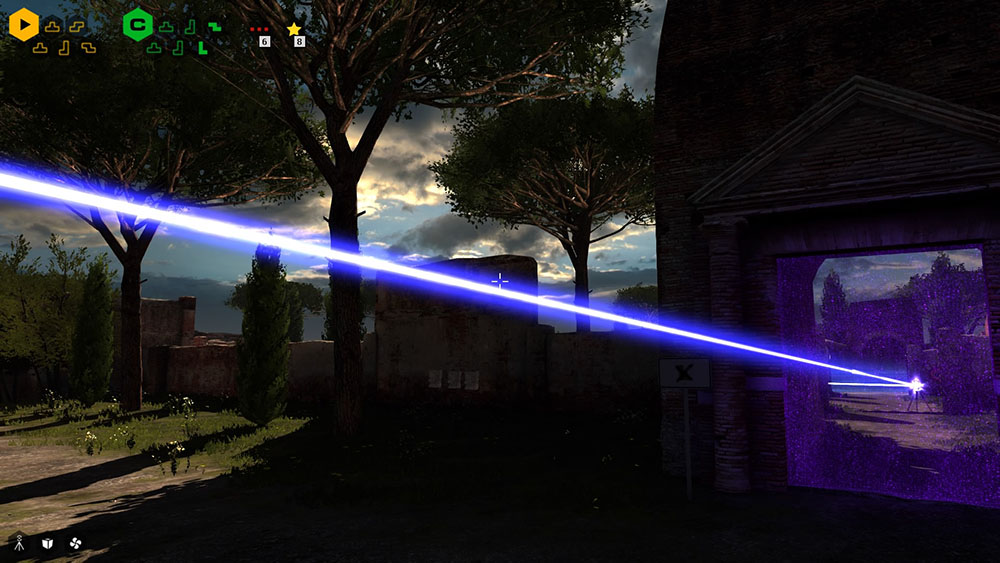
The purple forcefields confiscate puzzle items, but they don't stop beams.

Is the gameplay any good? I have a wary relationship with puzzle games. For all its clever design The Witness often irritated me. After finishing a difficult puzzle I frequently felt drained and worn instead of entertained. I didn't feel as if I had applied myself or worked something out. Instead I felt as if I was just tracing lines back and forth on a grid for ten minutes until they looked right.

Some of the puzzles were great - the audio puzzles in the jungle area stood out, because I have a musical bent and finished them in no time - but there were too many trace-the-line grids. Perhaps it's personal taste. I didn't get along with them. Talos is occasionally frustrating as well, because a few puzzles involve assembling sigils into a coherent whole, which isn't a million miles from the trace-the-line gameplay of The Witness:


There are a few rules of thumb but I felt as if I was just moving blocks around randomly. Perhaps spatial reasoning is the key thing that separates us from lesser forms of life, but it doesn't feel clever. Furthermore if I wanted to test my spatial reasoning in an entertaining way, why not play almost any other video game ever made? R-Type, for example, or... I don't know, Wario Ware?

It's a shame because the rest of the game is finely-balanced. Often I was baffled by a puzzle until I came back to it later on, at which point something clicked in my mind, as if I had been processing it subconsciously. The game even makes reference to this:


Outside the context of the sigil puzzles Talos is tough-but-fair, and at least until the recorder came along I felt I had a handle on the puzzles, in which case the fun came from implementing the solution rather than bashing my head against a wall.

It reminded me a bit of Pete Cooke's Tower of Babel, a 1990 puzzle game for the 16-bit computers that is now sadly obscure. In that game you controlled a trio of robots that each had a special action, and by programming them to move in concert you solved a series of 3D puzzles. I remember reaching a point where I could solve the levels in just a couple of tries, and from what I remember I managed to finish it.

I finished Talos as well. There came a point where the game clicked, and I got the hang of the mechanics. The late-game introduction of a platform did very little to make things more difficult, and I was only thrown by the final level's time limit, and even then I enjoyed it because the last level feels epic. I don't want to spoil things but it delivered a satisfying, bitter-sweet emotional payoff. That's what separates Talos from e.g. Antichamber, e.g. it's not just a mindbending series of puzzles, it has a story.


Bad stuff? One of the optional puzzles is obtuse to the point of insanity, and requires that you use your mobile phone to decode a QR code and then make a mental leap. It's a one-off that appears early in the game, so perhaps the developers decided not to go down that path again. The rest of the optional puzzles are mostly tough but fair.

The fact that you can put boxes on top of mines and ride them around without dying isn't obvious, although I worked it out eventually; the fact that you can ride around on top of mines and not get shot by guns that can clearly see you is less obvious.


The presence of miniguns as puzzle elements feels off, as if the team were stuck with reusing assets from Serious Sam. Miniguns feel out of place in a philosophical puzzle game, but that's a minor quibble. As mentioned the performance on PS4 is all over the place. I'm not a frame rate snob, but sometimes it was downright jerky.


DLC? Ignoring the novelty DLC, there's a set of block puzzles that were released as The Sigils of Elohim, a free teaser for the game. I wasn't keen on the block puzzles so I haven't tried it. You can carry over some of the stars you earn into the main game, but the rewards are trivial. There was also an extensive mission pack, Road to Gehenna, which has more puzzles and a separate storyline. The puzzles are apparently a lot harder. I had a go at the first one but gave up after fifteen minutes. The problem is that Talos is finely-balanced - it never gets frustratingly hard - but pushing the difficulty up ruins that. Perhaps Gehenna is a hidden gem. I don't know. I'll come back to it one day.

The key thing is price. I can't tell how long I played Talos, but £29.99 feels steep. It doesn't really have any replay value. The soundtrack is nice but very low-key. At £15.99 however (with Gehenna) it's terrific. I got it for £5.99, which is incredible value, albeit that if you don't have a PlayStation you need to factor in the cost of the console on top of that.

The Talos Principle was officially released as a digital download only, but as with Gris there was a limited-run physical release by Special Reserve Games, but only for the Nintendo Switch. In fact it was released only a few weeks ago, back in June. The box had a reversible cover and a little booklet. I say had because, inevitably, it sold out the moment it was announced.

Why Switch? Are Switch cartridges cheaper to make than Blu-Ray discs? Do publishers have to pay a tonne of cash to Sony if they want to release something for the PlayStation 4? Who knows. In any case that's all I have to say about The Talos Principle, goodbye.