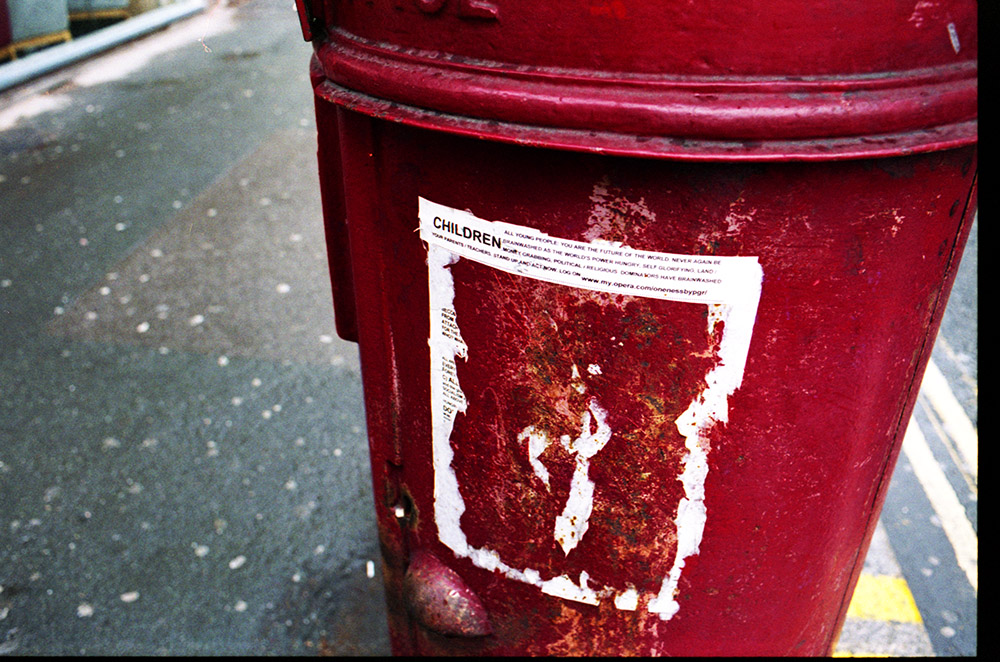
Canon 5D MkII / Nikon 28mm f/2.8 AI-S
Wesley Willis had names for his demons. Heartbreaker, Meansucker. Nervewrecker. They made his life hell; but they gave him targets for his anger, something he could rail against without harming others. Without his demons he would probably never have become famous, but what kind of fame did he end up with? He was a novelty act, and twelve years after his death his legacy has faded.
He seemed destined for internet stardom, but sadly he died in the pre-Facebook period, the pre-Twitter period. He would have been Twitter's killer app. I would follow him on Twitter.
Rock over London, rock on Chicago is 34 characters long, leaving 106 characters for him to spread his word. I loved the way he cussed the crowd. It meant he was telling them something.
"
When faced with my demons / I clothe them and feed them". Pac-Man's demons were called Blinky, Pinky, Inky, and Clyde. I have often wondered if they were objectively real within the abstract world of
Pac-Man, or if they were actually manifestations of Pac-Man's neuroses. How come Pac-Man looked so jolly in the face of inevitable death, and why did the ghosts hide away in that little box?
A glimpse inside the game's source code reveals that the ghosts are driven by a compulsive mixture of phobic avoidance, unreasoning aggression, and mental confusion; a programming error means that
Pinky and Inky are mentally ill, because one of their subroutines has an error. When Pac-Man heads up the screen they go haywire.
But what of Pac-Man himself? Very little has been written about the psychology of video game characters, presumably because they don't have an internal life; they are us, they are direct translations of our desires. Pac-Man himself has rudimentary characterisation - creator Toru Iwatani thought of him as
a voracious, mischievous engine of pure will - but most people didn't care. Kids played
Pac-Man because they liked the flashing lights and noises, women thought that Pac-Man was cute, grown men such as Billy Mitchell were driven by a compulsive desire to beat the game and achieve a perfect score.
Like most early arcade machines
Pac-Man simply repeated the same level over and over again, but eventually a counter broke down and the game reached a "kill screen", where even the best player was stuck forever. Nonetheless it is possible to achieve an optimal score, whereby the player consumes every dot and power pellet and eats every vulnerable ghost, and all of the bonus fruit. It takes enormous concentration to achieve this feat. There was very little reward for being first - Mitchell broke the game in 1999, long after people had stopped caring about
Pac-Man - and none at all for being second or third. Roughly half a dozen people, all men, have driven themselves to beat
Pac-Man. They belong to an elite club which has no clubhouse, no perks, no drinks discount, no formal membership list, no dancing girls.
What does
Pac-Man tell us about ourselves? When I play the game I tend to clear the board counter-clockwise, moving to the bottom-left and then proceeding along to the right and up and back across again. Does this make me a monster? Am I a bad man? Do women or normal people play
Pac-Man in a fundamentally different way? Systems analysis is the study of systems, and at its heart is the idea that every process can be broken down into a set of fundamental subroutines, and in the other direction each system is part of a larger system.
The lens has an unusually close focus distance of 20cm (from the film plane) or 10cm (from the tip of the lens). This was shot with a Fuji S5, an APS-C camera, using a macro ring.
In the field of software development systems analysis is invaluable for understanding how, for example, an air traffic control centre is supposed to work - it has to integrate with weather radar and the national air traffic control system, and depending on the complexity of the brief perhaps also the local airport's baggage handling department and independent airline scheduling systems. I can imagine an air traffic control system growing until it runs everybody's lives 24/7 from cradle to grave. We will all either be flying, or awaiting flights, or planning flights.

Taken to its extreme the entirety of human society is an enormous super-system; the Earth's environment is another system, driven not by conscious desire but by feedback and inertia, and given that much of the Earth's energy comes from the Sun it is impossible to consider the Earth in isolation from the solar system. On a human level systems analysts have to differentiate between components of the network that need to be modelled in fine detail, and those that can be abstracted away. In the example of an air traffic control network, it is sufficient to model the workings of the sun; the storms on Jupiter do not have a measurable impact on flight times over the continental United States.
But what about that cliché, the stock market? The stock market is a gigantic analogue computer, fed with inputs that are processed by stock market traders, who are essentially nodes in an enormous network, themselves processing inputs from a multitude of diverse sources. Their collective output is stock market prices. Ultimately the stock market is a machine that exists to calculate stock market prices, and we are unable to predict future stock prices because that would require a hyper-machine, an uber-machine that can simulate a pocket universe.
And what of human society? Most computer programs are created for a definite, useful purpose, whether generating ballistic tables or designing rifle barrels or modelling nuclear explosions. Human society on the other hand is a computer program that simply exists, processing inputs and generating outputs for no ultimate purpose. I say "computer program", it would be more accurate to say that human society is a single-purpose analogue computer rather than software running on a general-purpose computing machine, which would imply that human society could be used to model something other than itself.
But perhaps it can. Perhaps the motion of human beings can be used to calculate ballistic tables or the loads passing through a suspension bridge on a windy day. If only the signs could be interpreted correctly.

Katy Perry wears daylo clothing, and people observe her and start to copy her, and the price of dayglo clothing increases, and from God's perspective Katy Perry is the nodal point of a psychedelic dayglo fungus that spreads across the planet. There are seven billion of us, processing nodes in our great computer, and we are also outputs, individual pixels in a seven-billion-pixel monitor that can only be viewed from afar. Imagine if Katy Perry was in fact the starter crank of a machine that uses human beings as its gears. Her music, overheard in shopping malls, subtly influences our behaviour. Eighteen months later a sufficiently perceptive observer strolls through his local high street; after studying us, he returns home with the encryption key of some secret files, or the nine millionth digit of Pi.
And perhaps there are rival programs jostling for our attention, trying to smother or pervert Katy Perry's message. The likes of Carly Rae Jepsen and Gabriella Cilmi failed to displace her, but the tide always recedes. Douglas Adams described a similar idea in
The Hitch-Hiker's Guide to the Galaxy. At the end of the book it is revealed that the Earth's ecosystem is a computer, and the living creatures on its surface are part of a distributed processing network; Arthur Dent was part of the final generation of human beings born before the program reached its conclusion, and he is eventually able to dredge up the answer to life, the universe, and everything from within his own mind.
Adams' sci-fi concepts tend to be lost amongst his wordplay, but the notion that society is actually a processing network has stuck with me. A processing network that consumes the present, regurgitates the past, and spits out the future, in real time.
A typical workplace is essentially an analogue processing unit that receives letters and telephone calls as its input, and generates spreadsheets and work schedules and bills as its output; the people who perform the work aren't really human beings when they are at work, they are office workers, subroutines in a computer program. A national government is an office workplace writ large. Information goes in one end, money is pumped in as fuel, and the output is a set of rules and regulations. Sometimes fuel is pumped over the output to boost performance.
Pac-Man was a machine designed to produce the ultimate
Pac-Man player, as in
The Last Starfighter, and it is fascinating to ponder its influence and that of other arcade machines. Before computer games, human beings were lumpy boring potato people who ate lard and played darts. Namco and Sega gave us crack reflexes and incredible concentration;
Defender and
Tempest had the effect of overclocking human society's mind. And, outside the world of computer games, the likes of Miles Davis and Einstein - and in his own small way, Wesley Willis - they tweaked our programming, added new hardware, eliminated useless subroutines.
On a more dramatic level Hitler and Stalin eliminated great chunks of the machine, in the most direct way. Their approach was unscientific, and I suspect that with a machine as complex and interdependent as human society, so prone to chaotic imponderables, any attempt to consciously pervert its progress is doomed to failure, at the mercy of unforeseen consequences.
Hitler cared only for the good of his tribe. But the great machine of humanity has its own course, and cares not for individual tribes; its ultimate destination is unknowable and perhaps not to our satisfaction. We may not recognise it when we arrive. Perhaps the program has already run its course, and we are simply swarf left to blow away in the wind, patients left forgotten in the waiting room of a dental practice that shut half an hour ago. Today we're going to have a look at the
Nikon 28mm f/2.8 AI-S. It's one of Nikon's most legendary lenses. It was launched in 1981 as part of a general overhaul of Nikon's lens range. In another world it might have been just a cosmetic update of the earlier 28mm f/2.8, with support for AI-S.
But Nikon decided to fiddle with the design and throw in the close-range-correction technology from the posh 28mm f/2, and the result was a lens that was well-made, optically excellent, and reasonably priced. In theory Nikon's big star 28mm lens of the early 1980s was the 28mm f/2.0, but perhaps because of its higher price it didn't grab people as much; neither Google Books' archive of old magazines nor the modern internet has much to say about the 28mm f/2.0. My impression is that professional PJs of the early 1980s were wowed by the Nikon 25-50mm f/4 or the compact 20mm f/2.8 AI-S instead.

What was AI-S? Some kind of Nikon thing. Something to do with aperture control. Only half a dozen cameras supported it. Too late for the F3. Not even Nikon people remember it. It died a death when Nikon switched to electronic cameras with autofocus in the mid-80s. The 28mm f/2.8 AI-S remained in production, however, because it took a while for Nikon to release a really good autofocus 28mm; it was sold up until the late 2000s and apparently old-new stock still exists.
Press adverts from the mid-80s show a price of around $140-170, about twice that of equivalent lenses from Canon and Pentax, in step with Nikon's generally premium market position. At the time Nikon was trying to broaden its appeal, and the 28mm f/2.8 AI-S was sold alongside a much cheaper 28mm f/2.8 Series E lens. The Series E lenses were also compatible with AI-S, and modern eBay sellers often try to confuse the two, by listing the Series E as a
28mm f/2.8 Series E AI-S, or just outright lying. The 28mm Series E appears to be the Porsche Boxster of the Nikon 28mm lens range, in the sense that it's an admission you can't afford a 911.
To confuse matters still further the AI-S is cosmetically similar to the earlier 28mm f/2.8 AI, and there's nothing on the nameplate to indicate which is which; you have to know what they look like and check the serial numbers. The AI-S has its name ring inside the filter thread and has a flatter front end. What's it like performance-wise? Here's one of the local museums:
28mm is unfashionable nowadays - it's wide, but people are spoiled with 24mm and even wider. In the middle it's slightly soft at f/2.8 but not obviously so; it sharpens up at f/4 and then perhaps if I study
real close it gets sharper at f/5.6 but no more beyond that, shown here at f/2.8, f/4 and f/5.6:
In the extreme full-frame corner it's decent at f/5.6 and becomes basically sharp across the entire frame at f/11, shown here at f/2.8, f/4, f/5.6, f/8, and f/11, with the levels boosted:
Why did I pick a corner that was in shadow? The other corners either had nothing in them, or they had a wavy banner that waved and looked blurry. f/16 is the same as f/11 but slightly softer. On an APS-C camera it would be razor-sharp across the frame at f/8. Nikon fans with APS-C bodies might also consider the modern, autofocus 28mm f/1.8 AF-S, which is also a very good performer with the caveats that it retails for $700 and it's a lot bigger than the AI-S. 28mm is roughly 40mm in APS-C terms, in other words a kind of slightly wide normal.
The rest of Nikon's AI-S range was, apparently, uniformly good - the 105mm f/2.5 AI-S was the other famous AI-S lens - and I surmise that a 24mm f/2.8 or f/2 AI-S would be more versatile if you plan on using it with an APS-C camera. The problem is that everybody knew the AI-S lenses were good even in the early days of digital photography, and they were snapped up fifteen years ago. I believe that the latter-day popularity of other vintage lens mounts - Olympus OM, Contax/Yashica, Leica R - came about because the supply of cheap AI-S lenses on eBay dried up.


The AI-S is a pre-CPU lens, and it will only automate on the posher Nikon bodies; compact Nikon SLRs won't meter with it. It won't meter on my Nikon F50 film camera either. As an AI lens it's otherwise unproblematic, there's no risk of it breaking anything off the camera body. This is academic in my case because I used it mostly on a Canon 5D MkII with an adapter ring, although it works just fine on my Fuji S5. The S5 / D200 and I assume other high-end Nikon bodies won't recognise the lens automatically, and you have to use the aperture ring, but they can be programmed to understand that it's a 28mm f/2.8.
It focuses very closely, although this didn't wow me as much as it might because I've used a lot of Olympus OM lenses, and they focus very closely as well. Distortion is very mild:
The lens is very highly regarded but it doesn't seem to have much of a legend in the
real world. I associate it with the Nikon F3, and I think of it as the quintessential early-mid-80s photojournalist wide prime, but if photojournalists used it they were too busy shooting to write about it. It did however appear in one of Nikon's most memorable print adverts (mounted on a battered F3, centre):
I have a vision of Nikon's ad agency flinging their prop F3 body around the car park in order to make it look used. In summary the 28mm f/2.8 AI-S is a lovely lens - I haven't mentioned the neutral colours, the decent bokeh, the very mild and easily correctable CA, the stellar build quality, the standard 52mm filter thread - although something of a pain on the used market. Used examples tend to have been bashed about, a few have been converted to modern cinema mounts, yet more have fungus, others are advertised in a way that borders on sharp practice. There are
in theory six currently listed on eBay here in the UK, but one is actually an "AI-S fit" third party lens, one is a "Series E AI-S", three are broken, one is ambitiously priced.
Production continued until the 2000s but by the end of the line it was only available as a very expensive special order (perhaps assembled from Nikon's parts supply) and so the vast majority of examples are roughly a quarter of a century old. Nikon apparently made over two hundred thousand of them, so I guess that Nikon fans simply don't want to part with them. I don't blame them.
Rock over London. Rock on, Chigaco. Nikon: we get the world's worst assignments.