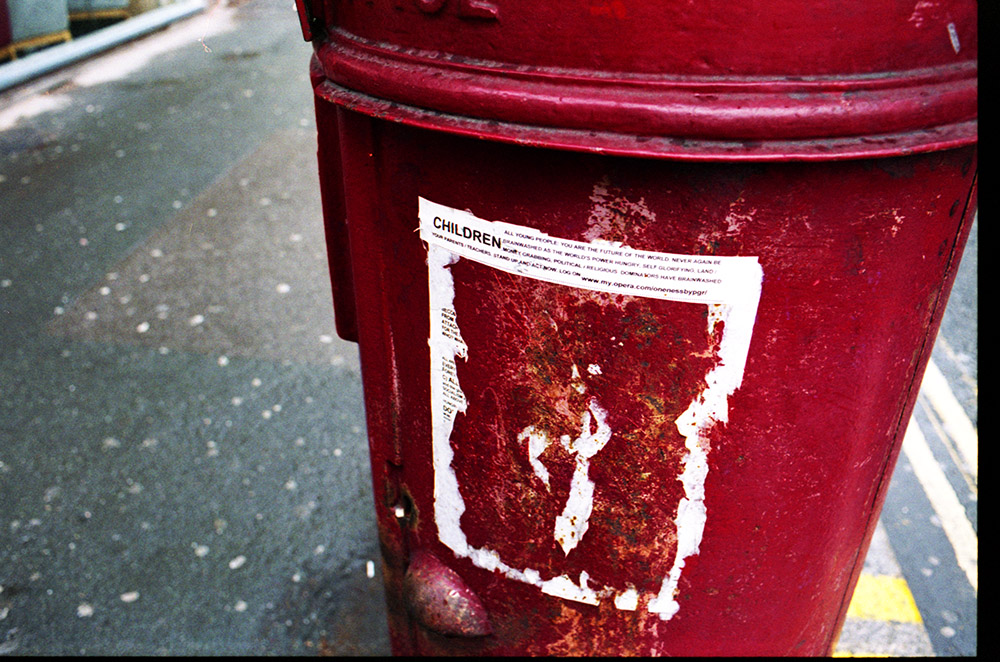
Nikon L35AF / Kodak TMAX 400
In
the last post I had a look at a compact rangefinder camera from the late 1970s. Since then I've gone on a compact camera trip, and today we're going to have a look at the Nikon L35AF, an autofocus point-and-shoot from 1983. It was Nikon's first ever compact camera, and was released at a time when the company was trying to broaden its appeal. Throughout the 1960s and 1970s Nikon dominated the professional 35mm SLR market - and continued to do so for several years - but it struggled to sell cameras to the man on the street.* Nikons were rugged and the Nikon brand commanded respect, but the consumer-level
Nikkorex and
Nikkormat were still quite dear, and there was a bloodstained feeding frenzy of competition in the lower end of the market. As Apple found recently with the iPhone 5C, it's difficult for a market leading high-end company to "do cheap".
* Or woman. In those days SLRs were marketed squarely at men. Or at least the adverts were aimed at men; the few women shown holding a camera were either housewives taking snapshots of their children, or they were the stereotypical Daisy Duke-wearing wildlife photographers who (you just knew) had been given a camera by her wealthy husband e.g. you, the man.
Was this because men controlled the family's finances in the 1970s? Was it because this kind of advertising was measurably effective? Was it because camera manufacturers had limited promotional budgets and went with cheap old cheesy old ad firms? I have no idea. Camera adverts have traditionally been awful, and haven't improved over time; Nikon's S60 campaign seemed to be aimed at the Eastern European teen porn market, and Canon's Ixus 75 campaign pulled off the difficult feat of being visually ugly, conceptually misguided, technically incorrect and just plain disturbing all at once.
And so in the late 1970s Nikon made a concerted attempt to broaden its appeal, with the plastic-bodied
EM and a range of budget-priced
Series E lenses. The L35AF was a late arrival, post-dating Canon's similar
Sure Shot by four years, but it seems to have sold quite well, or at least there are lots on the used market nowadays. It remained on sale until 1985, at which point it was replaced by the very similar L35AF2. Subsequent Nikon compacts used the same basic body design until the 1990s. Here's mine:
It has a 46mm filter thread, and I've loaded some Kodak TMAX black and white film.
Fuji Superia XTRA 400, shot at ISO 200
The L35AF has a fixed 35mm f/2.8 lens, with very simple controls - apart from the shutter button, it has a +2 stop backlight compensation lever, a self-timer, and you set the film speed manually. Unlike the Ricoh 500 ME in the previous post there's no way to set aperture or shutter speed yourself. My L35AF has an ISO range from 25-1000, but earlier revisions topped out at ISO 400 (the manual recommends setting the camera at ISO 1000 for 1600-speed film, which would probably work just fine for Ilford 3200 as well).
Most reviews on the internet point out that the L35AF's lens vignettes heavily, but as you can see this isn't necessarily the case. I shot all of the images that accompany this article on the sunniest day of the year, and presumably the L35's program autoexposure was forced to stop down; perhaps the autoexposure system tries to shoot at f/2.8 unless it absolutely can't, and other L35 users took their camera out on duller days.
Two new American imports opened recently, Five Guys Burger And Fries, and Shake Shack. They're aimed at a posher market than McDonald's, posher even than Burger King. They both had huge queues outside them - tended by jolly staff who will presumably be laid off after a few weeks, once the fuss has died down or they go bust - and I wasn't that keen for a burger on the hottest day of the year, so I can't tell if they're any good or not.
Nikon discusses the camera's lens design in an article
here. The lens was completed in 1981, two years before the camera was launched, which suggests to me that Nikon had trouble coming up with an autofocus system that worked properly and didn't infringe anybody's patents. Even if the camera had come out in 1981 it would still have looked a little old-fashioned, because the hot trend at the time was for Olympus XA-esque clamshell bodies. The L35AF's sticky-out lens mount looks like a throwback to the 1970s.
Two years later the queues had died down. On the positive side the relatively high prices keep out riff-raff, and you get masses of chips. The burgers are very filling. On the negative side the menu is tiny and they don't have wi-fi.
According to a review in
Popular Photography, November 1983, the launch price was $210, but adverts in the very same publication from a few months later list the street price as $149 (versus $250 or so for an SLR with a 35mm f/2.8). For years afterwards L35AFs were a staple of local charity shops, but nowadays everybody has mobile always-on internet so they have all been snapped up and listed on eBay for inflated prices.
The relatively fast lens sets it apart from the tele-zoom compacts of the late 1980s and 1990s - with incredibly slow zoom lenses that were
f/10 at the long end - which are basically worthless nowadays.
Backpacker magazine has a little overview of the state of the market at the time:
The headline font says
1983. The camera uses an active infrared autofocus system. There are two circular windows just above the lens. The window nearest to the viewfinder has an infrared emitter that sends out an infrared beam. Here's what the beam looks like, with a shot taken by my ancient Game Boy Camera, which is sensitive to infrared:
The other window watches for the beam's reflection, and the camera's digital electronic brain does some simple mathematics to work out how far it should focus the lens. Most SLRs use a passive autofocus system that watches for sharp contrast in the image, but active infrared is cheaper and simpler and works well in dim light, with the downside that it can be confused by reflective surfaces.
The camera has a metal chassis encased in hard black plastic. It feels as if it would withstand being chucked into a glovebox and rattled around and I suspect that lots of them were. The flash unit pops out violently when the camera decides that flash is necessary - you have to hold it down in order to turn the flash off. As a consequence you have to grasp the camera by both hands when you shoot in subdued light:
Some impressive lens flare, there. As with the Ricoh 500 ME in the previous post, hand-held shooting at very slow shutter speeds is easy because there's no SLR mirror slap.
The L35AF takes a pair of standard AA batteries. The camera's only Achilles heel is the battery compartment door, which is flimsy and doesn't inspire confidence. My recollection of the 1990s is that most consumer-level SLRs had flimsy battery compartment doors, it seems to have been a
thing.
The viewfinder is large and clear but only shows focus distance and framing. There's no indication of aperture or shutter speed. The camera doesn't have a hotshoe, despite having plenty of space on the top plate.
The L35AF's lens has surprisingly mild distortion.
Apart from being the first compact Nikon (and the first Nikon with autofocus, for that matter), it's also the first ever Nikon with a built-in motor drive. The drive loads, advances, and rewinds the film. It's quieter than I expected but no good if you like to go around photographing women's bottoms clandestinely in public. You might get away with it
once, if there's traffic passing by, but once is not enough. The key to victory in the amateur porn market is
volume, volume, volume, and in that case a compact digital is a much better bet. Alternatively, hire a model and just pretend that she's a random passer-by. That's what BangBros and the like do.
The clever thing about catering for the ass market is that you can reuse the same models over and over again; change the underwear and no-one will know. Asses aren't as distinctive as faces, which is probably why we have faces. So that we can tell friend from foe.
An Emirates Airbus A380, flying paying customers from Heathrow, rather than sitting on the tarmac smouldering.
Ultimately I didn't warm to the L35AF. It's quite bulky and feels old-fashioned, and although the filter thread is a neat feature I prefer a compact camera to be
compact and pocketable. In fact the filter thread annoyed me because it triggered my OCD. The same impulse that compelled me to spend ages working out how tall a person would look from a distance of one light-second whilst writing this post. I've cut that bit out because it was waffly and I wasn't confident enough of my mathematics to leave it in. The joke would only be funny if the maths were precisely correct.
But, yes, I can't help myself from screwing filters into the L35AF's filter thread. The colour shots were taken with a polarising filter, black and white with a yellow filter. In theory I could just ignore it, but it's
there, I have to screw something into it, and that chips away at the raison d'etre of a compact pocket camera. It's like having a cock, you know? You see a hole, you can't help but wonder if your cock would fit into it, and it preys on your mind all the time. Does the hole have teeth? Whereas if I didn't have a cock, I wouldn't have that problem. But then again if I was a woman I would spend ages evaluating cucumbers, roll-on deodorants, lipstick sticks etc.
The simplicity and compact dimension of the XA, or the later Olympus Mju, or the Yashica T etc appeal to me more. If the L35AF had been packed with features - a hotshoe, perhaps an intervalometer, manual controls - I would love it to bits, but ultimately it's just too conservative.
What else? My L35AF gets 37 shots from 36-shot Fuji Superia rolls. The motor rewind leaves a little bit of the leader outside the cassette when it has finished rewinding, which is a godsend if you develop your own film, but potentially disastrous if you don't keep track of which rolls you've shot and which rolls you haven't. On a hipster level the L35AF is a bit
too obscure to attract the right attention, you'll hunt for ages before you find someone who recognises it. Of all the film cameras I have shot of late, it's the one most likely to end up in a cupboard forevermore. The thing that made it so appealing in 1983 - "it's a Nikon, so it works" - make it feel boring nowadays, and as an arty hipster camera it's a disaster because it's so
competent. On an artistic level it doesn't have a distinctive visual signature, and as a practical means of recording the world it's bulkier and more awkward than my XA.
There are only so many ways to compose a picture with a moderately wideangle, moderately fast lens. Here are two of them.