Showing posts with label yashicamat. Show all posts

Thursday, 14 July 2016

Yeovilton Yashicamat


In the last post I went off to the Yeovilton air show. Yeovilton is the poor person's Fairford. I took along an old telephoto zoom lens and tried it out, but I also took along my Yashicamat, just for a lark. As a means of photographing aeroplanes in flight a medium format TLR is not ideal, viz this shot of a Rafale:


I think it's a Rafale. It has canards. However the combination of some expired Fuji Velvia 100 and menacing clouds was visually striking, and furthermore the Yashicamat is small and light and not a bother to carry around.


All of these photographs were taken when David Cameron was still Prime Minister.

Why so many shots of aircraft tails? It's the Kim Kardashian effect. Kim Kardashian has shifted the locus of Western society's erotic fixation from breasts to the butt, and that is why I shot so many aircraft tails. I'm programmed by modern culture to be erotically fixated on them. The early-mid 1980s, when I was very young, was all about breasts. It was the heyday of Page 3's mainstream success, an era in which the pendulous breasts of Sam Fox and Linda Lusardi were household names. As the 1980s matured...

Sorry, I mean Sam Fox and Linda Lusardi were household names. Their breasts were not household names. Their breasts didn't have names. As the 1980s matured into the 1990s... at least, not as far as I know. Do breasts have names? I really need to ask a woman, but alas I don't know any.

In the 1990s breasts became overshadowed by overall physical fitness - the post-Jane Fonda plastic hardbody era - and in the second decade of the twenty-first century which is today breasts play second violin in the orchestra of Western society's erotic objectification of the female body to the first violin, which in this case is the butt. They are both violins, but they have swapped around.

Freshly-scanned expired Velvia has a washed-out purple-red colour cast, with purple shadows. As far as I can tell purple is common to all slide films (compare it with the expired Agfa Precisa from this post) but the red is a Velvia thing. Photoshop can fix it, and has been doing so ever since Velvia was new, in 1990. They were both released in the same year, and were almost made for each other. Velvia has bright bold plastic colours and is almost grainless. It scans well, although very dense.

Breasts aren't exactly obsolete. In this century the likes of Christina Hendricks, Katy Perry, and Kate Upton have all shoved open the door to stardom with their breasts, but breasts are no longer the dominant erotic body part.

There is still a place for them, and the competition from butts and toned midriffs has caused them to become more sophisticated. As this surprisingly well-written Imgur post suggests, Katy Perry is differentiated from busty starlets of the past by the quality of her breasts; by the versatility with which they can be presented. They are not so large that she is dismissed as a porn model, but they are however large enough to be the centrepiece of an outfit. Conversely they're small enough to work with formal clothes, and in her original persona as Christian rock musician Katy Hudson her breasts were completely anonymous. Their undeniably natural composition gives her an out in the face of criticism from social conservatives - she can argue that she didn't choose to have breasts.

Instead God chose that Katy Perry should have breasts, which suggests to me that God was a man. Good job, God. You know, when I was young I remember thinking that I should like The Durutti Column, because the idea of The Durutti Column is right up my street. But the band's music never seemed to progress, and within a few years The Cocteau Twins and My Bloody Valentine overshadowed Vini Reilly. In retrospect the likes of Robin Guthrie and Michael Brook were just better, more inventive musicians. There was something uniform and samey about The Durutti Column's music. Given Reilly's recent illness, this sounds mean. Lots of people liked The Durutti Column, although obviously not enough to pay Vini Reilly's rent.

There's something melancholic about old guitarists. They are like retired airline pilots. They've seen things you people wouldn't believe, but without an airline, without an airliner, they are minds forever voyaging.

Sunday, 12 April 2015

Vienna 2


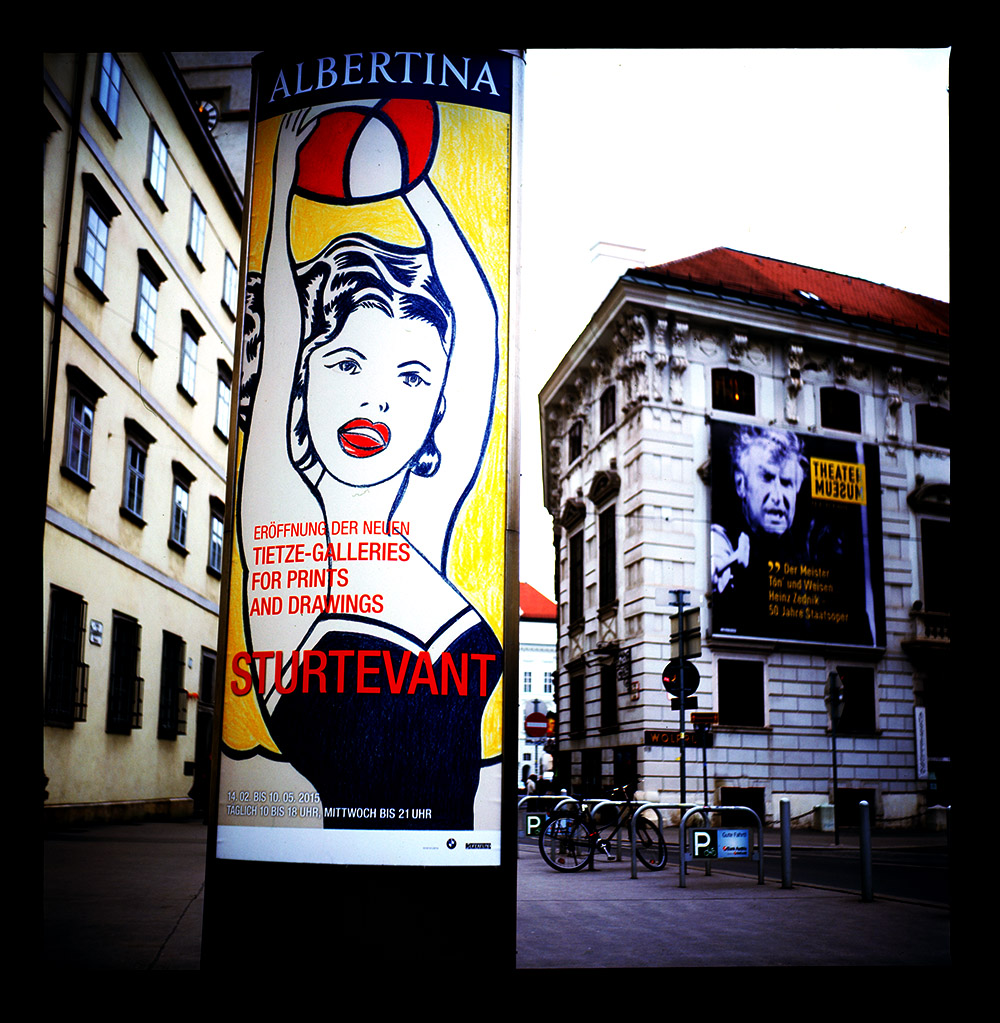
Off to Vienna, with a Yashica Mat and a bag of Fuji Superia (above) and Fuji Velvia (Duran Sandwiches, below). Vienna is a popular day trip on the train from Budapest or Bratislava. They all lie on the Danube, and a river cruise is a cost-effective way of ticking several countries off your list. I'm going to visit Wales and Scotland last, because they're easiest.


After spending five hours in Vienna I now feel that I can look Central Europe in the eye, as an equal; me a human being, Central Europe a mass of countries where young men debate politics in coffee houses and women dress in big skirts and they have horse-drawn carriages etc. I learn this from Project Gutenberg's With the World's Great Travellers, a compendium of travel writing from the 19th Century.


On the day I visited Vienna the horse-drawn carriages and early photographers and men with large moustaches and anarchists had been packed away; in their place there was a large shopping mall attached to a smaller museum area that was also a shopping mall, with a low-key style. We are all heading in the same direction, driven by the same fears and desires. With the World's Etc has a lengthy excerpt from John Russell's A Tour in Germany, published in the mid-1820s. Of Vienna I learn that:
    "The proper city is of nearly a circular form, and cannot be more than three miles in circumference, for I have often walked quite around the ramparts in less than an hour. The style of building does not pretend to much ornament, but is massive and imposing; the streets are generally narrow, and the houses lofty, rising to four or five floors, which are all entered by a common stair. ... Some individual masses of building, in the very heart of the city, are as populous as large villages."
Which suggests that Vienna circa 1820 must have seemed like Judge Dredd's Mega-City One to John Russell. Little did he know what the future had in store. New York of the 1820s was a modest port, and Europe was still the centre, the future, the pinnacle of the world.

Elsewhere in the book American traveller Bayard Taylor, writing in the mid-century, is "...lost in astonishment at the perfection of art attained by the Greeks and Romans. ... I should almost despair of such another blaze of glory on the world were it not for my devout belief that what has been done may be done again, and had I not faith that the dawn in which we live will bring another day equally glorious."

After all, "why should not America with the experience and added wisdom which three thousand years have slowly yielded to the old world, joined to the giant energy of her youth and freedom, re-bestow on the world the divine creations of art?" And only one hundred short years later Jeff Koons was born.


I find it hard to think about Vienna without thinking about Hitler. Perhaps that's because I'm British, or perhaps it's because I'm a closet Nazi. Not thinking about Hitler is like not thinking about an elephant, it's difficult to do it consciously. (tries) And now I'm thinking about a Nazi elephant, wearing a stahlhelm, and did you know the Germans had a tank called the Elefant? It was actually a tank destroyer, basically an anti-tank gun in an armoured chassis. They were awesome! But German industry could only make a few dozen of them and so sadly the Nazis... and so the Nazis lost the war. Which is a good thing.


Hitler was of course born in Austria. There was nothing particularly unusual about Hitler's early life. His dad was an authoritarian bureaucrat who was a big fish in a small pond; Hitler seems to have consciously rebelled against his father whilst simultaneously and unconsciously becoming a copy of him, incapable of admitting error and prone to outbursts of anger whenever people failed to heed his instructions. As with Adventure Time's Earl of Lemongrab he found himself continually butting against a world that was unacceptable! but also bigger than him, but rather than learn to fit his environment he decided to change the world instead. Some people try to change the world constructively, by inventing a more efficient vacuum cleaner or curing Hepatitis; Hitler had no time for that.

After finishing school Hitler essentially became a pretentious hipster, and it's fascinating to draw parallels between him and the modern world. Hitler's dad died when he was young, and so he spent his teenage years lazing about whilst his mother did the housework. At the risk of offending single parents worldwide, I maintain that it's easier for two people to raise children than a single person by themselves, if only on a purely practical level, and that the socialist alternative - for the state to raise children so that everybody has seven billion parents - is unworkable and open to abuse, beside which it's just mean.


Like all teenagers, Hitler was an arrogant sod who learned about the human world from books first and from first-hand experience second, so that he began with a vastly over-inflated sense of his own importance and knowledge. His modern heirs spend their days on Reddit; my generation grew up with Wired magazine and No Logo, and my ancestors presumably grew up with The Downwave and Omni, pre-packaged facts with all the little details and boring working-out removed. As an autodidact Hitler was free to ignore anything he didn't agree with or have the time to think about, and throughout his life he seems to have surrounded himself with a mixture of fawning sycophants and strong people who saw in him a useful shield.

He set himself the task of becoming a great artist, and failed, and from that point onwards he blamed his failure on those around him. Meanwhile his mother died and he found himself essentially a piece of human flotsam in Vienna, where he was an insignificant dot, a tiny particle of radioactive fallout. Like fallout he continued to burn. The Great War fashioned his generation into a bomb, and during the 1920s and 1930s he finally achieved critical mass, touching off a runaway chain reaction that engulfed the world in another one of its periodic orgies of bloodletting.

It's just "Duran Sandwiches". Named after Vladimir Duran, who founded the place.
The New Romantics had a thing for Europe, in homage to David Bowie's Berlin period, and the retro-futurism of mid-70s Kraftwerk. They had a thing for a kind of fantasy mitteleuropa that linked the Weimar republic with the modern day, skipping over the Nazi regime. There was Bauhaus, Spandau Ballet, "Vienna". Future historians of culture will wonder why a bunch of London clubgoers decided to draw inspiration from half a century ago and far away.

And yet the human race keeps going. The two World Wars demonstrated that individual human life was insignificant; but in terms of mass death the wars were just a blip, because the Earth's population more than tripled during the twentieth century. A few months ago it was theorised that a new world war would have almost no effect on global population. Over the coming century the human population will increase even if a catastrophic event kills two billion people, assuming that this event does not make the planet uninhabitable.

The average human being weighs 62kg. Two billion corpses would weigh one hundred and twenty four million metric tonnes of flesh bone and blood. If my calculations are correct that would equal the world's tonnage of chicken meat production for one year in the mid-2030s. For human beings the deaths of two billion people would be a horrendous event that would hopefully cause us to turn away from violence forever, although in practice we would get used to it and carry on as before; for chickens, the deaths of two billion chickens is the United States' chicken consumption for four months.

It would take the elimination of over four billion of us to cut the human population down, so the next time you complain that the roads are too crowded, or that you have to sit next to fat people on the plane, bear in mind that the alternative is far worse.

"And it was the buildings themselves that were always the principal attraction for me."


Saturday, 14 March 2015

Fuji Velvia: 2007


In the previous post I shot some long-expired rolls of Kodak Ektachrome 64, a venerable slide film that was discontinued a few years ago. For this post I tried out some rolls of Fuji Velvia RVP which expired back in 2007, the same year that Gordon Brown achieved his lifelong political dream of becoming Prime Minister of the United Kingdom. Would the US sub-prime crisis affect Northern Rock, at that time the UK's eighth-largest bank? Who could tell. In February of 2007 the FTSE 100 hit a six-year high of 6,383; it continued to rise for a few months, but it was another six years before it reached 6,383 again, by which time Gordon Brown was long-gone.


The FTSE currently stands at 6,740, ninety points higher than its previous all-time peak, which was reached on the last trading day of 1999. Of course, if you had invested wisely and widely you would have made money from dividends; but that's boring. You got a thrill from watching the numbers go up. Back in 1998, if you had borrowed half a million pounds and invested that money in Cisco, the numbers would have gone up very rapidly. The numbers would be very high even if you paid back the loan, but why not get a second, even bigger loan? Provided you sold up before the inevitable correction, you would be quids in.


I know what you're thinking. Either the viewfinder is off, or my right leg is shorter than my left. The fact is that I align my body in accordance with the Earth's magnetic field, which is perturbed by the gravitational pull of Jupiter, which just so happened to be above me and to the right.

Velvia was notorious in its day for going off quickly. It tended to develop a red cast. I have no idea how mine was stored; the colours seem to be more or less accurate within the heightened context of Velvia. The image of Bob Dylan looks more purple than the original, and is well within the ability of Photoshop to correct. Even though I exposed at ISO 50 and leaned lightwards, the film was very dark. Like Salo or When the Wind Blows, that kind of dark.


Friday, 6 March 2015

Ektachrome 64: 2004


While rummaging through my box of drugs I found some rolls of Kodak Ektachrome 64 EPR, a professional film that was introduced in the late 1970s. It was discontinued a few years ago. My rolls expired in 2004, year of retro mock-rock band The Darkness. While you were headbanging ironically to "I Believe in a Thing Called Love", my rolls of Kodak Ektachrome were clawing at the inside of their box, begging to be taken out and put through a camera; but no-one heard them, and their potential was wasted.

Reading through old issues of Pop Photo on Google Books it seems that Ektachrome was infamous for making everything look blue, and after eleven years of being in a cupboard this is doubly true; saggy-breasted out-of-breath balding smelly old Ektachrome turns everything blue, as if it had transformed into Tungsten film. Photoshop can rescue it, however:


I used a Rolleisoft diffusion filter, as in the previous post, although the results are almost unnoticeable. As I tweak the colours I imagine that I am working at NASA, tweaking the colours of raw data transmitted from a space probe, or from Landsat 8 in Earth orbit. And if I tweak the colours so that they no longer look like real life, who is going to punish me? What god will strike me down? I was fascinated with Landsat when I was a kid. The Landsat programme was a kind of Google Earth prototype, but with an emphasis on infrared and multi-spectal imaging rather than visible light; I had a mental vision of bearded, sandal-wearing Californian scientists poring over the data so that they could show farmers how to make more food. The images were used extensively in popular science books as filler. Nowadays Landsat has lots of competition, but the programme still survives (just). There's a fascinating table in the January 1982 Popular Photo that gives the expected lifespan of various film stocks of the time:


Or at least their life before they start to fade noticeably. "They only want you when you're seventeen. When you're twenty-one, you're no fun." Once it has been shot, Ektachrome 64 should lose ten per cent of its mojo after fifty years of dark storage, and as I gaze at Kodak's table I see memories of the twentieth century fading away to nothingness. The charming look of old prints and old slides is actually a defect, a snapshot of decay, and ultimately the photographs themselves - the images - are snapshots of decay, images of kids who are now old men, and their mothers who are now dead, Spanish coastal towns that are now covered in hotels, aeroplanes that were taken out of service because they were too noisy, cars that were once ubiquitous but have now all rusted away.

Even the hardiest films could not survive the death of film itself, and I imagine there are vaults of Kodakchrome slides in hospitals and police stations and museums that were taken out once to be digitised in the mid-2000s and will be taken out a second and final time to be disposed of in a few years. Time is the great enemy; the biggest battalion of all. It is not kind, and no amount of good generalship or guile will defeat it.


Digital storage does not fade, of course, and now that everything is stored remotely, in the cloud, our memories will accumulate indefinitely. The collective memories of humanity are trapped on this planet, where they will be erased once the Earth dies. Unless we broadcast them into space; but they will simply criss-cross the paths of memory archives broadcast by alien civilisations, slowly fading and dispersing as they travel across the universe until the signal is indistinguishable from cosmic background radiation, leaving behind dead planets and dead suns.